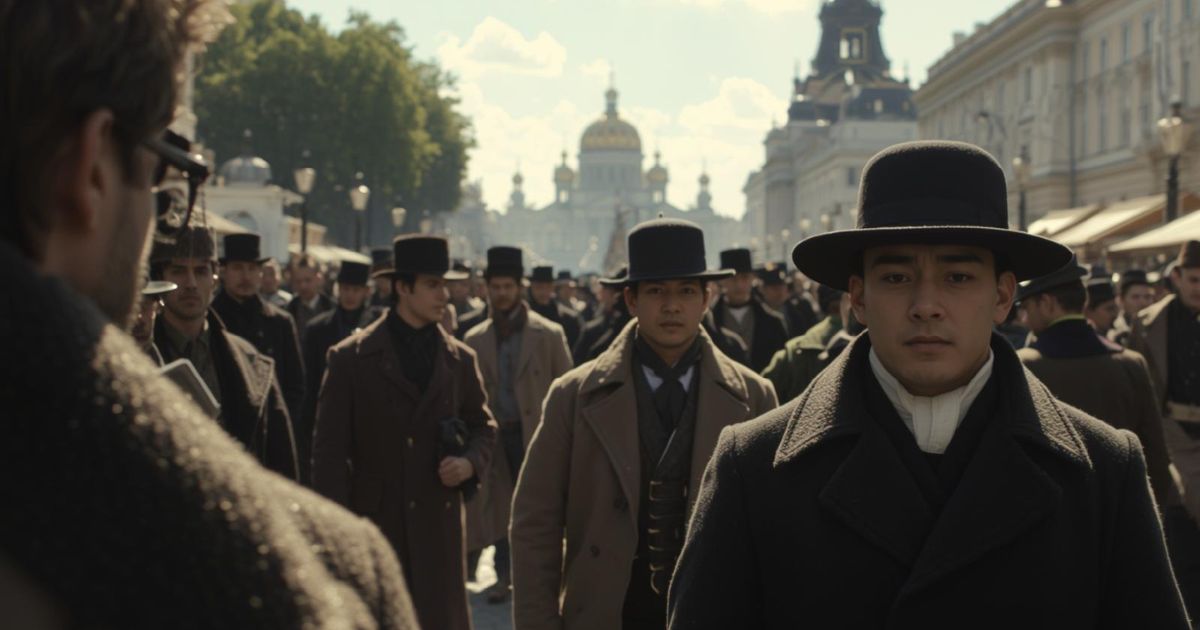
An excerpt from the original text.(complete · 3034 words)
EPILOGUE - PART I
I
Siberia. On the banks of a broad solitary river stands a town, one of
the administrative centres of Russia; in the town there is a fortress,
in the fortress there is a prison. In the prison the second-class
convict Rodion Raskolnikov has been confined for nine months. Almost a
year and a half has passed since his crime.
There had been little difficulty about his trial. The criminal adhered
exactly, firmly, and clearly to his statement. He did not confuse nor
misrepresent the facts, nor soften them in his own interest, nor omit
the smallest detail. He explained every incident of the murder, the
secret of the pledge (the piece of wood with a strip of metal) which
was found in the murdered woman’s hand. He described minutely how he
had taken her keys, what they were like, as well as the chest and its
contents; he explained the mystery of Lizaveta’s murder; described how
Koch and, after him, the student knocked, and repeated all they had said
to one another; how he afterwards had run downstairs and heard Nikolay
and Dmitri shouting; how he had hidden in the empty flat and afterwards
gone home. He ended by indicating the stone in the yard off the
Voznesensky Prospect under which the purse and the trinkets were found.
The whole thing, in fact, was perfectly clear. The lawyers and the
judges were very much struck, among other things, by the fact that he
had hidden the trinkets and the purse under a stone, without making
use of them, and that, what was more, he did not now remember what the
trinkets were like, or even how many there were. The fact that he had
never opened the purse and did not even know how much was in it seemed
incredible. There turned out to be in the purse three hundred and
seventeen roubles and sixty copecks. From being so long under the stone,
some of the most valuable notes lying uppermost had suffered from the
damp. They were a long while trying to discover why the accused man
should tell a lie about this, when about everything else he had made
a truthful and straightforward confession. Finally some of the lawyers
more versed in psychology admitted that it was possible he had really
not looked into the purse, and so didn’t know what was in it when he
hid it under the stone. But they immediately drew the deduction that
the crime could only have been committed through temporary mental
derangement, through homicidal mania, without object or the pursuit of
gain. This fell in with the most recent fashionable theory of temporary
insanity, so often applied in our days in criminal cases. Moreover
Raskolnikov’s hypochondriacal condition was proved by many witnesses, by
Dr. Zossimov, his former fellow students, his landlady and her servant.
All this pointed strongly to the conclusion that Raskolnikov was not
quite like an ordinary murderer and robber, but that there was another
element in the case.
To the intense annoyance of those who maintained this opinion, the
criminal scarcely attempted to defend himself. To the decisive question
as to what motive impelled him to the murder and the robbery, he
answered very clearly with the coarsest frankness that the cause was
his miserable position, his poverty and helplessness, and his desire to
provide for his first steps in life by the help of the three thousand
roubles he had reckoned on finding. He had been led to the murder
through his shallow and cowardly nature, exasperated moreover by
privation and failure. To the question what led him to confess, he
answered that it was his heartfelt repentance. All this was almost
coarse....
The sentence however was more merciful than could have been expected,
perhaps partly because the criminal had not tried to justify himself,
but had rather shown a desire to exaggerate his guilt. All the strange
and peculiar circumstances of the crime were taken into consideration.
There could be no doubt of the abnormal and poverty-stricken condition
of the criminal at the time. The fact that he had made no use of what he
had stolen was put down partly to the effect of remorse, partly to his
abnormal mental condition at the time of the crime. Incidentally the
murder of Lizaveta served indeed to confirm the last hypothesis: a man
commits two murders and forgets that the door is open! Finally, the
confession, at the very moment when the case was hopelessly muddled by
the false evidence given by Nikolay through melancholy and fanaticism,
and when, moreover, there were no proofs against the real criminal, no
suspicions even (Porfiry Petrovitch fully kept his word)--all this did
much to soften the sentence. Other circumstances, too, in the prisoner’s
favour came out quite unexpectedly. Razumihin somehow discovered and
proved that while Raskolnikov was at the university he had helped a poor
consumptive fellow student and had spent his last penny on supporting
him for six months, and when this student died, leaving a decrepit
old father whom he had maintained almost from his thirteenth year,
Raskolnikov had got the old man into a hospital and paid for his funeral
when he died. Raskolnikov’s landlady bore witness, too, that when they
had lived in another house at Five Corners, Raskolnikov had rescued two
little children from a house on fire and was burnt in doing so. This was
investigated and fairly well confirmed by many witnesses. These facts
made an impression in his favour.
And in the end the criminal was, in consideration of extenuating
circumstances, condemned to penal servitude in the second class for a
term of eight years only.
At the very beginning of the trial Raskolnikov’s mother fell ill. Dounia
and Razumihin found it possible to get her out of Petersburg during the
trial. Razumihin chose a town on the railway not far from Petersburg, so
as to be able to follow every step of the trial and at the same time
to see Avdotya Romanovna as often as possible. Pulcheria Alexandrovna’s
illness was a strange nervous one and was accompanied by a partial
derangement of her intellect.
When Dounia returned from her last interview with her brother, she
had found her mother already ill, in feverish delirium. That evening
Razumihin and she agreed what answers they must make to her mother’s
questions about Raskolnikov and made up a complete story for her
mother’s benefit of his having to go away to a distant part of Russia
on a business commission, which would bring him in the end money and
reputation.
But they were struck by the fact that Pulcheria Alexandrovna never
asked them anything on the subject, neither then nor thereafter. On the
contrary, she had her own version of her son’s sudden departure; she
told them with tears how he had come to say good-bye to her, hinting
that she alone knew many mysterious and important facts, and that Rodya
had many very powerful enemies, so that it was necessary for him to be
in hiding. As for his future career, she had no doubt that it would be
brilliant when certain sinister influences could be removed. She assured
Razumihin that her son would be one day a great statesman, that his
article and brilliant literary talent proved it. This article she was
continually reading, she even read it aloud, almost took it to bed
with her, but scarcely asked where Rodya was, though the subject was
obviously avoided by the others, which might have been enough to awaken
her suspicions.
They began to be frightened at last at Pulcheria Alexandrovna’s strange
silence on certain subjects. She did not, for instance, complain of
getting no letters from him, though in previous years she had only lived
on the hope of letters from her beloved Rodya. This was the cause of
great uneasiness to Dounia; the idea occurred to her that her mother
suspected that there was something terrible in her son’s fate and was
afraid to ask, for fear of hearing something still more awful. In any
case, Dounia saw clearly that her mother was not in full possession of
her faculties.
It happened once or twice, however, that Pulcheria Alexandrovna gave
such a turn to the conversation that it was impossible to answer her
without mentioning where Rodya was, and on receiving unsatisfactory and
suspicious answers she became at once gloomy and silent, and this mood
lasted for a long time. Dounia saw at last that it was hard to deceive
her and came to the conclusion that it was better to be absolutely
silent on certain points; but it became more and more evident that
the poor mother suspected something terrible. Dounia remembered her
brother’s telling her that her mother had overheard her talking in her
sleep on the night after her interview with Svidrigaïlov and before the
fatal day of the confession: had not she made out something from that?
Sometimes days and even weeks of gloomy silence and tears would be
succeeded by a period of hysterical animation, and the invalid would
begin to talk almost incessantly of her son, of her hopes of his
future.... Her fancies were sometimes very strange. They humoured her,
pretended to agree with her (she saw perhaps that they were pretending),
but she still went on talking.
Five months after Raskolnikov’s confession, he was sentenced. Razumihin
and Sonia saw him in prison as often as it was possible. At last
the moment of separation came. Dounia swore to her brother that the
separation should not be for ever, Razumihin did the same. Razumihin, in
his youthful ardour, had firmly resolved to lay the foundations at least
of a secure livelihood during the next three or four years, and saving
up a certain sum, to emigrate to Siberia, a country rich in every
natural resource and in need of workers, active men and capital. There
they would settle in the town where Rodya was and all together would
begin a new life. They all wept at parting.
Raskolnikov had been very dreamy for a few days before. He asked a great
deal about his mother and was constantly anxious about her. He worried
so much about her that it alarmed Dounia. When he heard about his
mother’s illness he became very gloomy. With Sonia he was particularly
reserved all the time. With the help of the money left to her by
Svidrigaïlov, Sonia had long ago made her preparations to follow the
party of convicts in which he was despatched to Siberia. Not a word
passed between Raskolnikov and her on the subject, but both knew it
would be so. At the final leave-taking he smiled strangely at his
sister’s and Razumihin’s fervent anticipations of their happy future
together when he should come out of prison. He predicted that their
mother’s illness would soon have a fatal ending. Sonia and he at last
set off.
Two months later Dounia was married to Razumihin. It was a quiet and
sorrowful wedding; Porfiry Petrovitch and Zossimov were invited however.
During all this period Razumihin wore an air of resolute determination.
Dounia put implicit faith in his carrying out his plans and indeed she
could not but believe in him. He displayed a rare strength of will.
Among other things he began attending university lectures again in order
to take his degree. They were continually making plans for the future;
both counted on settling in Siberia within five years at least. Till
then they rested their hopes on Sonia.
Pulcheria Alexandrovna was delighted to give her blessing to Dounia’s
marriage with Razumihin; but after the marriage she became even more
melancholy and anxious. To give her pleasure Razumihin told her how
Raskolnikov had looked after the poor student and his decrepit father
and how a year ago he had been burnt and injured in rescuing two
little children from a fire. These two pieces of news excited Pulcheria
Alexandrovna’s disordered imagination almost to ecstasy. She was
continually talking about them, even entering into conversation with
strangers in the street, though Dounia always accompanied her. In public
conveyances and shops, wherever she could capture a listener, she would
begin the discourse about her son, his article, how he had helped the
student, how he had been burnt at the fire, and so on! Dounia did
not know how to restrain her. Apart from the danger of her morbid
excitement, there was the risk of someone’s recalling Raskolnikov’s name
and speaking of the recent trial. Pulcheria Alexandrovna found out the
address of the mother of the two children her son had saved and insisted
on going to see her.
At last her restlessness reached an extreme point. She would sometimes
begin to cry suddenly and was often ill and feverishly delirious. One
morning she declared that by her reckoning Rodya ought soon to be home,
that she remembered when he said good-bye to her he said that they must
expect him back in nine months. She began to prepare for his coming,
began to do up her room for him, to clean the furniture, to wash and
put up new hangings and so on. Dounia was anxious, but said nothing and
helped her to arrange the room. After a fatiguing day spent in continual
fancies, in joyful day-dreams and tears, Pulcheria Alexandrovna was
taken ill in the night and by morning she was feverish and delirious.
It was brain fever. She died within a fortnight. In her delirium she
dropped words which showed that she knew a great deal more about her
son’s terrible fate than they had supposed.
For a long time Raskolnikov did not know of his mother’s death, though
a regular correspondence had been maintained from the time he reached
Siberia. It was carried on by means of Sonia, who wrote every month
to the Razumihins and received an answer with unfailing regularity. At
first they found Sonia’s letters dry and unsatisfactory, but later on
they came to the conclusion that the letters could not be better, for
from these letters they received a complete picture of their unfortunate
brother’s life. Sonia’s letters were full of the most matter-of-fact
detail, the simplest and clearest description of all Raskolnikov’s
surroundings as a convict. There was no word of her own hopes, no
conjecture as to the future, no description of her feelings. Instead of
any attempt to interpret his state of mind and inner life, she gave the
simple facts--that is, his own words, an exact account of his health,
what he asked for at their interviews, what commission he gave her
and so on. All these facts she gave with extraordinary minuteness. The
picture of their unhappy brother stood out at last with great clearness
and precision. There could be no mistake, because nothing was given but
facts.
But Dounia and her husband could get little comfort out of the news,
especially at first. Sonia wrote that he was constantly sullen and not
ready to talk, that he scarcely seemed interested in the news she gave
him from their letters, that he sometimes asked after his mother and
that when, seeing that he had guessed the truth, she told him at last
of her death, she was surprised to find that he did not seem greatly
affected by it, not externally at any rate. She told them that, although
he seemed so wrapped up in himself and, as it were, shut himself off
from everyone--he took a very direct and simple view of his new life;
that he understood his position, expected nothing better for the time,
had no ill-founded hopes (as is so common in his position) and scarcely
seemed surprised at anything in his surroundings, so unlike anything he
had known before. She wrote that his health was satisfactory; he did his
work without shirking or seeking to do more; he was almost indifferent
about food, but except on Sundays and holidays the food was so bad that
at last he had been glad to accept some money from her, Sonia, to have
his own tea every day. He begged her not to trouble about anything else,
declaring that all this fuss about him only annoyed him. Sonia wrote
further that in prison he shared the same room with the rest, that she
had not seen the inside of their barracks, but concluded that they were
crowded, miserable and unhealthy; that he slept on a plank bed with a
rug under him and was unwilling to make any other arrangement. But that
he lived so poorly and roughly, not from any plan or design, but simply
from inattention and indifference.
Sonia wrote simply that he had at first shown no interest in her visits,
had almost been vexed with her indeed for coming, unwilling to talk and
rude to her. But that in the end these visits had become a habit and
almost a necessity for him, so that he was positively distressed when
she was ill for some days and could not visit him. She used to see him
on holidays at the prison gates or in the guard-room, to which he was
brought for a few minutes to see her. On working days she would go to
see him at work either at the workshops or at the brick kilns, or at the
sheds on the banks of the Irtish.
About herself, Sonia wrote that she had succeeded in making some
acquaintances in the town, that she did sewing, and, as there
was scarcely a dressmaker in the town, she was looked upon as an
indispensable person in many houses. But she did not mention that the
authorities were, through her, interested in Raskolnikov; that his task
was lightened and so on.
At last the news came (Dounia had indeed noticed signs of alarm and
uneasiness in the preceding letters) that he held aloof from everyone,
that his fellow prisoners did not like him, that he kept silent for days
at a time and was becoming very pale. In the last letter Sonia wrote
that he had been taken very seriously ill and was in the convict ward of
the hospital.
Master this chapter. Complete your experience
Purchase the complete book to access all chapters and support classic literature
As an Amazon Associate, we earn a small commission from qualifying purchases at no additional cost to you.
Available in paperback, hardcover, and e-book formats
Let's Analyse the Pattern
Why This Matters
Connect literature to life
This chapter teaches how to distinguish between surface-level remorse and genuine transformation that comes through accepting your place in the human community.
Now let's explore the literary elements.
Key Quotes & Analysis
"They were both resurrected by love; the heart of each held infinite sources of life for the heart of the other."
Context: Describing the moment when Raskolnikov and Sonya realize their mutual love
This quote captures the central theme of the entire novel - that love has the power to bring people back to life spiritually. Both characters have been transformed through their connection to each other.
"He had been resurrected and he knew it and felt it in all his being, while she - she only lived in his life."
Context: Explaining Raskolnikov's complete spiritual transformation
Shows how genuine change feels - not just intellectual understanding, but a complete renewal of your entire being. Raskolnikov has become a fundamentally different person through the power of love.
"But that is the beginning of a new story - the story of the gradual renewal of a man, the story of his gradual regeneration."
Context: The novel's final lines, looking toward Raskolnikov's future
Suggests that true redemption is not a single moment but an ongoing process. The real work of becoming fully human again is just beginning, but now Raskolnikov has the foundation of love to build on.
Thematic Threads
Pride
In This Chapter
Raskolnikov finally abandons his belief in his own superiority and accepts his need for human connection
Development
Evolved from intellectual arrogance justifying murder to complete surrender of ego
Redemption
In This Chapter
True spiritual renewal comes through love and vulnerability, not just punishment or guilt
Development
Culmination of the novel's exploration of what genuine change requires
Love
In This Chapter
Sonya's unconditional love finally penetrates Raskolnikov's defenses and transforms him completely
Development
Evolved from Raskolnikov's inability to connect to full spiritual and emotional awakening
Identity
In This Chapter
Raskolnikov becomes a fundamentally different person, recognized even by fellow prisoners
Development
Complete transformation from the isolated, superior individual to connected human being
Human Connection
In This Chapter
Acceptance back into human community after months of spiritual isolation
Development
Resolution of the novel's central tension between individual will and collective humanity
You now have the context. Time to form your own thoughts.
Discussion Questions
- 1
What finally breaks through to Raskolnikov and changes him completely in this chapter?
- 2
Why do you think it took love rather than punishment or arguments to transform him?
- 3
Where have you seen someone's pride or sense of being 'different' cut them off from help they actually needed?
- 4
When you catch yourself thinking 'they just don't understand me,' what's one concrete step you could take to choose connection over being right?
- 5
What does Raskolnikov's transformation suggest about what it really takes for people to change at the deepest level?
Critical Thinking Exercise
Map Your Pride Patterns
Think of a relationship where you've been stuck in conflict or distance. Write down three specific moments when you chose being right over being connected. For each moment, identify what you were trying to protect (your expertise, your image, your feelings) and what it cost you in terms of relationship. Then rewrite one of those moments showing how you could have chosen vulnerability instead.
Consider:
- •Notice how pride often disguises itself as principles or being helpful
- •Consider what you were afraid would happen if you admitted you were wrong or needed help
- •Look for patterns - do you pull away in similar situations or with certain types of people?
Coming Up Next...
Chapter 41: Resurrection
The final chapter reveals what happens to Raskolnikov and Sonya as they begin their new life together, showing how love can truly conquer even the darkest chapters of our past.