An excerpt from the original text.(complete · 3914 words)
hen he went into Sonia’s room, it was already getting dark. All day
Sonia had been waiting for him in terrible anxiety. Dounia had been
waiting with her. She had come to her that morning, remembering
Svidrigaïlov’s words that Sonia knew. We will not describe the
conversation and tears of the two girls, and how friendly they became.
Dounia gained one comfort at least from that interview, that her
brother would not be alone. He had gone to her, Sonia, first with his
confession; he had gone to her for human fellowship when he needed it;
she would go with him wherever fate might send him. Dounia did not ask,
but she knew it was so. She looked at Sonia almost with reverence and
at first almost embarrassed her by it. Sonia was almost on the point
of tears. She felt herself, on the contrary, hardly worthy to look at
Dounia. Dounia’s gracious image when she had bowed to her so attentively
and respectfully at their first meeting in Raskolnikov’s room had
remained in her mind as one of the fairest visions of her life.
Dounia at last became impatient and, leaving Sonia, went to her
brother’s room to await him there; she kept thinking that he would come
there first. When she had gone, Sonia began to be tortured by the dread
of his committing suicide, and Dounia too feared it. But they had spent
the day trying to persuade each other that that could not be, and both
were less anxious while they were together. As soon as they parted, each
thought of nothing else. Sonia remembered how Svidrigaïlov had said to
her the day before that Raskolnikov had two alternatives--Siberia or...
Besides she knew his vanity, his pride and his lack of faith.
“Is it possible that he has nothing but cowardice and fear of death to
make him live?” she thought at last in despair.
Meanwhile the sun was setting. Sonia was standing in dejection, looking
intently out of the window, but from it she could see nothing but the
unwhitewashed blank wall of the next house. At last when she began to
feel sure of his death--he walked into the room.
She gave a cry of joy, but looking carefully into his face she turned
pale.
“Yes,” said Raskolnikov, smiling. “I have come for your cross, Sonia. It
was you told me to go to the cross-roads; why is it you are frightened
now it’s come to that?”
Sonia gazed at him astonished. His tone seemed strange to her; a cold
shiver ran over her, but in a moment she guessed that the tone and the
words were a mask. He spoke to her looking away, as though to avoid
meeting her eyes.
“You see, Sonia, I’ve decided that it will be better so. There is one
fact.... But it’s a long story and there’s no need to discuss it. But
do you know what angers me? It annoys me that all those stupid brutish
faces will be gaping at me directly, pestering me with their stupid
questions, which I shall have to answer--they’ll point their fingers at
me.... Tfoo! You know I am not going to Porfiry, I am sick of him. I’d
rather go to my friend, the Explosive Lieutenant; how I shall surprise
him, what a sensation I shall make! But I must be cooler; I’ve become
too irritable of late. You know I was nearly shaking my fist at my
sister just now, because she turned to take a last look at me. It’s
a brutal state to be in! Ah! what am I coming to! Well, where are the
crosses?”
He seemed hardly to know what he was doing. He could not stay still or
concentrate his attention on anything; his ideas seemed to gallop after
one another, he talked incoherently, his hands trembled slightly.
Without a word Sonia took out of the drawer two crosses, one of cypress
wood and one of copper. She made the sign of the cross over herself and
over him, and put the wooden cross on his neck.
“It’s the symbol of my taking up the cross,” he laughed. “As though I
had not suffered much till now! The wooden cross, that is the peasant
one; the copper one, that is Lizaveta’s--you will wear yourself, show
me! So she had it on... at that moment? I remember two things like
these too, a silver one and a little ikon. I threw them back on the old
woman’s neck. Those would be appropriate now, really, those are what I
ought to put on now.... But I am talking nonsense and forgetting what
matters; I’m somehow forgetful.... You see I have come to warn you,
Sonia, so that you might know... that’s all--that’s all I came for. But
I thought I had more to say. You wanted me to go yourself. Well, now I
am going to prison and you’ll have your wish. Well, what are you crying
for? You too? Don’t. Leave off! Oh, how I hate it all!”
But his feeling was stirred; his heart ached, as he looked at her. “Why
is she grieving too?” he thought to himself. “What am I to her? Why does
she weep? Why is she looking after me, like my mother or Dounia? She’ll
be my nurse.”
“Cross yourself, say at least one prayer,” Sonia begged in a timid
broken voice.
“Oh certainly, as much as you like! And sincerely, Sonia, sincerely....”
But he wanted to say something quite different.
He crossed himself several times. Sonia took up her shawl and put
it over her head. It was the green drap de dames shawl of which
Marmeladov had spoken, “the family shawl.” Raskolnikov thought of that
looking at it, but he did not ask. He began to feel himself that he
was certainly forgetting things and was disgustingly agitated. He was
frightened at this. He was suddenly struck too by the thought that Sonia
meant to go with him.
“What are you doing? Where are you going? Stay here, stay! I’ll go
alone,” he cried in cowardly vexation, and almost resentful, he moved
towards the door. “What’s the use of going in procession?” he muttered
going out.
Sonia remained standing in the middle of the room. He had not even said
good-bye to her; he had forgotten her. A poignant and rebellious doubt
surged in his heart.
“Was it right, was it right, all this?” he thought again as he went down
the stairs. “Couldn’t he stop and retract it all... and not go?”
But still he went. He felt suddenly once for all that he mustn’t ask
himself questions. As he turned into the street he remembered that he
had not said good-bye to Sonia, that he had left her in the middle of
the room in her green shawl, not daring to stir after he had shouted
at her, and he stopped short for a moment. At the same instant, another
thought dawned upon him, as though it had been lying in wait to strike
him then.
“Why, with what object did I go to her just now? I told her--on
business; on what business? I had no sort of business! To tell her I was
going; but where was the need? Do I love her? No, no, I drove her away
just now like a dog. Did I want her crosses? Oh, how low I’ve sunk! No,
I wanted her tears, I wanted to see her terror, to see how her heart
ached! I had to have something to cling to, something to delay me, some
friendly face to see! And I dared to believe in myself, to dream of what
I would do! I am a beggarly contemptible wretch, contemptible!”
He walked along the canal bank, and he had not much further to go. But
on reaching the bridge he stopped and turning out of his way along it
went to the Hay Market.
He looked eagerly to right and left, gazed intently at every object and
could not fix his attention on anything; everything slipped away. “In
another week, another month I shall be driven in a prison van over this
bridge, how shall I look at the canal then? I should like to remember
this!” slipped into his mind. “Look at this sign! How shall I read those
letters then? It’s written here ‘Campany,’ that’s a thing to remember,
that letter a, and to look at it again in a month--how shall I look
at it then? What shall I be feeling and thinking then?... How trivial
it all must be, what I am fretting about now! Of course it must all be
interesting... in its way... (Ha-ha-ha! What am I thinking about?) I am
becoming a baby, I am showing off to myself; why am I ashamed? Foo! how
people shove! that fat man--a German he must be--who pushed against
me, does he know whom he pushed? There’s a peasant woman with a baby,
begging. It’s curious that she thinks me happier than she is. I might
give her something, for the incongruity of it. Here’s a five copeck
piece left in my pocket, where did I get it? Here, here... take it, my
good woman!”
“God bless you,” the beggar chanted in a lachrymose voice.
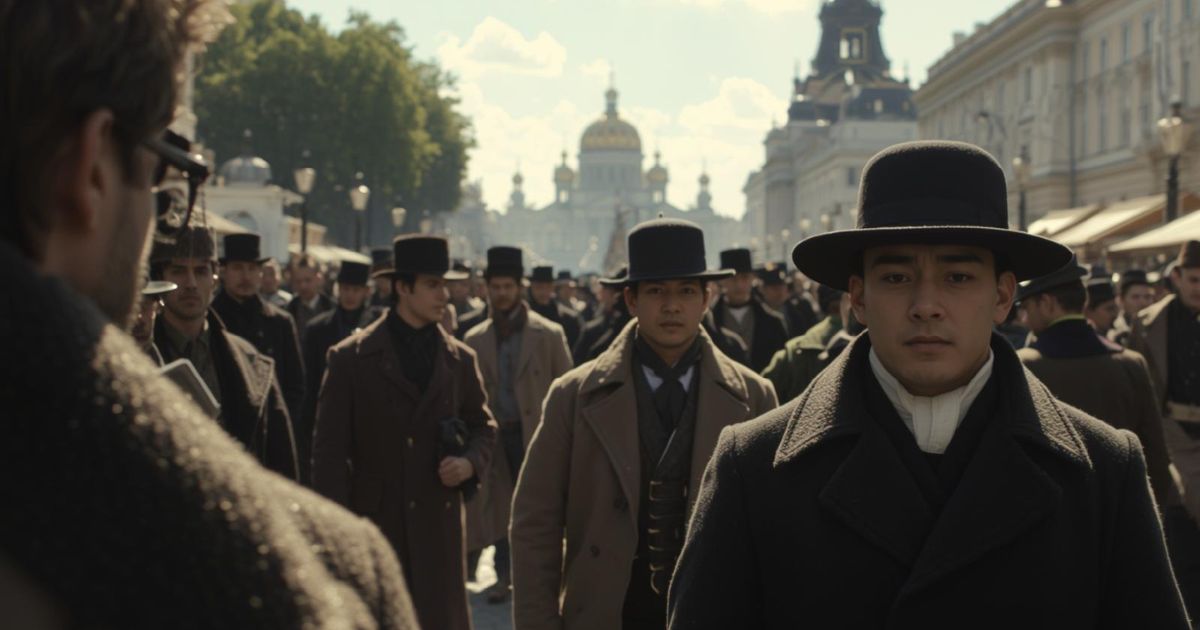
He went into the Hay Market. It was distasteful, very distasteful to be
in a crowd, but he walked just where he saw most people. He would have
given anything in the world to be alone; but he knew himself that he
would not have remained alone for a moment. There was a man drunk and
disorderly in the crowd; he kept trying to dance and falling down. There
was a ring round him. Raskolnikov squeezed his way through the crowd,
stared for some minutes at the drunken man and suddenly gave a short
jerky laugh. A minute later he had forgotten him and did not see him,
though he still stared. He moved away at last, not remembering where he
was; but when he got into the middle of the square an emotion suddenly
came over him, overwhelming him body and mind.
He suddenly recalled Sonia’s words, “Go to the cross-roads, bow down to
the people, kiss the earth, for you have sinned against it too, and say
aloud to the whole world, ‘I am a murderer.’” He trembled, remembering
that. And the hopeless misery and anxiety of all that time, especially
of the last hours, had weighed so heavily upon him that he positively
clutched at the chance of this new unmixed, complete sensation. It came
over him like a fit; it was like a single spark kindled in his soul and
spreading fire through him. Everything in him softened at once and the
tears started into his eyes. He fell to the earth on the spot....
He knelt down in the middle of the square, bowed down to the earth, and
kissed that filthy earth with bliss and rapture. He got up and bowed
down a second time.
“He’s boozed,” a youth near him observed.
There was a roar of laughter.
“He’s going to Jerusalem, brothers, and saying good-bye to his children
and his country. He’s bowing down to all the world and kissing the great
city of St. Petersburg and its pavement,” added a workman who was a
little drunk.
“Quite a young man, too!” observed a third.
“And a gentleman,” someone observed soberly.
“There’s no knowing who’s a gentleman and who isn’t nowadays.”
These exclamations and remarks checked Raskolnikov, and the words, “I am
a murderer,” which were perhaps on the point of dropping from his lips,
died away. He bore these remarks quietly, however, and, without looking
round, he turned down a street leading to the police office. He had a
glimpse of something on the way which did not surprise him; he had felt
that it must be so. The second time he bowed down in the Hay Market he
saw, standing fifty paces from him on the left, Sonia. She was hiding
from him behind one of the wooden shanties in the market-place. She had
followed him then on his painful way! Raskolnikov at that moment felt
and knew once for all that Sonia was with him for ever and would follow
him to the ends of the earth, wherever fate might take him. It wrung his
heart... but he was just reaching the fatal place.
He went into the yard fairly resolutely. He had to mount to the third
storey. “I shall be some time going up,” he thought. He felt as though
the fateful moment was still far off, as though he had plenty of time
left for consideration.
Again the same rubbish, the same eggshells lying about on the spiral
stairs, again the open doors of the flats, again the same kitchens and
the same fumes and stench coming from them. Raskolnikov had not been
here since that day. His legs were numb and gave way under him, but
still they moved forward. He stopped for a moment to take breath, to
collect himself, so as to enter like a man. “But why? what for?” he
wondered, reflecting. “If I must drink the cup what difference does it
make? The more revolting the better.” He imagined for an instant the
figure of the “explosive lieutenant,” Ilya Petrovitch. Was he actually
going to him? Couldn’t he go to someone else? To Nikodim Fomitch?
Couldn’t he turn back and go straight to Nikodim Fomitch’s lodgings?
At least then it would be done privately.... No, no! To the “explosive
lieutenant”! If he must drink it, drink it off at once.
Turning cold and hardly conscious, he opened the door of the office.
There were very few people in it this time--only a house porter and a
peasant. The doorkeeper did not even peep out from behind his screen.
Raskolnikov walked into the next room. “Perhaps I still need not speak,”
passed through his mind. Some sort of clerk not wearing a uniform was
settling himself at a bureau to write. In a corner another clerk was
seating himself. Zametov was not there, nor, of course, Nikodim Fomitch.
“No one in?” Raskolnikov asked, addressing the person at the bureau.
“Whom do you want?”
“A-ah! Not a sound was heard, not a sight was seen, but I scent the
Russian... how does it go on in the fairy tale... I’ve forgotten! ‘At
your service!’” a familiar voice cried suddenly.
Raskolnikov shuddered. The Explosive Lieutenant stood before him. He
had just come in from the third room. “It is the hand of fate,” thought
Raskolnikov. “Why is he here?”
“You’ve come to see us? What about?” cried Ilya Petrovitch. He
was obviously in an exceedingly good humour and perhaps a trifle
exhilarated. “If it’s on business you are rather early.[*] It’s only a
chance that I am here... however I’ll do what I can. I must admit, I...
what is it, what is it? Excuse me....”
[*] Dostoevsky appears to have forgotten that it is after
sunset, and that the last time Raskolnikov visited the
police office at two in the afternoon he was reproached for
coming too late.--TRANSLATOR.
“Raskolnikov.”
“Of course, Raskolnikov. You didn’t imagine I’d forgotten? Don’t think I
am like that... Rodion Ro--Ro--Rodionovitch, that’s it, isn’t it?”
“Rodion Romanovitch.”
“Yes, yes, of course, Rodion Romanovitch! I was just getting at it. I
made many inquiries about you. I assure you I’ve been genuinely grieved
since that... since I behaved like that... it was explained to me
afterwards that you were a literary man... and a learned one too... and
so to say the first steps... Mercy on us! What literary or scientific
man does not begin by some originality of conduct! My wife and I have
the greatest respect for literature, in my wife it’s a genuine passion!
Literature and art! If only a man is a gentleman, all the rest can be
gained by talents, learning, good sense, genius. As for a hat--well,
what does a hat matter? I can buy a hat as easily as I can a bun; but
what’s under the hat, what the hat covers, I can’t buy that! I was even
meaning to come and apologise to you, but thought maybe you’d... But I
am forgetting to ask you, is there anything you want really? I hear your
family have come?”
“Yes, my mother and sister.”
“I’ve even had the honour and happiness of meeting your sister--a highly
cultivated and charming person. I confess I was sorry I got so hot with
you. There it is! But as for my looking suspiciously at your fainting
fit--that affair has been cleared up splendidly! Bigotry and fanaticism!
I understand your indignation. Perhaps you are changing your lodging on
account of your family’s arriving?”
“No, I only looked in... I came to ask... I thought that I should find
Zametov here.”
“Oh, yes! Of course, you’ve made friends, I heard. Well, no, Zametov is
not here. Yes, we’ve lost Zametov. He’s not been here since yesterday...
he quarrelled with everyone on leaving... in the rudest way. He is a
feather-headed youngster, that’s all; one might have expected something
from him, but there, you know what they are, our brilliant young men.
He wanted to go in for some examination, but it’s only to talk and
boast about it, it will go no further than that. Of course it’s a very
different matter with you or Mr. Razumihin there, your friend. Your
career is an intellectual one and you won’t be deterred by failure. For
you, one may say, all the attractions of life nihil est--you are an
ascetic, a monk, a hermit!... A book, a pen behind your ear, a learned
research--that’s where your spirit soars! I am the same way myself....
Have you read Livingstone’s Travels?”
“No.”
“Oh, I have. There are a great many Nihilists about nowadays, you know,
and indeed it is not to be wondered at. What sort of days are they? I
ask you. But we thought... you are not a Nihilist of course? Answer me
openly, openly!”
“N-no...”
“Believe me, you can speak openly to me as you would to yourself!
Official duty is one thing but... you are thinking I meant to say
friendship is quite another? No, you’re wrong! It’s not friendship,
but the feeling of a man and a citizen, the feeling of humanity and of
love for the Almighty. I may be an official, but I am always bound
to feel myself a man and a citizen.... You were asking about Zametov.
Zametov will make a scandal in the French style in a house of bad
reputation, over a glass of champagne... that’s all your Zametov is good
for! While I’m perhaps, so to speak, burning with devotion and lofty
feelings, and besides I have rank, consequence, a post! I am married and
have children, I fulfil the duties of a man and a citizen, but who is
he, may I ask? I appeal to you as a man ennobled by education... Then
these midwives, too, have become extraordinarily numerous.”
Raskolnikov raised his eyebrows inquiringly. The words of Ilya
Petrovitch, who had obviously been dining, were for the most part a
stream of empty sounds for him. But some of them he understood. He
looked at him inquiringly, not knowing how it would end.
“I mean those crop-headed wenches,” the talkative Ilya Petrovitch
continued. “Midwives is my name for them. I think it a very satisfactory
one, ha-ha! They go to the Academy, study anatomy. If I fall ill, am
I to send for a young lady to treat me? What do you say? Ha-ha!” Ilya
Petrovitch laughed, quite pleased with his own wit. “It’s an immoderate
zeal for education, but once you’re educated, that’s enough. Why abuse
it? Why insult honourable people, as that scoundrel Zametov does? Why
did he insult me, I ask you? Look at these suicides, too, how common
they are, you can’t fancy! People spend their last halfpenny and kill
themselves, boys and girls and old people. Only this morning we heard
about a gentleman who had just come to town. Nil Pavlitch, I say, what
was the name of that gentleman who shot himself?”
“Svidrigaïlov,” someone answered from the other room with drowsy
listlessness.
Raskolnikov started.
“Svidrigaïlov! Svidrigaïlov has shot himself!” he cried.
“What, do you know Svidrigaïlov?”
“Yes... I knew him.... He hadn’t been here long.”
“Yes, that’s so. He had lost his wife, was a man of reckless habits and
all of a sudden shot himself, and in such a shocking way.... He left
in his notebook a few words: that he dies in full possession of his
faculties and that no one is to blame for his death. He had money, they
say. How did you come to know him?”
“I... was acquainted... my sister was governess in his family.”
“Bah-bah-bah! Then no doubt you can tell us something about him. You had
no suspicion?”
“I saw him yesterday... he... was drinking wine; I knew nothing.”
Raskolnikov felt as though something had fallen on him and was stifling
him.
“You’ve turned pale again. It’s so stuffy here...”
“Yes, I must go,” muttered Raskolnikov. “Excuse my troubling you....”
“Oh, not at all, as often as you like. It’s a pleasure to see you and I
am glad to say so.”
Ilya Petrovitch held out his hand.
“I only wanted... I came to see Zametov.”
“I understand, I understand, and it’s a pleasure to see you.”
“I... am very glad... good-bye,” Raskolnikov smiled.
He went out; he reeled, he was overtaken with giddiness and did not know
what he was doing. He began going down the stairs, supporting himself
with his right hand against the wall. He fancied that a porter pushed
past him on his way upstairs to the police office, that a dog in
the lower storey kept up a shrill barking and that a woman flung a
rolling-pin at it and shouted. He went down and out into the yard.
There, not far from the entrance, stood Sonia, pale and horror-stricken.
She looked wildly at him. He stood still before her. There was a look of
poignant agony, of despair, in her face. She clasped her hands. His lips
worked in an ugly, meaningless smile. He stood still a minute, grinned
and went back to the police office.
Ilya Petrovitch had sat down and was rummaging among some papers. Before
him stood the same peasant who had pushed by on the stairs.
“Hulloa! Back again! have you left something behind? What’s the matter?”
Raskolnikov, with white lips and staring eyes, came slowly nearer.
He walked right to the table, leaned his hand on it, tried to say
something, but could not; only incoherent sounds were audible.
“You are feeling ill, a chair! Here, sit down! Some water!”
Raskolnikov dropped on to a chair, but he kept his eyes fixed on the
face of Ilya Petrovitch, which expressed unpleasant surprise. Both
looked at one another for a minute and waited. Water was brought.
“It was I...” began Raskolnikov.
“Drink some water.”
Raskolnikov refused the water with his hand, and softly and brokenly,
but distinctly said:
“It was I killed the old pawnbroker woman and her sister Lizaveta with
an axe and robbed them.”
Ilya Petrovitch opened his mouth. People ran up on all sides.
Raskolnikov repeated his statement.
Master this chapter. Complete your experience
Purchase the complete book to access all chapters and support classic literature
As an Amazon Associate, we earn a small commission from qualifying purchases at no additional cost to you.
Available in paperback, hardcover, and e-book formats
Let's Analyse the Pattern
Why This Matters
Connect literature to life
This chapter teaches readers to recognize when someone (including themselves) is going through the motions versus experiencing genuine personal growth.
Now let's explore the literary elements.
Key Quotes & Analysis
"They were renewed by love; the heart of each held infinite sources of life for the heart of the other."
Context: Describing the moment when Raskolnikov and Sonia finally connect on a deep spiritual level
This shows how genuine love creates a cycle of renewal between two people. It's not just romance - it's the kind of connection that gives both people new life and hope.
"He had been resurrected and he knew it and felt it in all his being, while she - she lived only in his life."
Context: Explaining Raskolnikov's spiritual transformation through love
The word 'resurrected' shows this isn't just feeling better - it's a complete spiritual rebirth. Sonia's selfless love has literally brought him back to life as a human being.
"But that is the beginning of a new story - the story of the gradual renewal of a man, the story of his gradual regeneration."
Context: The final lines of the novel, looking toward Raskolnikov's future
This reminds us that real change is a process, not a moment. Raskolnikov's transformation has begun, but he still has years of hard work ahead to become the person he can be.
Thematic Threads
Redemption
In This Chapter
Raskolnikov experiences genuine spiritual transformation through love rather than intellectual understanding
Development
Culminates themes of suffering and grace that have built throughout the novel
Pride
In This Chapter
His intellectual arrogance finally breaks down, allowing him to accept love and connection
Development
The pride that drove his crime and sustained his isolation finally crumbles completely
Human Connection
In This Chapter
Love with Sonia becomes the catalyst for genuine change, and other prisoners respond to his transformation
Development
Transforms from his earlier isolation into authentic community belonging
Class
In This Chapter
His sense of intellectual superiority over fellow prisoners dissolves as he embraces shared humanity
Development
Completes his journey from class-based contempt to genuine equality with others
Personal Growth
In This Chapter
Real change happens through emotional breakthrough rather than rational understanding
Development
Shows that his previous attempts at reform were incomplete without heart transformation
You now have the context. Time to form your own thoughts.
Discussion Questions
- 1
What finally changed in Raskolnikov's heart, and how was this different from his previous months of 'good behavior' in prison?
- 2
Why couldn't Raskolnikov's intellectual understanding of his guilt create real transformation, but his love for Sonia could?
- 3
Where do you see people 'performing change' in your workplace, family, or community instead of genuinely transforming?
- 4
How can you tell when someone is going through the motions versus actually changing, and how do you respond to each differently?
- 5
What does this chapter suggest about the role of genuine connection in helping people become their better selves?
Critical Thinking Exercise
Spot the Performance vs. Real Change
Think of someone in your life who needs to change something - maybe it's you, a family member, coworker, or friend. Write down three signs that would tell you they're just performing change versus three signs that would show genuine transformation is happening. Then consider: what kind of 'Sonia' support might help move from performance to authenticity?
Consider:
- •Performance often involves saying the right words while keeping the same underlying attitudes
- •Real change usually shows up in small, consistent behaviors rather than grand gestures
- •Authentic transformation often makes someone more humble and connected, not more defensive or isolated
Coming Up Next...
Chapter 40: Sonia Follows
The story moves toward its conclusion as we see what this transformation means for both Raskolnikov and Sonia's future together. Their love story is just beginning, built on a foundation of shared suffering and genuine redemption.