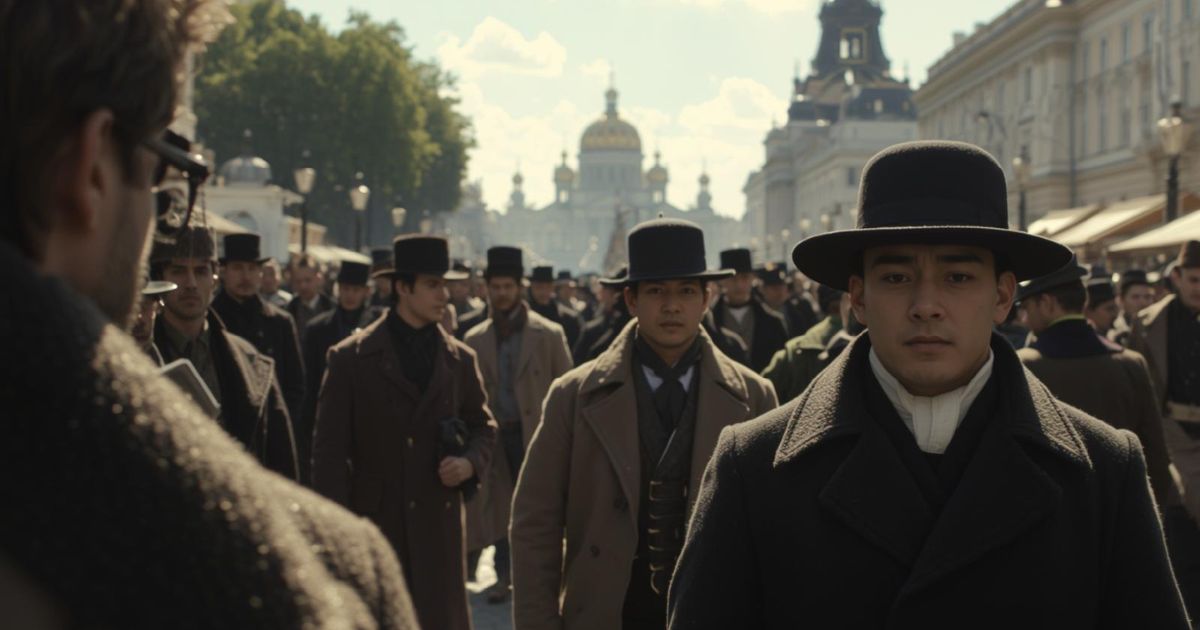
An excerpt from the original text.(complete · 3792 words)
strange period began for Raskolnikov: it was as though a fog had
fallen upon him and wrapped him in a dreary solitude from which there
was no escape. Recalling that period long after, he believed that his
mind had been clouded at times, and that it had continued so, with
intervals, till the final catastrophe. He was convinced that he had been
mistaken about many things at that time, for instance as to the date
of certain events. Anyway, when he tried later on to piece his
recollections together, he learnt a great deal about himself from what
other people told him. He had mixed up incidents and had explained
events as due to circumstances which existed only in his imagination. At
times he was a prey to agonies of morbid uneasiness, amounting sometimes
to panic. But he remembered, too, moments, hours, perhaps whole days,
of complete apathy, which came upon him as a reaction from his previous
terror and might be compared with the abnormal insensibility, sometimes
seen in the dying. He seemed to be trying in that latter stage to escape
from a full and clear understanding of his position. Certain essential
facts which required immediate consideration were particularly irksome
to him. How glad he would have been to be free from some cares, the
neglect of which would have threatened him with complete, inevitable
ruin.
He was particularly worried about Svidrigaïlov, he might be said to be
permanently thinking of Svidrigaïlov. From the time of Svidrigaïlov’s
too menacing and unmistakable words in Sonia’s room at the moment of
Katerina Ivanovna’s death, the normal working of his mind seemed to
break down. But although this new fact caused him extreme uneasiness,
Raskolnikov was in no hurry for an explanation of it. At times, finding
himself in a solitary and remote part of the town, in some wretched
eating-house, sitting alone lost in thought, hardly knowing how he had
come there, he suddenly thought of Svidrigaïlov. He recognised
suddenly, clearly, and with dismay that he ought at once to come to an
understanding with that man and to make what terms he could. Walking
outside the city gates one day, he positively fancied that they had
fixed a meeting there, that he was waiting for Svidrigaïlov. Another
time he woke up before daybreak lying on the ground under some bushes
and could not at first understand how he had come there.
But during the two or three days after Katerina Ivanovna’s death, he
had two or three times met Svidrigaïlov at Sonia’s lodging, where he
had gone aimlessly for a moment. They exchanged a few words and made no
reference to the vital subject, as though they were tacitly agreed not
to speak of it for a time.
Katerina Ivanovna’s body was still lying in the coffin, Svidrigaïlov was
busy making arrangements for the funeral. Sonia too was very busy. At
their last meeting Svidrigaïlov informed Raskolnikov that he had made
an arrangement, and a very satisfactory one, for Katerina Ivanovna’s
children; that he had, through certain connections, succeeded in getting
hold of certain personages by whose help the three orphans could be at
once placed in very suitable institutions; that the money he had settled
on them had been of great assistance, as it is much easier to place
orphans with some property than destitute ones. He said something
too about Sonia and promised to come himself in a day or two to see
Raskolnikov, mentioning that “he would like to consult with him, that
there were things they must talk over....”
This conversation took place in the passage on the stairs. Svidrigaïlov
looked intently at Raskolnikov and suddenly, after a brief pause,
dropping his voice, asked: “But how is it, Rodion Romanovitch; you
don’t seem yourself? You look and you listen, but you don’t seem to
understand. Cheer up! We’ll talk things over; I am only sorry, I’ve
so much to do of my own business and other people’s. Ah, Rodion
Romanovitch,” he added suddenly, “what all men need is fresh air, fresh
air... more than anything!”
He moved to one side to make way for the priest and server, who
were coming up the stairs. They had come for the requiem service. By
Svidrigaïlov’s orders it was sung twice a day punctually. Svidrigaïlov
went his way. Raskolnikov stood still a moment, thought, and followed
the priest into Sonia’s room. He stood at the door. They began quietly,
slowly and mournfully singing the service. From his childhood the
thought of death and the presence of death had something oppressive
and mysteriously awful; and it was long since he had heard the requiem
service. And there was something else here as well, too awful and
disturbing. He looked at the children: they were all kneeling by the
coffin; Polenka was weeping. Behind them Sonia prayed, softly and, as it
were, timidly weeping.
“These last two days she hasn’t said a word to me, she hasn’t glanced at
me,” Raskolnikov thought suddenly. The sunlight was bright in the room;
the incense rose in clouds; the priest read, “Give rest, oh Lord....”
Raskolnikov stayed all through the service. As he blessed them and
took his leave, the priest looked round strangely. After the service,
Raskolnikov went up to Sonia. She took both his hands and let her
head sink on his shoulder. This slight friendly gesture bewildered
Raskolnikov. It seemed strange to him that there was no trace of
repugnance, no trace of disgust, no tremor in her hand. It was the
furthest limit of self-abnegation, at least so he interpreted it.
Sonia said nothing. Raskolnikov pressed her hand and went out. He felt
very miserable. If it had been possible to escape to some solitude, he
would have thought himself lucky, even if he had to spend his whole life
there. But although he had almost always been by himself of late, he had
never been able to feel alone. Sometimes he walked out of the town on to
the high road, once he had even reached a little wood, but the lonelier
the place was, the more he seemed to be aware of an uneasy presence near
him. It did not frighten him, but greatly annoyed him, so that he
made haste to return to the town, to mingle with the crowd, to enter
restaurants and taverns, to walk in busy thoroughfares. There he felt
easier and even more solitary. One day at dusk he sat for an hour
listening to songs in a tavern and he remembered that he positively
enjoyed it. But at last he had suddenly felt the same uneasiness again,
as though his conscience smote him. “Here I sit listening to singing,
is that what I ought to be doing?” he thought. Yet he felt at once
that that was not the only cause of his uneasiness; there was something
requiring immediate decision, but it was something he could not clearly
understand or put into words. It was a hopeless tangle. “No, better the
struggle again! Better Porfiry again... or Svidrigaïlov.... Better some
challenge again... some attack. Yes, yes!” he thought. He went out of
the tavern and rushed away almost at a run. The thought of Dounia and
his mother suddenly reduced him almost to a panic. That night he woke
up before morning among some bushes in Krestovsky Island, trembling
all over with fever; he walked home, and it was early morning when he
arrived. After some hours’ sleep the fever left him, but he woke up
late, two o’clock in the afternoon.
He remembered that Katerina Ivanovna’s funeral had been fixed for that
day, and was glad that he was not present at it. Nastasya brought him
some food; he ate and drank with appetite, almost with greediness. His
head was fresher and he was calmer than he had been for the last three
days. He even felt a passing wonder at his previous attacks of panic.
The door opened and Razumihin came in.
“Ah, he’s eating, then he’s not ill,” said Razumihin. He took a chair
and sat down at the table opposite Raskolnikov.
He was troubled and did not attempt to conceal it. He spoke with evident
annoyance, but without hurry or raising his voice. He looked as though
he had some special fixed determination.
“Listen,” he began resolutely. “As far as I am concerned, you may all go
to hell, but from what I see, it’s clear to me that I can’t make head or
tail of it; please don’t think I’ve come to ask you questions. I don’t
want to know, hang it! If you begin telling me your secrets, I dare say
I shouldn’t stay to listen, I should go away cursing. I have only come
to find out once for all whether it’s a fact that you are mad? There is
a conviction in the air that you are mad or very nearly so. I admit
I’ve been disposed to that opinion myself, judging from your stupid,
repulsive and quite inexplicable actions, and from your recent behavior
to your mother and sister. Only a monster or a madman could treat them
as you have; so you must be mad.”
“When did you see them last?”
“Just now. Haven’t you seen them since then? What have you been doing
with yourself? Tell me, please. I’ve been to you three times already.
Your mother has been seriously ill since yesterday. She had made up
her mind to come to you; Avdotya Romanovna tried to prevent her; she
wouldn’t hear a word. ‘If he is ill, if his mind is giving way, who can
look after him like his mother?’ she said. We all came here together, we
couldn’t let her come alone all the way. We kept begging her to be calm.
We came in, you weren’t here; she sat down, and stayed ten minutes,
while we stood waiting in silence. She got up and said: ‘If he’s
gone out, that is, if he is well, and has forgotten his mother, it’s
humiliating and unseemly for his mother to stand at his door begging for
kindness.’ She returned home and took to her bed; now she is in a fever.
‘I see,’ she said, ‘that he has time for his girl.’ She means by your
girl Sofya Semyonovna, your betrothed or your mistress, I don’t know. I
went at once to Sofya Semyonovna’s, for I wanted to know what was going
on. I looked round, I saw the coffin, the children crying, and
Sofya Semyonovna trying them on mourning dresses. No sign of you. I
apologised, came away, and reported to Avdotya Romanovna. So that’s all
nonsense and you haven’t got a girl; the most likely thing is that you
are mad. But here you sit, guzzling boiled beef as though you’d not had
a bite for three days. Though as far as that goes, madmen eat too, but
though you have not said a word to me yet... you are not mad! That I’d
swear! Above all, you are not mad! So you may go to hell, all of you,
for there’s some mystery, some secret about it, and I don’t intend to
worry my brains over your secrets. So I’ve simply come to swear at you,”
he finished, getting up, “to relieve my mind. And I know what to do
now.”
“What do you mean to do now?”
“What business is it of yours what I mean to do?”
“You are going in for a drinking bout.”
“How... how did you know?”
“Why, it’s pretty plain.”
Razumihin paused for a minute.
“You always have been a very rational person and you’ve never been mad,
never,” he observed suddenly with warmth. “You’re right: I shall drink.
Good-bye!”
And he moved to go out.
“I was talking with my sister--the day before yesterday, I think it
was--about you, Razumihin.”
“About me! But... where can you have seen her the day before yesterday?”
Razumihin stopped short and even turned a little pale.
One could see that his heart was throbbing slowly and violently.
“She came here by herself, sat there and talked to me.”
“She did!”
“Yes.”
“What did you say to her... I mean, about me?”
“I told her you were a very good, honest, and industrious man. I didn’t
tell her you love her, because she knows that herself.”
“She knows that herself?”
“Well, it’s pretty plain. Wherever I might go, whatever happened to me,
you would remain to look after them. I, so to speak, give them into your
keeping, Razumihin. I say this because I know quite well how you love
her, and am convinced of the purity of your heart. I know that she too
may love you and perhaps does love you already. Now decide for yourself,
as you know best, whether you need go in for a drinking bout or not.”
“Rodya! You see... well.... Ach, damn it! But where do you mean to go?
Of course, if it’s all a secret, never mind.... But I... I shall find
out the secret... and I am sure that it must be some ridiculous nonsense
and that you’ve made it all up. Anyway you are a capital fellow, a
capital fellow!...”
“That was just what I wanted to add, only you interrupted, that that was
a very good decision of yours not to find out these secrets. Leave it to
time, don’t worry about it. You’ll know it all in time when it must be.
Yesterday a man said to me that what a man needs is fresh air, fresh
air, fresh air. I mean to go to him directly to find out what he meant
by that.”
Razumihin stood lost in thought and excitement, making a silent
conclusion.
“He’s a political conspirator! He must be. And he’s on the eve of some
desperate step, that’s certain. It can only be that! And... and Dounia
knows,” he thought suddenly.
“So Avdotya Romanovna comes to see you,” he said, weighing each
syllable, “and you’re going to see a man who says we need more air, and
so of course that letter... that too must have something to do with it,”
he concluded to himself.
“What letter?”
“She got a letter to-day. It upset her very much--very much indeed. Too
much so. I began speaking of you, she begged me not to. Then... then
she said that perhaps we should very soon have to part... then she began
warmly thanking me for something; then she went to her room and locked
herself in.”
“She got a letter?” Raskolnikov asked thoughtfully.
“Yes, and you didn’t know? hm...”
They were both silent.
“Good-bye, Rodion. There was a time, brother, when I.... Never mind,
good-bye. You see, there was a time.... Well, good-bye! I must be off
too. I am not going to drink. There’s no need now.... That’s all stuff!”
He hurried out; but when he had almost closed the door behind him, he
suddenly opened it again, and said, looking away:
“Oh, by the way, do you remember that murder, you know Porfiry’s, that
old woman? Do you know the murderer has been found, he has confessed
and given the proofs. It’s one of those very workmen, the painter, only
fancy! Do you remember I defended them here? Would you believe it, all
that scene of fighting and laughing with his companions on the stairs
while the porter and the two witnesses were going up, he got up on
purpose to disarm suspicion. The cunning, the presence of mind of the
young dog! One can hardly credit it; but it’s his own explanation, he
has confessed it all. And what a fool I was about it! Well, he’s simply
a genius of hypocrisy and resourcefulness in disarming the suspicions of
the lawyers--so there’s nothing much to wonder at, I suppose! Of course
people like that are always possible. And the fact that he couldn’t keep
up the character, but confessed, makes him easier to believe in. But
what a fool I was! I was frantic on their side!”
“Tell me, please, from whom did you hear that, and why does it interest
you so?” Raskolnikov asked with unmistakable agitation.
“What next? You ask me why it interests me!... Well, I heard it from
Porfiry, among others... It was from him I heard almost all about it.”
“From Porfiry?”
“From Porfiry.”
“What... what did he say?” Raskolnikov asked in dismay.
“He gave me a capital explanation of it. Psychologically, after his
fashion.”
“He explained it? Explained it himself?”
“Yes, yes; good-bye. I’ll tell you all about it another time, but now
I’m busy. There was a time when I fancied... But no matter, another
time!... What need is there for me to drink now? You have made me drunk
without wine. I am drunk, Rodya! Good-bye, I’m going. I’ll come again
very soon.”
He went out.
“He’s a political conspirator, there’s not a doubt about it,” Razumihin
decided, as he slowly descended the stairs. “And he’s drawn his sister
in; that’s quite, quite in keeping with Avdotya Romanovna’s character.
There are interviews between them!... She hinted at it too... So many of
her words.... and hints... bear that meaning! And how else can all this
tangle be explained? Hm! And I was almost thinking... Good heavens,
what I thought! Yes, I took leave of my senses and I wronged him! It was
his doing, under the lamp in the corridor that day. Pfoo! What a crude,
nasty, vile idea on my part! Nikolay is a brick, for confessing.... And
how clear it all is now! His illness then, all his strange actions...
before this, in the university, how morose he used to be, how gloomy....
But what’s the meaning now of that letter? There’s something in that,
too, perhaps. Whom was it from? I suspect...! No, I must find out!”
He thought of Dounia, realising all he had heard and his heart throbbed,
and he suddenly broke into a run.
As soon as Razumihin went out, Raskolnikov got up, turned to the window,
walked into one corner and then into another, as though forgetting the
smallness of his room, and sat down again on the sofa. He felt, so to
speak, renewed; again the struggle, so a means of escape had come.
“Yes, a means of escape had come! It had been too stifling, too
cramping, the burden had been too agonising. A lethargy had come upon
him at times. From the moment of the scene with Nikolay at Porfiry’s he
had been suffocating, penned in without hope of escape. After Nikolay’s
confession, on that very day had come the scene with Sonia; his
behaviour and his last words had been utterly unlike anything he
could have imagined beforehand; he had grown feebler, instantly and
fundamentally! And he had agreed at the time with Sonia, he had agreed
in his heart he could not go on living alone with such a thing on his
mind!
“And Svidrigaïlov was a riddle... He worried him, that was true, but
somehow not on the same point. He might still have a struggle to come
with Svidrigaïlov. Svidrigaïlov, too, might be a means of escape; but
Porfiry was a different matter.
“And so Porfiry himself had explained it to Razumihin, had explained it
psychologically. He had begun bringing in his damned psychology again!
Porfiry? But to think that Porfiry should for one moment believe that
Nikolay was guilty, after what had passed between them before Nikolay’s
appearance, after that tête-à-tête interview, which could have only
one explanation? (During those days Raskolnikov had often recalled
passages in that scene with Porfiry; he could not bear to let his mind
rest on it.) Such words, such gestures had passed between them, they
had exchanged such glances, things had been said in such a tone and had
reached such a pass, that Nikolay, whom Porfiry had seen through at the
first word, at the first gesture, could not have shaken his conviction.
“And to think that even Razumihin had begun to suspect! The scene in the
corridor under the lamp had produced its effect then. He had rushed to
Porfiry.... But what had induced the latter to receive him like that?
What had been his object in putting Razumihin off with Nikolay? He must
have some plan; there was some design, but what was it? It was true that
a long time had passed since that morning--too long a time--and no sight
nor sound of Porfiry. Well, that was a bad sign....”
Raskolnikov took his cap and went out of the room, still pondering. It
was the first time for a long while that he had felt clear in his mind,
at least. “I must settle Svidrigaïlov,” he thought, “and as soon as
possible; he, too, seems to be waiting for me to come to him of my own
accord.” And at that moment there was such a rush of hate in his
weary heart that he might have killed either of those two--Porfiry or
Svidrigaïlov. At least he felt that he would be capable of doing it
later, if not now.
“We shall see, we shall see,” he repeated to himself.
But no sooner had he opened the door than he stumbled upon Porfiry
himself in the passage. He was coming in to see him. Raskolnikov was
dumbfounded for a minute, but only for one minute. Strange to say, he
was not very much astonished at seeing Porfiry and scarcely afraid of
him. He was simply startled, but was quickly, instantly, on his guard.
“Perhaps this will mean the end? But how could Porfiry have approached
so quietly, like a cat, so that he had heard nothing? Could he have been
listening at the door?”
“You didn’t expect a visitor, Rodion Romanovitch,” Porfiry explained,
laughing. “I’ve been meaning to look in a long time; I was passing by
and thought why not go in for five minutes. Are you going out? I won’t
keep you long. Just let me have one cigarette.”
“Sit down, Porfiry Petrovitch, sit down.” Raskolnikov gave his visitor
a seat with so pleased and friendly an expression that he would have
marvelled at himself, if he could have seen it.
The last moment had come, the last drops had to be drained! So a man
will sometimes go through half an hour of mortal terror with a brigand,
yet when the knife is at his throat at last, he feels no fear.
Raskolnikov seated himself directly facing Porfiry, and looked at him
without flinching. Porfiry screwed up his eyes and began lighting a
cigarette.
“Speak, speak,” seemed as though it would burst from Raskolnikov’s
heart. “Come, why don’t you speak?”
Master this chapter. Complete your experience
Purchase the complete book to access all chapters and support classic literature
As an Amazon Associate, we earn a small commission from qualifying purchases at no additional cost to you.
Available in paperback, hardcover, and e-book formats
Let's Analyse the Pattern
Why This Matters
Connect literature to life
This chapter teaches how to identify who in your life has earned the right to hear your deepest struggles—people who respond to pain with presence, not judgment.
Now let's explore the literary elements.
Key Quotes & Analysis
"I killed her! I killed the old woman and her sister! I killed them with an axe and robbed them."
Context: His desperate confession to Sonia after months of psychological torment
This raw admission strips away all his intellectual justifications and theories. The repetition of 'I killed' shows he's finally taking full responsibility rather than hiding behind abstract ideas about extraordinary people and social utility.
"What have you done to yourself? There is no one, no one in the whole world now so unhappy as you!"
Context: Her immediate response to Raskolnikov's confession
Instead of condemning him, she recognizes his suffering. This shows how true compassion focuses on the person's pain rather than their crimes, creating space for healing rather than more shame.
"Go at once, this very minute, stand at the cross-roads, bow down, first kiss the earth which you have defiled, and then bow down to all the world."
Context: Her advice on how Raskolnikov should publicly confess
She's prescribing a ritual of humility that will reconnect him with humanity and the earth he's violated. This physical act of submission is meant to heal his spiritual pride and isolation.
Thematic Threads
Redemption
In This Chapter
Sonia sees Raskolnikov's confession as the first step toward spiritual healing, not the end of his story
Development
Culmination of the novel's central question about whether anyone can be saved from their worst actions
Truth
In This Chapter
Raskolnikov's confession strips away all his intellectual justifications and theories, leaving raw honesty
Development
Evolution from his early rationalization attempts to this moment of complete vulnerability
Isolation
In This Chapter
The secret has been eating Raskolnikov alive precisely because he carried it alone
Development
Deepened throughout the novel as his guilt has separated him from all genuine human connection
Class
In This Chapter
Sonia, despite her low social status, becomes the moral authority who can offer what Raskolnikov needs
Development
Continued reversal of expectations about who holds real wisdom and strength in society
Love
In This Chapter
Sonia's unconditional acceptance demonstrates love that doesn't depend on perfection or worthiness
Development
Introduced here as the force that can break through guilt and shame where logic and philosophy failed
You now have the context. Time to form your own thoughts.
Discussion Questions
- 1
What does Raskolnikov finally tell Sonia, and how does she react to his confession?
- 2
Why do you think Raskolnikov chose Sonia to confess to rather than anyone else in his life?
- 3
Think about a time when keeping a secret felt like it was eating you alive - what made it so hard to carry alone?
- 4
If you were advising someone who needed to confess something difficult, how would you help them choose the right person to tell?
- 5
What does Sonia's response teach us about the difference between judging someone's actions and judging their worth as a person?
Critical Thinking Exercise
Map Your Trust Network
Draw a simple diagram with yourself in the center. Around you, place the people in your life who have proven they can handle difficult truths with love - your potential 'Sonias.' For each person, write one example of how they've shown this trustworthiness. Then identify any 'secrets' or burdens you're carrying alone that might benefit from sharing with the right person from your network.
Consider:
- •Look for people who have responded to others' mistakes with compassion rather than judgment
- •Consider who has shared their own vulnerabilities with you - this often indicates someone safe
- •Remember that the 'right person' for one type of problem might not be right for another
Coming Up Next...
Chapter 33: Dunya's Escape
Now that Raskolnikov has confessed to Sonia, he must decide whether to follow her advice and turn himself in publicly. But making that choice will test everything he believes about himself and force him to confront whether he's truly ready to change.