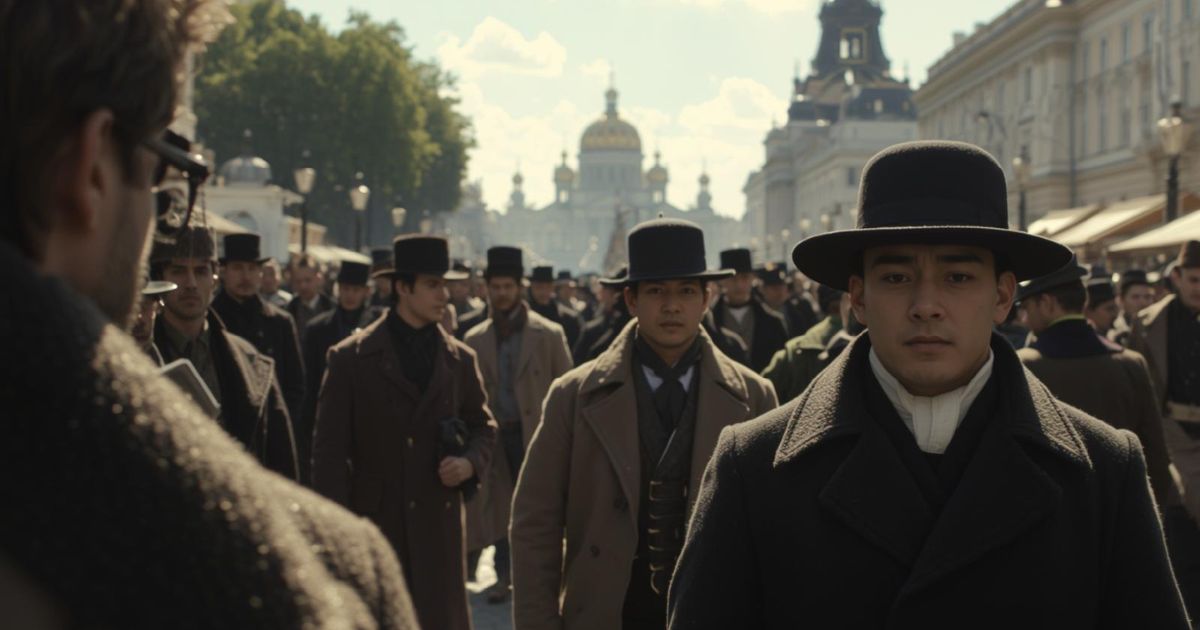
An excerpt from the original text.(complete · 4983 words)
“e is well, quite well!” Zossimov cried cheerfully as they entered.
He had come in ten minutes earlier and was sitting in the same place
as before, on the sofa. Raskolnikov was sitting in the opposite corner,
fully dressed and carefully washed and combed, as he had not been for
some time past. The room was immediately crowded, yet Nastasya managed
to follow the visitors in and stayed to listen.
Raskolnikov really was almost well, as compared with his condition the
day before, but he was still pale, listless, and sombre. He looked like
a wounded man or one who has undergone some terrible physical suffering.
His brows were knitted, his lips compressed, his eyes feverish. He spoke
little and reluctantly, as though performing a duty, and there was a
restlessness in his movements.
He only wanted a sling on his arm or a bandage on his finger to complete
the impression of a man with a painful abscess or a broken arm. The
pale, sombre face lighted up for a moment when his mother and sister
entered, but this only gave it a look of more intense suffering, in
place of its listless dejection. The light soon died away, but the look
of suffering remained, and Zossimov, watching and studying his patient
with all the zest of a young doctor beginning to practise, noticed
in him no joy at the arrival of his mother and sister, but a sort of
bitter, hidden determination to bear another hour or two of inevitable
torture. He saw later that almost every word of the following
conversation seemed to touch on some sore place and irritate it. But
at the same time he marvelled at the power of controlling himself
and hiding his feelings in a patient who the previous day had, like a
monomaniac, fallen into a frenzy at the slightest word.
“Yes, I see myself now that I am almost well,” said Raskolnikov,
giving his mother and sister a kiss of welcome which made Pulcheria
Alexandrovna radiant at once. “And I don’t say this as I did
yesterday,” he said, addressing Razumihin, with a friendly pressure of
his hand.
“Yes, indeed, I am quite surprised at him to-day,” began Zossimov, much
delighted at the ladies’ entrance, for he had not succeeded in keeping
up a conversation with his patient for ten minutes. “In another three or
four days, if he goes on like this, he will be just as before, that is,
as he was a month ago, or two... or perhaps even three. This has been
coming on for a long while.... eh? Confess, now, that it has been
perhaps your own fault?” he added, with a tentative smile, as though
still afraid of irritating him.
“It is very possible,” answered Raskolnikov coldly.
“I should say, too,” continued Zossimov with zest, “that your complete
recovery depends solely on yourself. Now that one can talk to you,
I should like to impress upon you that it is essential to avoid the
elementary, so to speak, fundamental causes tending to produce your
morbid condition: in that case you will be cured, if not, it will go
from bad to worse. These fundamental causes I don’t know, but they must
be known to you. You are an intelligent man, and must have observed
yourself, of course. I fancy the first stage of your derangement
coincides with your leaving the university. You must not be left without
occupation, and so, work and a definite aim set before you might, I
fancy, be very beneficial.”
“Yes, yes; you are perfectly right.... I will make haste and return to
the university: and then everything will go smoothly....”
Zossimov, who had begun his sage advice partly to make an effect before
the ladies, was certainly somewhat mystified, when, glancing at his
patient, he observed unmistakable mockery on his face. This lasted
an instant, however. Pulcheria Alexandrovna began at once thanking
Zossimov, especially for his visit to their lodging the previous night.
“What! he saw you last night?” Raskolnikov asked, as though startled.
“Then you have not slept either after your journey.”
“Ach, Rodya, that was only till two o’clock. Dounia and I never go to
bed before two at home.”
“I don’t know how to thank him either,” Raskolnikov went on,
suddenly frowning and looking down. “Setting aside the question of
payment--forgive me for referring to it (he turned to Zossimov)--I
really don’t know what I have done to deserve such special attention
from you! I simply don’t understand it... and... and... it weighs upon
me, indeed, because I don’t understand it. I tell you so candidly.”
“Don’t be irritated.” Zossimov forced himself to laugh. “Assume that you
are my first patient--well--we fellows just beginning to practise love
our first patients as if they were our children, and some almost fall in
love with them. And, of course, I am not rich in patients.”
“I say nothing about him,” added Raskolnikov, pointing to Razumihin,
“though he has had nothing from me either but insult and trouble.”
“What nonsense he is talking! Why, you are in a sentimental mood to-day,
are you?” shouted Razumihin.
If he had had more penetration he would have seen that there was no
trace of sentimentality in him, but something indeed quite the opposite.
But Avdotya Romanovna noticed it. She was intently and uneasily watching
her brother.
“As for you, mother, I don’t dare to speak,” he went on, as though
repeating a lesson learned by heart. “It is only to-day that I have
been able to realise a little how distressed you must have been here
yesterday, waiting for me to come back.”
When he had said this, he suddenly held out his hand to his sister,
smiling without a word. But in this smile there was a flash of real
unfeigned feeling. Dounia caught it at once, and warmly pressed his
hand, overjoyed and thankful. It was the first time he had addressed her
since their dispute the previous day. The mother’s face lighted up
with ecstatic happiness at the sight of this conclusive unspoken
reconciliation. “Yes, that is what I love him for,” Razumihin,
exaggerating it all, muttered to himself, with a vigorous turn in his
chair. “He has these movements.”
“And how well he does it all,” the mother was thinking to herself. “What
generous impulses he has, and how simply, how delicately he put an end
to all the misunderstanding with his sister--simply by holding out his
hand at the right minute and looking at her like that.... And what
fine eyes he has, and how fine his whole face is!... He is even better
looking than Dounia.... But, good heavens, what a suit--how terribly
he’s dressed!... Vasya, the messenger boy in Afanasy Ivanitch’s shop, is
better dressed! I could rush at him and hug him... weep over him--but
I am afraid.... Oh, dear, he’s so strange! He’s talking kindly, but I’m
afraid! Why, what am I afraid of?...”
“Oh, Rodya, you wouldn’t believe,” she began suddenly, in haste to
answer his words to her, “how unhappy Dounia and I were yesterday! Now
that it’s all over and done with and we are quite happy again--I can
tell you. Fancy, we ran here almost straight from the train to embrace
you and that woman--ah, here she is! Good morning, Nastasya!... She told
us at once that you were lying in a high fever and had just run away
from the doctor in delirium, and they were looking for you in the
streets. You can’t imagine how we felt! I couldn’t help thinking of the
tragic end of Lieutenant Potanchikov, a friend of your father’s--you
can’t remember him, Rodya--who ran out in the same way in a high fever
and fell into the well in the court-yard and they couldn’t pull him out
till next day. Of course, we exaggerated things. We were on the point of
rushing to find Pyotr Petrovitch to ask him to help.... Because we were
alone, utterly alone,” she said plaintively and stopped short,
suddenly, recollecting it was still somewhat dangerous to speak of Pyotr
Petrovitch, although “we are quite happy again.”
“Yes, yes.... Of course it’s very annoying....” Raskolnikov muttered in
reply, but with such a preoccupied and inattentive air that Dounia gazed
at him in perplexity.
“What else was it I wanted to say?” He went on trying to recollect. “Oh,
yes; mother, and you too, Dounia, please don’t think that I didn’t mean
to come and see you to-day and was waiting for you to come first.”
“What are you saying, Rodya?” cried Pulcheria Alexandrovna. She, too,
was surprised.
“Is he answering us as a duty?” Dounia wondered. “Is he being reconciled
and asking forgiveness as though he were performing a rite or repeating
a lesson?”
“I’ve only just waked up, and wanted to go to you, but was delayed owing
to my clothes; I forgot yesterday to ask her... Nastasya... to wash out
the blood... I’ve only just dressed.”
“Blood! What blood?” Pulcheria Alexandrovna asked in alarm.
“Oh, nothing--don’t be uneasy. It was when I was wandering about
yesterday, rather delirious, I chanced upon a man who had been run
over... a clerk...”
“Delirious? But you remember everything!” Razumihin interrupted.
“That’s true,” Raskolnikov answered with special carefulness. “I
remember everything even to the slightest detail, and yet--why I did
that and went there and said that, I can’t clearly explain now.”
“A familiar phenomenon,” interposed Zossimov, “actions are sometimes
performed in a masterly and most cunning way, while the direction of the
actions is deranged and dependent on various morbid impressions--it’s
like a dream.”
“Perhaps it’s a good thing really that he should think me almost a
madman,” thought Raskolnikov.
“Why, people in perfect health act in the same way too,” observed
Dounia, looking uneasily at Zossimov.
“There is some truth in your observation,” the latter replied. “In that
sense we are certainly all not infrequently like madmen, but with the
slight difference that the deranged are somewhat madder, for we
must draw a line. A normal man, it is true, hardly exists. Among
dozens--perhaps hundreds of thousands--hardly one is to be met with.”
At the word “madman,” carelessly dropped by Zossimov in his chatter on
his favourite subject, everyone frowned.
Raskolnikov sat seeming not to pay attention, plunged in thought with a
strange smile on his pale lips. He was still meditating on something.
“Well, what about the man who was run over? I interrupted you!”
Razumihin cried hastily.
“What?” Raskolnikov seemed to wake up. “Oh... I got spattered with
blood helping to carry him to his lodging. By the way, mamma, I did an
unpardonable thing yesterday. I was literally out of my mind. I gave
away all the money you sent me... to his wife for the funeral. She’s
a widow now, in consumption, a poor creature... three little children,
starving... nothing in the house... there’s a daughter, too... perhaps
you’d have given it yourself if you’d seen them. But I had no right to
do it I admit, especially as I knew how you needed the money yourself.
To help others one must have the right to do it, or else Crevez,
chiens, si vous n’êtes pas contents.” He laughed, “That’s right, isn’t
it, Dounia?”
“No, it’s not,” answered Dounia firmly.
“Bah! you, too, have ideals,” he muttered, looking at her almost with
hatred, and smiling sarcastically. “I ought to have considered that....
Well, that’s praiseworthy, and it’s better for you... and if you reach a
line you won’t overstep, you will be unhappy... and if you overstep it,
maybe you will be still unhappier.... But all that’s nonsense,” he added
irritably, vexed at being carried away. “I only meant to say that I beg
your forgiveness, mother,” he concluded, shortly and abruptly.
“That’s enough, Rodya, I am sure that everything you do is very good,”
said his mother, delighted.
“Don’t be too sure,” he answered, twisting his mouth into a smile.
A silence followed. There was a certain constraint in all this
conversation, and in the silence, and in the reconciliation, and in the
forgiveness, and all were feeling it.
“It is as though they were afraid of me,” Raskolnikov was thinking
to himself, looking askance at his mother and sister. Pulcheria
Alexandrovna was indeed growing more timid the longer she kept silent.
“Yet in their absence I seemed to love them so much,” flashed through
his mind.
“Do you know, Rodya, Marfa Petrovna is dead,” Pulcheria Alexandrovna
suddenly blurted out.
“What Marfa Petrovna?”
“Oh, mercy on us--Marfa Petrovna Svidrigaïlov. I wrote you so much about
her.”
“A-a-h! Yes, I remember.... So she’s dead! Oh, really?” he roused
himself suddenly, as if waking up. “What did she die of?”
“Only imagine, quite suddenly,” Pulcheria Alexandrovna answered
hurriedly, encouraged by his curiosity. “On the very day I was sending
you that letter! Would you believe it, that awful man seems to have been
the cause of her death. They say he beat her dreadfully.”
“Why, were they on such bad terms?” he asked, addressing his sister.
“Not at all. Quite the contrary indeed. With her, he was always very
patient, considerate even. In fact, all those seven years of their
married life he gave way to her, too much so indeed, in many cases. All
of a sudden he seems to have lost patience.”
“Then he could not have been so awful if he controlled himself for seven
years? You seem to be defending him, Dounia?”
“No, no, he’s an awful man! I can imagine nothing more awful!” Dounia
answered, almost with a shudder, knitting her brows, and sinking into
thought.
“That had happened in the morning,” Pulcheria Alexandrovna went on
hurriedly. “And directly afterwards she ordered the horses to be
harnessed to drive to the town immediately after dinner. She always used
to drive to the town in such cases. She ate a very good dinner, I am
told....”
“After the beating?”
“That was always her... habit; and immediately after dinner, so as not
to be late in starting, she went to the bath-house.... You see, she was
undergoing some treatment with baths. They have a cold spring there, and
she used to bathe in it regularly every day, and no sooner had she got
into the water when she suddenly had a stroke!”
“I should think so,” said Zossimov.
“And did he beat her badly?”
“What does that matter!” put in Dounia.
“H’m! But I don’t know why you want to tell us such gossip, mother,”
said Raskolnikov irritably, as it were in spite of himself.
“Ah, my dear, I don’t know what to talk about,” broke from Pulcheria
Alexandrovna.
“Why, are you all afraid of me?” he asked, with a constrained smile.
“That’s certainly true,” said Dounia, looking directly and sternly at
her brother. “Mother was crossing herself with terror as she came up the
stairs.”
His face worked, as though in convulsion.
“Ach, what are you saying, Dounia! Don’t be angry, please, Rodya....
Why did you say that, Dounia?” Pulcheria Alexandrovna began,
overwhelmed--“You see, coming here, I was dreaming all the way, in the
train, how we should meet, how we should talk over everything
together.... And I was so happy, I did not notice the journey! But what
am I saying? I am happy now.... You should not, Dounia.... I am happy
now--simply in seeing you, Rodya....”
“Hush, mother,” he muttered in confusion, not looking at her, but
pressing her hand. “We shall have time to speak freely of everything!”
As he said this, he was suddenly overwhelmed with confusion and turned
pale. Again that awful sensation he had known of late passed with deadly
chill over his soul. Again it became suddenly plain and perceptible to
him that he had just told a fearful lie--that he would never now be
able to speak freely of everything--that he would never again be able to
speak of anything to anyone. The anguish of this thought was such that
for a moment he almost forgot himself. He got up from his seat, and not
looking at anyone walked towards the door.
“What are you about?” cried Razumihin, clutching him by the arm.
He sat down again, and began looking about him, in silence. They were
all looking at him in perplexity.
“But what are you all so dull for?” he shouted, suddenly and quite
unexpectedly. “Do say something! What’s the use of sitting like this?
Come, do speak. Let us talk.... We meet together and sit in silence....
Come, anything!”
“Thank God; I was afraid the same thing as yesterday was beginning
again,” said Pulcheria Alexandrovna, crossing herself.
“What is the matter, Rodya?” asked Avdotya Romanovna, distrustfully.
“Oh, nothing! I remembered something,” he answered, and suddenly
laughed.
“Well, if you remembered something; that’s all right!... I was beginning
to think...” muttered Zossimov, getting up from the sofa. “It is time
for me to be off. I will look in again perhaps... if I can...” He made
his bows, and went out.
“What an excellent man!” observed Pulcheria Alexandrovna.
“Yes, excellent, splendid, well-educated, intelligent,” Raskolnikov
began, suddenly speaking with surprising rapidity, and a liveliness he
had not shown till then. “I can’t remember where I met him before my
illness.... I believe I have met him somewhere----... And this is a good
man, too,” he nodded at Razumihin. “Do you like him, Dounia?” he asked
her; and suddenly, for some unknown reason, laughed.
“Very much,” answered Dounia.
“Foo!--what a pig you are!” Razumihin protested, blushing in terrible
confusion, and he got up from his chair. Pulcheria Alexandrovna smiled
faintly, but Raskolnikov laughed aloud.
“Where are you off to?”
“I must go.”
“You need not at all. Stay. Zossimov has gone, so you must. Don’t go.
What’s the time? Is it twelve o’clock? What a pretty watch you have got,
Dounia. But why are you all silent again? I do all the talking.”
“It was a present from Marfa Petrovna,” answered Dounia.
“And a very expensive one!” added Pulcheria Alexandrovna.
“A-ah! What a big one! Hardly like a lady’s.”
“I like that sort,” said Dounia.
“So it is not a present from her fiancé,” thought Razumihin, and was
unreasonably delighted.
“I thought it was Luzhin’s present,” observed Raskolnikov.
“No, he has not made Dounia any presents yet.”
“A-ah! And do you remember, mother, I was in love and wanted to get
married?” he said suddenly, looking at his mother, who was disconcerted
by the sudden change of subject and the way he spoke of it.
“Oh, yes, my dear.”
Pulcheria Alexandrovna exchanged glances with Dounia and Razumihin.
“H’m, yes. What shall I tell you? I don’t remember much indeed. She was
such a sickly girl,” he went on, growing dreamy and looking down again.
“Quite an invalid. She was fond of giving alms to the poor, and was
always dreaming of a nunnery, and once she burst into tears when she
began talking to me about it. Yes, yes, I remember. I remember very
well. She was an ugly little thing. I really don’t know what drew me
to her then--I think it was because she was always ill. If she had been
lame or hunchback, I believe I should have liked her better still,” he
smiled dreamily. “Yes, it was a sort of spring delirium.”
“No, it was not only spring delirium,” said Dounia, with warm feeling.
He fixed a strained intent look on his sister, but did not hear or did
not understand her words. Then, completely lost in thought, he got up,
went up to his mother, kissed her, went back to his place and sat down.
“You love her even now?” said Pulcheria Alexandrovna, touched.
“Her? Now? Oh, yes.... You ask about her? No... that’s all now, as
it were, in another world... and so long ago. And indeed everything
happening here seems somehow far away.” He looked attentively at them.
“You, now... I seem to be looking at you from a thousand miles away...
but, goodness knows why we are talking of that! And what’s the use of
asking about it?” he added with annoyance, and biting his nails, fell
into dreamy silence again.
“What a wretched lodging you have, Rodya! It’s like a tomb,” said
Pulcheria Alexandrovna, suddenly breaking the oppressive silence. “I
am sure it’s quite half through your lodging you have become so
melancholy.”
“My lodging,” he answered, listlessly. “Yes, the lodging had a great
deal to do with it.... I thought that, too.... If only you knew, though,
what a strange thing you said just now, mother,” he said, laughing
strangely.
A little more, and their companionship, this mother and this sister,
with him after three years’ absence, this intimate tone of conversation,
in face of the utter impossibility of really speaking about anything,
would have been beyond his power of endurance. But there was one urgent
matter which must be settled one way or the other that day--so he had
decided when he woke. Now he was glad to remember it, as a means of
escape.
“Listen, Dounia,” he began, gravely and drily, “of course I beg your
pardon for yesterday, but I consider it my duty to tell you again that
I do not withdraw from my chief point. It is me or Luzhin. If I am a
scoundrel, you must not be. One is enough. If you marry Luzhin, I cease
at once to look on you as a sister.”
“Rodya, Rodya! It is the same as yesterday again,” Pulcheria
Alexandrovna cried, mournfully. “And why do you call yourself a
scoundrel? I can’t bear it. You said the same yesterday.”
“Brother,” Dounia answered firmly and with the same dryness. “In all
this there is a mistake on your part. I thought it over at night,
and found out the mistake. It is all because you seem to fancy I am
sacrificing myself to someone and for someone. That is not the case at
all. I am simply marrying for my own sake, because things are hard for
me. Though, of course, I shall be glad if I succeed in being useful to
my family. But that is not the chief motive for my decision....”
“She is lying,” he thought to himself, biting his nails vindictively.
“Proud creature! She won’t admit she wants to do it out of charity! Too
haughty! Oh, base characters! They even love as though they hate.... Oh,
how I... hate them all!”
“In fact,” continued Dounia, “I am marrying Pyotr Petrovitch because of
two evils I choose the less. I intend to do honestly all he expects of
me, so I am not deceiving him.... Why did you smile just now?” She, too,
flushed, and there was a gleam of anger in her eyes.
“All?” he asked, with a malignant grin.
“Within certain limits. Both the manner and form of Pyotr Petrovitch’s
courtship showed me at once what he wanted. He may, of course, think too
well of himself, but I hope he esteems me, too.... Why are you laughing
again?”
“And why are you blushing again? You are lying, sister. You are
intentionally lying, simply from feminine obstinacy, simply to hold your
own against me.... You cannot respect Luzhin. I have seen him and talked
with him. So you are selling yourself for money, and so in any case you
are acting basely, and I am glad at least that you can blush for it.”
“It is not true. I am not lying,” cried Dounia, losing her composure.
“I would not marry him if I were not convinced that he esteems me
and thinks highly of me. I would not marry him if I were not firmly
convinced that I can respect him. Fortunately, I can have convincing
proof of it this very day... and such a marriage is not a vileness, as
you say! And even if you were right, if I really had determined on a
vile action, is it not merciless on your part to speak to me like that?
Why do you demand of me a heroism that perhaps you have not either? It
is despotism; it is tyranny. If I ruin anyone, it is only myself.... I
am not committing a murder. Why do you look at me like that? Why are you
so pale? Rodya, darling, what’s the matter?”
“Good heavens! You have made him faint,” cried Pulcheria Alexandrovna.
“No, no, nonsense! It’s nothing. A little giddiness--not fainting. You
have fainting on the brain. H’m, yes, what was I saying? Oh, yes. In
what way will you get convincing proof to-day that you can respect him,
and that he... esteems you, as you said. I think you said to-day?”
“Mother, show Rodya Pyotr Petrovitch’s letter,” said Dounia.
With trembling hands, Pulcheria Alexandrovna gave him the letter. He
took it with great interest, but, before opening it, he suddenly looked
with a sort of wonder at Dounia.
“It is strange,” he said, slowly, as though struck by a new idea. “What
am I making such a fuss for? What is it all about? Marry whom you like!”
He said this as though to himself, but said it aloud, and looked for
some time at his sister, as though puzzled. He opened the letter at
last, still with the same look of strange wonder on his face. Then,
slowly and attentively, he began reading, and read it through twice.
Pulcheria Alexandrovna showed marked anxiety, and all indeed expected
something particular.
“What surprises me,” he began, after a short pause, handing the letter
to his mother, but not addressing anyone in particular, “is that he is a
business man, a lawyer, and his conversation is pretentious indeed, and
yet he writes such an uneducated letter.”
They all started. They had expected something quite different.
“But they all write like that, you know,” Razumihin observed, abruptly.
“Have you read it?”
“Yes.”
“We showed him, Rodya. We... consulted him just now,” Pulcheria
Alexandrovna began, embarrassed.
“That’s just the jargon of the courts,” Razumihin put in. “Legal
documents are written like that to this day.”
“Legal? Yes, it’s just legal--business language--not so very uneducated,
and not quite educated--business language!”
“Pyotr Petrovitch makes no secret of the fact that he had a cheap
education, he is proud indeed of having made his own way,” Avdotya
Romanovna observed, somewhat offended by her brother’s tone.
“Well, if he’s proud of it, he has reason, I don’t deny it. You seem to
be offended, sister, at my making only such a frivolous criticism on the
letter, and to think that I speak of such trifling matters on purpose to
annoy you. It is quite the contrary, an observation apropos of the style
occurred to me that is by no means irrelevant as things stand. There
is one expression, ‘blame yourselves’, put in very significantly and
plainly, and there is besides a threat that he will go away at once if I
am present. That threat to go away is equivalent to a threat to abandon
you both if you are disobedient, and to abandon you now after summoning
you to Petersburg. Well, what do you think? Can one resent such an
expression from Luzhin, as we should if he (he pointed to Razumihin) had
written it, or Zossimov, or one of us?”
“N-no,” answered Dounia, with more animation. “I saw clearly that it
was too naïvely expressed, and that perhaps he simply has no skill
in writing... that is a true criticism, brother. I did not expect,
indeed...”
“It is expressed in legal style, and sounds coarser than perhaps he
intended. But I must disillusion you a little. There is one expression
in the letter, one slander about me, and rather a contemptible one. I
gave the money last night to the widow, a woman in consumption, crushed
with trouble, and not ‘on the pretext of the funeral,’ but simply to pay
for the funeral, and not to the daughter--a young woman, as he writes,
of notorious behaviour (whom I saw last night for the first time in my
life)--but to the widow. In all this I see a too hasty desire to slander
me and to raise dissension between us. It is expressed again in legal
jargon, that is to say, with a too obvious display of the aim, and
with a very naïve eagerness. He is a man of intelligence, but to act
sensibly, intelligence is not enough. It all shows the man and... I
don’t think he has a great esteem for you. I tell you this simply to
warn you, because I sincerely wish for your good...”
Dounia did not reply. Her resolution had been taken. She was only
awaiting the evening.
“Then what is your decision, Rodya?” asked Pulcheria Alexandrovna, who
was more uneasy than ever at the sudden, new businesslike tone of his
talk.
“What decision?”
“You see Pyotr Petrovitch writes that you are not to be with us this
evening, and that he will go away if you come. So will you... come?”
“That, of course, is not for me to decide, but for you first, if you are
not offended by such a request; and secondly, by Dounia, if she, too, is
not offended. I will do what you think best,” he added, drily.
“Dounia has already decided, and I fully agree with her,” Pulcheria
Alexandrovna hastened to declare.
“I decided to ask you, Rodya, to urge you not to fail to be with us at
this interview,” said Dounia. “Will you come?”
“Yes.”
“I will ask you, too, to be with us at eight o’clock,” she said,
addressing Razumihin. “Mother, I am inviting him, too.”
“Quite right, Dounia. Well, since you have decided,” added Pulcheria
Alexandrovna, “so be it. I shall feel easier myself. I do not like
concealment and deception. Better let us have the whole truth.... Pyotr
Petrovitch may be angry or not, now!”
Master this chapter. Complete your experience
Purchase the complete book to access all chapters and support classic literature
As an Amazon Associate, we earn a small commission from qualifying purchases at no additional cost to you.
Available in paperback, hardcover, and e-book formats
Let's Analyse the Pattern
Why This Matters
Connect literature to life
This chapter teaches how to identify people who can separate your actions from your worth—those who respond to confession with compassion rather than judgment.
Now let's explore the literary elements.
Key Quotes & Analysis
"It was I who killed the old pawnbroker woman and her sister Lizaveta with an axe and robbed them."
Context: His direct confession to Sonya after circling around the truth
The stark, simple language contrasts with all his earlier philosophical justifications. This moment strips away his intellectual defenses and forces him to face the brutal reality of what he did.
"What have you done to yourself?"
Context: Her immediate response upon hearing his confession
She instinctively understands that the murder harmed Raskolnikov as much as his victims. Her question focuses on his spiritual condition rather than judging his actions.
"Go at once, this very minute, stand at the cross-roads, bow down, first kiss the earth which you have defiled and then bow down to all the world."
Context: Her advice for how he should publicly confess
She prescribes a ritual of humility that would reconnect him to humanity and the earth. This reflects Russian Orthodox beliefs about redemption requiring public acknowledgment and spiritual submission.
Thematic Threads
Isolation
In This Chapter
Raskolnikov's months of carrying his secret alone have nearly destroyed him mentally and spiritually
Development
Evolved from his initial philosophical isolation to complete psychological breakdown
Redemption
In This Chapter
Sonya immediately sees confession and acceptance of suffering as the path to spiritual renewal
Development
Introduced here as the counterpoint to Raskolnikov's self-justification
Love
In This Chapter
Sonya's unconditional compassion shows how true love operates—seeing the person beneath their worst actions
Development
Deepened from earlier hints of her caring nature to full demonstration of sacrificial love
Class
In This Chapter
The pawnbroker's murder reflects Raskolnikov's belief that some lives matter less than others
Development
Continues the theme of how poverty and social status distort moral reasoning
Identity
In This Chapter
Raskolnikov struggles with who he is after committing murder—extraordinary person or ordinary criminal
Development
Central conflict throughout, now reaching crisis point through confession
You now have the context. Time to form your own thoughts.
Discussion Questions
- 1
What finally pushes Raskolnikov to confess to Sonya, and how does she respond to his revelation?
- 2
Why does Sonya immediately understand that Raskolnikov's real punishment isn't legal consequences but spiritual death?
- 3
Where do you see people today carrying secrets that are slowly destroying them from the inside?
- 4
How would you identify someone in your life who could be your 'Sonya' - someone safe enough to share your hardest truths with?
- 5
What does this chapter reveal about the difference between being judged and being truly understood?
Critical Thinking Exercise
Map Your Support Network
Draw three circles: Inner (people who would stay if they knew your worst mistake), Middle (people who might stay but you're not sure), and Outer (people who would probably leave). Place the important people in your life in these circles. Then identify what qualities make someone 'Inner Circle' material - what do they do or say that shows they can handle difficult truths?
Consider:
- •Notice if your Inner Circle is empty or very small - this might explain why you feel isolated with problems
- •Look for patterns in your Inner Circle people - what makes them safe to confide in?
- •Consider whether you've been avoiding vulnerability with people who might actually be more understanding than you think
Coming Up Next...
Chapter 18: Sonia's Room
Now that Sonya knows his secret, Raskolnikov must decide whether to follow her advice about public confession. But first, he has to navigate the dangerous game of cat and mouse with Porfiry, who seems to be closing in on the truth through his own methods.