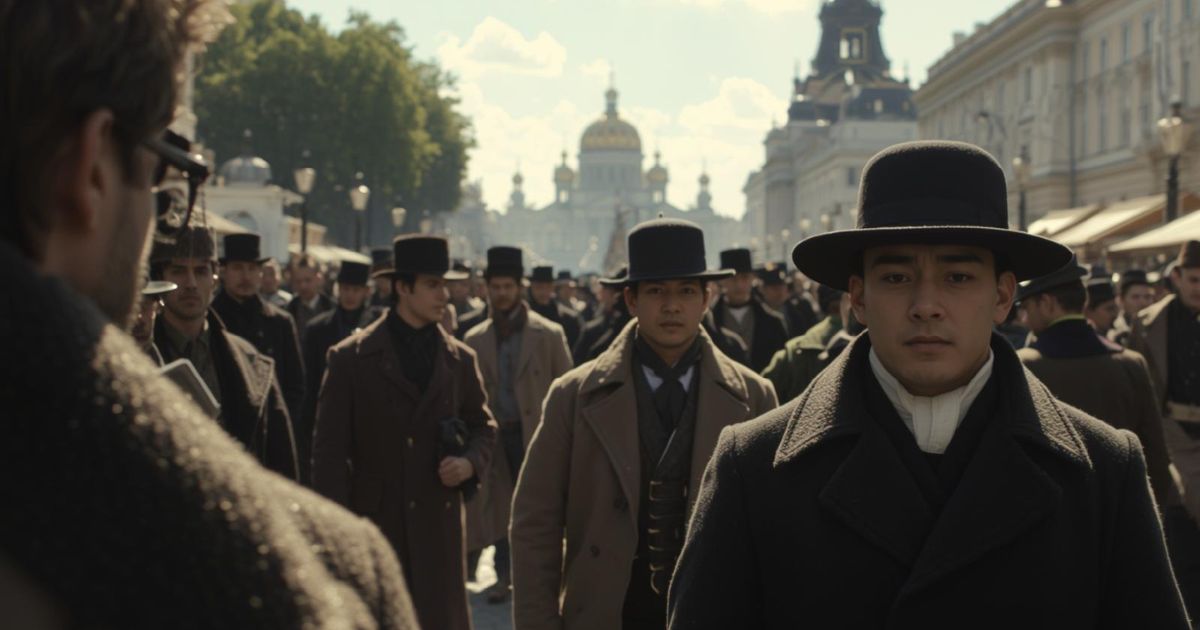
An excerpt from the original text.(complete · 5077 words)
askolnikov got up, and sat down on the sofa. He waved his hand weakly
to Razumihin to cut short the flow of warm and incoherent consolations
he was addressing to his mother and sister, took them both by the hand
and for a minute or two gazed from one to the other without speaking.
His mother was alarmed by his expression. It revealed an emotion
agonisingly poignant, and at the same time something immovable, almost
insane. Pulcheria Alexandrovna began to cry.
Avdotya Romanovna was pale; her hand trembled in her brother’s.
“Go home... with him,” he said in a broken voice, pointing to Razumihin,
“good-bye till to-morrow; to-morrow everything... Is it long since you
arrived?”
“This evening, Rodya,” answered Pulcheria Alexandrovna, “the train was
awfully late. But, Rodya, nothing would induce me to leave you now! I
will spend the night here, near you...”
“Don’t torture me!” he said with a gesture of irritation.
“I will stay with him,” cried Razumihin, “I won’t leave him for a
moment. Bother all my visitors! Let them rage to their hearts’ content!
My uncle is presiding there.”
“How, how can I thank you!” Pulcheria Alexandrovna was beginning, once
more pressing Razumihin’s hands, but Raskolnikov interrupted her again.
“I can’t have it! I can’t have it!” he repeated irritably, “don’t worry
me! Enough, go away... I can’t stand it!”
“Come, mamma, come out of the room at least for a minute,” Dounia
whispered in dismay; “we are distressing him, that’s evident.”
“Mayn’t I look at him after three years?” wept Pulcheria Alexandrovna.
“Stay,” he stopped them again, “you keep interrupting me, and my ideas
get muddled.... Have you seen Luzhin?”
“No, Rodya, but he knows already of our arrival. We have heard, Rodya,
that Pyotr Petrovitch was so kind as to visit you today,” Pulcheria
Alexandrovna added somewhat timidly.
“Yes... he was so kind... Dounia, I promised Luzhin I’d throw him
downstairs and told him to go to hell....”
“Rodya, what are you saying! Surely, you don’t mean to tell us...”
Pulcheria Alexandrovna began in alarm, but she stopped, looking at
Dounia.
Avdotya Romanovna was looking attentively at her brother, waiting
for what would come next. Both of them had heard of the quarrel from
Nastasya, so far as she had succeeded in understanding and reporting it,
and were in painful perplexity and suspense.
“Dounia,” Raskolnikov continued with an effort, “I don’t want that
marriage, so at the first opportunity to-morrow you must refuse Luzhin,
so that we may never hear his name again.”
“Good Heavens!” cried Pulcheria Alexandrovna.
“Brother, think what you are saying!” Avdotya Romanovna began
impetuously, but immediately checked herself. “You are not fit to talk
now, perhaps; you are tired,” she added gently.
“You think I am delirious? No... You are marrying Luzhin for my
sake. But I won’t accept the sacrifice. And so write a letter before
to-morrow, to refuse him... Let me read it in the morning and that will
be the end of it!”
“That I can’t do!” the girl cried, offended, “what right have you...”
“Dounia, you are hasty, too, be quiet, to-morrow... Don’t you see...”
the mother interposed in dismay. “Better come away!”
“He is raving,” Razumihin cried tipsily, “or how would he dare!
To-morrow all this nonsense will be over... to-day he certainly did
drive him away. That was so. And Luzhin got angry, too.... He made
speeches here, wanted to show off his learning and he went out
crest-fallen....”
“Then it’s true?” cried Pulcheria Alexandrovna.
“Good-bye till to-morrow, brother,” said Dounia compassionately--“let us
go, mother... Good-bye, Rodya.”
“Do you hear, sister,” he repeated after them, making a last effort,
“I am not delirious; this marriage is--an infamy. Let me act like
a scoundrel, but you mustn’t... one is enough... and though I am a
scoundrel, I wouldn’t own such a sister. It’s me or Luzhin! Go now....”
“But you’re out of your mind! Despot!” roared Razumihin; but Raskolnikov
did not and perhaps could not answer. He lay down on the sofa, and
turned to the wall, utterly exhausted. Avdotya Romanovna looked with
interest at Razumihin; her black eyes flashed; Razumihin positively
started at her glance.
Pulcheria Alexandrovna stood overwhelmed.
“Nothing would induce me to go,” she whispered in despair to Razumihin.
“I will stay somewhere here... escort Dounia home.”
“You’ll spoil everything,” Razumihin answered in the same whisper,
losing patience--“come out on to the stairs, anyway. Nastasya, show a
light! I assure you,” he went on in a half whisper on the stairs--“that
he was almost beating the doctor and me this afternoon! Do you
understand? The doctor himself! Even he gave way and left him, so as not
to irritate him. I remained downstairs on guard, but he dressed at once
and slipped off. And he will slip off again if you irritate him, at this
time of night, and will do himself some mischief....”
“What are you saying?”
“And Avdotya Romanovna can’t possibly be left in those lodgings without
you. Just think where you are staying! That blackguard Pyotr Petrovitch
couldn’t find you better lodgings... But you know I’ve had a little to
drink, and that’s what makes me... swear; don’t mind it....”
“But I’ll go to the landlady here,” Pulcheria Alexandrovna insisted,
“I’ll beseech her to find some corner for Dounia and me for the night. I
can’t leave him like that, I cannot!”
This conversation took place on the landing just before the landlady’s
door. Nastasya lighted them from a step below. Razumihin was in
extraordinary excitement. Half an hour earlier, while he was bringing
Raskolnikov home, he had indeed talked too freely, but he was aware of
it himself, and his head was clear in spite of the vast quantities he
had imbibed. Now he was in a state bordering on ecstasy, and all that he
had drunk seemed to fly to his head with redoubled effect. He stood with
the two ladies, seizing both by their hands, persuading them, and giving
them reasons with astonishing plainness of speech, and at almost every
word he uttered, probably to emphasise his arguments, he squeezed their
hands painfully as in a vise. He stared at Avdotya Romanovna without the
least regard for good manners. They sometimes pulled their hands out of
his huge bony paws, but far from noticing what was the matter, he drew
them all the closer to him. If they’d told him to jump head foremost
from the staircase, he would have done it without thought or hesitation
in their service. Though Pulcheria Alexandrovna felt that the young man
was really too eccentric and pinched her hand too much, in her anxiety
over her Rodya she looked on his presence as providential, and was
unwilling to notice all his peculiarities. But though Avdotya Romanovna
shared her anxiety, and was not of timorous disposition, she could not
see the glowing light in his eyes without wonder and almost alarm. It
was only the unbounded confidence inspired by Nastasya’s account of her
brother’s queer friend, which prevented her from trying to run away from
him, and to persuade her mother to do the same. She realised, too,
that even running away was perhaps impossible now. Ten minutes later,
however, she was considerably reassured; it was characteristic of
Razumihin that he showed his true nature at once, whatever mood he might
be in, so that people quickly saw the sort of man they had to deal with.
“You can’t go to the landlady, that’s perfect nonsense!” he cried. “If
you stay, though you are his mother, you’ll drive him to a frenzy, and
then goodness knows what will happen! Listen, I’ll tell you what I’ll
do: Nastasya will stay with him now, and I’ll conduct you both home, you
can’t be in the streets alone; Petersburg is an awful place in that
way.... But no matter! Then I’ll run straight back here and a quarter of
an hour later, on my word of honour, I’ll bring you news how he is,
whether he is asleep, and all that. Then, listen! Then I’ll run home in
a twinkling--I’ve a lot of friends there, all drunk--I’ll fetch
Zossimov--that’s the doctor who is looking after him, he is there, too,
but he is not drunk; he is not drunk, he is never drunk! I’ll drag him
to Rodya, and then to you, so that you’ll get two reports in the
hour--from the doctor, you understand, from the doctor himself, that’s a
very different thing from my account of him! If there’s anything wrong,
I swear I’ll bring you here myself, but, if it’s all right, you go to
bed. And I’ll spend the night here, in the passage, he won’t hear me,
and I’ll tell Zossimov to sleep at the landlady’s, to be at hand. Which
is better for him: you or the doctor? So come home then! But the
landlady is out of the question; it’s all right for me, but it’s out of
the question for you: she wouldn’t take you, for she’s... for she’s a
fool... She’d be jealous on my account of Avdotya Romanovna and of you,
too, if you want to know... of Avdotya Romanovna certainly. She is an
absolutely, absolutely unaccountable character! But I am a fool, too!...
No matter! Come along! Do you trust me? Come, do you trust me or not?”
“Let us go, mother,” said Avdotya Romanovna, “he will certainly do what
he has promised. He has saved Rodya already, and if the doctor really
will consent to spend the night here, what could be better?”
“You see, you... you... understand me, because you are an angel!”
Razumihin cried in ecstasy, “let us go! Nastasya! Fly upstairs and sit
with him with a light; I’ll come in a quarter of an hour.”
Though Pulcheria Alexandrovna was not perfectly convinced, she made no
further resistance. Razumihin gave an arm to each and drew them down
the stairs. He still made her uneasy, as though he was competent and
good-natured, was he capable of carrying out his promise? He seemed in
such a condition....
“Ah, I see you think I am in such a condition!” Razumihin broke in upon
her thoughts, guessing them, as he strolled along the pavement with huge
steps, so that the two ladies could hardly keep up with him, a fact he
did not observe, however. “Nonsense! That is... I am drunk like a fool,
but that’s not it; I am not drunk from wine. It’s seeing you has turned
my head... But don’t mind me! Don’t take any notice: I am talking
nonsense, I am not worthy of you.... I am utterly unworthy of you! The
minute I’ve taken you home, I’ll pour a couple of pailfuls of water over
my head in the gutter here, and then I shall be all right.... If only
you knew how I love you both! Don’t laugh, and don’t be angry! You may
be angry with anyone, but not with me! I am his friend, and therefore I
am your friend, too, I want to be... I had a presentiment... Last year
there was a moment... though it wasn’t a presentiment really, for
you seem to have fallen from heaven. And I expect I shan’t sleep all
night... Zossimov was afraid a little time ago that he would go mad...
that’s why he mustn’t be irritated.”
“What do you say?” cried the mother.
“Did the doctor really say that?” asked Avdotya Romanovna, alarmed.
“Yes, but it’s not so, not a bit of it. He gave him some medicine, a
powder, I saw it, and then your coming here.... Ah! It would have been
better if you had come to-morrow. It’s a good thing we went away. And in
an hour Zossimov himself will report to you about everything. He is not
drunk! And I shan’t be drunk.... And what made me get so tight? Because
they got me into an argument, damn them! I’ve sworn never to argue! They
talk such trash! I almost came to blows! I’ve left my uncle to preside.
Would you believe, they insist on complete absence of individualism
and that’s just what they relish! Not to be themselves, to be as unlike
themselves as they can. That’s what they regard as the highest point of
progress. If only their nonsense were their own, but as it is...”
“Listen!” Pulcheria Alexandrovna interrupted timidly, but it only added
fuel to the flames.
“What do you think?” shouted Razumihin, louder than ever, “you think I
am attacking them for talking nonsense? Not a bit! I like them to talk
nonsense. That’s man’s one privilege over all creation. Through error
you come to the truth! I am a man because I err! You never reach any
truth without making fourteen mistakes and very likely a hundred and
fourteen. And a fine thing, too, in its way; but we can’t even make
mistakes on our own account! Talk nonsense, but talk your own nonsense,
and I’ll kiss you for it. To go wrong in one’s own way is better than
to go right in someone else’s. In the first case you are a man, in the
second you’re no better than a bird. Truth won’t escape you, but life
can be cramped. There have been examples. And what are we doing now?
In science, development, thought, invention, ideals, aims, liberalism,
judgment, experience and everything, everything, everything, we are
still in the preparatory class at school. We prefer to live on other
people’s ideas, it’s what we are used to! Am I right, am I right?” cried
Razumihin, pressing and shaking the two ladies’ hands.
“Oh, mercy, I do not know,” cried poor Pulcheria Alexandrovna.
“Yes, yes... though I don’t agree with you in everything,” added Avdotya
Romanovna earnestly and at once uttered a cry, for he squeezed her hand
so painfully.
“Yes, you say yes... well after that you... you...” he cried in
a transport, “you are a fount of goodness, purity, sense... and
perfection. Give me your hand... you give me yours, too! I want to kiss
your hands here at once, on my knees...” and he fell on his knees on the
pavement, fortunately at that time deserted.
“Leave off, I entreat you, what are you doing?” Pulcheria Alexandrovna
cried, greatly distressed.
“Get up, get up!” said Dounia laughing, though she, too, was upset.
“Not for anything till you let me kiss your hands! That’s it! Enough! I
get up and we’ll go on! I am a luckless fool, I am unworthy of you and
drunk... and I am ashamed.... I am not worthy to love you, but to do
homage to you is the duty of every man who is not a perfect beast! And
I’ve done homage.... Here are your lodgings, and for that alone Rodya
was right in driving your Pyotr Petrovitch away.... How dare he! how
dare he put you in such lodgings! It’s a scandal! Do you know the
sort of people they take in here? And you his betrothed! You are
his betrothed? Yes? Well, then, I’ll tell you, your fiancé is a
scoundrel.”
“Excuse me, Mr. Razumihin, you are forgetting...” Pulcheria Alexandrovna
was beginning.
“Yes, yes, you are right, I did forget myself, I am ashamed of it,”
Razumihin made haste to apologise. “But... but you can’t be angry with
me for speaking so! For I speak sincerely and not because... hm, hm!
That would be disgraceful; in fact not because I’m in... hm! Well,
anyway, I won’t say why, I daren’t.... But we all saw to-day when he
came in that that man is not of our sort. Not because he had his hair
curled at the barber’s, not because he was in such a hurry to show his
wit, but because he is a spy, a speculator, because he is a skin-flint
and a buffoon. That’s evident. Do you think him clever? No, he is a
fool, a fool. And is he a match for you? Good heavens! Do you see,
ladies?” he stopped suddenly on the way upstairs to their rooms, “though
all my friends there are drunk, yet they are all honest, and though we
do talk a lot of trash, and I do, too, yet we shall talk our way to the
truth at last, for we are on the right path, while Pyotr Petrovitch...
is not on the right path. Though I’ve been calling them all sorts of
names just now, I do respect them all... though I don’t respect Zametov,
I like him, for he is a puppy, and that bullock Zossimov, because he
is an honest man and knows his work. But enough, it’s all said and
forgiven. Is it forgiven? Well, then, let’s go on. I know this corridor,
I’ve been here, there was a scandal here at Number 3.... Where are you
here? Which number? eight? Well, lock yourselves in for the night, then.
Don’t let anybody in. In a quarter of an hour I’ll come back with news,
and half an hour later I’ll bring Zossimov, you’ll see! Good-bye, I’ll
run.”
“Good heavens, Dounia, what is going to happen?” said Pulcheria
Alexandrovna, addressing her daughter with anxiety and dismay.
“Don’t worry yourself, mother,” said Dounia, taking off her hat and
cape. “God has sent this gentleman to our aid, though he has come from a
drinking party. We can depend on him, I assure you. And all that he has
done for Rodya....”
“Ah. Dounia, goodness knows whether he will come! How could I bring
myself to leave Rodya?... And how different, how different I had fancied
our meeting! How sullen he was, as though not pleased to see us....”
Tears came into her eyes.
“No, it’s not that, mother. You didn’t see, you were crying all the
time. He is quite unhinged by serious illness--that’s the reason.”
“Ah, that illness! What will happen, what will happen? And how he talked
to you, Dounia!” said the mother, looking timidly at her daughter,
trying to read her thoughts and, already half consoled by Dounia’s
standing up for her brother, which meant that she had already forgiven
him. “I am sure he will think better of it to-morrow,” she added,
probing her further.
“And I am sure that he will say the same to-morrow... about that,”
Avdotya Romanovna said finally. And, of course, there was no going
beyond that, for this was a point which Pulcheria Alexandrovna was
afraid to discuss. Dounia went up and kissed her mother. The latter
warmly embraced her without speaking. Then she sat down to wait
anxiously for Razumihin’s return, timidly watching her daughter who
walked up and down the room with her arms folded, lost in thought.
This walking up and down when she was thinking was a habit of Avdotya
Romanovna’s and the mother was always afraid to break in on her
daughter’s mood at such moments.
Razumihin, of course, was ridiculous in his sudden drunken infatuation
for Avdotya Romanovna. Yet apart from his eccentric condition, many
people would have thought it justified if they had seen Avdotya
Romanovna, especially at that moment when she was walking to and
fro with folded arms, pensive and melancholy. Avdotya Romanovna was
remarkably good-looking; she was tall, strikingly well-proportioned,
strong and self-reliant--the latter quality was apparent in every
gesture, though it did not in the least detract from the grace and
softness of her movements. In face she resembled her brother, but she
might be described as really beautiful. Her hair was dark brown, a
little lighter than her brother’s; there was a proud light in her almost
black eyes and yet at times a look of extraordinary kindness. She was
pale, but it was a healthy pallor; her face was radiant with freshness
and vigour. Her mouth was rather small; the full red lower lip projected
a little as did her chin; it was the only irregularity in her beautiful
face, but it gave it a peculiarly individual and almost haughty
expression. Her face was always more serious and thoughtful than gay;
but how well smiles, how well youthful, lighthearted, irresponsible,
laughter suited her face! It was natural enough that a warm, open,
simple-hearted, honest giant like Razumihin, who had never seen anyone
like her and was not quite sober at the time, should lose his head
immediately. Besides, as chance would have it, he saw Dounia for the
first time transfigured by her love for her brother and her joy at
meeting him. Afterwards he saw her lower lip quiver with indignation
at her brother’s insolent, cruel and ungrateful words--and his fate was
sealed.
He had spoken the truth, moreover, when he blurted out in his drunken
talk on the stairs that Praskovya Pavlovna, Raskolnikov’s eccentric
landlady, would be jealous of Pulcheria Alexandrovna as well as of
Avdotya Romanovna on his account. Although Pulcheria Alexandrovna was
forty-three, her face still retained traces of her former beauty; she
looked much younger than her age, indeed, which is almost always the
case with women who retain serenity of spirit, sensitiveness and pure
sincere warmth of heart to old age. We may add in parenthesis that to
preserve all this is the only means of retaining beauty to old age. Her
hair had begun to grow grey and thin, there had long been little crow’s
foot wrinkles round her eyes, her cheeks were hollow and sunken from
anxiety and grief, and yet it was a handsome face. She was Dounia
over again, twenty years older, but without the projecting underlip.
Pulcheria Alexandrovna was emotional, but not sentimental, timid and
yielding, but only to a certain point. She could give way and accept a
great deal even of what was contrary to her convictions, but there was a
certain barrier fixed by honesty, principle and the deepest convictions
which nothing would induce her to cross.
Exactly twenty minutes after Razumihin’s departure, there came two
subdued but hurried knocks at the door: he had come back.
“I won’t come in, I haven’t time,” he hastened to say when the door was
opened. “He sleeps like a top, soundly, quietly, and God grant he may
sleep ten hours. Nastasya’s with him; I told her not to leave till I
came. Now I am fetching Zossimov, he will report to you and then you’d
better turn in; I can see you are too tired to do anything....”
And he ran off down the corridor.
“What a very competent and... devoted young man!” cried Pulcheria
Alexandrovna exceedingly delighted.
“He seems a splendid person!” Avdotya Romanovna replied with some
warmth, resuming her walk up and down the room.
It was nearly an hour later when they heard footsteps in the corridor
and another knock at the door. Both women waited this time completely
relying on Razumihin’s promise; he actually had succeeded in bringing
Zossimov. Zossimov had agreed at once to desert the drinking party to
go to Raskolnikov’s, but he came reluctantly and with the greatest
suspicion to see the ladies, mistrusting Razumihin in his exhilarated
condition. But his vanity was at once reassured and flattered; he saw
that they were really expecting him as an oracle. He stayed just ten
minutes and succeeded in completely convincing and comforting Pulcheria
Alexandrovna. He spoke with marked sympathy, but with the reserve and
extreme seriousness of a young doctor at an important consultation.
He did not utter a word on any other subject and did not display the
slightest desire to enter into more personal relations with the two
ladies. Remarking at his first entrance the dazzling beauty of Avdotya
Romanovna, he endeavoured not to notice her at all during his visit and
addressed himself solely to Pulcheria Alexandrovna. All this gave him
extraordinary inward satisfaction. He declared that he thought the
invalid at this moment going on very satisfactorily. According to his
observations the patient’s illness was due partly to his unfortunate
material surroundings during the last few months, but it had partly also
a moral origin, “was, so to speak, the product of several material and
moral influences, anxieties, apprehensions, troubles, certain ideas...
and so on.” Noticing stealthily that Avdotya Romanovna was following his
words with close attention, Zossimov allowed himself to enlarge on this
theme. On Pulcheria Alexandrovna’s anxiously and timidly inquiring as
to “some suspicion of insanity,” he replied with a composed and candid
smile that his words had been exaggerated; that certainly the patient
had some fixed idea, something approaching a monomania--he, Zossimov,
was now particularly studying this interesting branch of medicine--but
that it must be recollected that until to-day the patient had been in
delirium and... and that no doubt the presence of his family would have
a favourable effect on his recovery and distract his mind, “if only all
fresh shocks can be avoided,” he added significantly. Then he got up,
took leave with an impressive and affable bow, while blessings, warm
gratitude, and entreaties were showered upon him, and Avdotya Romanovna
spontaneously offered her hand to him. He went out exceedingly pleased
with his visit and still more so with himself.
“We’ll talk to-morrow; go to bed at once!” Razumihin said in conclusion,
following Zossimov out. “I’ll be with you to-morrow morning as early as
possible with my report.”
“That’s a fetching little girl, Avdotya Romanovna,” remarked Zossimov,
almost licking his lips as they both came out into the street.
“Fetching? You said fetching?” roared Razumihin and he flew at Zossimov
and seized him by the throat. “If you ever dare.... Do you understand?
Do you understand?” he shouted, shaking him by the collar and squeezing
him against the wall. “Do you hear?”
“Let me go, you drunken devil,” said Zossimov, struggling and when he
had let him go, he stared at him and went off into a sudden guffaw.
Razumihin stood facing him in gloomy and earnest reflection.
“Of course, I am an ass,” he observed, sombre as a storm cloud, “but
still... you are another.”
“No, brother, not at all such another. I am not dreaming of any folly.”
They walked along in silence and only when they were close to
Raskolnikov’s lodgings, Razumihin broke the silence in considerable
anxiety.
“Listen,” he said, “you’re a first-rate fellow, but among your other
failings, you’re a loose fish, that I know, and a dirty one, too. You
are a feeble, nervous wretch, and a mass of whims, you’re getting fat
and lazy and can’t deny yourself anything--and I call that dirty because
it leads one straight into the dirt. You’ve let yourself get so slack
that I don’t know how it is you are still a good, even a devoted doctor.
You--a doctor--sleep on a feather bed and get up at night to your
patients! In another three or four years you won’t get up for your
patients... But hang it all, that’s not the point!... You are going
to spend to-night in the landlady’s flat here. (Hard work I’ve had to
persuade her!) And I’ll be in the kitchen. So here’s a chance for you to
get to know her better.... It’s not as you think! There’s not a trace of
anything of the sort, brother...!”
“But I don’t think!”
“Here you have modesty, brother, silence, bashfulness, a savage
virtue... and yet she’s sighing and melting like wax, simply melting!
Save me from her, by all that’s unholy! She’s most prepossessing... I’ll
repay you, I’ll do anything....”
Zossimov laughed more violently than ever.
“Well, you are smitten! But what am I to do with her?”
“It won’t be much trouble, I assure you. Talk any rot you like to her,
as long as you sit by her and talk. You’re a doctor, too; try curing
her of something. I swear you won’t regret it. She has a piano, and you
know, I strum a little. I have a song there, a genuine Russian one: ‘I
shed hot tears.’ She likes the genuine article--and well, it all
began with that song; Now you’re a regular performer, a maître, a
Rubinstein.... I assure you, you won’t regret it!”
“But have you made her some promise? Something signed? A promise of
marriage, perhaps?”
“Nothing, nothing, absolutely nothing of the kind! Besides she is not
that sort at all.... Tchebarov tried that....”
“Well then, drop her!”
“But I can’t drop her like that!”
“Why can’t you?”
“Well, I can’t, that’s all about it! There’s an element of attraction
here, brother.”
“Then why have you fascinated her?”
“I haven’t fascinated her; perhaps I was fascinated myself in my folly.
But she won’t care a straw whether it’s you or I, so long as somebody
sits beside her, sighing.... I can’t explain the position, brother...
look here, you are good at mathematics, and working at it now... begin
teaching her the integral calculus; upon my soul, I’m not joking, I’m
in earnest, it’ll be just the same to her. She will gaze at you and sigh
for a whole year together. I talked to her once for two days at a time
about the Prussian House of Lords (for one must talk of something)--she
just sighed and perspired! And you mustn’t talk of love--she’s bashful
to hysterics--but just let her see you can’t tear yourself away--that’s
enough. It’s fearfully comfortable; you’re quite at home, you can
read, sit, lie about, write. You may even venture on a kiss, if you’re
careful.”
“But what do I want with her?”
“Ach, I can’t make you understand! You see, you are made for each other!
I have often been reminded of you!... You’ll come to it in the end! So
does it matter whether it’s sooner or later? There’s the feather-bed
element here, brother--ach! and not only that! There’s an attraction
here--here you have the end of the world, an anchorage, a quiet haven,
the navel of the earth, the three fishes that are the foundation of the
world, the essence of pancakes, of savoury fish-pies, of the evening
samovar, of soft sighs and warm shawls, and hot stoves to sleep on--as
snug as though you were dead, and yet you’re alive--the advantages
of both at once! Well, hang it, brother, what stuff I’m talking, it’s
bedtime! Listen. I sometimes wake up at night; so I’ll go in and look at
him. But there’s no need, it’s all right. Don’t you worry yourself,
yet if you like, you might just look in once, too. But if you notice
anything--delirium or fever--wake me at once. But there can’t be....”
Master this chapter. Complete your experience
Purchase the complete book to access all chapters and support classic literature
As an Amazon Associate, we earn a small commission from qualifying purchases at no additional cost to you.
Available in paperback, hardcover, and e-book formats
Let's Analyse the Pattern
Why This Matters
Connect literature to life
This chapter teaches how guilt-driven behavior creates predictable patterns that endanger the very thing we're trying to protect.
Now let's explore the literary elements.
Key Quotes & Analysis
"What if it was I who murdered the old woman and Lizaveta?"
Context: He says this to Zamyotov in the tavern, pretending it's just a hypothetical question.
This moment shows Raskolnikov's desperate need to confess while still trying to maintain deniability. He's testing how close he can come to the truth without actually admitting guilt, revealing his internal torment.
"There was blood here, blood!"
Context: He's questioning the workmen about bloodstains in the pawnbroker's apartment.
His obsession with the physical evidence of his crime shows how the murder has consumed his thoughts completely. He can't let go of any detail, even when discussing it puts him in danger.
"We'll take you to the police station!"
Context: They threaten Raskolnikov when his questions about the murder become too suspicious.
This threat represents how close Raskolnikov is coming to exposure through his own compulsive behavior. His guilt is literally driving him back toward the consequences he's trying to avoid.
Thematic Threads
Psychological Compulsion
In This Chapter
Raskolnikov's irresistible urge to revisit the crime scene and drop hints about his guilt
Development
Deepening from earlier anxiety into active self-sabotaging behavior
Class Dynamics
In This Chapter
Workers in the apartment become suspicious and threaten police involvement, showing how different social positions handle authority
Development
Continuing theme of how class affects who gets believed and who gets questioned
Self-Destruction
In This Chapter
Raskolnikov actively puts himself in danger through reckless behavior and near-confessions
Development
Escalating from internal torment to external risk-taking behaviors
Identity Crisis
In This Chapter
Raskolnikov can't maintain his ordinary self while carrying the secret of murder
Development
His fractured sense of self becoming more apparent to others through erratic behavior
You now have the context. Time to form your own thoughts.
Discussion Questions
- 1
What specific behaviors does Raskolnikov exhibit that make Zamyotov and the workers suspicious of him?
- 2
Why does Raskolnikov keep putting himself in situations where he might be discovered, even though he fears being caught?
- 3
Where have you seen people drop hints about things they've done wrong instead of staying quiet or confessing directly?
- 4
If you noticed someone in your life exhibiting this pattern of guilt-driven behavior, how would you respond to help them without enabling the dangerous game?
- 5
What does Raskolnikov's compulsive return to the crime scene reveal about how unresolved guilt affects our decision-making and self-control?
Critical Thinking Exercise
Trace Your Own Guilt Orbits
Think of a time when you did something wrong and felt compelled to keep talking about it, revisiting it, or putting yourself near situations that could expose you. Write down the specific behaviors you exhibited and the internal tension you felt. Then identify what finally broke the cycle - did you confess, get caught, or find another resolution?
Consider:
- •Notice how guilt made you act against your own self-interest
- •Identify the difference between productive accountability and destructive guilt orbiting
- •Consider what you needed to resolve the internal tension in a healthier way
Coming Up Next...
Chapter 16: Cat and Mouse
Raskolnikov's dangerous behavior at the crime scene attracts unwanted attention, and his emotional state reaches a breaking point. A chance encounter will force him to confront someone from his past in an unexpected way.