
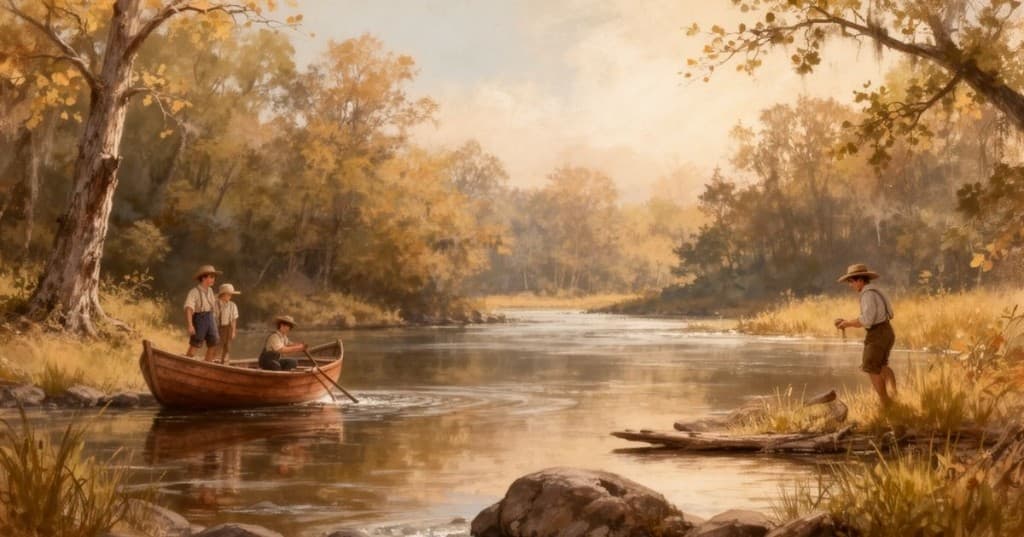
The River as a Temporary Republic
The raft on the Mississippi is the freest space in the novel — and also the most fragile one. On the raft, Huck and Jim are neither slave nor property nor ward nor criminal. They are two people afloat together on a river, answerable to its current and each other. Every time the raft touches shore, civilization reasserts itself and freedom collapses.
Twain is making a structural point through this rhythm: freedom is not a destination but a condition that must be actively maintained, and the forces that erode it are relentless. The Duke and King board the raft and compromise everything. The shores are always full of feuds, cons, and slave hunters. The river itself pushes south, toward slave territory, rather than north, toward freedom. The geography is not neutral.
What the novel teaches about freedom, chapter by chapter, is that it comes in at least three distinct forms: freedom from (constraint, authority, harm), freedom to (think, feel, act, wander), and freedom for (Jim's family, Huck's self-determination, the life waiting in the territory). All three matter. Knowing the difference between them is the skill.
Chapter-by-Chapter Analysis
Making Your Own Exit
Huck spends weeks planning and executing his escape from Pap's cabin — hauling provisions to the island, cutting the logs, staging a crime scene convincing enough to make people stop looking. He doesn't wait to be rescued. He engineers his own disappearance and paddles into the dark.
“I did wish Tom Sawyer was there, I knowed he would take an interest in this kind of business, and throw in the fancy touches.”
Key Insight
Freedom begins as an act of imagination before it becomes an act of movement. Huck first has to conceive of a world in which he is not where he is — not Pap's prisoner, not the Widow's project — and then build it physically, piece by piece, while pretending nothing is changing. The initial freedom is the cognitive one: the decision that the current situation is not fixed. Everything else follows from that.
The Island Where No One Owns You
Jackson's Island in the days before Jim arrives: Huck sleeps when he wants, eats what he finds, smokes in the sun, watches the river. He is completely alone for the first time in his life, with no one to tell him what to do or be. He describes it as bully. He means it as the highest possible compliment.
“I was boss of it; it all belonged to me, so to say.”
Key Insight
Solitude without threat is a form of freedom most people have very little of. Huck's island days represent something the novel will keep gesturing toward and then interrupting: the state of being accountable to no one except the present moment and your own actual needs. It is temporary — Jim arrives, the adventure begins — but Twain establishes it as the baseline against which every subsequent constraint will be measured.
Curiosity as a Form of Freedom
Huck spots the wrecked steamboat Walter Scott in a storm and insists on boarding it against Jim's better judgment. There are robbers inside. It's dangerous. He goes anyway, driven by the pure engine of wanting to know what's there. Jim thinks he's crazy. Huck thinks Jim doesn't understand what it is to be curious.
Key Insight
Curiosity is one of the forms freedom takes in the mind. Huck's insistence on boarding the wreck is not recklessness — it is the expression of a mind that refuses to let caution be the final answer. One of the costs of constrained freedom is the death of curiosity: the habituated sense that you do not have the right to investigate, to wonder, to push toward the unknown. Huck still has this, and it costs him sometimes. Twain treats it as a feature.
Freedom Is Not the Same as Safety
The Grangerfords offer Huck a beautiful home — a real family, genuine warmth, fine food, a room of his own. He has more physical comfort than at any point in the novel. When the feud erupts and Buck is killed, Huck runs back to the raft. Freedom has a specific texture, and a gilded cage is still a cage.
Key Insight
Comfort and freedom are not the same thing, and the Grangerford chapters are Twain's clearest illustration of this. The house is everything the raft is not — solid, warm, stable, protected. But it is built on a feud no one can leave and a code no one can question. Huck trades comfort for the raft without apparent regret. The capacity to recognize that the comfortable trap is still a trap is a freedom most people never develop.
Nights on the River
Huck describes floating down the Mississippi at night — the silence, the stars, the occasional lamp-lit shore, the soft splash of the water, him and Jim lying on their backs looking up. These passages are the most purely beautiful writing in the novel. Twain is not describing plot. He is describing freedom as an experience.
“It's lovely to live on a raft. We had the sky, up there, all speckled with stars, and we used to lay on our backs and look up at them.”
Key Insight
Twain's river descriptions are not ornamental. They are the argument. The freedom the raft offers is not the absence of constraint alone — it is the presence of something positive: space, beauty, silence, stars, the sense that the world is large and the night is generous. Freedom is not just what you escape from. It is what you are free to notice, feel, and be when the noise stops. Huck notices it. That noticing is itself a form of freedom.
The Freedom Jim Is Actually Owed
The Duke and King sell Jim back into slavery. Huck has to decide whether to help Jim escape again — at enormous personal risk — even though Jim was never free in the first place. The chapter forces the question the whole novel has been building toward: what kind of freedom matters, for whom, and at what price.
“All right, then, I'll go to hell.”
Key Insight
Jim's freedom is the moral center of the entire freedom theme. All of Huck's freedom — on the island, on the river, at night under the stars — is chosen freedom, the freedom of a person who has other options. Jim has no other options. His freedom is a matter of survival, family, and basic human dignity. Twain places Huck's crisis at exactly this point to argue that freedom is meaningless as a value if it is only valued for yourself.
When the Romantic Plan Costs Real Freedom
Tom's elaborate escape plan is in motion. It goes wrong. Tom gets shot. Jim stays to help him. The freedom Jim was days away from — legal freedom, Miss Watson having freed him in her will — is delayed and nearly destroyed by Tom's insistence on doing things romantically rather than practically.
Key Insight
Tom Sawyer's plan is the novel's warning about mistaking the performance of freedom for freedom itself. He wants the adventure, the drama, the story he can tell. Jim wants to not be enslaved. These are not the same desire. The chapter teaches that freedom talk without genuine commitment to actual freedom for actual people is worse than useless — it is actively harmful. The romantic vision of freedom costs Jim almost everything.
The Territory as Possibility
The novel ends with Huck announcing he is going to head to the Territory — the unsettled West, beyond the reach of the institutions that have been trying to claim him throughout the book. He is not running from something. He is running toward the possibility of a life not yet defined.
“I reckon I got to light out for the Territory ahead of the rest.”
Key Insight
The territory is not utopia — Twain knew better. It is the space of possibility, the horizon not yet colonized by the institutions that failed in the novel. The final freedom Huck chooses is not the freedom of the raft, which is mobile but still in the world. It is the freedom of the not-yet: the refusal to have the rest of his life organized by the institutions he has watched fail, combined with the belief that somewhere ahead there is space to figure out who he actually is. That combination — refusal and belief together — is what Twain means by freedom in the end.
Applying This to Your Life
Know the Difference Between Freedom From and Freedom To
Most people think of freedom as escaping from something — the bad job, the bad relationship, the situation that constrains them. Huck does this too, and it works, temporarily. But the novel keeps asking what Huck is free to do once he's free from Pap. The nights on the raft are the answer — and they are not about accomplishment. They are about presence, attention, being in the world without being owned by it. The freedom to notice, to feel, to just be somewhere without agenda is the freedom most worth protecting.
Comfort Is Not Freedom
The Grangerford house is more comfortable than the raft in every measurable way. It is also a trap that kills its inhabitants. The comforts that constrain you — the job you hate but can't leave because of the salary, the relationship that suffocates you because the alternative feels frightening — are offering exactly what the Grangerford house offers: security in exchange for the freedom you were trying to protect. The exchange is real. Twain's argument is that most people make it without fully understanding what they are trading away.
Your Freedom and Someone Else's Are Not Separate Questions
Huck's freedom on the raft is inseparable from Jim's. They are sharing the same space, the same sky, the same danger. When the Duke and King sell Jim, they don't just destroy Jim's freedom — they destroy the raft's. Twain is arguing, through the whole structure of the novel, that freedom as a private possession — secured for yourself and not extended to others — is not really freedom at all. It is just a more comfortable form of captivity. The territory Huck is heading for at the end only means something if Jim can get there too.
The Central Lesson
The most beautiful writing in Huckleberry Finn describes the river at night — the stars, the silence, the two figures on the raft lying on their backs looking up. Twain gives this beauty to a boy who has escaped abuse and a man escaping slavery. The freedom they share is real and fragile and earned. The lesson is not that freedom is easy or permanent or guaranteed. It is that it is worth everything — worth the risk, worth the moral cost, worth going to hell for. And that the only way to really have it is to extend it to everyone who deserves it, which is everyone.
Related Themes in Huckleberry Finn
Trusting Your Conscience
Following your moral instincts when society says you're wrong
Questioning Authority
Developing the courage to challenge rules that cause harm
Building Authentic Friendships
Forming genuine connections that transcend social boundaries
Navigating Moral Complexity
Making hard choices when there is no clean right answer