
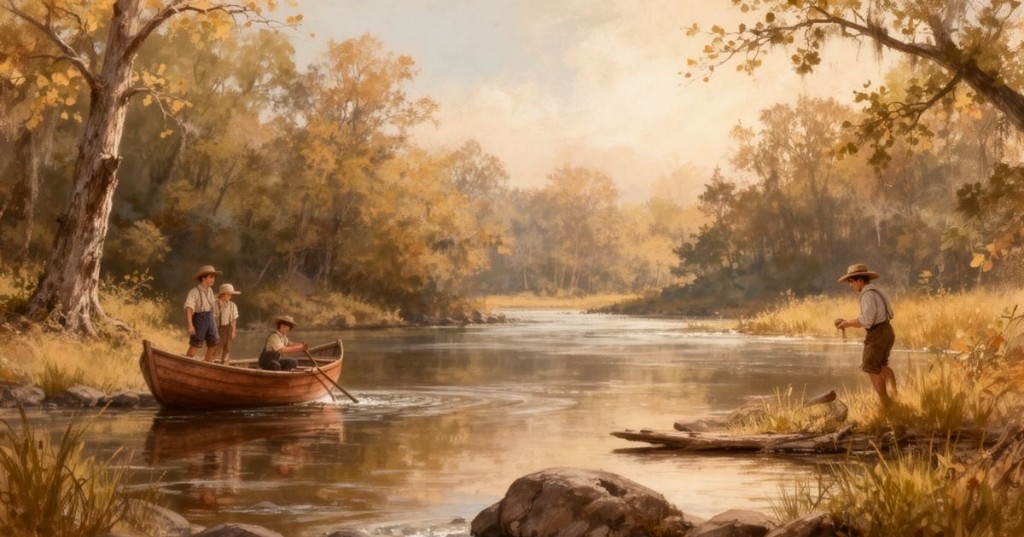
An excerpt from the original text.(complete · 2280 words)
ver the river a-fishing, with a lunch, and had a good time, and took a
look at the raft and found her all right, and got home late to supper,
and found them in such a sweat and worry they didn’t know which end
they was standing on, and made us go right off to bed the minute we was
done supper, and wouldn’t tell us what the trouble was, and never let
on a word about the new letter, but didn’t need to, because we knowed
as much about it as anybody did, and as soon as we was half up stairs
and her back was turned we slid for the cellar cupboard and loaded up a
good lunch and took it up to our room and went to bed, and got up about
half-past eleven, and Tom put on Aunt Sally’s dress that he stole and
was going to start with the lunch, but says:
“Where’s the butter?”
“I laid out a hunk of it,” I says, “on a piece of a corn-pone.”
“Well, you left it laid out, then—it ain’t here.”
“We can get along without it,” I says.
“We can get along with it, too,” he says; “just you slide down cellar
and fetch it. And then mosey right down the lightning-rod and come
along. I’ll go and stuff the straw into Jim’s clothes to represent his
mother in disguise, and be ready to ba like a sheep and shove soon
as you get there.”
So out he went, and down cellar went I. The hunk of butter, big as a
person’s fist, was where I had left it, so I took up the slab of
corn-pone with it on, and blowed out my light, and started up stairs
very stealthy, and got up to the main floor all right, but here comes
Aunt Sally with a candle, and I clapped the truck in my hat, and
clapped my hat on my head, and the next second she see me; and she
says:
“You been down cellar?”
“Yes’m.”
“What you been doing down there?”
“Noth’n.”
“Noth’n!”
“No’m.”
“Well, then, what possessed you to go down there this time of night?”
“I don’t know ’m.”
“You don’t know? Don’t answer me that way. Tom, I want to know what
you been doing down there.”
“I hain’t been doing a single thing, Aunt Sally, I hope to gracious if
I have.”
I reckoned she’d let me go now, and as a generl thing she would; but I
s’pose there was so many strange things going on she was just in a
sweat about every little thing that warn’t yard-stick straight; so she
says, very decided:
“You just march into that setting-room and stay there till I come. You
been up to something you no business to, and I lay I’ll find out what
it is before I’m done with you.”
So she went away as I opened the door and walked into the setting-room.
My, but there was a crowd there! Fifteen farmers, and every one of them
had a gun. I was most powerful sick, and slunk to a chair and set down.
They was setting around, some of them talking a little, in a low voice,
and all of them fidgety and uneasy, but trying to look like they
warn’t; but I knowed they was, because they was always taking off their
hats, and putting them on, and scratching their heads, and changing
their seats, and fumbling with their buttons. I warn’t easy myself, but
I didn’t take my hat off, all the same.
I did wish Aunt Sally would come, and get done with me, and lick me, if
she wanted to, and let me get away and tell Tom how we’d overdone this
thing, and what a thundering hornet’s-nest we’d got ourselves into, so
we could stop fooling around straight off, and clear out with Jim
before these rips got out of patience and come for us.
At last she come and begun to ask me questions, but I couldn’t answer
them straight, I didn’t know which end of me was up; because these men
was in such a fidget now that some was wanting to start right now and
lay for them desperadoes, and saying it warn’t but a few minutes to
midnight; and others was trying to get them to hold on and wait for the
sheep-signal; and here was Aunty pegging away at the questions, and me
a-shaking all over and ready to sink down in my tracks I was that
scared; and the place getting hotter and hotter, and the butter
beginning to melt and run down my neck and behind my ears; and pretty
soon, when one of them says, “I’m for going and getting in the cabin
first and right now, and catching them when they come,” I most
dropped; and a streak of butter come a-trickling down my forehead, and
Aunt Sally she see it, and turns white as a sheet, and says:
“For the land’s sake, what is the matter with the child? He’s got the
brain-fever as shore as you’re born, and they’re oozing out!”
And everybody runs to see, and she snatches off my hat, and out comes
the bread and what was left of the butter, and she grabbed me, and
hugged me, and says:
“Oh, what a turn you did give me! and how glad and grateful I am it
ain’t no worse; for luck’s against us, and it never rains but it pours,
and when I see that truck I thought we’d lost you, for I knowed by the
color and all it was just like your brains would be if—Dear, dear,
whyd’nt you tell me that was what you’d been down there for, I
wouldn’t a cared. Now cler out to bed, and don’t lemme see no more of
you till morning!”
I was up stairs in a second, and down the lightning-rod in another one,
and shinning through the dark for the lean-to. I couldn’t hardly get my
words out, I was so anxious; but I told Tom as quick as I could we must
jump for it now, and not a minute to lose—the house full of men,
yonder, with guns!
His eyes just blazed; and he says:
“No!—is that so? Ain’t it bully! Why, Huck, if it was to do over
again, I bet I could fetch two hundred! If we could put it off till—”
“Hurry! hurry!” I says. “Where’s Jim?”
“Right at your elbow; if you reach out your arm you can touch him. He’s
dressed, and everything’s ready. Now we’ll slide out and give the
sheep-signal.”
But then we heard the tramp of men coming to the door, and heard them
begin to fumble with the pad-lock, and heard a man say:
“I told you we’d be too soon; they haven’t come—the door is locked.
Here, I’ll lock some of you into the cabin, and you lay for ’em in the
dark and kill ’em when they come; and the rest scatter around a piece,
and listen if you can hear ’em coming.”
So in they come, but couldn’t see us in the dark, and most trod on us
whilst we was hustling to get under the bed. But we got under all
right, and out through the hole, swift but soft—Jim first, me next, and
Tom last, which was according to Tom’s orders. Now we was in the
lean-to, and heard trampings close by outside. So we crept to the door,
and Tom stopped us there and put his eye to the crack, but couldn’t
make out nothing, it was so dark; and whispered and said he would
listen for the steps to get further, and when he nudged us Jim must
glide out first, and him last. So he set his ear to the crack and
listened, and listened, and listened, and the steps a-scraping around
out there all the time; and at last he nudged us, and we slid out, and
stooped down, not breathing, and not making the least noise, and
slipped stealthy towards the fence in Injun file, and got to it all
right, and me and Jim over it; but Tom’s britches catched fast on a
splinter on the top rail, and then he hear the steps coming, so he had
to pull loose, which snapped the splinter and made a noise; and as he
dropped in our tracks and started somebody sings out:
“Who’s that? Answer, or I’ll shoot!”
But we didn’t answer; we just unfurled our heels and shoved. Then there
was a rush, and a bang, bang, bang! and the bullets fairly whizzed
around us! We heard them sing out:
“Here they are! They’ve broke for the river! After ’em, boys, and turn
loose the dogs!”
So here they come, full tilt. We could hear them because they wore
boots and yelled, but we didn’t wear no boots and didn’t yell. We was
in the path to the mill; and when they got pretty close on to us we
dodged into the bush and let them go by, and then dropped in behind
them. They’d had all the dogs shut up, so they wouldn’t scare off the
robbers; but by this time somebody had let them loose, and here they
come, making powwow enough for a million; but they was our dogs; so we
stopped in our tracks till they catched up; and when they see it warn’t
nobody but us, and no excitement to offer them, they only just said
howdy, and tore right ahead towards the shouting and clattering; and
then we up-steam again, and whizzed along after them till we was nearly
to the mill, and then struck up through the bush to where my canoe was
tied, and hopped in and pulled for dear life towards the middle of the
river, but didn’t make no more noise than we was obleeged to. Then we
struck out, easy and comfortable, for the island where my raft was; and
we could hear them yelling and barking at each other all up and down
the bank, till we was so far away the sounds got dim and died out. And
when we stepped onto the raft I says:
“Now, old Jim, you’re a free man again, and I bet you won’t ever be
a slave no more.”
“En a mighty good job it wuz, too, Huck. It ’uz planned beautiful, en
it ’uz done beautiful; en dey ain’t nobody kin git up a plan dat’s
mo’ mixed-up en splendid den what dat one wuz.”
We was all glad as we could be, but Tom was the gladdest of all because
he had a bullet in the calf of his leg.
When me and Jim heard that we didn’t feel so brash as what we did
before. It was hurting him considerable, and bleeding; so we laid him
in the wigwam and tore up one of the duke’s shirts for to bandage him,
but he says:
“Gimme the rags; I can do it myself. Don’t stop now; don’t fool around
here, and the evasion booming along so handsome; man the sweeps, and
set her loose! Boys, we done it elegant!—’deed we did. I wish we’d a
had the handling of Louis XVI., there wouldn’t a been no ‘Son of Saint
Louis, ascend to heaven!’ wrote down in his biography; no, sir, we’d
a whooped him over the border—that’s what we’d a done with him—and
done it just as slick as nothing at all, too. Man the sweeps—man the
sweeps!”
But me and Jim was consulting—and thinking. And after we’d thought a
minute, I says:
“Say it, Jim.”
So he says:
“Well, den, dis is de way it look to me, Huck. Ef it wuz him dat ’uz
bein’ sot free, en one er de boys wuz to git shot, would he say, ‘Go on
en save me, nemmine ’bout a doctor f’r to save dis one?’ Is dat like
Mars Tom Sawyer? Would he say dat? You bet he wouldn’t! Well, den,
is Jim gywne to say it? No, sah—I doan’ budge a step out’n dis place
’dout a doctor; not if it’s forty year!”
I knowed he was white inside, and I reckoned he’d say what he did
say—so it was all right now, and I told Tom I was a-going for a doctor.
He raised considerable row about it, but me and Jim stuck to it and
wouldn’t budge; so he was for crawling out and setting the raft loose
himself; but we wouldn’t let him. Then he give us a piece of his mind,
but it didn’t do no good.
So when he sees me getting the canoe ready, he says:
“Well, then, if you’re bound to go, I’ll tell you the way to do when
you get to the village. Shut the door and blindfold the doctor tight
and fast, and make him swear to be silent as the grave, and put a purse
full of gold in his hand, and then take and lead him all around the
back alleys and everywheres in the dark, and then fetch him here in the
canoe, in a roundabout way amongst the islands, and search him and take
his chalk away from him, and don’t give it back to him till you get him
back to the village, or else he will chalk this raft so he can find it
again. It’s the way they all do.”
So I said I would, and left, and Jim was to hide in the woods when he
see the doctor coming till he was gone again.
Master this chapter. Complete your experience
Purchase the complete book to access all chapters and support classic literature
As an Amazon Associate, we earn a small commission from qualifying purchases at no additional cost to you.
Available in paperback, hardcover, and e-book formats
Let's Analyse the Pattern
The Reality Check - When Games Meet Consequences
The moment when theoretical plans meet actual consequences, revealing true character and forcing authentic decisions.
Why This Matters
Connect literature to life
This chapter teaches how to recognize when someone is treating your serious situation as their entertainment versus who will sacrifice for you when it matters.
Practice This Today
This week, notice when someone makes your problem more complicated than it needs to be - ask yourself if they're helping you or entertaining themselves with your situation.
Now let's explore the literary elements.
Key Quotes & Analysis
"I knowed he was white inside"
Context: The doctor speaks admiringly of Jim's character after Jim helps care for Tom
This backhanded compliment reveals how racism works - the doctor can only praise Jim's goodness by comparing him to white people, showing how prejudice blinds people to others' humanity.
In Today's Words:
He's one of the good ones
"I never see a nigger that was a better nuss or faithfuller"
Context: Describing Jim's care for wounded Tom to the other adults
The doctor recognizes Jim's exceptional character but can't escape the racist language and assumptions of his time. His praise is real but limited by his prejudices.
In Today's Words:
I've never seen anyone take better care of a patient
"Well, then, if that's the way it feels to you, it's all right with me"
Context: When Jim decides to stay and help Tom instead of escaping
Huck respects Jim's decision even though he doesn't fully understand it. This shows Huck's growing ability to see Jim as a person who can make his own choices.
In Today's Words:
If that's what you think is right, I'll support you
Thematic Threads
Class
In This Chapter
Tom's privileged perspective treats serious situations like entertainment while Jim faces life-or-death stakes
Development
Evolved from earlier class tensions to show how privilege can blind people to real consequences
In Your Life:
You might see this when well-meaning people with security offer advice about risks they'll never face themselves
Identity
In This Chapter
Crisis forces each character to act from their core self rather than playing roles
Development
Culmination of Huck's growth - he chooses practical help over social expectations
In Your Life:
You discover who you really are not in calm moments but when pressure forces authentic choices
Human Relationships
In This Chapter
Jim's sacrifice for Tom reveals the depth of his humanity and moral strength
Development
Builds on growing bond between Huck and Jim to show Jim's ultimate nobility
In Your Life:
You might find that the people who truly care for you are the ones willing to sacrifice when you're vulnerable
Personal Growth
In This Chapter
Huck learns to trust his practical instincts over elaborate schemes when stakes are real
Development
Major turning point - Huck stops deferring to Tom's authority when consequences become serious
In Your Life:
You grow when you stop letting others overcomplicate situations you understand better than they do
Social Expectations
In This Chapter
Adventure story expectations collapse when faced with actual blood and real danger
Development
Exposes how romantic notions about heroism fail in real crisis situations
In Your Life:
You might realize that doing the right thing often looks nothing like what movies and stories suggest
You now have the context. Time to form your own thoughts.
Discussion Questions
- 1
What happens when Tom gets shot, and how does each character react differently to the crisis?
analysis • surface - 2
Why does Jim choose to stay with wounded Tom instead of escaping to freedom, and what does this reveal about his character?
analysis • medium - 3
Where have you seen people's true priorities emerge when a situation stopped being theoretical and became real?
application • medium - 4
How would you handle being caught between loyalty to a friend and doing what's practically smart in a crisis?
application • deep - 5
What does Jim's sacrifice teach us about the difference between playing at nobility and actually being noble?
reflection • deep
Critical Thinking Exercise
Reality Check Your Own Plans
Think of a current plan or goal you have that feels exciting or important to you. Now imagine something goes seriously wrong - you get injured, lose your job, or face a family crisis. Write down what parts of your plan would still matter and what parts would suddenly seem unimportant. What would you actually do versus what you like to imagine you'd do?
Consider:
- •Are you making things more complicated than they need to be, like Tom did?
- •Who in your life would sacrifice for you the way Jim sacrificed for Tom?
- •What simple, direct approach might work better than your elaborate plan?
Journaling Prompt
Write about a time when a crisis revealed what really mattered to you, or when you had to choose between what looked good and what was actually right.
Coming Up Next...
Chapter 41
With Tom wounded and Jim recaptured, the adventure takes a serious turn toward real consequences. Huck faces some hard truths about friendship, loyalty, and what really matters when the games are over.



