
Themes in This Book
Click a theme to find more books with similar topics
What to expect ahead
What follows is a compact summary of each chapter in the book, designed to help you quickly grasp the core ideas while inviting you to continue into the full original text. Even when chapter text is presented here, these summaries are meant as a gateway to understanding, so your eventual reading of the complete book feels richer, deeper, and more fully appreciated.
Adventures of Huckleberry Finn
A Brief Description
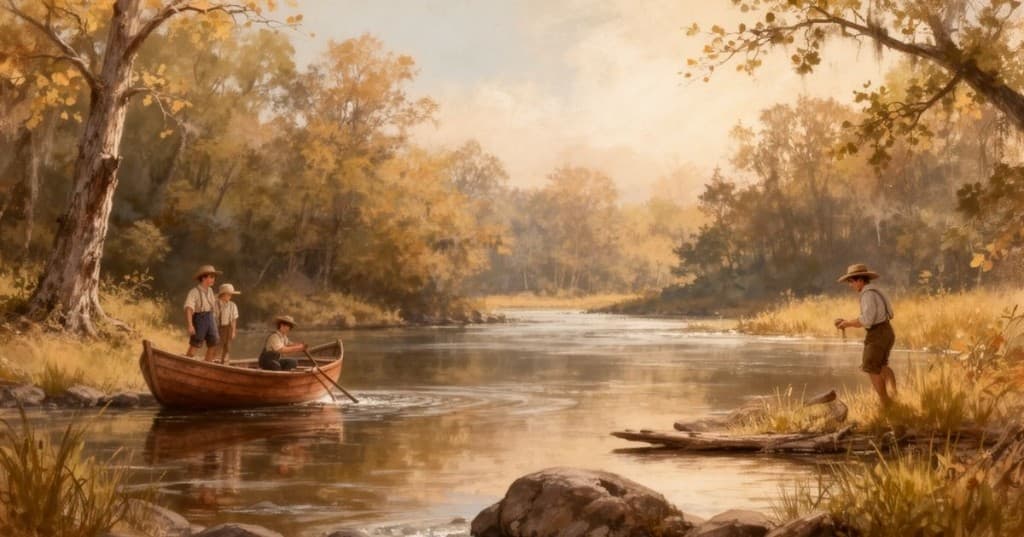
Adventures of Huckleberry Finn picks up where Tom Sawyer left off — but the tone could not be more different. Huck Finn, the boy who slept in barrels and answered to no one, is living with the Widow Douglas, who is trying to civilize him. When his violent father reappears, Huck fakes his own death and escapes down the Mississippi. On a nearby island he finds Jim, an enslaved man who has run away to avoid being sold downriver. The two set off on a raft, bound for the free states.
The river becomes their world. They fish, talk, and hide by day, drifting at night. They run into con men, feuding families, and the brutal reality of a society that treats Jim as property and Huck as an outlaw for helping him.
Twain’s novel is narrated in Huck’s own voice — uneducated, literal, and morally confused in exactly the right ways. He has been taught that helping an enslaved person escape is a sin. He also likes Jim, trusts him, and owes him his life. The central crisis of the book is Huck’s decision to tear up the letter that would turn Jim in, and to choose instead to help his friend — even if it means damning himself. “All right, then, I’ll go to hell,” he says. Twain never preaches. He lets Huck’s conscience collide with the world’s rules and shows which one wins.
What makes the novel endure is the question it never stops asking: when the law says one thing and your experience of another person says something else entirely, which do you follow? Huckleberry Finn is set inside a slave society, and Twain’s satire targets the whole system. But at its heart is one boy’s discovery that doing right and being told you’re right are not the same thing.
Essential Life Skills Deep Dive
Explore chapter-by-chapter breakdowns of the essential life skills taught in this classic novel.
Trusting Your Conscience
8 chapters tracking Huck's journey from a boy who does what he's told to one who chooses hell over betraying a friend — and what that arc teaches about moral courage.
Recognizing Hypocrisy
8 chapters showing how Twain trained Huck — and through Huck, the reader — to see the gap between what respectable people say and what they actually do.
Building Authentic Friendships
8 chapters charting the growth of the most important friendship in American literature — and what Huck and Jim's bond teaches about genuine connection across difference.
Questioning Authority
8 chapters tracking how Huck navigates every authority that tries to claim him — church, law, family, culture — and what he keeps and discards from each.
Finding Freedom
8 chapters exploring what Huck and Jim are actually seeking on the river — and what Twain teaches about the difference between escaping a cage and true liberation.
Navigating Moral Complexity
8 chapters presenting the hardest choices in Huck's journey — where the rules say one thing, the heart says another, and there is no clean way to be right by every standard.
Essential Skills
Life skills and patterns this book helps you develop—drawn from its themes and characters.
Trusting Your Conscience
Learn to follow your moral instincts even when society tells you you're wrong
Recognizing Hypocrisy
See through the gap between what people preach and how they actually behave
Building Authentic Friendships
Form genuine connections that transcend social boundaries and expectations
Questioning Authority
Develop the courage to challenge rules and beliefs when they cause harm
Finding Freedom
Understand what true freedom means beyond just escaping physical constraints
Navigating Moral Complexity
Make difficult choices when the 'right' answer isn't clear or easy
Table of Contents
Huck Finn introduces himself as the troublemaker from Tom Sawyer's ...
Huck gets swept into Tom Sawyer's world of elaborate make-believe w...
Huck gets a harsh reality check about the difference between book l...
Huck returns to his room to find Pap waiting for him - drunk, angry...
Huck's abusive father Pap returns to town, drunk and demanding the ...
Huck's father, known as Pap, returns to town after hearing about Hu...
Huck stages his own death to escape Pap's abuse and control
Huck wakes up alone on Jackson's Island and discovers Jim, Miss Wat...
Huck and Jim find themselves caught in a dangerous thunderstorm whi...
Huck and Jim settle into life on the raft, and Huck decides to test...
Huck disguises himself as a girl and visits a newcomer to town, Mrs
About Mark Twain
Published 1884
Mark Twain (1835-1910), born Samuel Clemens, was an American writer, humorist, and lecturer. His experiences as a steamboat pilot on the Mississippi River deeply influenced his work. Called 'the father of American literature' by William Faulkner, Twain used humor and satire to expose the hypocrisy of American society, particularly regarding race and class.
Why This Author Matters Today
Mark Twain's insights into human nature, social constraints, and the search for authenticity remain powerfully relevant. Their work helps us understand the timeless tensions between individual desire and social expectation, making them an essential guide for navigating modern life's complexities.
More by Mark Twain in Our Library

Amplified Classics is different.
not a sparknotes, nor a cliffnotes
This is a retelling. The story is still told—completely. You walk with the characters, feel what they feel, discover what they discover. The meaning arrives because you experienced it, not because someone explained a summary.
Read this, then read the original. The prose will illuminate—you'll notice what makes the author that author, because you're no longer fighting to follow the story.
Read the original first, then read this. Something will click. You'll want to go back.
Either way, the door opens inward.
Get the Full Book
Purchase the complete book to access all chapters and support classic literature
As an Amazon Associate, we earn a small commission from qualifying purchases at no additional cost to you.
Available in paperback, hardcover, and e-book formats
You Might Also Like




Free to read • No account required