
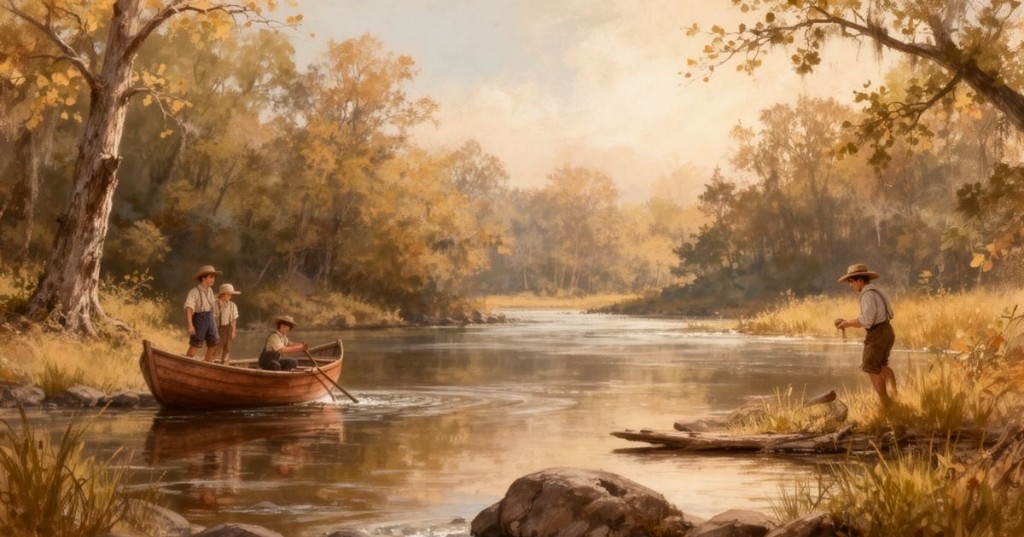
An excerpt from the original text.(complete · 4482 words)
’clock. I laid there in the grass and the cool shade thinking about
things, and feeling rested and ruther comfortable and satisfied. I
could see the sun out at one or two holes, but mostly it was big trees
all about, and gloomy in there amongst them. There was freckled places
on the ground where the light sifted down through the leaves, and the
freckled places swapped about a little, showing there was a little
breeze up there. A couple of squirrels set on a limb and jabbered at me
very friendly.
I was powerful lazy and comfortable—didn’t want to get up and cook
breakfast. Well, I was dozing off again when I thinks I hears a deep
sound of “boom!” away up the river. I rouses up, and rests on my elbow
and listens; pretty soon I hears it again. I hopped up, and went and
looked out at a hole in the leaves, and I see a bunch of smoke laying
on the water a long ways up—about abreast the ferry. And there was the
ferry-boat full of people floating along down. I knowed what was the
matter now. “Boom!” I see the white smoke squirt out of the ferry-boat’s
side. You see, they was firing cannon over the water, trying to make my
carcass come to the top.
I was pretty hungry, but it warn’t going to do for me to start a fire,
because they might see the smoke. So I set there and watched the
cannon-smoke and listened to the boom. The river was a mile wide there,
and it always looks pretty on a summer morning—so I was having a good
enough time seeing them hunt for my remainders if I only had a bite to
eat. Well, then I happened to think how they always put quicksilver in
loaves of bread and float them off, because they always go right to the
drownded carcass and stop there. So, says I, I’ll keep a lookout, and
if any of them’s floating around after me I’ll give them a show. I
changed to the Illinois edge of the island to see what luck I could
have, and I warn’t disappointed. A big double loaf come along, and I
most got it with a long stick, but my foot slipped and she floated out
further. Of course I was where the current set in the closest to the
shore—I knowed enough for that. But by-and-by along comes another one,
and this time I won. I took out the plug and shook out the little dab
of quicksilver, and set my teeth in. It was “baker’s bread”—what the
quality eat; none of your low-down corn-pone.
I got a good place amongst the leaves, and set there on a log, munching
the bread and watching the ferry-boat, and very well satisfied. And
then something struck me. I says, now I reckon the widow or the parson
or somebody prayed that this bread would find me, and here it has gone
and done it. So there ain’t no doubt but there is something in that
thing—that is, there’s something in it when a body like the widow or
the parson prays, but it don’t work for me, and I reckon it don’t work
for only just the right kind.
I lit a pipe and had a good long smoke, and went on watching. The
ferry-boat was floating with the current, and I allowed I’d have a
chance to see who was aboard when she come along, because she would
come in close, where the bread did. When she’d got pretty well along
down towards me, I put out my pipe and went to where I fished out the
bread, and laid down behind a log on the bank in a little open place.
Where the log forked I could peep through.
By-and-by she come along, and she drifted in so close that they could a
run out a plank and walked ashore. Most everybody was on the boat. Pap,
and Judge Thatcher, and Bessie Thatcher, and Jo Harper, and Tom Sawyer,
and his old Aunt Polly, and Sid and Mary, and plenty more. Everybody
was talking about the murder, but the captain broke in and says:
“Look sharp, now; the current sets in the closest here, and maybe he’s
washed ashore and got tangled amongst the brush at the water’s edge. I
hope so, anyway.”
I didn’t hope so. They all crowded up and leaned over the rails, nearly
in my face, and kept still, watching with all their might. I could see
them first-rate, but they couldn’t see me. Then the captain sung out:
“Stand away!” and the cannon let off such a blast right before me that
it made me deef with the noise and pretty near blind with the smoke,
and I judged I was gone. If they’d a had some bullets in, I reckon
they’d a got the corpse they was after. Well, I see I warn’t hurt,
thanks to goodness. The boat floated on and went out of sight around
the shoulder of the island. I could hear the booming now and then,
further and further off, and by-and-by, after an hour, I didn’t hear it
no more. The island was three mile long. I judged they had got to the
foot, and was giving it up. But they didn’t yet a while. They turned
around the foot of the island and started up the channel on the
Missouri side, under steam, and booming once in a while as they went. I
crossed over to that side and watched them. When they got abreast the
head of the island they quit shooting and dropped over to the Missouri
shore and went home to the town.
I knowed I was all right now. Nobody else would come a-hunting after
me. I got my traps out of the canoe and made me a nice camp in the
thick woods. I made a kind of a tent out of my blankets to put my
things under so the rain couldn’t get at them. I catched a catfish and
haggled him open with my saw, and towards sundown I started my camp
fire and had supper. Then I set out a line to catch some fish for
breakfast.
When it was dark I set by my camp fire smoking, and feeling pretty well
satisfied; but by-and-by it got sort of lonesome, and so I went and set
on the bank and listened to the current swashing along, and counted the
stars and drift logs and rafts that come down, and then went to bed;
there ain’t no better way to put in time when you are lonesome; you
can’t stay so, you soon get over it.
And so for three days and nights. No difference—just the same thing.
But the next day I went exploring around down through the island. I was
boss of it; it all belonged to me, so to say, and I wanted to know all
about it; but mainly I wanted to put in the time. I found plenty
strawberries, ripe and prime; and green summer grapes, and green
razberries; and the green blackberries was just beginning to show. They
would all come handy by-and-by, I judged.
Well, I went fooling along in the deep woods till I judged I warn’t far
from the foot of the island. I had my gun along, but I hadn’t shot
nothing; it was for protection; thought I would kill some game nigh
home. About this time I mighty near stepped on a good-sized snake, and
it went sliding off through the grass and flowers, and I after it,
trying to get a shot at it. I clipped along, and all of a sudden I
bounded right on to the ashes of a camp fire that was still smoking.
My heart jumped up amongst my lungs. I never waited for to look
further, but uncocked my gun and went sneaking back on my tiptoes as
fast as ever I could. Every now and then I stopped a second amongst the
thick leaves and listened, but my breath come so hard I couldn’t hear
nothing else. I slunk along another piece further, then listened again;
and so on, and so on. If I see a stump, I took it for a man; if I trod
on a stick and broke it, it made me feel like a person had cut one of
my breaths in two and I only got half, and the short half, too.
When I got to camp I warn’t feeling very brash, there warn’t much sand
in my craw; but I says, this ain’t no time to be fooling around. So I
got all my traps into my canoe again so as to have them out of sight,
and I put out the fire and scattered the ashes around to look like an
old last year’s camp, and then clumb a tree.
I reckon I was up in the tree two hours; but I didn’t see nothing, I
didn’t hear nothing—I only thought I heard and seen as much as a
thousand things. Well, I couldn’t stay up there forever; so at last I
got down, but I kept in the thick woods and on the lookout all the
time. All I could get to eat was berries and what was left over from
breakfast.
By the time it was night I was pretty hungry. So when it was good and
dark I slid out from shore before moonrise and paddled over to the
Illinois bank—about a quarter of a mile. I went out in the woods and
cooked a supper, and I had about made up my mind I would stay there all
night when I hear a plunkety-plunk, plunkety-plunk, and says to
myself, horses coming; and next I hear people’s voices. I got
everything into the canoe as quick as I could, and then went creeping
through the woods to see what I could find out. I hadn’t got far when I
hear a man say:
“We better camp here if we can find a good place; the horses is about
beat out. Let’s look around.”
I didn’t wait, but shoved out and paddled away easy. I tied up in the
old place, and reckoned I would sleep in the canoe.
I didn’t sleep much. I couldn’t, somehow, for thinking. And every time
I waked up I thought somebody had me by the neck. So the sleep didn’t
do me no good. By-and-by I says to myself, I can’t live this way; I’m
a-going to find out who it is that’s here on the island with me; I’ll
find it out or bust. Well, I felt better right off.
So I took my paddle and slid out from shore just a step or two, and
then let the canoe drop along down amongst the shadows. The moon was
shining, and outside of the shadows it made it most as light as day. I
poked along well on to an hour, everything still as rocks and sound
asleep. Well, by this time I was most down to the foot of the island. A
little ripply, cool breeze begun to blow, and that was as good as
saying the night was about done. I give her a turn with the paddle and
brung her nose to shore; then I got my gun and slipped out and into the
edge of the woods. I sat down there on a log, and looked out through
the leaves. I see the moon go off watch, and the darkness begin to
blanket the river. But in a little while I see a pale streak over the
treetops, and knowed the day was coming. So I took my gun and slipped
off towards where I had run across that camp fire, stopping every
minute or two to listen. But I hadn’t no luck somehow; I couldn’t seem
to find the place. But by-and-by, sure enough, I catched a glimpse of
fire away through the trees. I went for it, cautious and slow.
By-and-by I was close enough to have a look, and there laid a man on
the ground. It most give me the fan-tods. He had a blanket around his
head, and his head was nearly in the fire. I set there behind a clump
of bushes, in about six foot of him, and kept my eyes on him steady. It
was getting gray daylight now. Pretty soon he gapped and stretched
himself and hove off the blanket, and it was Miss Watson’s Jim! I bet I
was glad to see him. I says:
“Hello, Jim!” and skipped out.
He bounced up and stared at me wild. Then he drops down on his knees,
and puts his hands together and says:
“Doan’ hurt me—don’t! I hain’t ever done no harm to a ghos’. I alwuz
liked dead people, en done all I could for ’em. You go en git in de
river agin, whah you b’longs, en doan’ do nuffn to Ole Jim, ’at ’uz
awluz yo’ fren’.”
Well, I warn’t long making him understand I warn’t dead. I was ever so
glad to see Jim. I warn’t lonesome now. I told him I warn’t afraid of
him telling the people where I was. I talked along, but he only set
there and looked at me; never said nothing. Then I says:
“It’s good daylight. Le’s get breakfast. Make up your camp fire good.”
“What’s de use er makin’ up de camp fire to cook strawbries en sich
truck? But you got a gun, hain’t you? Den we kin git sumfn better den
strawbries.”
“Strawberries and such truck,” I says. “Is that what you live on?”
“I couldn’ git nuffn else,” he says.
“Why, how long you been on the island, Jim?”
“I come heah de night arter you’s killed.”
“What, all that time?”
“Yes—indeedy.”
“And ain’t you had nothing but that kind of rubbage to eat?”
“No, sah—nuffn else.”
“Well, you must be most starved, ain’t you?”
“I reck’n I could eat a hoss. I think I could. How long you ben on de
islan’?”
“Since the night I got killed.”
“No! W’y, what has you lived on? But you got a gun. Oh, yes, you got a
gun. Dat’s good. Now you kill sumfn en I’ll make up de fire.”
So we went over to where the canoe was, and while he built a fire in a
grassy open place amongst the trees, I fetched meal and bacon and
coffee, and coffee-pot and frying-pan, and sugar and tin cups, and the
nigger was set back considerable, because he reckoned it was all done
with witchcraft. I catched a good big catfish, too, and Jim cleaned him
with his knife, and fried him.
When breakfast was ready we lolled on the grass and eat it smoking hot.
Jim laid it in with all his might, for he was most about starved. Then
when we had got pretty well stuffed, we laid off and lazied. By-and-by
Jim says:
“But looky here, Huck, who wuz it dat ’uz killed in dat shanty ef it
warn’t you?”
Then I told him the whole thing, and he said it was smart. He said Tom
Sawyer couldn’t get up no better plan than what I had. Then I says:
“How do you come to be here, Jim, and how’d you get here?”
He looked pretty uneasy, and didn’t say nothing for a minute. Then he
says:
“Maybe I better not tell.”
“Why, Jim?”
“Well, dey’s reasons. But you wouldn’ tell on me ef I uz to tell you,
would you, Huck?”
“Blamed if I would, Jim.”
“Well, I b’lieve you, Huck. I—I run off.”
“Jim!”
“But mind, you said you wouldn’ tell—you know you said you wouldn’
tell, Huck.”
“Well, I did. I said I wouldn’t, and I’ll stick to it. Honest injun,
I will. People would call me a low-down Abolitionist and despise me for
keeping mum—but that don’t make no difference. I ain’t a-going to tell,
and I ain’t a-going back there, anyways. So, now, le’s know all about
it.”
“Well, you see, it ’uz dis way. Ole missus—dat’s Miss Watson—she pecks
on me all de time, en treats me pooty rough, but she awluz said she
wouldn’ sell me down to Orleans. But I noticed dey wuz a nigger trader
roun’ de place considable lately, en I begin to git oneasy. Well, one
night I creeps to de do’ pooty late, en de do’ warn’t quite shet, en I
hear old missus tell de widder she gwyne to sell me down to Orleans,
but she didn’ want to, but she could git eight hund’d dollars for me,
en it ’uz sich a big stack o’ money she couldn’ resis’. De widder she
try to git her to say she wouldn’ do it, but I never waited to hear de
res’. I lit out mighty quick, I tell you.
“I tuck out en shin down de hill, en ’spec to steal a skift ’long de
sho’ som’ers ’bove de town, but dey wuz people a-stirring yit, so I hid
in de ole tumble-down cooper-shop on de bank to wait for everybody to
go ’way. Well, I wuz dah all night. Dey wuz somebody roun’ all de time.
’Long ’bout six in de mawnin’ skifts begin to go by, en ’bout eight er
nine every skift dat went ’long wuz talkin’ ’bout how yo’ pap come over
to de town en say you’s killed. Dese las’ skifts wuz full o’ ladies en
genlmen a-goin’ over for to see de place. Sometimes dey’d pull up at de
sho’ en take a res’ b’fo’ dey started acrost, so by de talk I got to
know all ’bout de killin’. I ’uz powerful sorry you’s killed, Huck, but
I ain’t no mo’ now.
“I laid dah under de shavin’s all day. I ’uz hungry, but I warn’t
afeard; bekase I knowed ole missus en de widder wuz goin’ to start to
de camp-meet’n’ right arter breakfas’ en be gone all day, en dey knows
I goes off wid de cattle ’bout daylight, so dey wouldn’ ’spec to see me
roun’ de place, en so dey wouldn’ miss me tell arter dark in de
evenin’. De yuther servants wouldn’ miss me, kase dey’d shin out en
take holiday soon as de ole folks ’uz out’n de way.
“Well, when it come dark I tuck out up de river road, en went ’bout two
mile er more to whah dey warn’t no houses. I’d made up my mine ’bout
what I’s agwyne to do. You see, ef I kep’ on tryin’ to git away afoot,
de dogs ’ud track me; ef I stole a skift to cross over, dey’d miss dat
skift, you see, en dey’d know ’bout whah I’d lan’ on de yuther side, en
whah to pick up my track. So I says, a raff is what I’s arter; it doan’
make no track.
“I see a light a-comin’ roun’ de p’int bymeby, so I wade’ in en shove’
a log ahead o’ me en swum more’n half way acrost de river, en got in
’mongst de drift-wood, en kep’ my head down low, en kinder swum agin de
current tell de raff come along. Den I swum to de stern uv it en tuck
a-holt. It clouded up en ’uz pooty dark for a little while. So I clumb
up en laid down on de planks. De men ’uz all ’way yonder in de middle,
whah de lantern wuz. De river wuz a-risin’, en dey wuz a good current;
so I reck’n’d ’at by fo’ in de mawnin’ I’d be twenty-five mile down de
river, en den I’d slip in jis b’fo’ daylight en swim asho’, en take to
de woods on de Illinois side.
“But I didn’ have no luck. When we ’uz mos’ down to de head er de
islan’ a man begin to come aft wid de lantern, I see it warn’t no use
fer to wait, so I slid overboard en struck out fer de islan’. Well, I
had a notion I could lan’ mos’ anywhers, but I couldn’t—bank too bluff.
I ’uz mos’ to de foot er de islan’ b’fo’ I found’ a good place. I went
into de woods en jedged I wouldn’ fool wid raffs no mo’, long as dey
move de lantern roun’ so. I had my pipe en a plug er dog-leg, en some
matches in my cap, en dey warn’t wet, so I ’uz all right.”
“And so you ain’t had no meat nor bread to eat all this time? Why
didn’t you get mud-turkles?”
“How you gwyne to git ’m? You can’t slip up on um en grab um; en how’s
a body gwyne to hit um wid a rock? How could a body do it in de night?
En I warn’t gwyne to show mysef on de bank in de daytime.”
“Well, that’s so. You’ve had to keep in the woods all the time, of
course. Did you hear ’em shooting the cannon?”
“Oh, yes. I knowed dey was arter you. I see um go by heah—watched um
thoo de bushes.”
Some young birds come along, flying a yard or two at a time and
lighting. Jim said it was a sign it was going to rain. He said it was a
sign when young chickens flew that way, and so he reckoned it was the
same way when young birds done it. I was going to catch some of them,
but Jim wouldn’t let me. He said it was death. He said his father laid
mighty sick once, and some of them catched a bird, and his old granny
said his father would die, and he did.
And Jim said you mustn’t count the things you are going to cook for
dinner, because that would bring bad luck. The same if you shook the
table-cloth after sundown. And he said if a man owned a beehive and
that man died, the bees must be told about it before sun-up next
morning, or else the bees would all weaken down and quit work and die.
Jim said bees wouldn’t sting idiots; but I didn’t believe that, because
I had tried them lots of times myself, and they wouldn’t sting me.
I had heard about some of these things before, but not all of them. Jim
knowed all kinds of signs. He said he knowed most everything. I said it
looked to me like all the signs was about bad luck, and so I asked him
if there warn’t any good-luck signs. He says:
“Mighty few—an’ dey ain’t no use to a body. What you want to know
when good luck’s a-comin’ for? Want to keep it off?” And he said: “Ef
you’s got hairy arms en a hairy breas’, it’s a sign dat you’s agwyne to
be rich. Well, dey’s some use in a sign like dat, ’kase it’s so fur
ahead. You see, maybe you’s got to be po’ a long time fust, en so you
might git discourage’ en kill yo’sef ’f you didn’ know by de sign dat
you gwyne to be rich bymeby.”
“Have you got hairy arms and a hairy breast, Jim?”
“What’s de use to ax dat question? Don’t you see I has?”
“Well, are you rich?”
“No, but I ben rich wunst, and gwyne to be rich agin. Wunst I had
foteen dollars, but I tuck to specalat’n’, en got busted out.”
“What did you speculate in, Jim?”
“Well, fust I tackled stock.”
“What kind of stock?”
“Why, live stock—cattle, you know. I put ten dollars in a cow. But I
ain’ gwyne to resk no mo’ money in stock. De cow up ’n’ died on my
han’s.”
“So you lost the ten dollars.”
“No, I didn’t lose it all. I on’y los’ ’bout nine of it. I sole de hide
en taller for a dollar en ten cents.”
“You had five dollars and ten cents left. Did you speculate any more?”
“Yes. You know that one-laigged nigger dat b’longs to old Misto
Bradish? Well, he sot up a bank, en say anybody dat put in a dollar
would git fo’ dollars mo’ at de en’ er de year. Well, all de niggers
went in, but dey didn’t have much. I wuz de on’y one dat had much. So I
stuck out for mo’ dan fo’ dollars, en I said ’f I didn’ git it I’d
start a bank mysef. Well, o’ course dat nigger want’ to keep me out er
de business, bekase he says dey warn’t business ’nough for two banks,
so he say I could put in my five dollars en he pay me thirty-five at de
en’ er de year.
“So I done it. Den I reck’n’d I’d inves’ de thirty-five dollars right
off en keep things a-movin’. Dey wuz a nigger name’ Bob, dat had
ketched a wood-flat, en his marster didn’ know it; en I bought it off’n
him en told him to take de thirty-five dollars when de en’ er de year
come; but somebody stole de wood-flat dat night, en nex day de
one-laigged nigger say de bank’s busted. So dey didn’ none uv us git no
money.”
“What did you do with the ten cents, Jim?”
“Well, I ’uz gwyne to spen’ it, but I had a dream, en de dream tole me
to give it to a nigger name’ Balum—Balum’s Ass dey call him for short;
he’s one er dem chuckleheads, you know. But he’s lucky, dey say, en I
see I warn’t lucky. De dream say let Balum inves’ de ten cents en he’d
make a raise for me. Well, Balum he tuck de money, en when he wuz in
church he hear de preacher say dat whoever give to de po’ len’ to de
Lord, en boun’ to git his money back a hund’d times. So Balum he tuck
en give de ten cents to de po’, en laid low to see what wuz gwyne to
come of it.”
“Well, what did come of it, Jim?”
“Nuffn never come of it. I couldn’ manage to k’leck dat money no way;
en Balum he couldn’. I ain’ gwyne to len’ no mo’ money ’dout I see de
security. Boun’ to git yo’ money back a hund’d times, de preacher says!
Ef I could git de ten cents back, I’d call it squah, en be glad er de
chanst.”
“Well, it’s all right anyway, Jim, long as you’re going to be rich
again some time or other.”
“Yes; en I’s rich now, come to look at it. I owns mysef, en I’s wuth
eight hund’d dollars. I wisht I had de money, I wouldn’ want no mo’.”
Master this chapter. Complete your experience
Purchase the complete book to access all chapters and support classic literature
As an Amazon Associate, we earn a small commission from qualifying purchases at no additional cost to you.
Available in paperback, hardcover, and e-book formats
Let's Analyse the Pattern
Real human connection forms when people drop their social masks and acknowledge their shared struggles and fears.
Why This Matters
Connect literature to life
This chapter teaches how to see past society's categories to recognize the person underneath the stereotype.
Practice This Today
This week, notice when you catch yourself believing a label about someone—then ask what struggle might be hidden behind their situation.
Now let's explore the literary elements.
Key Quotes & Analysis
"I was powerful glad to get away from the feuds, and so was Jim to get away from the swamp."
Context: Both characters reflecting on escaping their previous dangerous situations
Shows how both Huck and Jim are refugees from different forms of violence - family dysfunction and slavery. Their shared relief creates the foundation for understanding each other as fellow human beings in trouble.
In Today's Words:
We were both just relieved to get away from all that drama and danger.
"I was ever so glad to see Jim. I warn't lonesome now."
Context: When Huck first discovers Jim hiding on the island
Reveals Huck's fundamental need for human connection and shows he instinctively sees Jim as a companion, not as property. His loneliness disappears because he recognizes Jim's humanity.
In Today's Words:
I was so happy to see someone I knew - I didn't feel so alone anymore.
"Well, I b'lieve you, Huck. I—I run off."
Context: Jim admitting to Huck that he's a runaway slave
Jim's hesitation shows his vulnerability and trust. By confessing, he's putting his life in Huck's hands, demonstrating the courage required for their friendship to begin.
In Today's Words:
Okay, I trust you enough to tell you the truth - I ran away.
"People would call me a low-down Abolitionist and despise me for keeping mum—but that don't make no difference."
Context: Huck deciding not to turn Jim in despite social pressure
Shows Huck choosing human loyalty over social approval. He understands the cost of his choice but decides Jim's friendship matters more than what others think of him.
In Today's Words:
People would call me a traitor and hate me for not snitching, but I don't care.
Thematic Threads
Class
In This Chapter
Social hierarchy collapses when Huck and Jim become equals through shared desperation—neither has power over the other
Development
Introduced here
In Your Life:
You might notice how crisis situations reveal that titles and status matter less than character and kindness
Identity
In This Chapter
Huck begins questioning who he really is when freed from society's expectations about how to treat Jim
Development
Builds on earlier hints of Huck's independence
In Your Life:
You might find your true values emerging when you're away from people who expect you to act a certain way
Human Relationships
In This Chapter
Jim shows Huck unconditional care—watching over him, sharing food—without expecting anything in return
Development
Introduced here
In Your Life:
You might recognize how rare it is to receive kindness with no strings attached, and how powerful that feels
Social Expectations
In This Chapter
Huck faces his first real moral choice between what society taught him (turn in runaway slaves) and his conscience
Development
Escalates from earlier questioning of authority
In Your Life:
You might face moments where doing the 'right' thing according to others conflicts with what feels right to you
Personal Growth
In This Chapter
Huck's promise not to betray Jim marks his first independent moral decision based on human connection rather than social rules
Development
Major step forward from earlier passive rebellion
In Your Life:
You might find that your biggest growth moments come from choosing loyalty to individuals over loyalty to systems
You now have the context. Time to form your own thoughts.
Discussion Questions
- 1
What drives Jim to run away, and how does his reason challenge what Huck has been taught about enslaved people?
analysis • surface - 2
Why does Huck's promise not to turn Jim in represent such a significant moment for his character development?
analysis • medium - 3
Where do you see people today forming unexpected connections when they're both vulnerable or facing similar challenges?
application • medium - 4
When have you had to choose between what you were taught was 'right' and what your personal experience told you was actually right?
reflection • deep - 5
How does shared vulnerability create stronger bonds than shared advantages or similarities?
reflection • deep
Critical Thinking Exercise
Map Your Vulnerability Bridges
Think of three relationships in your life that became deeper when either you or the other person shared something real and vulnerable. Write down what was shared, how it changed the relationship, and what barriers it broke down. Then identify one current relationship where strategic vulnerability might create better connection.
Consider:
- •Consider relationships that surprised you with their depth after vulnerability was shared
- •Think about times when someone's honesty about their struggles changed how you saw them
- •Notice the difference between performed vulnerability and genuine openness
Journaling Prompt
Write about a time when you had to choose between following what you were taught and following what felt right based on your direct experience with someone. What did you learn about making moral decisions independently?
Coming Up Next...
Chapter 9
Huck and Jim settle into life on the island, but their peaceful refuge won't last long. Soon they'll discover they're not as safe as they thought, and danger is closer than they realize.



