
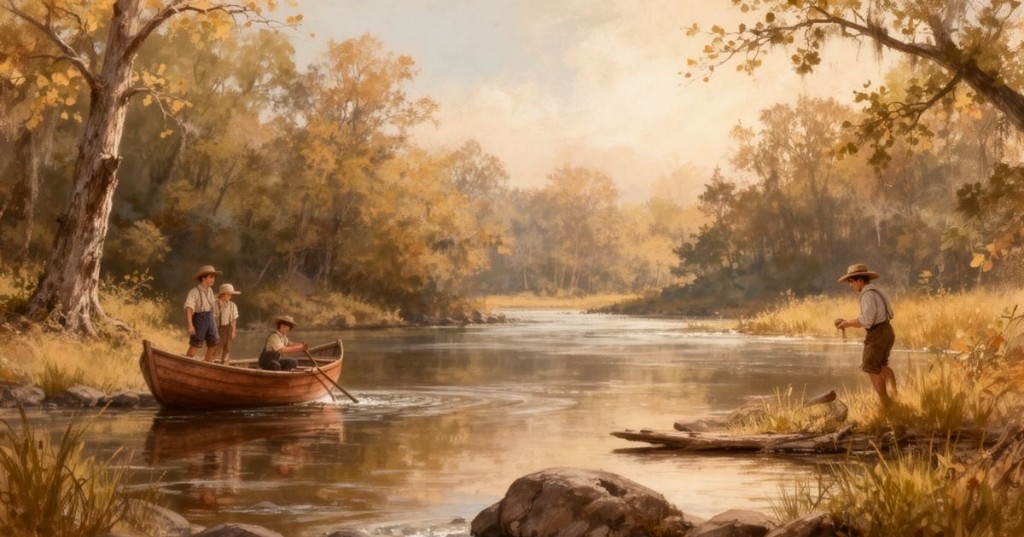
An excerpt from the original text.(complete · 2838 words)
ast, and the raft did seem to go mighty slow. If a boat was to come
along we was going to take to the canoe and break for the Illinois
shore; and it was well a boat didn’t come, for we hadn’t ever thought
to put the gun in the canoe, or a fishing-line, or anything to eat. We
was in ruther too much of a sweat to think of so many things. It warn’t
good judgment to put everything on the raft.
If the men went to the island I just expect they found the camp fire I
built, and watched it all night for Jim to come. Anyways, they stayed
away from us, and if my building the fire never fooled them it warn’t
no fault of mine. I played it as low down on them as I could.
When the first streak of day began to show we tied up to a tow-head in a
big bend on the Illinois side, and hacked off cottonwood branches with
the hatchet, and covered up the raft with them so she looked like there
had been a cave-in in the bank there. A tow-head is a sandbar that has
cottonwoods on it as thick as harrow-teeth.
We had mountains on the Missouri shore and heavy timber on the Illinois
side, and the channel was down the Missouri shore at that place, so we
warn’t afraid of anybody running across us. We laid there all day, and
watched the rafts and steamboats spin down the Missouri shore, and
up-bound steamboats fight the big river in the middle. I told Jim all
about the time I had jabbering with that woman; and Jim said she was a
smart one, and if she was to start after us herself she wouldn’t set
down and watch a camp fire—no, sir, she’d fetch a dog. Well, then, I
said, why couldn’t she tell her husband to fetch a dog? Jim said he bet
she did think of it by the time the men was ready to start, and he
believed they must a gone up-town to get a dog and so they lost all
that time, or else we wouldn’t be here on a tow-head sixteen or
seventeen mile below the village—no, indeedy, we would be in that same
old town again. So I said I didn’t care what was the reason they didn’t
get us as long as they didn’t.
When it was beginning to come on dark we poked our heads out of the
cottonwood thicket, and looked up and down and across; nothing in
sight; so Jim took up some of the top planks of the raft and built a
snug wigwam to get under in blazing weather and rainy, and to keep the
things dry. Jim made a floor for the wigwam, and raised it a foot or
more above the level of the raft, so now the blankets and all the traps
was out of reach of steamboat waves. Right in the middle of the wigwam
we made a layer of dirt about five or six inches deep with a frame
around it for to hold it to its place; this was to build a fire on in
sloppy weather or chilly; the wigwam would keep it from being seen. We
made an extra steering-oar, too, because one of the others might get
broke on a snag or something. We fixed up a short forked stick to hang
the old lantern on, because we must always light the lantern whenever
we see a steamboat coming down-stream, to keep from getting run over;
but we wouldn’t have to light it for up-stream boats unless we see we
was in what they call a “crossing”; for the river was pretty high yet,
very low banks being still a little under water; so up-bound boats
didn’t always run the channel, but hunted easy water.
This second night we run between seven and eight hours, with a current
that was making over four mile an hour. We catched fish and talked, and
we took a swim now and then to keep off sleepiness. It was kind of
solemn, drifting down the big, still river, laying on our backs looking
up at the stars, and we didn’t ever feel like talking loud, and it
warn’t often that we laughed—only a little kind of a low chuckle. We
had mighty good weather as a general thing, and nothing ever happened
to us at all—that night, nor the next, nor the next.
Every night we passed towns, some of them away up on black hillsides,
nothing but just a shiny bed of lights; not a house could you see. The
fifth night we passed St. Louis, and it was like the whole world lit
up. In St. Petersburg they used to say there was twenty or thirty
thousand people in St. Louis, but I never believed it till I see that
wonderful spread of lights at two o’clock that still night. There
warn’t a sound there; everybody was asleep.
Every night now I used to slip ashore towards ten o’clock at some
little village, and buy ten or fifteen cents’ worth of meal or bacon or
other stuff to eat; and sometimes I lifted a chicken that warn’t
roosting comfortable, and took him along. Pap always said, take a
chicken when you get a chance, because if you don’t want him yourself
you can easy find somebody that does, and a good deed ain’t ever
forgot. I never see pap when he didn’t want the chicken himself, but
that is what he used to say, anyway.
Mornings before daylight I slipped into cornfields and borrowed a
watermelon, or a mushmelon, or a punkin, or some new corn, or things of
that kind. Pap always said it warn’t no harm to borrow things if you
was meaning to pay them back some time; but the widow said it warn’t
anything but a soft name for stealing, and no decent body would do it.
Jim said he reckoned the widow was partly right and pap was partly
right; so the best way would be for us to pick out two or three things
from the list and say we wouldn’t borrow them any more—then he reckoned
it wouldn’t be no harm to borrow the others. So we talked it over all
one night, drifting along down the river, trying to make up our minds
whether to drop the watermelons, or the cantelopes, or the mushmelons,
or what. But towards daylight we got it all settled satisfactory, and
concluded to drop crabapples and p’simmons. We warn’t feeling just
right before that, but it was all comfortable now. I was glad the way
it come out, too, because crabapples ain’t ever good, and the p’simmons
wouldn’t be ripe for two or three months yet.
We shot a water-fowl, now and, then that got up too early in the morning
or didn’t go to bed early enough in the evening. Take it all round, we
lived pretty high.
The fifth night below St. Louis we had a big storm after midnight, with
a power of thunder and lightning, and the rain poured down in a solid
sheet. We stayed in the wigwam and let the raft take care of itself.
When the lightning glared out we could see a big straight river ahead,
and high, rocky bluffs on both sides. By-and-by says I, “Hel-lo, Jim,
looky yonder!” It was a steamboat that had killed herself on a rock. We
was drifting straight down for her. The lightning showed her very
distinct. She was leaning over, with part of her upper deck above
water, and you could see every little chimbly-guy clean and clear, and
a chair by the big bell, with an old slouch hat hanging on the back of
it, when the flashes come.
Well, it being away in the night and stormy, and all so
mysterious-like, I felt just the way any other boy would a felt when I
see that wreck laying there so mournful and lonesome in the middle of
the river. I wanted to get aboard of her and slink around a little, and
see what there was there. So I says:
“Le’s land on her, Jim.”
But Jim was dead against it at first. He says:
“I doan’ want to go fool’n ’long er no wrack. We’s doin’ blame’ well,
en we better let blame’ well alone, as de good book says. Like as not
dey’s a watchman on dat wrack.”
“Watchman your grandmother,” I says; “there ain’t nothing to watch but
the texas and the pilot-house; and do you reckon anybody’s going to
resk his life for a texas and a pilot-house such a night as this, when
it’s likely to break up and wash off down the river any minute?” Jim
couldn’t say nothing to that, so he didn’t try. “And besides,” I says,
“we might borrow something worth having out of the captain’s stateroom.
Seegars, I bet you—and cost five cents apiece, solid cash. Steamboat
captains is always rich, and get sixty dollars a month, and they
don’t care a cent what a thing costs, you know, long as they want it.
Stick a candle in your pocket; I can’t rest, Jim, till we give her a
rummaging. Do you reckon Tom Sawyer would ever go by this thing? Not
for pie, he wouldn’t. He’d call it an adventure—that’s what he’d call
it; and he’d land on that wreck if it was his last act. And wouldn’t he
throw style into it?—wouldn’t he spread himself, nor nothing? Why,
you’d think it was Christopher C’lumbus discovering Kingdom-Come. I
wish Tom Sawyer was here.”
Jim he grumbled a little, but give in. He said we mustn’t talk any more
than we could help, and then talk mighty low. The lightning showed us
the wreck again just in time, and we fetched the stabboard derrick, and
made fast there.
The deck was high out here. We went sneaking down the slope of it to
labboard, in the dark, towards the texas, feeling our way slow with our
feet, and spreading our hands out to fend off the guys, for it was so
dark we couldn’t see no sign of them. Pretty soon we struck the forward
end of the skylight, and clumb on to it; and the next step fetched us
in front of the captain’s door, which was open, and by Jimminy, away
down through the texas-hall we see a light! and all in the same second
we seem to hear low voices in yonder!
Jim whispered and said he was feeling powerful sick, and told me to
come along. I says, all right, and was going to start for the raft; but
just then I heard a voice wail out and say:
“Oh, please don’t, boys; I swear I won’t ever tell!”
Another voice said, pretty loud:
“It’s a lie, Jim Turner. You’ve acted this way before. You always want
more’n your share of the truck, and you’ve always got it, too, because
you’ve swore ’t if you didn’t you’d tell. But this time you’ve said it
jest one time too many. You’re the meanest, treacherousest hound in
this country.”
By this time Jim was gone for the raft. I was just a-biling with
curiosity; and I says to myself, Tom Sawyer wouldn’t back out now, and
so I won’t either; I’m a-going to see what’s going on here. So I
dropped on my hands and knees in the little passage, and crept aft in
the dark till there warn’t but one stateroom betwixt me and the
cross-hall of the texas. Then in there I see a man stretched on the
floor and tied hand and foot, and two men standing over him, and one of
them had a dim lantern in his hand, and the other one had a pistol.
This one kept pointing the pistol at the man’s head on the floor, and
saying:
“I’d like to! And I orter, too—a mean skunk!”
The man on the floor would shrivel up and say, “Oh, please don’t, Bill;
I hain’t ever goin’ to tell.”
And every time he said that the man with the lantern would laugh and
say:
“’Deed you ain’t! You never said no truer thing ’n that, you bet
you.” And once he said: “Hear him beg! and yit if we hadn’t got the
best of him and tied him he’d a killed us both. And what for? Jist
for noth’n. Jist because we stood on our rights—that’s what for. But
I lay you ain’t a-goin’ to threaten nobody any more, Jim Turner. Put
up that pistol, Bill.”
Bill says:
“I don’t want to, Jake Packard. I’m for killin’ him—and didn’t he kill
old Hatfield jist the same way—and don’t he deserve it?”
“But I don’t want him killed, and I’ve got my reasons for it.”
“Bless yo’ heart for them words, Jake Packard! I’ll never forgit you
long’s I live!” says the man on the floor, sort of blubbering.
Packard didn’t take no notice of that, but hung up his lantern on a
nail and started towards where I was there in the dark, and motioned
Bill to come. I crawfished as fast as I could about two yards, but the
boat slanted so that I couldn’t make very good time; so to keep from
getting run over and catched I crawled into a stateroom on the upper
side. The man came a-pawing along in the dark, and when Packard got to
my stateroom, he says:
“Here—come in here.”
And in he come, and Bill after him. But before they got in I was up in
the upper berth, cornered, and sorry I come. Then they stood there,
with their hands on the ledge of the berth, and talked. I couldn’t see
them, but I could tell where they was by the whisky they’d been having.
I was glad I didn’t drink whisky; but it wouldn’t made much difference
anyway, because most of the time they couldn’t a treed me because I
didn’t breathe. I was too scared. And, besides, a body couldn’t
breathe and hear such talk. They talked low and earnest. Bill wanted to
kill Turner. He says:
“He’s said he’ll tell, and he will. If we was to give both our shares
to him now it wouldn’t make no difference after the row and the way
we’ve served him. Shore’s you’re born, he’ll turn State’s evidence; now
you hear me. I’m for putting him out of his troubles.”
“So’m I,” says Packard, very quiet.
“Blame it, I’d sorter begun to think you wasn’t. Well, then, that’s all
right. Le’s go and do it.”
“Hold on a minute; I hain’t had my say yit. You listen to me.
Shooting’s good, but there’s quieter ways if the thing’s got to be
done. But what I say is this: it ain’t good sense to go court’n
around after a halter if you can git at what you’re up to in some way
that’s jist as good and at the same time don’t bring you into no resks.
Ain’t that so?”
“You bet it is. But how you goin’ to manage it this time?”
“Well, my idea is this: we’ll rustle around and gather up whatever
pickins we’ve overlooked in the staterooms, and shove for shore and
hide the truck. Then we’ll wait. Now I say it ain’t a-goin’ to be
more’n two hours befo’ this wrack breaks up and washes off down the
river. See? He’ll be drownded, and won’t have nobody to blame for it
but his own self. I reckon that’s a considerble sight better ’n killin’
of him. I’m unfavorable to killin’ a man as long as you can git aroun’
it; it ain’t good sense, it ain’t good morals. Ain’t I right?”
“Yes, I reck’n you are. But s’pose she don’t break up and wash off?”
“Well, we can wait the two hours anyway and see, can’t we?”
“All right, then; come along.”
So they started, and I lit out, all in a cold sweat, and scrambled
forward. It was dark as pitch there; but I said, in a kind of a coarse
whisper, “Jim!” and he answered up, right at my elbow, with a sort of a
moan, and I says:
“Quick, Jim, it ain’t no time for fooling around and moaning; there’s a
gang of murderers in yonder, and if we don’t hunt up their boat and set
her drifting down the river so these fellows can’t get away from the
wreck there’s one of ’em going to be in a bad fix. But if we find their
boat we can put all of ’em in a bad fix—for the Sheriff ’ll get ’em.
Quick—hurry! I’ll hunt the labboard side, you hunt the stabboard. You
start at the raft, and—”
“Oh, my lordy, lordy! Raf’? Dey ain’ no raf’ no mo’; she done broke
loose en gone I—en here we is!”
Master this chapter. Complete your experience
Purchase the complete book to access all chapters and support classic literature
As an Amazon Associate, we earn a small commission from qualifying purchases at no additional cost to you.
Available in paperback, hardcover, and e-book formats
Let's Analyse the Pattern
When fascination with the unknown overrides practical warnings about real danger.
Why This Matters
Connect literature to life
This chapter teaches how to identify the moment when investigation or exploration crosses from safe territory into situations where powerful people will fight back.
Practice This Today
This week, notice when your curiosity about workplace drama or neighborhood conflicts starts overriding someone's practical warnings about potential consequences.
Now let's explore the literary elements.
Key Quotes & Analysis
"I can't rest, Jim, till we give him a chance."
Context: After overhearing the murder plot, Huck tells Jim they have to try to save Turner
This shows Huck's growing moral courage and sense of responsibility for others. Despite the danger to himself and Jim, he can't ignore someone in mortal peril. It marks a key moment in his moral development.
In Today's Words:
I can't just walk away knowing someone's about to get killed.
"I don't want no such glory."
Context: Jim's response to Huck's desire for adventure on the steamboat
Jim's practical wisdom shines through - he knows that glory often comes at too high a price. His life experience has taught him that survival matters more than excitement or reputation.
In Today's Words:
I don't need that kind of trouble in my life.
"He'll be drownded in ten minutes."
Context: Discussing how Turner will die when the steamboat breaks apart
The casual, matter-of-fact way Bill discusses murder shows his complete lack of conscience. This cold calculation horrifies Huck and forces him to confront real evil, not just mischief.
In Today's Words:
The river will take care of our problem for us.
Thematic Threads
Class
In This Chapter
Huck's working-class background makes him see the steamboat as potential treasure rather than danger
Development
Building from earlier chapters where class shapes how characters view opportunities
In Your Life:
Your background affects whether you see situations as opportunities or threats.
Identity
In This Chapter
Huck's identity as an adventurer conflicts with his growing responsibility to Jim
Development
Continuing his struggle between boyish impulses and mature judgment
In Your Life:
Who you think you are can conflict with who you need to be in relationships.
Social Expectations
In This Chapter
Society expects boys to be adventurous, but this expectation puts Jim at risk
Development
Expanding from earlier themes about how social roles create moral conflicts
In Your Life:
Social expectations about your role can lead you to make choices that hurt people you care about.
Personal Growth
In This Chapter
Huck faces the gap between adventure-seeking and real moral courage when he hears murder being planned
Development
His moral awareness is deepening beyond simple rule-following
In Your Life:
Real maturity means distinguishing between harmless excitement and situations with serious consequences.
Human Relationships
In This Chapter
Jim's practical wisdom balances Huck's impulsiveness, showing how partnerships work
Development
Their relationship continues evolving from convenience to genuine partnership
In Your Life:
Strong relationships require balancing different strengths and listening to each other's concerns.
You now have the context. Time to form your own thoughts.
Discussion Questions
- 1
Why does Huck want to explore the wrecked steamboat despite Jim's clear warnings about the danger?
analysis • surface - 2
How does Huck's curiosity put both him and Jim at risk, and what does this reveal about how excitement can override good judgment?
analysis • medium - 3
Where do you see people today getting drawn into dangerous situations because something seems exciting or mysterious, despite clear warning signs?
application • medium - 4
When someone you trust warns you away from something that seems appealing, how do you decide whether to listen to their caution or follow your curiosity?
application • deep - 5
What does this chapter teach us about the balance between taking risks for growth and protecting ourselves from real danger?
reflection • deep
Critical Thinking Exercise
Map Your Warning System
Think of a recent situation where you felt torn between curiosity and caution. Write down who or what was your 'Jim voice' giving practical warnings, and who or what was your 'Huck voice' pushing for adventure. Then trace what actually happened and what you learned from the outcome.
Consider:
- •Notice whether you tend to be more like Huck (curiosity-driven) or Jim (caution-focused) in most situations
- •Identify the people in your life who consistently give you practical warnings versus those who encourage risk-taking
- •Consider how your decision-making changes when you're excited or stressed versus when you're calm
Journaling Prompt
Write about a time when you ignored good advice because something seemed too interesting to pass up. What happened, and how do you make those decisions differently now?
Coming Up Next...
Chapter 13
Trapped on a sinking steamboat with murderers, Huck must find a way to save both himself and Jim while grappling with whether to help the criminals' intended victim. His next decision will test everything he's learning about right and wrong.



