An excerpt from the original text.(complete · 4559 words)
OOK IX. Last of all comes the tyrannical man, about whom we have to
enquire, Whence is he, and how does he live—in happiness or in misery?
There is, however, a previous question of the nature and number of the
appetites, which I should like to consider first. Some of them are
unlawful, and yet admit of being chastened and weakened in various
degrees by the power of reason and law. ‘What appetites do you mean?’ I
mean those which are awake when the reasoning powers are asleep, which
get up and walk about naked without any self-respect or shame; and
there is no conceivable folly or crime, however cruel or unnatural, of
which, in imagination, they may not be guilty. ‘True,’ he said; ‘very
true.’ But when a man’s pulse beats temperately; and he has supped on a
feast of reason and come to a knowledge of himself before going to
rest, and has satisfied his desires just enough to prevent their
perturbing his reason, which remains clear and luminous, and when he is
free from quarrel and heat,—the visions which he has on his bed are
least irregular and abnormal. Even in good men there is such an
irregular wild-beast nature, which peers out in sleep.
To return:—You remember what was said of the democrat; that he was the
son of a miserly father, who encouraged the saving desires and
repressed the ornamental and expensive ones; presently the youth got
into fine company, and began to entertain a dislike to his father’s
narrow ways; and being a better man than the corrupters of his youth,
he came to a mean, and led a life, not of lawless or slavish passion,
but of regular and successive indulgence. Now imagine that the youth
has become a father, and has a son who is exposed to the same
temptations, and has companions who lead him into every sort of
iniquity, and parents and friends who try to keep him right. The
counsellors of evil find that their only chance of retaining him is to
implant in his soul a monster drone, or love; while other desires buzz
around him and mystify him with sweet sounds and scents, this monster
love takes possession of him, and puts an end to every true or modest
thought or wish. Love, like drunkenness and madness, is a tyranny; and
the tyrannical man, whether made by nature or habit, is just a
drinking, lusting, furious sort of animal.
And how does such an one live? ‘Nay, that you must tell me.’ Well then,
I fancy that he will live amid revelries and harlotries, and love will
be the lord and master of the house. Many desires require much money,
and so he spends all that he has and borrows more; and when he has
nothing the young ravens are still in the nest in which they were
hatched, crying for food. Love urges them on; and they must be
gratified by force or fraud, or if not, they become painful and
troublesome; and as the new pleasures succeed the old ones, so will the
son take possession of the goods of his parents; if they show signs of
refusing, he will defraud and deceive them; and if they openly resist,
what then? ‘I can only say, that I should not much like to be in their
place.’ But, O heavens, Adeimantus, to think that for some new-fangled
and unnecessary love he will give up his old father and mother, best
and dearest of friends, or enslave them to the fancies of the hour!
Truly a tyrannical son is a blessing to his father and mother! When
there is no more to be got out of them, he turns burglar or pickpocket,
or robs a temple. Love overmasters the thoughts of his youth, and he
becomes in sober reality the monster that he was sometimes in sleep. He
waxes strong in all violence and lawlessness; and is ready for any deed
of daring that will supply the wants of his rabble-rout. In a
well-ordered State there are only a few such, and these in time of war
go out and become the mercenaries of a tyrant. But in time of peace
they stay at home and do mischief; they are the thieves, footpads,
cut-purses, man-stealers of the community; or if they are able to
speak, they turn false-witnesses and informers. ‘No small catalogue of
crimes truly, even if the perpetrators are few.’ Yes, I said; but small
and great are relative terms, and no crimes which are committed by them
approach those of the tyrant, whom this class, growing strong and
numerous, create out of themselves. If the people yield, well and good,
but, if they resist, then, as before he beat his father and mother, so
now he beats his fatherland and motherland, and places his mercenaries
over them. Such men in their early days live with flatterers, and they
themselves flatter others, in order to gain their ends; but they soon
discard their followers when they have no longer any need of them; they
are always either masters or servants,—the joys of friendship are
unknown to them. And they are utterly treacherous and unjust, if the
nature of justice be at all understood by us. They realize our dream;
and he who is the most of a tyrant by nature, and leads the life of a
tyrant for the longest time, will be the worst of them, and being the
worst of them, will also be the most miserable.
Like man, like State,—the tyrannical man will answer to tyranny, which
is the extreme opposite of the royal State; for one is the best and the
other the worst. But which is the happier? Great and terrible as the
tyrant may appear enthroned amid his satellites, let us not be afraid
to go in and ask; and the answer is, that the monarchical is the
happiest, and the tyrannical the most miserable of States. And may we
not ask the same question about the men themselves, requesting some one
to look into them who is able to penetrate the inner nature of man, and
will not be panic-struck by the vain pomp of tyranny? I will suppose
that he is one who has lived with him, and has seen him in family life,
or perhaps in the hour of trouble and danger.
Assuming that we ourselves are the impartial judge for whom we seek,
let us begin by comparing the individual and State, and ask first of
all, whether the State is likely to be free or enslaved—Will there not
be a little freedom and a great deal of slavery? And the freedom is of
the bad, and the slavery of the good; and this applies to the man as
well as to the State; for his soul is full of meanness and slavery, and
the better part is enslaved to the worse. He cannot do what he would,
and his mind is full of confusion; he is the very reverse of a freeman.
The State will be poor and full of misery and sorrow; and the man’s
soul will also be poor and full of sorrows, and he will be the most
miserable of men. No, not the most miserable, for there is yet a more
miserable. ‘Who is that?’ The tyrannical man who has the misfortune
also to become a public tyrant. ‘There I suspect that you are right.’
Say rather, ‘I am sure;’ conjecture is out of place in an enquiry of
this nature. He is like a wealthy owner of slaves, only he has more of
them than any private individual. You will say, ‘The owners of slaves
are not generally in any fear of them.’ But why? Because the whole city
is in a league which protects the individual. Suppose however that one
of these owners and his household is carried off by a god into a
wilderness, where there are no freemen to help him—will he not be in an
agony of terror?—will he not be compelled to flatter his slaves and to
promise them many things sore against his will? And suppose the same
god who carried him off were to surround him with neighbours who
declare that no man ought to have slaves, and that the owners of them
should be punished with death. ‘Still worse and worse! He will be in
the midst of his enemies.’ And is not our tyrant such a captive soul,
who is tormented by a swarm of passions which he cannot indulge; living
indoors always like a woman, and jealous of those who can go out and
see the world?
Having so many evils, will not the most miserable of men be still more
miserable in a public station? Master of others when he is not master
of himself; like a sick man who is compelled to be an athlete; the
meanest of slaves and the most abject of flatterers; wanting all
things, and never able to satisfy his desires; always in fear and
distraction, like the State of which he is the representative. His
jealous, hateful, faithless temper grows worse with command; he is more
and more faithless, envious, unrighteous,—the most wretched of men, a
misery to himself and to others. And so let us have a final trial and
proclamation; need we hire a herald, or shall I proclaim the result?
‘Made the proclamation yourself.’ The son of Ariston (the best) is of
opinion that the best and justest of men is also the happiest, and that
this is he who is the most royal master of himself; and that the unjust
man is he who is the greatest tyrant of himself and of his State. And I
add further—‘seen or unseen by gods or men.’
This is our first proof. The second is derived from the three kinds of
pleasure, which answer to the three elements of the soul—reason,
passion, desire; under which last is comprehended avarice as well as
sensual appetite, while passion includes ambition, party-feeling, love
of reputation. Reason, again, is solely directed to the attainment of
truth, and careless of money and reputation. In accordance with the
difference of men’s natures, one of these three principles is in the
ascendant, and they have their several pleasures corresponding to them.
Interrogate now the three natures, and each one will be found praising
his own pleasures and depreciating those of others. The money-maker
will contrast the vanity of knowledge with the solid advantages of
wealth. The ambitious man will despise knowledge which brings no
honour; whereas the philosopher will regard only the fruition of truth,
and will call other pleasures necessary rather than good. Now, how
shall we decide between them? Is there any better criterion than
experience and knowledge? And which of the three has the truest
knowledge and the widest experience? The experience of youth makes the
philosopher acquainted with the two kinds of desire, but the avaricious
and the ambitious man never taste the pleasures of truth and wisdom.
Honour he has equally with them; they are ‘judged of him,’ but he is
‘not judged of them,’ for they never attain to the knowledge of true
being. And his instrument is reason, whereas their standard is only
wealth and honour; and if by reason we are to judge, his good will be
the truest. And so we arrive at the result that the pleasure of the
rational part of the soul, and a life passed in such pleasure is the
pleasantest. He who has a right to judge judges thus. Next comes the
life of ambition, and, in the third place, that of money-making.
Twice has the just man overthrown the unjust—once more, as in an
Olympian contest, first offering up a prayer to the saviour Zeus, let
him try a fall. A wise man whispers to me that the pleasures of the
wise are true and pure; all others are a shadow only. Let us examine
this: Is not pleasure opposed to pain, and is there not a mean state
which is neither? When a man is sick, nothing is more pleasant to him
than health. But this he never found out while he was well. In pain he
desires only to cease from pain; on the other hand, when he is in an
ecstasy of pleasure, rest is painful to him. Thus rest or cessation is
both pleasure and pain. But can that which is neither become both?
Again, pleasure and pain are motions, and the absence of them is rest;
but if so, how can the absence of either of them be the other? Thus we
are led to infer that the contradiction is an appearance only, and
witchery of the senses. And these are not the only pleasures, for there
are others which have no preceding pains. Pure pleasure then is not the
absence of pain, nor pure pain the absence of pleasure; although most
of the pleasures which reach the mind through the body are reliefs of
pain, and have not only their reactions when they depart, but their
anticipations before they come. They can be best described in a simile.
There is in nature an upper, lower, and middle region, and he who
passes from the lower to the middle imagines that he is going up and is
already in the upper world; and if he were taken back again would
think, and truly think, that he was descending. All this arises out of
his ignorance of the true upper, middle, and lower regions. And a like
confusion happens with pleasure and pain, and with many other things.
The man who compares grey with black, calls grey white; and the man who
compares absence of pain with pain, calls the absence of pain pleasure.
Again, hunger and thirst are inanitions of the body, ignorance and
folly of the soul; and food is the satisfaction of the one, knowledge
of the other. Now which is the purer satisfaction—that of eating and
drinking, or that of knowledge? Consider the matter thus: The
satisfaction of that which has more existence is truer than of that
which has less. The invariable and immortal has a more real existence
than the variable and mortal, and has a corresponding measure of
knowledge and truth. The soul, again, has more existence and truth and
knowledge than the body, and is therefore more really satisfied and has
a more natural pleasure. Those who feast only on earthly food, are
always going at random up to the middle and down again; but they never
pass into the true upper world, or have a taste of true pleasure. They
are like fatted beasts, full of gluttony and sensuality, and ready to
kill one another by reason of their insatiable lust; for they are not
filled with true being, and their vessel is leaky (Gorgias). Their
pleasures are mere shadows of pleasure, mixed with pain, coloured and
intensified by contrast, and therefore intensely desired; and men go
fighting about them, as Stesichorus says that the Greeks fought about
the shadow of Helen at Troy, because they know not the truth.
The same may be said of the passionate element:—the desires of the
ambitious soul, as well as of the covetous, have an inferior
satisfaction. Only when under the guidance of reason do either of the
other principles do their own business or attain the pleasure which is
natural to them. When not attaining, they compel the other parts of the
soul to pursue a shadow of pleasure which is not theirs. And the more
distant they are from philosophy and reason, the more distant they will
be from law and order, and the more illusive will be their pleasures.
The desires of love and tyranny are the farthest from law, and those of
the king are nearest to it. There is one genuine pleasure, and two
spurious ones: the tyrant goes beyond even the latter; he has run away
altogether from law and reason. Nor can the measure of his inferiority
be told, except in a figure. The tyrant is the third removed from the
oligarch, and has therefore, not a shadow of his pleasure, but the
shadow of a shadow only. The oligarch, again, is thrice removed from
the king, and thus we get the formula 3 x 3, which is the number of a
surface, representing the shadow which is the tyrant’s pleasure, and if
you like to cube this ‘number of the beast,’ you will find that the
measure of the difference amounts to 729; the king is 729 times more
happy than the tyrant. And this extraordinary number is NEARLY equal to
the number of days and nights in a year (365 x 2 = 730); and is
therefore concerned with human life. This is the interval between a
good and bad man in happiness only: what must be the difference between
them in comeliness of life and virtue!
Perhaps you may remember some one saying at the beginning of our
discussion that the unjust man was profited if he had the reputation of
justice. Now that we know the nature of justice and injustice, let us
make an image of the soul, which will personify his words. First of
all, fashion a multitudinous beast, having a ring of heads of all
manner of animals, tame and wild, and able to produce and change them
at pleasure. Suppose now another form of a lion, and another of a man;
the second smaller than the first, the third than the second; join them
together and cover them with a human skin, in which they are completely
concealed. When this has been done, let us tell the supporter of
injustice that he is feeding up the beasts and starving the man. The
maintainer of justice, on the other hand, is trying to strengthen the
man; he is nourishing the gentle principle within him, and making an
alliance with the lion heart, in order that he may be able to keep down
the many-headed hydra, and bring all into unity with each other and
with themselves. Thus in every point of view, whether in relation to
pleasure, honour, or advantage, the just man is right, and the unjust
wrong.
But now, let us reason with the unjust, who is not intentionally in
error. Is not the noble that which subjects the beast to the man, or
rather to the God in man; the ignoble, that which subjects the man to
the beast? And if so, who would receive gold on condition that he was
to degrade the noblest part of himself under the worst?—who would sell
his son or daughter into the hands of brutal and evil men, for any
amount of money? And will he sell his own fairer and diviner part
without any compunction to the most godless and foul? Would he not be
worse than Eriphyle, who sold her husband’s life for a necklace? And
intemperance is the letting loose of the multiform monster, and pride
and sullenness are the growth and increase of the lion and serpent
element, while luxury and effeminacy are caused by a too great
relaxation of spirit. Flattery and meanness again arise when the
spirited element is subjected to avarice, and the lion is habituated to
become a monkey. The real disgrace of handicraft arts is, that those
who are engaged in them have to flatter, instead of mastering their
desires; therefore we say that they should be placed under the control
of the better principle in another because they have none in
themselves; not, as Thrasymachus imagined, to the injury of the
subjects, but for their good. And our intention in educating the young,
is to give them self-control; the law desires to nurse up in them a
higher principle, and when they have acquired this, they may go their
ways.
‘What, then, shall a man profit, if he gain the whole world’ and become
more and more wicked? Or what shall he profit by escaping discovery, if
the concealment of evil prevents the cure? If he had been punished, the
brute within him would have been silenced, and the gentler element
liberated; and he would have united temperance, justice, and wisdom in
his soul—a union better far than any combination of bodily gifts. The
man of understanding will honour knowledge above all; in the next place
he will keep under his body, not only for the sake of health and
strength, but in order to attain the most perfect harmony of body and
soul. In the acquisition of riches, too, he will aim at order and
harmony; he will not desire to heap up wealth without measure, but he
will fear that the increase of wealth will disturb the constitution of
his own soul. For the same reason he will only accept such honours as
will make him a better man; any others he will decline. ‘In that case,’
said he, ‘he will never be a politician.’ Yes, but he will, in his own
city; though probably not in his native country, unless by some divine
accident. ‘You mean that he will be a citizen of the ideal city, which
has no place upon earth.’ But in heaven, I replied, there is a pattern
of such a city, and he who wishes may order his life after that image.
Whether such a state is or ever will be matters not; he will act
according to that pattern and no other...
The most noticeable points in the 9th Book of the Republic are:—(1) the
account of pleasure; (2) the number of the interval which divides the
king from the tyrant; (3) the pattern which is in heaven.
1. Plato’s account of pleasure is remarkable for moderation, and in
this respect contrasts with the later Platonists and the views which
are attributed to them by Aristotle. He is not, like the Cynics,
opposed to all pleasure, but rather desires that the several parts of
the soul shall have their natural satisfaction; he even agrees with the
Epicureans in describing pleasure as something more than the absence of
pain. This is proved by the circumstance that there are pleasures which
have no antecedent pains (as he also remarks in the Philebus), such as
the pleasures of smell, and also the pleasures of hope and
anticipation. In the previous book he had made the distinction between
necessary and unnecessary pleasure, which is repeated by Aristotle, and
he now observes that there are a further class of ‘wild beast’
pleasures, corresponding to Aristotle’s (Greek). He dwells upon the
relative and unreal character of sensual pleasures and the illusion
which arises out of the contrast of pleasure and pain, pointing out the
superiority of the pleasures of reason, which are at rest, over the
fleeting pleasures of sense and emotion. The pre-eminence of royal
pleasure is shown by the fact that reason is able to form a judgment of
the lower pleasures, while the two lower parts of the soul are
incapable of judging the pleasures of reason. Thus, in his treatment of
pleasure, as in many other subjects, the philosophy of Plato is ‘sawn
up into quantities’ by Aristotle; the analysis which was originally
made by him became in the next generation the foundation of further
technical distinctions. Both in Plato and Aristotle we note the
illusion under which the ancients fell of regarding the transience of
pleasure as a proof of its unreality, and of confounding the permanence
of the intellectual pleasures with the unchangeableness of the
knowledge from which they are derived. Neither do we like to admit that
the pleasures of knowledge, though more elevating, are not more lasting
than other pleasures, and are almost equally dependent on the accidents
of our bodily state (Introduction to Philebus).
2. The number of the interval which separates the king from the tyrant,
and royal from tyrannical pleasures, is 729, the cube of 9. Which Plato
characteristically designates as a number concerned with human life,
because NEARLY equivalent to the number of days and nights in the year.
He is desirous of proclaiming that the interval between them is
immeasurable, and invents a formula to give expression to his idea.
Those who spoke of justice as a cube, of virtue as an art of measuring
(Prot.), saw no inappropriateness in conceiving the soul under the
figure of a line, or the pleasure of the tyrant as separated from the
pleasure of the king by the numerical interval of 729. And in modern
times we sometimes use metaphorically what Plato employed as a
philosophical formula. ‘It is not easy to estimate the loss of the
tyrant, except perhaps in this way,’ says Plato. So we might say, that
although the life of a good man is not to be compared to that of a bad
man, yet you may measure the difference between them by valuing one
minute of the one at an hour of the other (‘One day in thy courts is
better than a thousand’), or you might say that ‘there is an infinite
difference.’ But this is not so much as saying, in homely phrase, ‘They
are a thousand miles asunder.’ And accordingly Plato finds the natural
vehicle of his thoughts in a progression of numbers; this arithmetical
formula he draws out with the utmost seriousness, and both here and in
the number of generation seems to find an additional proof of the truth
of his speculation in forming the number into a geometrical figure;
just as persons in our own day are apt to fancy that a statement is
verified when it has been only thrown into an abstract form. In
speaking of the number 729 as proper to human life, he probably
intended to intimate that one year of the tyrannical = 12 hours of the
royal life.
The simple observation that the comparison of two similar solids is
effected by the comparison of the cubes of their sides, is the
mathematical groundwork of this fanciful expression. There is some
difficulty in explaining the steps by which the number 729 is obtained;
the oligarch is removed in the third degree from the royal and
aristocratical, and the tyrant in the third degree from the
oligarchical; but we have to arrange the terms as the sides of a square
and to count the oligarch twice over, thus reckoning them not as = 5
but as = 9. The square of 9 is passed lightly over as only a step
towards the cube.
3. Towards the close of the Republic, Plato seems to be more and more
convinced of the ideal character of his own speculations. At the end of
the 9th Book the pattern which is in heaven takes the place of the city
of philosophers on earth. The vision which has received form and
substance at his hands, is now discovered to be at a distance. And yet
this distant kingdom is also the rule of man’s life. (‘Say not lo!
here, or lo! there, for the kingdom of God is within you.’) Thus a note
is struck which prepares for the revelation of a future life in the
following Book. But the future life is present still; the ideal of
politics is to be realized in the individual.
Master this chapter. Complete your experience
Purchase the complete book to access all chapters and support classic literature
As an Amazon Associate, we earn a small commission from qualifying purchases at no additional cost to you.
Available in paperback, hardcover, and e-book formats
Let's Analyse the Pattern
The Beast You Feed: Why Your Worst Impulses Grow Stronger
Every choice feeds either your rational human nature or your appetitive beast nature, gradually determining which rules your life.
Why This Matters
Connect literature to life
This chapter teaches you to identify when appetites or emotions have overthrown reason in yourself and others.
Practice This Today
This week, notice when you feel compelled to do something you know you'll regret - that's your beast trying to rule your human.
Now let's explore the literary elements.
Key Quotes & Analysis
"There is no conceivable folly or crime, however cruel or unnatural, of which, in imagination, they may not be guilty."
Context: Describing the wild dreams and desires that emerge when reason sleeps
This reveals how even good people have dark impulses lurking beneath. The difference between just and unjust isn't the absence of bad thoughts but whether we let them control us. It's deeply honest about human nature.
In Today's Words:
We all have intrusive thoughts and messed-up dreams - what matters is whether we act on them when we're awake.
"The tyrant is 729 times more miserable than the philosopher-king."
Context: Calculating the exact difference in happiness between the best and worst lives
This mathematical precision shows Plato's belief that ethics can be as certain as geometry. The huge number emphasizes that this isn't a small difference - the gap between a life ruled by wisdom versus desires is astronomical.
In Today's Words:
The difference between someone who's got their life together and someone controlled by their addictions isn't just a little bit - it's like comparing a mansion to a cardboard box.
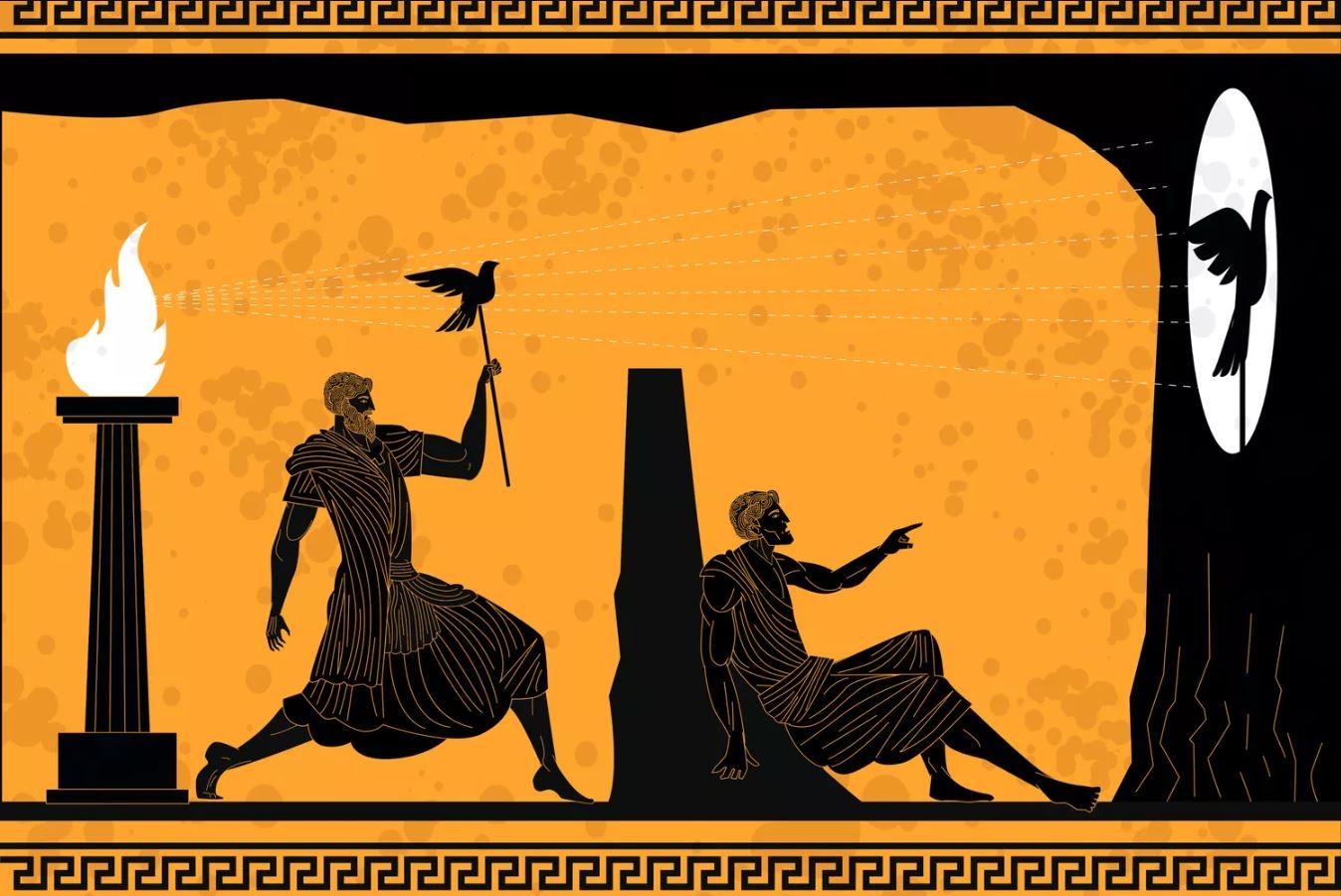
"Most pleasures are mere illusions - like someone in a cave thinking the middle is the top because they've never seen daylight."
Context: Explaining why bodily pleasures aren't real happiness
This transforms how we think about pleasure and pain. Most of what we call pleasure is just temporary relief from discomfort, not positive joy. Real happiness comes from feeding our higher nature with lasting goods like knowledge.
In Today's Words:
That feeling when your headache goes away isn't happiness - it's just not being in pain. Real joy is something positive, not just the absence of something negative.
"We each contain a many-headed beast, a lion, and a human."
Context: Creating an image of the three parts of the soul
This vivid metaphor makes abstract psychology concrete. The beast represents appetites, the lion is our spirited anger and courage, and the human is reason. Justice means keeping them in proper order, with the human in charge.
In Today's Words:
Inside you there's an animal that just wants to feed, a fighter that gets angry, and a thinker that makes plans - mental health means keeping the thinker in charge.
Thematic Threads
Power
In This Chapter
The tyrant appears powerful but is actually the most enslaved person, controlled by desires and fears
Development
Completes the progression from philosopher-kings (true power through wisdom) to tyrants (false power through appetite)
In Your Life:
The coworker who bullies others is usually the most insecure person in the room
Self-Deception
In This Chapter
People mistake the absence of pain for pleasure, like prisoners thinking the middle of a cave is the top
Development
Extends the cave allegory to show how we deceive ourselves about what makes us happy
In Your Life:
Thinking a day without crisis is good when you've never experienced real peace
Internal Order
In This Chapter
Justice means the human ruling with the lion's help over the beast - proper hierarchy within the soul
Development
Crystallizes the entire book's argument: external justice mirrors internal order
In Your Life:
Your worst days are when your emotions run your decisions instead of your thinking mind
Compound Effects
In This Chapter
The tyrannical person develops gradually - from rebellious youth to indulgent adult to enslaved tyrant
Development
Shows how the character types aren't fixed but evolve through accumulated choices
In Your Life:
That 'harmless' habit that now controls your evenings started with 'just this once'
You now have the context. Time to form your own thoughts.
Discussion Questions
- 1
What are the three creatures Plato says live inside every person, and what happens when we 'feed' one more than the others?
analysis • surface - 2
Why does Plato say the tyrant is actually the most enslaved person, even though they seem to have all the power?
analysis • medium - 3
Think about social media or shopping habits - how do you see the 'beast' getting fed in small ways that grow into bigger problems?
application • medium - 4
If you were helping a friend who keeps making the same bad choice (overspending, toxic relationships, etc.), how would you use Plato's three-creature framework to help them see what's happening?
application • deep - 5
What does this chapter teach us about why self-control gets harder the more we give in to temptation, and easier the more we practice it?
reflection • deep
Critical Thinking Exercise
Track Your Inner Kingdom
For the next week, keep a simple log of your daily choices. Mark each significant decision with B (fed the beast), H (fed the human), or L (fed the lion). At the end of each day, tally them up. Don't judge yourself - just observe the pattern. Which creature is winning in your inner kingdom?
Consider:
- •The beast isn't just obvious vices - it includes procrastination, gossip, and avoiding hard conversations
- •The lion can be positive (standing up for yourself) or negative (losing your temper)
- •Small choices count - hitting snooze vs getting up, scrolling vs reading, complaining vs problem-solving
Journaling Prompt
After tracking for a week, write about one area where the beast has been winning. What would it look like if the human took charge instead? What specific systems could you set up to make that easier?
Coming Up Next...
Chapter 10: The Immortal Soul and the Myth of Er
Plato returns to poetry's danger to the soul, revealing why even beloved Homer must be excluded from the ideal state. The conversation then turns to the ultimate question - what happens to just and unjust souls after death.