
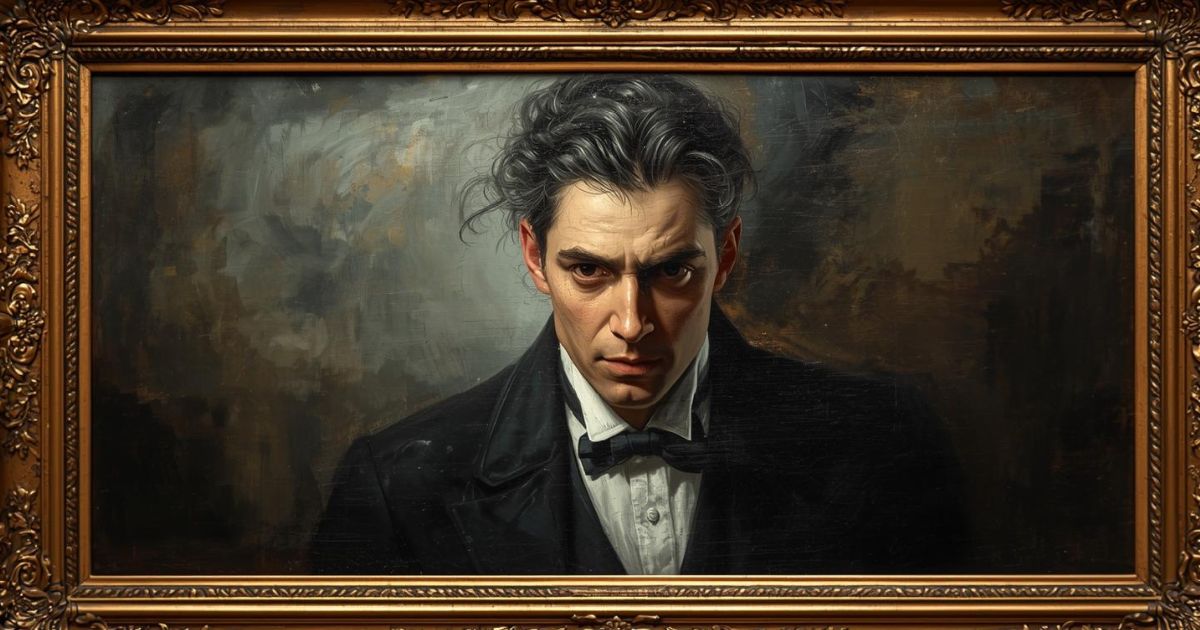
An excerpt from the original text.(complete · 3889 words)
s he was sitting at breakfast next morning, Basil Hallward was shown
into the room.
“I am so glad I have found you, Dorian,” he said gravely. “I called
last night, and they told me you were at the opera. Of course, I knew
that was impossible. But I wish you had left word where you had really
gone to. I passed a dreadful evening, half afraid that one tragedy
might be followed by another. I think you might have telegraphed for me
when you heard of it first. I read of it quite by chance in a late
edition of The Globe that I picked up at the club. I came here at
once and was miserable at not finding you. I can’t tell you how
heart-broken I am about the whole thing. I know what you must suffer.
But where were you? Did you go down and see the girl’s mother? For a
moment I thought of following you there. They gave the address in the
paper. Somewhere in the Euston Road, isn’t it? But I was afraid of
intruding upon a sorrow that I could not lighten. Poor woman! What a
state she must be in! And her only child, too! What did she say about
it all?”
“My dear Basil, how do I know?” murmured Dorian Gray, sipping some
pale-yellow wine from a delicate, gold-beaded bubble of Venetian glass
and looking dreadfully bored. “I was at the opera. You should have come
on there. I met Lady Gwendolen, Harry’s sister, for the first time. We
were in her box. She is perfectly charming; and Patti sang divinely.
Don’t talk about horrid subjects. If one doesn’t talk about a thing, it
has never happened. It is simply expression, as Harry says, that gives
reality to things. I may mention that she was not the woman’s only
child. There is a son, a charming fellow, I believe. But he is not on
the stage. He is a sailor, or something. And now, tell me about
yourself and what you are painting.”
“You went to the opera?” said Hallward, speaking very slowly and with a
strained touch of pain in his voice. “You went to the opera while Sibyl
Vane was lying dead in some sordid lodging? You can talk to me of other
women being charming, and of Patti singing divinely, before the girl
you loved has even the quiet of a grave to sleep in? Why, man, there
are horrors in store for that little white body of hers!”
“Stop, Basil! I won’t hear it!” cried Dorian, leaping to his feet. “You
must not tell me about things. What is done is done. What is past is
past.”
“You call yesterday the past?”
“What has the actual lapse of time got to do with it? It is only
shallow people who require years to get rid of an emotion. A man who is
master of himself can end a sorrow as easily as he can invent a
pleasure. I don’t want to be at the mercy of my emotions. I want to use
them, to enjoy them, and to dominate them.”
“Dorian, this is horrible! Something has changed you completely. You
look exactly the same wonderful boy who, day after day, used to come
down to my studio to sit for his picture. But you were simple, natural,
and affectionate then. You were the most unspoiled creature in the
whole world. Now, I don’t know what has come over you. You talk as if
you had no heart, no pity in you. It is all Harry’s influence. I see
that.”
The lad flushed up and, going to the window, looked out for a few
moments on the green, flickering, sun-lashed garden. “I owe a great
deal to Harry, Basil,” he said at last, “more than I owe to you. You
only taught me to be vain.”
“Well, I am punished for that, Dorian—or shall be some day.”
“I don’t know what you mean, Basil,” he exclaimed, turning round. “I
don’t know what you want. What do you want?”
“I want the Dorian Gray I used to paint,” said the artist sadly.
“Basil,” said the lad, going over to him and putting his hand on his
shoulder, “you have come too late. Yesterday, when I heard that Sibyl
Vane had killed herself—”
“Killed herself! Good heavens! is there no doubt about that?” cried
Hallward, looking up at him with an expression of horror.
“My dear Basil! Surely you don’t think it was a vulgar accident? Of
course she killed herself.”
The elder man buried his face in his hands. “How fearful,” he muttered,
and a shudder ran through him.
“No,” said Dorian Gray, “there is nothing fearful about it. It is one
of the great romantic tragedies of the age. As a rule, people who act
lead the most commonplace lives. They are good husbands, or faithful
wives, or something tedious. You know what I mean—middle-class virtue
and all that kind of thing. How different Sibyl was! She lived her
finest tragedy. She was always a heroine. The last night she played—the
night you saw her—she acted badly because she had known the reality of
love. When she knew its unreality, she died, as Juliet might have died.
She passed again into the sphere of art. There is something of the
martyr about her. Her death has all the pathetic uselessness of
martyrdom, all its wasted beauty. But, as I was saying, you must not
think I have not suffered. If you had come in yesterday at a particular
moment—about half-past five, perhaps, or a quarter to six—you would
have found me in tears. Even Harry, who was here, who brought me the
news, in fact, had no idea what I was going through. I suffered
immensely. Then it passed away. I cannot repeat an emotion. No one can,
except sentimentalists. And you are awfully unjust, Basil. You come
down here to console me. That is charming of you. You find me consoled,
and you are furious. How like a sympathetic person! You remind me of a
story Harry told me about a certain philanthropist who spent twenty
years of his life in trying to get some grievance redressed, or some
unjust law altered—I forget exactly what it was. Finally he succeeded,
and nothing could exceed his disappointment. He had absolutely nothing
to do, almost died of ennui, and became a confirmed misanthrope. And
besides, my dear old Basil, if you really want to console me, teach me
rather to forget what has happened, or to see it from a proper artistic
point of view. Was it not Gautier who used to write about la
consolation des arts? I remember picking up a little vellum-covered
book in your studio one day and chancing on that delightful phrase.
Well, I am not like that young man you told me of when we were down at
Marlow together, the young man who used to say that yellow satin could
console one for all the miseries of life. I love beautiful things that
one can touch and handle. Old brocades, green bronzes, lacquer-work,
carved ivories, exquisite surroundings, luxury, pomp—there is much to
be got from all these. But the artistic temperament that they create,
or at any rate reveal, is still more to me. To become the spectator of
one’s own life, as Harry says, is to escape the suffering of life. I
know you are surprised at my talking to you like this. You have not
realized how I have developed. I was a schoolboy when you knew me. I am
a man now. I have new passions, new thoughts, new ideas. I am
different, but you must not like me less. I am changed, but you must
always be my friend. Of course, I am very fond of Harry. But I know
that you are better than he is. You are not stronger—you are too much
afraid of life—but you are better. And how happy we used to be
together! Don’t leave me, Basil, and don’t quarrel with me. I am what I
am. There is nothing more to be said.”
The painter felt strangely moved. The lad was infinitely dear to him,
and his personality had been the great turning point in his art. He
could not bear the idea of reproaching him any more. After all, his
indifference was probably merely a mood that would pass away. There was
so much in him that was good, so much in him that was noble.
“Well, Dorian,” he said at length, with a sad smile, “I won’t speak to
you again about this horrible thing, after to-day. I only trust your
name won’t be mentioned in connection with it. The inquest is to take
place this afternoon. Have they summoned you?”
Dorian shook his head, and a look of annoyance passed over his face at
the mention of the word “inquest.” There was something so crude and
vulgar about everything of the kind. “They don’t know my name,” he
answered.
“But surely she did?”
“Only my Christian name, and that I am quite sure she never mentioned
to any one. She told me once that they were all rather curious to learn
who I was, and that she invariably told them my name was Prince
Charming. It was pretty of her. You must do me a drawing of Sibyl,
Basil. I should like to have something more of her than the memory of a
few kisses and some broken pathetic words.”
“I will try and do something, Dorian, if it would please you. But you
must come and sit to me yourself again. I can’t get on without you.”
“I can never sit to you again, Basil. It is impossible!” he exclaimed,
starting back.
The painter stared at him. “My dear boy, what nonsense!” he cried. “Do
you mean to say you don’t like what I did of you? Where is it? Why have
you pulled the screen in front of it? Let me look at it. It is the best
thing I have ever done. Do take the screen away, Dorian. It is simply
disgraceful of your servant hiding my work like that. I felt the room
looked different as I came in.”
“My servant has nothing to do with it, Basil. You don’t imagine I let
him arrange my room for me? He settles my flowers for me sometimes—that
is all. No; I did it myself. The light was too strong on the portrait.”
“Too strong! Surely not, my dear fellow? It is an admirable place for
it. Let me see it.” And Hallward walked towards the corner of the room.
A cry of terror broke from Dorian Gray’s lips, and he rushed between
the painter and the screen. “Basil,” he said, looking very pale, “you
must not look at it. I don’t wish you to.”
“Not look at my own work! You are not serious. Why shouldn’t I look at
it?” exclaimed Hallward, laughing.
“If you try to look at it, Basil, on my word of honour I will never
speak to you again as long as I live. I am quite serious. I don’t offer
any explanation, and you are not to ask for any. But, remember, if you
touch this screen, everything is over between us.”
Hallward was thunderstruck. He looked at Dorian Gray in absolute
amazement. He had never seen him like this before. The lad was actually
pallid with rage. His hands were clenched, and the pupils of his eyes
were like disks of blue fire. He was trembling all over.
“Dorian!”
“Don’t speak!”
“But what is the matter? Of course I won’t look at it if you don’t want
me to,” he said, rather coldly, turning on his heel and going over
towards the window. “But, really, it seems rather absurd that I
shouldn’t see my own work, especially as I am going to exhibit it in
Paris in the autumn. I shall probably have to give it another coat of
varnish before that, so I must see it some day, and why not to-day?”
“To exhibit it! You want to exhibit it?” exclaimed Dorian Gray, a
strange sense of terror creeping over him. Was the world going to be
shown his secret? Were people to gape at the mystery of his life? That
was impossible. Something—he did not know what—had to be done at once.
“Yes; I don’t suppose you will object to that. Georges Petit is going
to collect all my best pictures for a special exhibition in the Rue de
Sèze, which will open the first week in October. The portrait will only
be away a month. I should think you could easily spare it for that
time. In fact, you are sure to be out of town. And if you keep it
always behind a screen, you can’t care much about it.”
Dorian Gray passed his hand over his forehead. There were beads of
perspiration there. He felt that he was on the brink of a horrible
danger. “You told me a month ago that you would never exhibit it,” he
cried. “Why have you changed your mind? You people who go in for being
consistent have just as many moods as others have. The only difference
is that your moods are rather meaningless. You can’t have forgotten
that you assured me most solemnly that nothing in the world would
induce you to send it to any exhibition. You told Harry exactly the
same thing.” He stopped suddenly, and a gleam of light came into his
eyes. He remembered that Lord Henry had said to him once, half
seriously and half in jest, “If you want to have a strange quarter of
an hour, get Basil to tell you why he won’t exhibit your picture. He
told me why he wouldn’t, and it was a revelation to me.” Yes, perhaps
Basil, too, had his secret. He would ask him and try.
“Basil,” he said, coming over quite close and looking him straight in
the face, “we have each of us a secret. Let me know yours, and I shall
tell you mine. What was your reason for refusing to exhibit my
picture?”
The painter shuddered in spite of himself. “Dorian, if I told you, you
might like me less than you do, and you would certainly laugh at me. I
could not bear your doing either of those two things. If you wish me
never to look at your picture again, I am content. I have always you to
look at. If you wish the best work I have ever done to be hidden from
the world, I am satisfied. Your friendship is dearer to me than any
fame or reputation.”
“No, Basil, you must tell me,” insisted Dorian Gray. “I think I have a
right to know.” His feeling of terror had passed away, and curiosity
had taken its place. He was determined to find out Basil Hallward’s
mystery.
“Let us sit down, Dorian,” said the painter, looking troubled. “Let us
sit down. And just answer me one question. Have you noticed in the
picture something curious?—something that probably at first did not
strike you, but that revealed itself to you suddenly?”
“Basil!” cried the lad, clutching the arms of his chair with trembling
hands and gazing at him with wild startled eyes.
“I see you did. Don’t speak. Wait till you hear what I have to say.
Dorian, from the moment I met you, your personality had the most
extraordinary influence over me. I was dominated, soul, brain, and
power, by you. You became to me the visible incarnation of that unseen
ideal whose memory haunts us artists like an exquisite dream. I
worshipped you. I grew jealous of every one to whom you spoke. I wanted
to have you all to myself. I was only happy when I was with you. When
you were away from me, you were still present in my art.... Of course,
I never let you know anything about this. It would have been
impossible. You would not have understood it. I hardly understood it
myself. I only knew that I had seen perfection face to face, and that
the world had become wonderful to my eyes—too wonderful, perhaps, for
in such mad worships there is peril, the peril of losing them, no less
than the peril of keeping them.... Weeks and weeks went on, and I grew
more and more absorbed in you. Then came a new development. I had drawn
you as Paris in dainty armour, and as Adonis with huntsman’s cloak and
polished boar-spear. Crowned with heavy lotus-blossoms you had sat on
the prow of Adrian’s barge, gazing across the green turbid Nile. You
had leaned over the still pool of some Greek woodland and seen in the
water’s silent silver the marvel of your own face. And it had all been
what art should be—unconscious, ideal, and remote. One day, a fatal day
I sometimes think, I determined to paint a wonderful portrait of you as
you actually are, not in the costume of dead ages, but in your own
dress and in your own time. Whether it was the realism of the method,
or the mere wonder of your own personality, thus directly presented to
me without mist or veil, I cannot tell. But I know that as I worked at
it, every flake and film of colour seemed to me to reveal my secret. I
grew afraid that others would know of my idolatry. I felt, Dorian, that
I had told too much, that I had put too much of myself into it. Then it
was that I resolved never to allow the picture to be exhibited. You
were a little annoyed; but then you did not realize all that it meant
to me. Harry, to whom I talked about it, laughed at me. But I did not
mind that. When the picture was finished, and I sat alone with it, I
felt that I was right.... Well, after a few days the thing left my
studio, and as soon as I had got rid of the intolerable fascination of
its presence, it seemed to me that I had been foolish in imagining that
I had seen anything in it, more than that you were extremely
good-looking and that I could paint. Even now I cannot help feeling
that it is a mistake to think that the passion one feels in creation is
ever really shown in the work one creates. Art is always more abstract
than we fancy. Form and colour tell us of form and colour—that is all.
It often seems to me that art conceals the artist far more completely
than it ever reveals him. And so when I got this offer from Paris, I
determined to make your portrait the principal thing in my exhibition.
It never occurred to me that you would refuse. I see now that you were
right. The picture cannot be shown. You must not be angry with me,
Dorian, for what I have told you. As I said to Harry, once, you are
made to be worshipped.”
Dorian Gray drew a long breath. The colour came back to his cheeks, and
a smile played about his lips. The peril was over. He was safe for the
time. Yet he could not help feeling infinite pity for the painter who
had just made this strange confession to him, and wondered if he
himself would ever be so dominated by the personality of a friend. Lord
Henry had the charm of being very dangerous. But that was all. He was
too clever and too cynical to be really fond of. Would there ever be
some one who would fill him with a strange idolatry? Was that one of
the things that life had in store?
“It is extraordinary to me, Dorian,” said Hallward, “that you should
have seen this in the portrait. Did you really see it?”
“I saw something in it,” he answered, “something that seemed to me very
curious.”
“Well, you don’t mind my looking at the thing now?”
Dorian shook his head. “You must not ask me that, Basil. I could not
possibly let you stand in front of that picture.”
“You will some day, surely?”
“Never.”
“Well, perhaps you are right. And now good-bye, Dorian. You have been
the one person in my life who has really influenced my art. Whatever I
have done that is good, I owe to you. Ah! you don’t know what it cost
me to tell you all that I have told you.”
“My dear Basil,” said Dorian, “what have you told me? Simply that you
felt that you admired me too much. That is not even a compliment.”
“It was not intended as a compliment. It was a confession. Now that I
have made it, something seems to have gone out of me. Perhaps one
should never put one’s worship into words.”
“It was a very disappointing confession.”
“Why, what did you expect, Dorian? You didn’t see anything else in the
picture, did you? There was nothing else to see?”
“No; there was nothing else to see. Why do you ask? But you mustn’t
talk about worship. It is foolish. You and I are friends, Basil, and we
must always remain so.”
“You have got Harry,” said the painter sadly.
“Oh, Harry!” cried the lad, with a ripple of laughter. “Harry spends
his days in saying what is incredible and his evenings in doing what is
improbable. Just the sort of life I would like to lead. But still I
don’t think I would go to Harry if I were in trouble. I would sooner go
to you, Basil.”
“You will sit to me again?”
“Impossible!”
“You spoil my life as an artist by refusing, Dorian. No man comes
across two ideal things. Few come across one.”
“I can’t explain it to you, Basil, but I must never sit to you again.
There is something fatal about a portrait. It has a life of its own. I
will come and have tea with you. That will be just as pleasant.”
“Pleasanter for you, I am afraid,” murmured Hallward regretfully. “And
now good-bye. I am sorry you won’t let me look at the picture once
again. But that can’t be helped. I quite understand what you feel about
it.”
As he left the room, Dorian Gray smiled to himself. Poor Basil! How
little he knew of the true reason! And how strange it was that, instead
of having been forced to reveal his own secret, he had succeeded,
almost by chance, in wresting a secret from his friend! How much that
strange confession explained to him! The painter’s absurd fits of
jealousy, his wild devotion, his extravagant panegyrics, his curious
reticences—he understood them all now, and he felt sorry. There seemed
to him to be something tragic in a friendship so coloured by romance.
He sighed and touched the bell. The portrait must be hidden away at all
costs. He could not run such a risk of discovery again. It had been mad
of him to have allowed the thing to remain, even for an hour, in a room
to which any of his friends had access.
Master this chapter. Complete your experience
Purchase the complete book to access all chapters and support classic literature
As an Amazon Associate, we earn a small commission from qualifying purchases at no additional cost to you.
Available in paperback, hardcover, and e-book formats
Let's Analyse the Pattern
When you try to compartmentalize wrongdoing, your conscience eventually breaks through, creating paranoia and psychological torment that no external success can cure.
Why This Matters
Connect literature to life
This chapter teaches how to distinguish between rational concern and conscience-driven anxiety that signals hidden wrongdoing.
Practice This Today
This week, notice when anxiety feels like 'everyone knows something' - that's usually your conscience trying to get your attention about something you've been avoiding.
Now let's explore the literary elements.
Key Quotes & Analysis
"He was afraid of every stranger he met, and every casual passer-by seemed to him to be a spy."
Context: Describing Dorian's paranoid state as he walks through London
This shows how guilt transforms innocent situations into threats. When you know you deserve punishment, everyone becomes a potential judge or executioner.
In Today's Words:
When you're hiding something big, every stranger feels like they know your secret.
"The very sharpness of the contrast used to quicken his sense of pleasure. He had been tortured by it, and he had found in it a kind of joy."
Context: Reflecting on how Dorian used to enjoy the contrast between his beautiful appearance and his ugly actions
This reveals the psychology of someone who gets a thrill from getting away with things. But that thrill is fading as the weight of his actions grows heavier.
In Today's Words:
He used to get a rush from fooling everyone, but that high doesn't work anymore.
"It was not conscience that made cowards of them all. It was the fear of society."
Context: Dorian reflecting on why people follow moral rules
Dorian is trying to convince himself that morality is just social pressure, not genuine right and wrong. This is his attempt to minimize his guilt by claiming everyone else is just as fake.
In Today's Words:
People only act good because they're scared of getting caught, not because they actually care about right and wrong.
Thematic Threads
Guilt
In This Chapter
Dorian's paranoia and inability to enjoy his former pleasures as his conscience finally breaks through his psychological defenses
Development
Evolved from earlier denial and compartmentalization to active psychological torment
In Your Life:
You might recognize this in your own sleepless nights after treating someone badly, when guilt makes every interaction feel loaded with judgment.
Identity
In This Chapter
The growing gap between Dorian's beautiful public face and his internal psychological decay becomes impossible to maintain
Development
Developed from simple vanity to a complete split between public and private self
In Your Life:
You see this when maintaining a false image becomes exhausting and you start to crack under the pressure of pretending.
Class
In This Chapter
Dorian's social status and wealth can no longer protect him from the psychological consequences of his actions
Development
Evolved from class privilege providing easy escape to being powerless against internal reckoning
In Your Life:
You might notice how money and status feel meaningless when you're dealing with genuine guilt or grief.
Personal Growth
In This Chapter
Dorian's forced confrontation with his conscience represents the beginning of genuine self-awareness, though he resists it
Development
First real moment of potential growth after years of moral regression
In Your Life:
You experience this when you can no longer lie to yourself about your behavior and must choose between change or continued suffering.
You now have the context. Time to form your own thoughts.
Discussion Questions
- 1
Why can't Dorian enjoy his usual pleasures anymore - his art, music, and social gatherings?
analysis • surface - 2
What's the connection between Dorian's guilt and his paranoia about strangers on the street?
analysis • medium - 3
Where do you see this pattern of guilt creating paranoia in modern life - at work, in relationships, or in families?
application • medium - 4
If someone you cared about was trapped in this cycle of guilt and paranoia, what practical steps would you suggest they take?
application • deep - 5
What does Dorian's experience teach us about the relationship between our public image and our private conscience?
reflection • deep
Critical Thinking Exercise
Map Your Guilt Triggers
Think about a time when you felt guilty about something you did or didn't do. Write down three specific ways that guilt showed up in your daily life - did you avoid certain people, places, or conversations? Did you become suspicious or defensive about unrelated things? Map the connection between your internal guilt and your external behavior patterns.
Consider:
- •Guilt often disguises itself as other emotions like anger, defensiveness, or anxiety
- •The things we avoid or the people we can't look in the eye often reveal our unresolved guilt
- •Recognizing these patterns is the first step to breaking free from them
Journaling Prompt
Write about a time when guilt followed you home and affected how you interacted with innocent people. How did you eventually resolve it, or what would you do differently now?
Coming Up Next...
Chapter 10
Dorian's desperation reaches a breaking point as he makes a fateful decision about the portrait that has haunted him for so long. His attempt to destroy the evidence of his corruption will have consequences he never imagined.



