
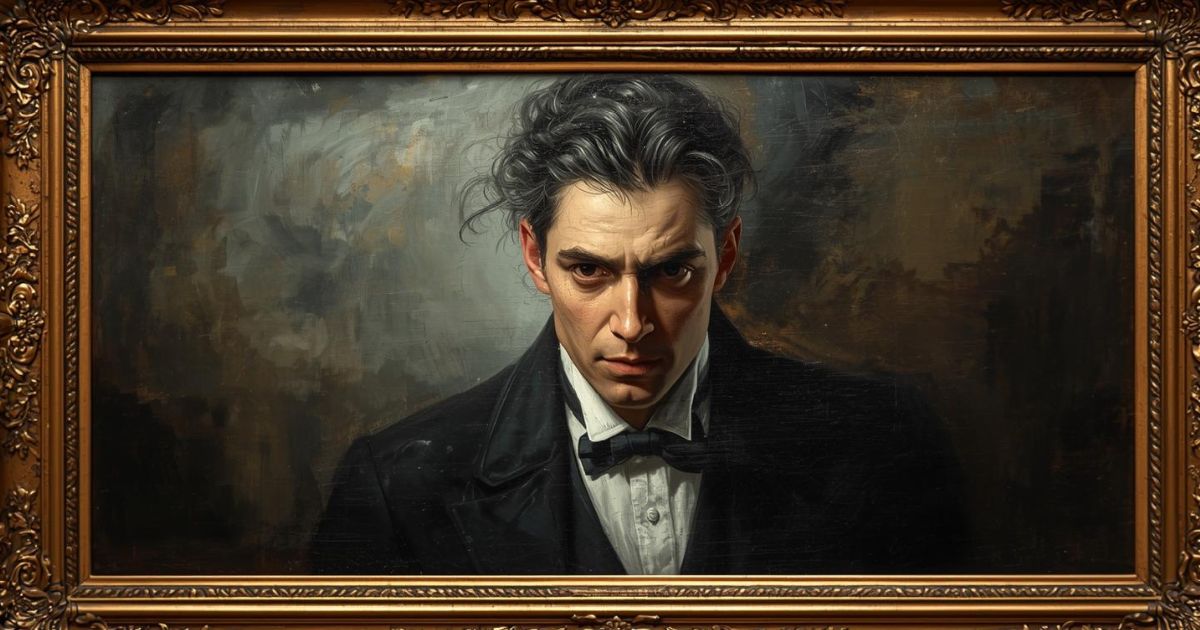
An excerpt from the original text.(complete · 3223 words)
hen his servant entered, he looked at him steadfastly and wondered if
he had thought of peering behind the screen. The man was quite
impassive and waited for his orders. Dorian lit a cigarette and walked
over to the glass and glanced into it. He could see the reflection of
Victor’s face perfectly. It was like a placid mask of servility. There
was nothing to be afraid of, there. Yet he thought it best to be on his
guard.
Speaking very slowly, he told him to tell the house-keeper that he
wanted to see her, and then to go to the frame-maker and ask him to
send two of his men round at once. It seemed to him that as the man
left the room his eyes wandered in the direction of the screen. Or was
that merely his own fancy?
After a few moments, in her black silk dress, with old-fashioned thread
mittens on her wrinkled hands, Mrs. Leaf bustled into the library. He
asked her for the key of the schoolroom.
“The old schoolroom, Mr. Dorian?” she exclaimed. “Why, it is full of
dust. I must get it arranged and put straight before you go into it. It
is not fit for you to see, sir. It is not, indeed.”
“I don’t want it put straight, Leaf. I only want the key.”
“Well, sir, you’ll be covered with cobwebs if you go into it. Why, it
hasn’t been opened for nearly five years—not since his lordship died.”
He winced at the mention of his grandfather. He had hateful memories of
him. “That does not matter,” he answered. “I simply want to see the
place—that is all. Give me the key.”
“And here is the key, sir,” said the old lady, going over the contents
of her bunch with tremulously uncertain hands. “Here is the key. I’ll
have it off the bunch in a moment. But you don’t think of living up
there, sir, and you so comfortable here?”
“No, no,” he cried petulantly. “Thank you, Leaf. That will do.”
She lingered for a few moments, and was garrulous over some detail of
the household. He sighed and told her to manage things as she thought
best. She left the room, wreathed in smiles.
As the door closed, Dorian put the key in his pocket and looked round
the room. His eye fell on a large, purple satin coverlet heavily
embroidered with gold, a splendid piece of late seventeenth-century
Venetian work that his grandfather had found in a convent near Bologna.
Yes, that would serve to wrap the dreadful thing in. It had perhaps
served often as a pall for the dead. Now it was to hide something that
had a corruption of its own, worse than the corruption of death
itself—something that would breed horrors and yet would never die. What
the worm was to the corpse, his sins would be to the painted image on
the canvas. They would mar its beauty and eat away its grace. They
would defile it and make it shameful. And yet the thing would still
live on. It would be always alive.
He shuddered, and for a moment he regretted that he had not told Basil
the true reason why he had wished to hide the picture away. Basil would
have helped him to resist Lord Henry’s influence, and the still more
poisonous influences that came from his own temperament. The love that
he bore him—for it was really love—had nothing in it that was not noble
and intellectual. It was not that mere physical admiration of beauty
that is born of the senses and that dies when the senses tire. It was
such love as Michelangelo had known, and Montaigne, and Winckelmann,
and Shakespeare himself. Yes, Basil could have saved him. But it was
too late now. The past could always be annihilated. Regret, denial, or
forgetfulness could do that. But the future was inevitable. There were
passions in him that would find their terrible outlet, dreams that
would make the shadow of their evil real.
He took up from the couch the great purple-and-gold texture that
covered it, and, holding it in his hands, passed behind the screen. Was
the face on the canvas viler than before? It seemed to him that it was
unchanged, and yet his loathing of it was intensified. Gold hair, blue
eyes, and rose-red lips—they all were there. It was simply the
expression that had altered. That was horrible in its cruelty. Compared
to what he saw in it of censure or rebuke, how shallow Basil’s
reproaches about Sibyl Vane had been!—how shallow, and of what little
account! His own soul was looking out at him from the canvas and
calling him to judgement. A look of pain came across him, and he flung
the rich pall over the picture. As he did so, a knock came to the door.
He passed out as his servant entered.
“The persons are here, Monsieur.”
He felt that the man must be got rid of at once. He must not be allowed
to know where the picture was being taken to. There was something sly
about him, and he had thoughtful, treacherous eyes. Sitting down at the
writing-table he scribbled a note to Lord Henry, asking him to send him
round something to read and reminding him that they were to meet at
eight-fifteen that evening.
“Wait for an answer,” he said, handing it to him, “and show the men in
here.”
In two or three minutes there was another knock, and Mr. Hubbard
himself, the celebrated frame-maker of South Audley Street, came in
with a somewhat rough-looking young assistant. Mr. Hubbard was a
florid, red-whiskered little man, whose admiration for art was
considerably tempered by the inveterate impecuniosity of most of the
artists who dealt with him. As a rule, he never left his shop. He
waited for people to come to him. But he always made an exception in
favour of Dorian Gray. There was something about Dorian that charmed
everybody. It was a pleasure even to see him.
“What can I do for you, Mr. Gray?” he said, rubbing his fat freckled
hands. “I thought I would do myself the honour of coming round in
person. I have just got a beauty of a frame, sir. Picked it up at a
sale. Old Florentine. Came from Fonthill, I believe. Admirably suited
for a religious subject, Mr. Gray.”
“I am so sorry you have given yourself the trouble of coming round, Mr.
Hubbard. I shall certainly drop in and look at the frame—though I don’t
go in much at present for religious art—but to-day I only want a
picture carried to the top of the house for me. It is rather heavy, so
I thought I would ask you to lend me a couple of your men.”
“No trouble at all, Mr. Gray. I am delighted to be of any service to
you. Which is the work of art, sir?”
“This,” replied Dorian, moving the screen back. “Can you move it,
covering and all, just as it is? I don’t want it to get scratched going
upstairs.”
“There will be no difficulty, sir,” said the genial frame-maker,
beginning, with the aid of his assistant, to unhook the picture from
the long brass chains by which it was suspended. “And, now, where shall
we carry it to, Mr. Gray?”
“I will show you the way, Mr. Hubbard, if you will kindly follow me. Or
perhaps you had better go in front. I am afraid it is right at the top
of the house. We will go up by the front staircase, as it is wider.”
He held the door open for them, and they passed out into the hall and
began the ascent. The elaborate character of the frame had made the
picture extremely bulky, and now and then, in spite of the obsequious
protests of Mr. Hubbard, who had the true tradesman’s spirited dislike
of seeing a gentleman doing anything useful, Dorian put his hand to it
so as to help them.
“Something of a load to carry, sir,” gasped the little man when they
reached the top landing. And he wiped his shiny forehead.
“I am afraid it is rather heavy,” murmured Dorian as he unlocked the
door that opened into the room that was to keep for him the curious
secret of his life and hide his soul from the eyes of men.
He had not entered the place for more than four years—not, indeed,
since he had used it first as a play-room when he was a child, and then
as a study when he grew somewhat older. It was a large,
well-proportioned room, which had been specially built by the last Lord
Kelso for the use of the little grandson whom, for his strange likeness
to his mother, and also for other reasons, he had always hated and
desired to keep at a distance. It appeared to Dorian to have but little
changed. There was the huge Italian cassone, with its fantastically
painted panels and its tarnished gilt mouldings, in which he had so
often hidden himself as a boy. There the satinwood book-case filled
with his dog-eared schoolbooks. On the wall behind it was hanging the
same ragged Flemish tapestry where a faded king and queen were playing
chess in a garden, while a company of hawkers rode by, carrying hooded
birds on their gauntleted wrists. How well he remembered it all! Every
moment of his lonely childhood came back to him as he looked round. He
recalled the stainless purity of his boyish life, and it seemed
horrible to him that it was here the fatal portrait was to be hidden
away. How little he had thought, in those dead days, of all that was in
store for him!
But there was no other place in the house so secure from prying eyes as
this. He had the key, and no one else could enter it. Beneath its
purple pall, the face painted on the canvas could grow bestial, sodden,
and unclean. What did it matter? No one could see it. He himself would
not see it. Why should he watch the hideous corruption of his soul? He
kept his youth—that was enough. And, besides, might not his nature grow
finer, after all? There was no reason that the future should be so full
of shame. Some love might come across his life, and purify him, and
shield him from those sins that seemed to be already stirring in spirit
and in flesh—those curious unpictured sins whose very mystery lent them
their subtlety and their charm. Perhaps, some day, the cruel look would
have passed away from the scarlet sensitive mouth, and he might show to
the world Basil Hallward’s masterpiece.
No; that was impossible. Hour by hour, and week by week, the thing upon
the canvas was growing old. It might escape the hideousness of sin, but
the hideousness of age was in store for it. The cheeks would become
hollow or flaccid. Yellow crow’s feet would creep round the fading eyes
and make them horrible. The hair would lose its brightness, the mouth
would gape or droop, would be foolish or gross, as the mouths of old
men are. There would be the wrinkled throat, the cold, blue-veined
hands, the twisted body, that he remembered in the grandfather who had
been so stern to him in his boyhood. The picture had to be concealed.
There was no help for it.
“Bring it in, Mr. Hubbard, please,” he said, wearily, turning round. “I
am sorry I kept you so long. I was thinking of something else.”
“Always glad to have a rest, Mr. Gray,” answered the frame-maker, who
was still gasping for breath. “Where shall we put it, sir?”
“Oh, anywhere. Here: this will do. I don’t want to have it hung up.
Just lean it against the wall. Thanks.”
“Might one look at the work of art, sir?”
Dorian started. “It would not interest you, Mr. Hubbard,” he said,
keeping his eye on the man. He felt ready to leap upon him and fling
him to the ground if he dared to lift the gorgeous hanging that
concealed the secret of his life. “I shan’t trouble you any more now. I
am much obliged for your kindness in coming round.”
“Not at all, not at all, Mr. Gray. Ever ready to do anything for you,
sir.” And Mr. Hubbard tramped downstairs, followed by the assistant,
who glanced back at Dorian with a look of shy wonder in his rough
uncomely face. He had never seen any one so marvellous.
When the sound of their footsteps had died away, Dorian locked the door
and put the key in his pocket. He felt safe now. No one would ever look
upon the horrible thing. No eye but his would ever see his shame.
On reaching the library, he found that it was just after five o’clock
and that the tea had been already brought up. On a little table of dark
perfumed wood thickly incrusted with nacre, a present from Lady Radley,
his guardian’s wife, a pretty professional invalid, who had spent the
preceding winter in Cairo, was lying a note from Lord Henry, and beside
it was a book bound in yellow paper, the cover slightly torn and the
edges soiled. A copy of the third edition of The St. James’s Gazette
had been placed on the tea-tray. It was evident that Victor had
returned. He wondered if he had met the men in the hall as they were
leaving the house and had wormed out of them what they had been doing.
He would be sure to miss the picture—had no doubt missed it already,
while he had been laying the tea-things. The screen had not been set
back, and a blank space was visible on the wall. Perhaps some night he
might find him creeping upstairs and trying to force the door of the
room. It was a horrible thing to have a spy in one’s house. He had
heard of rich men who had been blackmailed all their lives by some
servant who had read a letter, or overheard a conversation, or picked
up a card with an address, or found beneath a pillow a withered flower
or a shred of crumpled lace.
He sighed, and having poured himself out some tea, opened Lord Henry’s
note. It was simply to say that he sent him round the evening paper,
and a book that might interest him, and that he would be at the club at
eight-fifteen. He opened The St. James’s languidly, and looked
through it. A red pencil-mark on the fifth page caught his eye. It drew
attention to the following paragraph:
INQUEST ON AN ACTRESS.—An inquest was held this morning at the Bell
Tavern, Hoxton Road, by Mr. Danby, the District Coroner, on the body of
Sibyl Vane, a young actress recently engaged at the Royal Theatre,
Holborn. A verdict of death by misadventure was returned. Considerable
sympathy was expressed for the mother of the deceased, who was greatly
affected during the giving of her own evidence, and that of Dr.
Birrell, who had made the post-mortem examination of the deceased.
He frowned, and tearing the paper in two, went across the room and
flung the pieces away. How ugly it all was! And how horribly real
ugliness made things! He felt a little annoyed with Lord Henry for
having sent him the report. And it was certainly stupid of him to have
marked it with red pencil. Victor might have read it. The man knew more
than enough English for that.
Perhaps he had read it and had begun to suspect something. And, yet,
what did it matter? What had Dorian Gray to do with Sibyl Vane’s death?
There was nothing to fear. Dorian Gray had not killed her.
His eye fell on the yellow book that Lord Henry had sent him. What was
it, he wondered. He went towards the little, pearl-coloured octagonal
stand that had always looked to him like the work of some strange
Egyptian bees that wrought in silver, and taking up the volume, flung
himself into an arm-chair and began to turn over the leaves. After a
few minutes he became absorbed. It was the strangest book that he had
ever read. It seemed to him that in exquisite raiment, and to the
delicate sound of flutes, the sins of the world were passing in dumb
show before him. Things that he had dimly dreamed of were suddenly made
real to him. Things of which he had never dreamed were gradually
revealed.
It was a novel without a plot and with only one character, being,
indeed, simply a psychological study of a certain young Parisian who
spent his life trying to realize in the nineteenth century all the
passions and modes of thought that belonged to every century except his
own, and to sum up, as it were, in himself the various moods through
which the world-spirit had ever passed, loving for their mere
artificiality those renunciations that men have unwisely called virtue,
as much as those natural rebellions that wise men still call sin. The
style in which it was written was that curious jewelled style, vivid
and obscure at once, full of argot and of archaisms, of technical
expressions and of elaborate paraphrases, that characterizes the work
of some of the finest artists of the French school of Symbolistes.
There were in it metaphors as monstrous as orchids and as subtle in
colour. The life of the senses was described in the terms of mystical
philosophy. One hardly knew at times whether one was reading the
spiritual ecstasies of some mediæval saint or the morbid confessions of
a modern sinner. It was a poisonous book. The heavy odour of incense
seemed to cling about its pages and to trouble the brain. The mere
cadence of the sentences, the subtle monotony of their music, so full
as it was of complex refrains and movements elaborately repeated,
produced in the mind of the lad, as he passed from chapter to chapter,
a form of reverie, a malady of dreaming, that made him unconscious of
the falling day and creeping shadows.
Cloudless, and pierced by one solitary star, a copper-green sky gleamed
through the windows. He read on by its wan light till he could read no
more. Then, after his valet had reminded him several times of the
lateness of the hour, he got up, and going into the next room, placed
the book on the little Florentine table that always stood at his
bedside and began to dress for dinner.
It was almost nine o’clock before he reached the club, where he found
Lord Henry sitting alone, in the morning-room, looking very much bored.
“I am so sorry, Harry,” he cried, “but really it is entirely your
fault. That book you sent me so fascinated me that I forgot how the
time was going.”
“Yes, I thought you would like it,” replied his host, rising from his
chair.
“I didn’t say I liked it, Harry. I said it fascinated me. There is a
great difference.”
“Ah, you have discovered that?” murmured Lord Henry. And they passed
into the dining-room.
Master this chapter. Complete your experience
Purchase the complete book to access all chapters and support classic literature
As an Amazon Associate, we earn a small commission from qualifying purchases at no additional cost to you.
Available in paperback, hardcover, and e-book formats
Let's Analyse the Pattern
Using external acquisitions or experiences to fill internal emptiness, creating an endless cycle of temporary relief followed by deeper craving.
Why This Matters
Connect literature to life
This chapter teaches how to spot when collection or consumption becomes compulsive—when you need more and more of something to feel normal.
Practice This Today
This week, notice when you reach for your phone, your wallet, or any comfort habit—pause and ask yourself what feeling you're trying to avoid or fill.
Now let's explore the literary elements.
Key Quotes & Analysis
"It was the strangest book that he had ever read. It seemed to him that in exquisite raiment, and to the delicate sound of flutes, the sins of the world were passing in dumb show before him."
Context: Describing Dorian's reaction to reading the yellow book
This quote shows how the book presents corruption as beautiful and artistic rather than harmful. Dorian is seduced by the elegant presentation of vice, making sin seem glamorous and appealing.
In Today's Words:
The book made doing wrong things look cool and sophisticated, like watching a glamorous TV show about bad behavior.
"For years, Dorian Gray could not free himself from the influence of this book."
Context: Explaining how the book shaped Dorian's entire philosophy of life
This reveals how powerful influences can completely reshape someone's values and behavior. Dorian becomes trapped by a worldview that initially seemed liberating.
In Today's Words:
That book completely changed how he saw life, and he couldn't shake its influence no matter how hard he tried.
"He would often adopt certain modes of thought that he knew to be really alien to his nature, abandon himself to their subtle influences, and then, having, as it were, caught their colour and satisfied his intellectual curiosity, leave them with that curious indifference which is not incompatible with a real ardour of temperament."
Context: Describing how Dorian experiments with different philosophies and lifestyles
This shows Dorian treating beliefs and values like fashion accessories - trying them on for the experience rather than genuine conviction. He's become incapable of authentic commitment to anything.
In Today's Words:
He'd get obsessed with new ideas or trends just to see what they felt like, then drop them when he got bored and move on to the next thing.
Thematic Threads
Identity
In This Chapter
Dorian completely abandons authentic self-discovery, instead constructing identity through objects and sensations
Development
Evolved from earlier uncertainty about who he is to active avoidance of self-knowledge
In Your Life:
You might recognize this when you define yourself by what you own, achieve, or consume rather than who you actually are.
Class
In This Chapter
Dorian uses wealth to access endless pleasures and beautiful objects, showing how money enables avoidance of real problems
Development
Builds on earlier themes of privilege allowing escape from consequences
In Your Life:
You see this when people use whatever resources they have—money, status, connections—to avoid dealing with difficult truths.
Social Expectations
In This Chapter
Dorian maintains perfect public appearance while hiding his true corruption, living a complete double life
Development
Intensified from earlier concern with reputation to active deception
In Your Life:
This shows up when you exhaust yourself maintaining an image that doesn't match your reality.
Personal Growth
In This Chapter
Dorian actively chooses sensation over growth, using the yellow book as justification for avoiding moral development
Development
Represents complete rejection of the growth opportunities presented in earlier chapters
In Your Life:
You might recognize this when you choose comfort, pleasure, or distraction over the harder work of actually changing.
Human Relationships
In This Chapter
Dorian becomes increasingly isolated, relating more to objects than people, treating relationships as another form of collection
Development
Shows progression from Lord Henry's influence to complete disconnection from authentic human connection
In Your Life:
This appears when you find yourself more attached to things, achievements, or online interactions than real relationships.
You now have the context. Time to form your own thoughts.
Discussion Questions
- 1
What changes in Dorian's behavior after he reads the yellow book, and how does he spend his time?
analysis • surface - 2
Why does Dorian become obsessed with collecting beautiful objects, and what pattern do you notice in how each new acquisition affects him?
analysis • medium - 3
Where do you see people today using shopping, experiences, or collecting things to fill an emotional void?
application • medium - 4
When you recognize the consumption trap in your own life, what strategies could help you address the underlying emptiness instead of just acquiring more?
application • deep - 5
What does Dorian's need to hide his portrait reveal about self-awareness and the cost of avoiding who we're becoming?
reflection • deep
Critical Thinking Exercise
Track Your Consumption Patterns
For the next 24 hours, notice when you reach for something to fill time or avoid feelings - your phone, food, shopping, TV, social media. Don't judge or change anything yet, just observe. Write down what you were feeling right before you reached for each thing. Look for patterns in your emotional triggers.
Consider:
- •Pay attention to the difference between genuine need and emotional filling
- •Notice if certain emotions consistently trigger the same consumption behaviors
- •Observe whether the thing you reached for actually solved the underlying feeling
Journaling Prompt
Write about a time when you kept buying, consuming, or collecting something but never felt satisfied. What were you really trying to fill or avoid?
Coming Up Next...
Chapter 11
Dorian's reputation in London society begins to shift as whispers and rumors start following him wherever he goes. Some of the most respected families suddenly refuse to receive him, and young men who were once his friends cross the street to avoid him.



