
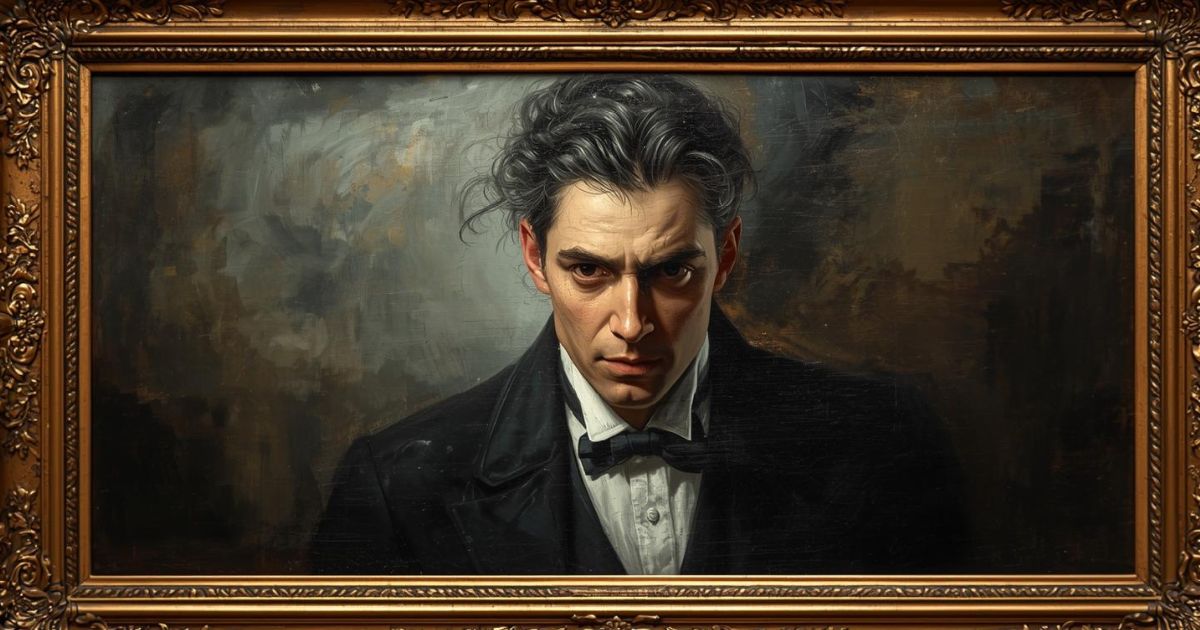
An excerpt from the original text.(complete · 7350 words)
or years, Dorian Gray could not free himself from the influence of
this book. Or perhaps it would be more accurate to say that he never
sought to free himself from it. He procured from Paris no less than
nine large-paper copies of the first edition, and had them bound in
different colours, so that they might suit his various moods and the
changing fancies of a nature over which he seemed, at times, to have
almost entirely lost control. The hero, the wonderful young Parisian in
whom the romantic and the scientific temperaments were so strangely
blended, became to him a kind of prefiguring type of himself. And,
indeed, the whole book seemed to him to contain the story of his own
life, written before he had lived it.
In one point he was more fortunate than the novel’s fantastic hero. He
never knew—never, indeed, had any cause to know—that somewhat grotesque
dread of mirrors, and polished metal surfaces, and still water which
came upon the young Parisian so early in his life, and was occasioned
by the sudden decay of a beau that had once, apparently, been so
remarkable. It was with an almost cruel joy—and perhaps in nearly every
joy, as certainly in every pleasure, cruelty has its place—that he used
to read the latter part of the book, with its really tragic, if
somewhat overemphasized, account of the sorrow and despair of one who
had himself lost what in others, and the world, he had most dearly
valued.
For the wonderful beauty that had so fascinated Basil Hallward, and
many others besides him, seemed never to leave him. Even those who had
heard the most evil things against him—and from time to time strange
rumours about his mode of life crept through London and became the
chatter of the clubs—could not believe anything to his dishonour when
they saw him. He had always the look of one who had kept himself
unspotted from the world. Men who talked grossly became silent when
Dorian Gray entered the room. There was something in the purity of his
face that rebuked them. His mere presence seemed to recall to them the
memory of the innocence that they had tarnished. They wondered how one
so charming and graceful as he was could have escaped the stain of an
age that was at once sordid and sensual.
Often, on returning home from one of those mysterious and prolonged
absences that gave rise to such strange conjecture among those who were
his friends, or thought that they were so, he himself would creep
upstairs to the locked room, open the door with the key that never left
him now, and stand, with a mirror, in front of the portrait that Basil
Hallward had painted of him, looking now at the evil and aging face on
the canvas, and now at the fair young face that laughed back at him
from the polished glass. The very sharpness of the contrast used to
quicken his sense of pleasure. He grew more and more enamoured of his
own beauty, more and more interested in the corruption of his own soul.
He would examine with minute care, and sometimes with a monstrous and
terrible delight, the hideous lines that seared the wrinkling forehead
or crawled around the heavy sensual mouth, wondering sometimes which
were the more horrible, the signs of sin or the signs of age. He would
place his white hands beside the coarse bloated hands of the picture,
and smile. He mocked the misshapen body and the failing limbs.
There were moments, indeed, at night, when, lying sleepless in his own
delicately scented chamber, or in the sordid room of the little
ill-famed tavern near the docks which, under an assumed name and in
disguise, it was his habit to frequent, he would think of the ruin he
had brought upon his soul with a pity that was all the more poignant
because it was purely selfish. But moments such as these were rare.
That curiosity about life which Lord Henry had first stirred in him, as
they sat together in the garden of their friend, seemed to increase
with gratification. The more he knew, the more he desired to know. He
had mad hungers that grew more ravenous as he fed them.
Yet he was not really reckless, at any rate in his relations to
society. Once or twice every month during the winter, and on each
Wednesday evening while the season lasted, he would throw open to the
world his beautiful house and have the most celebrated musicians of the
day to charm his guests with the wonders of their art. His little
dinners, in the settling of which Lord Henry always assisted him, were
noted as much for the careful selection and placing of those invited,
as for the exquisite taste shown in the decoration of the table, with
its subtle symphonic arrangements of exotic flowers, and embroidered
cloths, and antique plate of gold and silver. Indeed, there were many,
especially among the very young men, who saw, or fancied that they saw,
in Dorian Gray the true realization of a type of which they had often
dreamed in Eton or Oxford days, a type that was to combine something of
the real culture of the scholar with all the grace and distinction and
perfect manner of a citizen of the world. To them he seemed to be of
the company of those whom Dante describes as having sought to “make
themselves perfect by the worship of beauty.” Like Gautier, he was one
for whom “the visible world existed.”
And, certainly, to him life itself was the first, the greatest, of the
arts, and for it all the other arts seemed to be but a preparation.
Fashion, by which what is really fantastic becomes for a moment
universal, and dandyism, which, in its own way, is an attempt to assert
the absolute modernity of beauty, had, of course, their fascination for
him. His mode of dressing, and the particular styles that from time to
time he affected, had their marked influence on the young exquisites of
the Mayfair balls and Pall Mall club windows, who copied him in
everything that he did, and tried to reproduce the accidental charm of
his graceful, though to him only half-serious, fopperies.
For, while he was but too ready to accept the position that was almost
immediately offered to him on his coming of age, and found, indeed, a
subtle pleasure in the thought that he might really become to the
London of his own day what to imperial Neronian Rome the author of the
Satyricon once had been, yet in his inmost heart he desired to be
something more than a mere arbiter elegantiarum, to be consulted on
the wearing of a jewel, or the knotting of a necktie, or the conduct of
a cane. He sought to elaborate some new scheme of life that would have
its reasoned philosophy and its ordered principles, and find in the
spiritualizing of the senses its highest realization.
The worship of the senses has often, and with much justice, been
decried, men feeling a natural instinct of terror about passions and
sensations that seem stronger than themselves, and that they are
conscious of sharing with the less highly organized forms of existence.
But it appeared to Dorian Gray that the true nature of the senses had
never been understood, and that they had remained savage and animal
merely because the world had sought to starve them into submission or
to kill them by pain, instead of aiming at making them elements of a
new spirituality, of which a fine instinct for beauty was to be the
dominant characteristic. As he looked back upon man moving through
history, he was haunted by a feeling of loss. So much had been
surrendered! and to such little purpose! There had been mad wilful
rejections, monstrous forms of self-torture and self-denial, whose
origin was fear and whose result was a degradation infinitely more
terrible than that fancied degradation from which, in their ignorance,
they had sought to escape; Nature, in her wonderful irony, driving out
the anchorite to feed with the wild animals of the desert and giving to
the hermit the beasts of the field as his companions.
Yes: there was to be, as Lord Henry had prophesied, a new Hedonism that
was to recreate life and to save it from that harsh uncomely puritanism
that is having, in our own day, its curious revival. It was to have its
service of the intellect, certainly, yet it was never to accept any
theory or system that would involve the sacrifice of any mode of
passionate experience. Its aim, indeed, was to be experience itself,
and not the fruits of experience, sweet or bitter as they might be. Of
the asceticism that deadens the senses, as of the vulgar profligacy
that dulls them, it was to know nothing. But it was to teach man to
concentrate himself upon the moments of a life that is itself but a
moment.
There are few of us who have not sometimes wakened before dawn, either
after one of those dreamless nights that make us almost enamoured of
death, or one of those nights of horror and misshapen joy, when through
the chambers of the brain sweep phantoms more terrible than reality
itself, and instinct with that vivid life that lurks in all grotesques,
and that lends to Gothic art its enduring vitality, this art being, one
might fancy, especially the art of those whose minds have been troubled
with the malady of reverie. Gradually white fingers creep through the
curtains, and they appear to tremble. In black fantastic shapes, dumb
shadows crawl into the corners of the room and crouch there. Outside,
there is the stirring of birds among the leaves, or the sound of men
going forth to their work, or the sigh and sob of the wind coming down
from the hills and wandering round the silent house, as though it
feared to wake the sleepers and yet must needs call forth sleep from
her purple cave. Veil after veil of thin dusky gauze is lifted, and by
degrees the forms and colours of things are restored to them, and we
watch the dawn remaking the world in its antique pattern. The wan
mirrors get back their mimic life. The flameless tapers stand where we
had left them, and beside them lies the half-cut book that we had been
studying, or the wired flower that we had worn at the ball, or the
letter that we had been afraid to read, or that we had read too often.
Nothing seems to us changed. Out of the unreal shadows of the night
comes back the real life that we had known. We have to resume it where
we had left off, and there steals over us a terrible sense of the
necessity for the continuance of energy in the same wearisome round of
stereotyped habits, or a wild longing, it may be, that our eyelids
might open some morning upon a world that had been refashioned anew in
the darkness for our pleasure, a world in which things would have fresh
shapes and colours, and be changed, or have other secrets, a world in
which the past would have little or no place, or survive, at any rate,
in no conscious form of obligation or regret, the remembrance even of
joy having its bitterness and the memories of pleasure their pain.
It was the creation of such worlds as these that seemed to Dorian Gray
to be the true object, or amongst the true objects, of life; and in his
search for sensations that would be at once new and delightful, and
possess that element of strangeness that is so essential to romance, he
would often adopt certain modes of thought that he knew to be really
alien to his nature, abandon himself to their subtle influences, and
then, having, as it were, caught their colour and satisfied his
intellectual curiosity, leave them with that curious indifference that
is not incompatible with a real ardour of temperament, and that,
indeed, according to certain modern psychologists, is often a condition
of it.
It was rumoured of him once that he was about to join the Roman
Catholic communion, and certainly the Roman ritual had always a great
attraction for him. The daily sacrifice, more awful really than all the
sacrifices of the antique world, stirred him as much by its superb
rejection of the evidence of the senses as by the primitive simplicity
of its elements and the eternal pathos of the human tragedy that it
sought to symbolize. He loved to kneel down on the cold marble pavement
and watch the priest, in his stiff flowered dalmatic, slowly and with
white hands moving aside the veil of the tabernacle, or raising aloft
the jewelled, lantern-shaped monstrance with that pallid wafer that at
times, one would fain think, is indeed the “panis cælestis,” the
bread of angels, or, robed in the garments of the Passion of Christ,
breaking the Host into the chalice and smiting his breast for his sins.
The fuming censers that the grave boys, in their lace and scarlet,
tossed into the air like great gilt flowers had their subtle
fascination for him. As he passed out, he used to look with wonder at
the black confessionals and long to sit in the dim shadow of one of
them and listen to men and women whispering through the worn grating
the true story of their lives.
But he never fell into the error of arresting his intellectual
development by any formal acceptance of creed or system, or of
mistaking, for a house in which to live, an inn that is but suitable
for the sojourn of a night, or for a few hours of a night in which
there are no stars and the moon is in travail. Mysticism, with its
marvellous power of making common things strange to us, and the subtle
antinomianism that always seems to accompany it, moved him for a
season; and for a season he inclined to the materialistic doctrines of
the Darwinismus movement in Germany, and found a curious pleasure in
tracing the thoughts and passions of men to some pearly cell in the
brain, or some white nerve in the body, delighting in the conception of
the absolute dependence of the spirit on certain physical conditions,
morbid or healthy, normal or diseased. Yet, as has been said of him
before, no theory of life seemed to him to be of any importance
compared with life itself. He felt keenly conscious of how barren all
intellectual speculation is when separated from action and experiment.
He knew that the senses, no less than the soul, have their spiritual
mysteries to reveal.
And so he would now study perfumes and the secrets of their
manufacture, distilling heavily scented oils and burning odorous gums
from the East. He saw that there was no mood of the mind that had not
its counterpart in the sensuous life, and set himself to discover their
true relations, wondering what there was in frankincense that made one
mystical, and in ambergris that stirred one’s passions, and in violets
that woke the memory of dead romances, and in musk that troubled the
brain, and in champak that stained the imagination; and seeking often
to elaborate a real psychology of perfumes, and to estimate the several
influences of sweet-smelling roots and scented, pollen-laden flowers;
of aromatic balms and of dark and fragrant woods; of spikenard, that
sickens; of hovenia, that makes men mad; and of aloes, that are said to
be able to expel melancholy from the soul.
At another time he devoted himself entirely to music, and in a long
latticed room, with a vermilion-and-gold ceiling and walls of
olive-green lacquer, he used to give curious concerts in which mad
gipsies tore wild music from little zithers, or grave, yellow-shawled
Tunisians plucked at the strained strings of monstrous lutes, while
grinning Negroes beat monotonously upon copper drums and, crouching
upon scarlet mats, slim turbaned Indians blew through long pipes of
reed or brass and charmed—or feigned to charm—great hooded snakes and
horrible horned adders. The harsh intervals and shrill discords of
barbaric music stirred him at times when Schubert’s grace, and Chopin’s
beautiful sorrows, and the mighty harmonies of Beethoven himself, fell
unheeded on his ear. He collected together from all parts of the world
the strangest instruments that could be found, either in the tombs of
dead nations or among the few savage tribes that have survived contact
with Western civilizations, and loved to touch and try them. He had the
mysterious juruparis of the Rio Negro Indians, that women are not
allowed to look at and that even youths may not see till they have been
subjected to fasting and scourging, and the earthen jars of the
Peruvians that have the shrill cries of birds, and flutes of human
bones such as Alfonso de Ovalle heard in Chile, and the sonorous green
jaspers that are found near Cuzco and give forth a note of singular
sweetness. He had painted gourds filled with pebbles that rattled when
they were shaken; the long clarin of the Mexicans, into which the
performer does not blow, but through which he inhales the air; the
harsh ture of the Amazon tribes, that is sounded by the sentinels who
sit all day long in high trees, and can be heard, it is said, at a
distance of three leagues; the teponaztli, that has two vibrating
tongues of wood and is beaten with sticks that are smeared with an
elastic gum obtained from the milky juice of plants; the yotl-bells
of the Aztecs, that are hung in clusters like grapes; and a huge
cylindrical drum, covered with the skins of great serpents, like the
one that Bernal Diaz saw when he went with Cortes into the Mexican
temple, and of whose doleful sound he has left us so vivid a
description. The fantastic character of these instruments fascinated
him, and he felt a curious delight in the thought that art, like
Nature, has her monsters, things of bestial shape and with hideous
voices. Yet, after some time, he wearied of them, and would sit in his
box at the opera, either alone or with Lord Henry, listening in rapt
pleasure to “Tannhauser” and seeing in the prelude to that great work
of art a presentation of the tragedy of his own soul.
On one occasion he took up the study of jewels, and appeared at a
costume ball as Anne de Joyeuse, Admiral of France, in a dress covered
with five hundred and sixty pearls. This taste enthralled him for
years, and, indeed, may be said never to have left him. He would often
spend a whole day settling and resettling in their cases the various
stones that he had collected, such as the olive-green chrysoberyl that
turns red by lamplight, the cymophane with its wirelike line of silver,
the pistachio-coloured peridot, rose-pink and wine-yellow topazes,
carbuncles of fiery scarlet with tremulous, four-rayed stars, flame-red
cinnamon-stones, orange and violet spinels, and amethysts with their
alternate layers of ruby and sapphire. He loved the red gold of the
sunstone, and the moonstone’s pearly whiteness, and the broken rainbow
of the milky opal. He procured from Amsterdam three emeralds of
extraordinary size and richness of colour, and had a turquoise de la
vieille roche that was the envy of all the connoisseurs.
He discovered wonderful stories, also, about jewels. In Alphonso’s
Clericalis Disciplina a serpent was mentioned with eyes of real
jacinth, and in the romantic history of Alexander, the Conqueror of
Emathia was said to have found in the vale of Jordan snakes “with
collars of real emeralds growing on their backs.” There was a gem in
the brain of the dragon, Philostratus told us, and “by the exhibition
of golden letters and a scarlet robe” the monster could be thrown into
a magical sleep and slain. According to the great alchemist, Pierre de
Boniface, the diamond rendered a man invisible, and the agate of India
made him eloquent. The cornelian appeased anger, and the hyacinth
provoked sleep, and the amethyst drove away the fumes of wine. The
garnet cast out demons, and the hydropicus deprived the moon of her
colour. The selenite waxed and waned with the moon, and the meloceus,
that discovers thieves, could be affected only by the blood of kids.
Leonardus Camillus had seen a white stone taken from the brain of a
newly killed toad, that was a certain antidote against poison. The
bezoar, that was found in the heart of the Arabian deer, was a charm
that could cure the plague. In the nests of Arabian birds was the
aspilates, that, according to Democritus, kept the wearer from any
danger by fire.
The King of Ceilan rode through his city with a large ruby in his hand,
as the ceremony of his coronation. The gates of the palace of John the
Priest were “made of sardius, with the horn of the horned snake
inwrought, so that no man might bring poison within.” Over the gable
were “two golden apples, in which were two carbuncles,” so that the
gold might shine by day and the carbuncles by night. In Lodge’s strange
romance ‘A Margarite of America’, it was stated that in the chamber of
the queen one could behold “all the chaste ladies of the world,
inchased out of silver, looking through fair mirrours of chrysolites,
carbuncles, sapphires, and greene emeraults.” Marco Polo had seen the
inhabitants of Zipangu place rose-coloured pearls in the mouths of the
dead. A sea-monster had been enamoured of the pearl that the diver
brought to King Perozes, and had slain the thief, and mourned for seven
moons over its loss. When the Huns lured the king into the great pit,
he flung it away—Procopius tells the story—nor was it ever found again,
though the Emperor Anastasius offered five hundred-weight of gold
pieces for it. The King of Malabar had shown to a certain Venetian a
rosary of three hundred and four pearls, one for every god that he
worshipped.
When the Duke de Valentinois, son of Alexander VI., visited Louis XII.
of France, his horse was loaded with gold leaves, according to
Brantome, and his cap had double rows of rubies that threw out a great
light. Charles of England had ridden in stirrups hung with four hundred
and twenty-one diamonds. Richard II had a coat, valued at thirty
thousand marks, which was covered with balas rubies. Hall described
Henry VIII., on his way to the Tower previous to his coronation, as
wearing “a jacket of raised gold, the placard embroidered with diamonds
and other rich stones, and a great bauderike about his neck of large
balasses.” The favourites of James I wore ear-rings of emeralds set in
gold filigrane. Edward II gave to Piers Gaveston a suit of red-gold
armour studded with jacinths, a collar of gold roses set with
turquoise-stones, and a skull-cap parsemé with pearls. Henry II. wore
jewelled gloves reaching to the elbow, and had a hawk-glove sewn with
twelve rubies and fifty-two great orients. The ducal hat of Charles the
Rash, the last Duke of Burgundy of his race, was hung with pear-shaped
pearls and studded with sapphires.
How exquisite life had once been! How gorgeous in its pomp and
decoration! Even to read of the luxury of the dead was wonderful.
Then he turned his attention to embroideries and to the tapestries that
performed the office of frescoes in the chill rooms of the northern
nations of Europe. As he investigated the subject—and he always had an
extraordinary faculty of becoming absolutely absorbed for the moment in
whatever he took up—he was almost saddened by the reflection of the
ruin that time brought on beautiful and wonderful things. He, at any
rate, had escaped that. Summer followed summer, and the yellow jonquils
bloomed and died many times, and nights of horror repeated the story of
their shame, but he was unchanged. No winter marred his face or stained
his flowerlike bloom. How different it was with material things! Where
had they passed to? Where was the great crocus-coloured robe, on which
the gods fought against the giants, that had been worked by brown girls
for the pleasure of Athena? Where the huge velarium that Nero had
stretched across the Colosseum at Rome, that Titan sail of purple on
which was represented the starry sky, and Apollo driving a chariot
drawn by white, gilt-reined steeds? He longed to see the curious
table-napkins wrought for the Priest of the Sun, on which were
displayed all the dainties and viands that could be wanted for a feast;
the mortuary cloth of King Chilperic, with its three hundred golden
bees; the fantastic robes that excited the indignation of the Bishop of
Pontus and were figured with “lions, panthers, bears, dogs, forests,
rocks, hunters—all, in fact, that a painter can copy from nature”; and
the coat that Charles of Orleans once wore, on the sleeves of which
were embroidered the verses of a song beginning “Madame, je suis tout
joyeux,” the musical accompaniment of the words being wrought in gold
thread, and each note, of square shape in those days, formed with four
pearls. He read of the room that was prepared at the palace at Rheims
for the use of Queen Joan of Burgundy and was decorated with “thirteen
hundred and twenty-one parrots, made in broidery, and blazoned with the
king’s arms, and five hundred and sixty-one butterflies, whose wings
were similarly ornamented with the arms of the queen, the whole worked
in gold.” Catherine de Medicis had a mourning-bed made for her of black
velvet powdered with crescents and suns. Its curtains were of damask,
with leafy wreaths and garlands, figured upon a gold and silver ground,
and fringed along the edges with broideries of pearls, and it stood in
a room hung with rows of the queen’s devices in cut black velvet upon
cloth of silver. Louis XIV. had gold embroidered caryatides fifteen
feet high in his apartment. The state bed of Sobieski, King of Poland,
was made of Smyrna gold brocade embroidered in turquoises with verses
from the Koran. Its supports were of silver gilt, beautifully chased,
and profusely set with enamelled and jewelled medallions. It had been
taken from the Turkish camp before Vienna, and the standard of Mohammed
had stood beneath the tremulous gilt of its canopy.
And so, for a whole year, he sought to accumulate the most exquisite
specimens that he could find of textile and embroidered work, getting
the dainty Delhi muslins, finely wrought with gold-thread palmates and
stitched over with iridescent beetles’ wings; the Dacca gauzes, that
from their transparency are known in the East as “woven air,” and
“running water,” and “evening dew”; strange figured cloths from Java;
elaborate yellow Chinese hangings; books bound in tawny satins or fair
blue silks and wrought with fleurs-de-lis, birds and images; veils of
lacis worked in Hungary point; Sicilian brocades and stiff Spanish
velvets; Georgian work, with its gilt coins, and Japanese Foukousas,
with their green-toned golds and their marvellously plumaged birds.
He had a special passion, also, for ecclesiastical vestments, as indeed
he had for everything connected with the service of the Church. In the
long cedar chests that lined the west gallery of his house, he had
stored away many rare and beautiful specimens of what is really the
raiment of the Bride of Christ, who must wear purple and jewels and
fine linen that she may hide the pallid macerated body that is worn by
the suffering that she seeks for and wounded by self-inflicted pain. He
possessed a gorgeous cope of crimson silk and gold-thread damask,
figured with a repeating pattern of golden pomegranates set in
six-petalled formal blossoms, beyond which on either side was the
pine-apple device wrought in seed-pearls. The orphreys were divided
into panels representing scenes from the life of the Virgin, and the
coronation of the Virgin was figured in coloured silks upon the hood.
This was Italian work of the fifteenth century. Another cope was of
green velvet, embroidered with heart-shaped groups of acanthus-leaves,
from which spread long-stemmed white blossoms, the details of which
were picked out with silver thread and coloured crystals. The morse
bore a seraph’s head in gold-thread raised work. The orphreys were
woven in a diaper of red and gold silk, and were starred with
medallions of many saints and martyrs, among whom was St. Sebastian. He
had chasubles, also, of amber-coloured silk, and blue silk and gold
brocade, and yellow silk damask and cloth of gold, figured with
representations of the Passion and Crucifixion of Christ, and
embroidered with lions and peacocks and other emblems; dalmatics of
white satin and pink silk damask, decorated with tulips and dolphins
and fleurs-de-lis; altar frontals of crimson velvet and blue linen;
and many corporals, chalice-veils, and sudaria. In the mystic offices
to which such things were put, there was something that quickened his
imagination.
For these treasures, and everything that he collected in his lovely
house, were to be to him means of forgetfulness, modes by which he
could escape, for a season, from the fear that seemed to him at times
to be almost too great to be borne. Upon the walls of the lonely locked
room where he had spent so much of his boyhood, he had hung with his
own hands the terrible portrait whose changing features showed him the
real degradation of his life, and in front of it had draped the
purple-and-gold pall as a curtain. For weeks he would not go there,
would forget the hideous painted thing, and get back his light heart,
his wonderful joyousness, his passionate absorption in mere existence.
Then, suddenly, some night he would creep out of the house, go down to
dreadful places near Blue Gate Fields, and stay there, day after day,
until he was driven away. On his return he would sit in front of the
picture, sometimes loathing it and himself, but filled, at other times,
with that pride of individualism that is half the fascination of sin,
and smiling with secret pleasure at the misshapen shadow that had to
bear the burden that should have been his own.
After a few years he could not endure to be long out of England, and
gave up the villa that he had shared at Trouville with Lord Henry, as
well as the little white walled-in house at Algiers where they had more
than once spent the winter. He hated to be separated from the picture
that was such a part of his life, and was also afraid that during his
absence some one might gain access to the room, in spite of the
elaborate bars that he had caused to be placed upon the door.
He was quite conscious that this would tell them nothing. It was true
that the portrait still preserved, under all the foulness and ugliness
of the face, its marked likeness to himself; but what could they learn
from that? He would laugh at any one who tried to taunt him. He had not
painted it. What was it to him how vile and full of shame it looked?
Even if he told them, would they believe it?
Yet he was afraid. Sometimes when he was down at his great house in
Nottinghamshire, entertaining the fashionable young men of his own rank
who were his chief companions, and astounding the county by the wanton
luxury and gorgeous splendour of his mode of life, he would suddenly
leave his guests and rush back to town to see that the door had not
been tampered with and that the picture was still there. What if it
should be stolen? The mere thought made him cold with horror. Surely
the world would know his secret then. Perhaps the world already
suspected it.
For, while he fascinated many, there were not a few who distrusted him.
He was very nearly blackballed at a West End club of which his birth
and social position fully entitled him to become a member, and it was
said that on one occasion, when he was brought by a friend into the
smoking-room of the Churchill, the Duke of Berwick and another
gentleman got up in a marked manner and went out. Curious stories
became current about him after he had passed his twenty-fifth year. It
was rumoured that he had been seen brawling with foreign sailors in a
low den in the distant parts of Whitechapel, and that he consorted with
thieves and coiners and knew the mysteries of their trade. His
extraordinary absences became notorious, and, when he used to reappear
again in society, men would whisper to each other in corners, or pass
him with a sneer, or look at him with cold searching eyes, as though
they were determined to discover his secret.
Of such insolences and attempted slights he, of course, took no notice,
and in the opinion of most people his frank debonair manner, his
charming boyish smile, and the infinite grace of that wonderful youth
that seemed never to leave him, were in themselves a sufficient answer
to the calumnies, for so they termed them, that were circulated about
him. It was remarked, however, that some of those who had been most
intimate with him appeared, after a time, to shun him. Women who had
wildly adored him, and for his sake had braved all social censure and
set convention at defiance, were seen to grow pallid with shame or
horror if Dorian Gray entered the room.
Yet these whispered scandals only increased in the eyes of many his
strange and dangerous charm. His great wealth was a certain element of
security. Society—civilized society, at least—is never very ready to
believe anything to the detriment of those who are both rich and
fascinating. It feels instinctively that manners are of more importance
than morals, and, in its opinion, the highest respectability is of much
less value than the possession of a good chef. And, after all, it is
a very poor consolation to be told that the man who has given one a bad
dinner, or poor wine, is irreproachable in his private life. Even the
cardinal virtues cannot atone for half-cold entrées, as Lord Henry
remarked once, in a discussion on the subject, and there is possibly a
good deal to be said for his view. For the canons of good society are,
or should be, the same as the canons of art. Form is absolutely
essential to it. It should have the dignity of a ceremony, as well as
its unreality, and should combine the insincere character of a romantic
play with the wit and beauty that make such plays delightful to us. Is
insincerity such a terrible thing? I think not. It is merely a method
by which we can multiply our personalities.
Such, at any rate, was Dorian Gray’s opinion. He used to wonder at the
shallow psychology of those who conceive the ego in man as a thing
simple, permanent, reliable, and of one essence. To him, man was a
being with myriad lives and myriad sensations, a complex multiform
creature that bore within itself strange legacies of thought and
passion, and whose very flesh was tainted with the monstrous maladies
of the dead. He loved to stroll through the gaunt cold picture-gallery
of his country house and look at the various portraits of those whose
blood flowed in his veins. Here was Philip Herbert, described by
Francis Osborne, in his Memoires on the Reigns of Queen Elizabeth and
King James, as one who was “caressed by the Court for his handsome
face, which kept him not long company.” Was it young Herbert’s life
that he sometimes led? Had some strange poisonous germ crept from body
to body till it had reached his own? Was it some dim sense of that
ruined grace that had made him so suddenly, and almost without cause,
give utterance, in Basil Hallward’s studio, to the mad prayer that had
so changed his life? Here, in gold-embroidered red doublet, jewelled
surcoat, and gilt-edged ruff and wristbands, stood Sir Anthony Sherard,
with his silver-and-black armour piled at his feet. What had this man’s
legacy been? Had the lover of Giovanna of Naples bequeathed him some
inheritance of sin and shame? Were his own actions merely the dreams
that the dead man had not dared to realize? Here, from the fading
canvas, smiled Lady Elizabeth Devereux, in her gauze hood, pearl
stomacher, and pink slashed sleeves. A flower was in her right hand,
and her left clasped an enamelled collar of white and damask roses. On
a table by her side lay a mandolin and an apple. There were large green
rosettes upon her little pointed shoes. He knew her life, and the
strange stories that were told about her lovers. Had he something of
her temperament in him? These oval, heavy-lidded eyes seemed to look
curiously at him. What of George Willoughby, with his powdered hair and
fantastic patches? How evil he looked! The face was saturnine and
swarthy, and the sensual lips seemed to be twisted with disdain.
Delicate lace ruffles fell over the lean yellow hands that were so
overladen with rings. He had been a macaroni of the eighteenth century,
and the friend, in his youth, of Lord Ferrars. What of the second Lord
Beckenham, the companion of the Prince Regent in his wildest days, and
one of the witnesses at the secret marriage with Mrs. Fitzherbert? How
proud and handsome he was, with his chestnut curls and insolent pose!
What passions had he bequeathed? The world had looked upon him as
infamous. He had led the orgies at Carlton House. The star of the
Garter glittered upon his breast. Beside him hung the portrait of his
wife, a pallid, thin-lipped woman in black. Her blood, also, stirred
within him. How curious it all seemed! And his mother with her Lady
Hamilton face and her moist, wine-dashed lips—he knew what he had got
from her. He had got from her his beauty, and his passion for the
beauty of others. She laughed at him in her loose Bacchante dress.
There were vine leaves in her hair. The purple spilled from the cup she
was holding. The carnations of the painting had withered, but the eyes
were still wonderful in their depth and brilliancy of colour. They
seemed to follow him wherever he went.
Yet one had ancestors in literature as well as in one’s own race,
nearer perhaps in type and temperament, many of them, and certainly
with an influence of which one was more absolutely conscious. There
were times when it appeared to Dorian Gray that the whole of history
was merely the record of his own life, not as he had lived it in act
and circumstance, but as his imagination had created it for him, as it
had been in his brain and in his passions. He felt that he had known
them all, those strange terrible figures that had passed across the
stage of the world and made sin so marvellous and evil so full of
subtlety. It seemed to him that in some mysterious way their lives had
been his own.
The hero of the wonderful novel that had so influenced his life had
himself known this curious fancy. In the seventh chapter he tells how,
crowned with laurel, lest lightning might strike him, he had sat, as
Tiberius, in a garden at Capri, reading the shameful books of
Elephantis, while dwarfs and peacocks strutted round him and the
flute-player mocked the swinger of the censer; and, as Caligula, had
caroused with the green-shirted jockeys in their stables and supped in
an ivory manger with a jewel-frontleted horse; and, as Domitian, had
wandered through a corridor lined with marble mirrors, looking round
with haggard eyes for the reflection of the dagger that was to end his
days, and sick with that ennui, that terrible tædium vitæ, that comes
on those to whom life denies nothing; and had peered through a clear
emerald at the red shambles of the circus and then, in a litter of
pearl and purple drawn by silver-shod mules, been carried through the
Street of Pomegranates to a House of Gold and heard men cry on Nero
Caesar as he passed by; and, as Elagabalus, had painted his face with
colours, and plied the distaff among the women, and brought the Moon
from Carthage and given her in mystic marriage to the Sun.
Over and over again Dorian used to read this fantastic chapter, and the
two chapters immediately following, in which, as in some curious
tapestries or cunningly wrought enamels, were pictured the awful and
beautiful forms of those whom vice and blood and weariness had made
monstrous or mad: Filippo, Duke of Milan, who slew his wife and painted
her lips with a scarlet poison that her lover might suck death from the
dead thing he fondled; Pietro Barbi, the Venetian, known as Paul the
Second, who sought in his vanity to assume the title of Formosus, and
whose tiara, valued at two hundred thousand florins, was bought at the
price of a terrible sin; Gian Maria Visconti, who used hounds to chase
living men and whose murdered body was covered with roses by a harlot
who had loved him; the Borgia on his white horse, with Fratricide
riding beside him and his mantle stained with the blood of Perotto;
Pietro Riario, the young Cardinal Archbishop of Florence, child and
minion of Sixtus IV., whose beauty was equalled only by his debauchery,
and who received Leonora of Aragon in a pavilion of white and crimson
silk, filled with nymphs and centaurs, and gilded a boy that he might
serve at the feast as Ganymede or Hylas; Ezzelin, whose melancholy
could be cured only by the spectacle of death, and who had a passion
for red blood, as other men have for red wine—the son of the Fiend, as
was reported, and one who had cheated his father at dice when gambling
with him for his own soul; Giambattista Cibo, who in mockery took the
name of Innocent and into whose torpid veins the blood of three lads
was infused by a Jewish doctor; Sigismondo Malatesta, the lover of
Isotta and the lord of Rimini, whose effigy was burned at Rome as the
enemy of God and man, who strangled Polyssena with a napkin, and gave
poison to Ginevra d’Este in a cup of emerald, and in honour of a
shameful passion built a pagan church for Christian worship; Charles
VI., who had so wildly adored his brother’s wife that a leper had
warned him of the insanity that was coming on him, and who, when his
brain had sickened and grown strange, could only be soothed by Saracen
cards painted with the images of love and death and madness; and, in
his trimmed jerkin and jewelled cap and acanthuslike curls, Grifonetto
Baglioni, who slew Astorre with his bride, and Simonetto with his page,
and whose comeliness was such that, as he lay dying in the yellow
piazza of Perugia, those who had hated him could not choose but weep,
and Atalanta, who had cursed him, blessed him.
There was a horrible fascination in them all. He saw them at night, and
they troubled his imagination in the day. The Renaissance knew of
strange manners of poisoning—poisoning by a helmet and a lighted torch,
by an embroidered glove and a jewelled fan, by a gilded pomander and by
an amber chain. Dorian Gray had been poisoned by a book. There were
moments when he looked on evil simply as a mode through which he could
realize his conception of the beautiful.
Master this chapter. Complete your experience
Purchase the complete book to access all chapters and support classic literature
As an Amazon Associate, we earn a small commission from qualifying purchases at no additional cost to you.
Available in paperback, hardcover, and e-book formats
Let's Analyse the Pattern
When internal emptiness drives external accumulation, creating a cycle where each acquisition promises fulfillment but delivers only temporary distraction.
Why This Matters
Connect literature to life
This chapter teaches how to identify when we're buying things to fill emotional voids rather than meet actual needs.
Practice This Today
This week, notice the feeling right before you want to buy something non-essential—are you bored, lonely, anxious, or trying to prove something to yourself or others?
Now let's explore the literary elements.
Key Quotes & Analysis
"It was the creation of such worlds as these that seemed to Dorian Gray to be the true object of life."
Context: Describing Dorian's obsession with creating perfect aesthetic environments through his collections
This shows how Dorian has completely lost touch with reality and genuine human connection. He thinks life is about creating beautiful surfaces rather than developing meaningful relationships or moral character.
In Today's Words:
Dorian thought the whole point of living was to surround yourself with perfect, beautiful things.
"The worship of the senses has often, and with much justice, been decried, men feeling a natural instinct of terror about passions and sensations that seem stronger than themselves."
Context: Reflecting on society's fear of sensual pleasure while Dorian embraces it completely
Wilde is exploring why people are afraid of their own desires and pleasures. But Dorian has gone to the opposite extreme - he's let his senses completely rule his life without any moral compass to guide him.
In Today's Words:
People are often scared of their own desires and what they might do if they let themselves go completely.
"There were moments when he looked on evil simply as a mode of realizing his conception of the beautiful."
Context: Describing how Dorian has twisted his moral compass to justify his corrupt behavior
This is the heart of Dorian's corruption - he's convinced himself that even doing wrong things can be beautiful or artistic. He's lost the ability to distinguish between right and wrong because he only cares about what looks or feels good.
In Today's Words:
Sometimes Dorian thought that even doing bad things could be beautiful in their own way.
Thematic Threads
Identity
In This Chapter
Dorian tries to construct identity through beautiful objects and their histories rather than through his own actions and choices
Development
Evolved from earlier focus on physical beauty to desperate search for meaning through material culture
In Your Life:
You might recognize this when you buy things hoping they'll make you feel like the person you want to be
Class
In This Chapter
Dorian uses wealth to access rare, exotic objects that mark him as sophisticated and cultured
Development
Continues theme of using money to maintain social position, now through conspicuous consumption
In Your Life:
You might see this in pressure to own certain brands or items to fit in with a social group
Personal Growth
In This Chapter
Dorian mistakes accumulating knowledge about objects for actual personal development
Development
Shows regression from earlier potential for growth into stagnation disguised as learning
In Your Life:
You might fall into this trap when collecting information feels productive but doesn't change your behavior
Social Expectations
In This Chapter
Dorian performs the role of cultured collector to meet society's expectations of a wealthy gentleman
Development
Deepens earlier theme of living for others' approval rather than authentic self-expression
In Your Life:
You might recognize this when you curate your life more for how it looks than how it feels
Human Relationships
In This Chapter
Dorian relates more intimately to objects than to people, finding their histories safer than human connection
Development
Shows complete withdrawal from meaningful relationships established in earlier chapters
In Your Life:
You might notice this pattern when stuff becomes more reliable than people in your emotional life
You now have the context. Time to form your own thoughts.
Discussion Questions
- 1
What kinds of objects does Dorian collect, and how does his approach to collecting change over time?
analysis • surface - 2
Why does Dorian become obsessed with learning the histories of his treasures, and why doesn't this knowledge satisfy him?
analysis • medium - 3
Where do you see people today trying to fill internal emptiness with external purchases or collections?
application • medium - 4
How would you recognize when you're shopping or collecting to avoid dealing with deeper feelings, and what would you do instead?
application • deep - 5
What does Dorian's hollow collecting reveal about the difference between wanting things and wanting meaning?
reflection • deep
Critical Thinking Exercise
Track Your Own Hollow Collecting
For the next week, notice every time you want to buy something non-essential. Before purchasing, write down what feeling you're trying to fix or what void you're trying to fill. Don't judge yourself - just observe the pattern. At the end of the week, look at your list and identify the top three feelings that drive your purchasing decisions.
Consider:
- •Be honest about the difference between needing something and wanting to feel better
- •Notice if certain emotions (stress, loneliness, boredom) consistently trigger buying urges
- •Pay attention to whether the purchases actually fix the feelings they were meant to address
Journaling Prompt
Write about a time when you bought something hoping it would make you feel different about yourself. What were you really trying to change, and did the purchase work? What might have addressed the real need more effectively?
Coming Up Next...
Chapter 12
As Dorian's reputation in London society grows darker, whispers follow him wherever he goes. Some secrets are becoming harder to hide, and certain people are starting to ask uncomfortable questions.



