
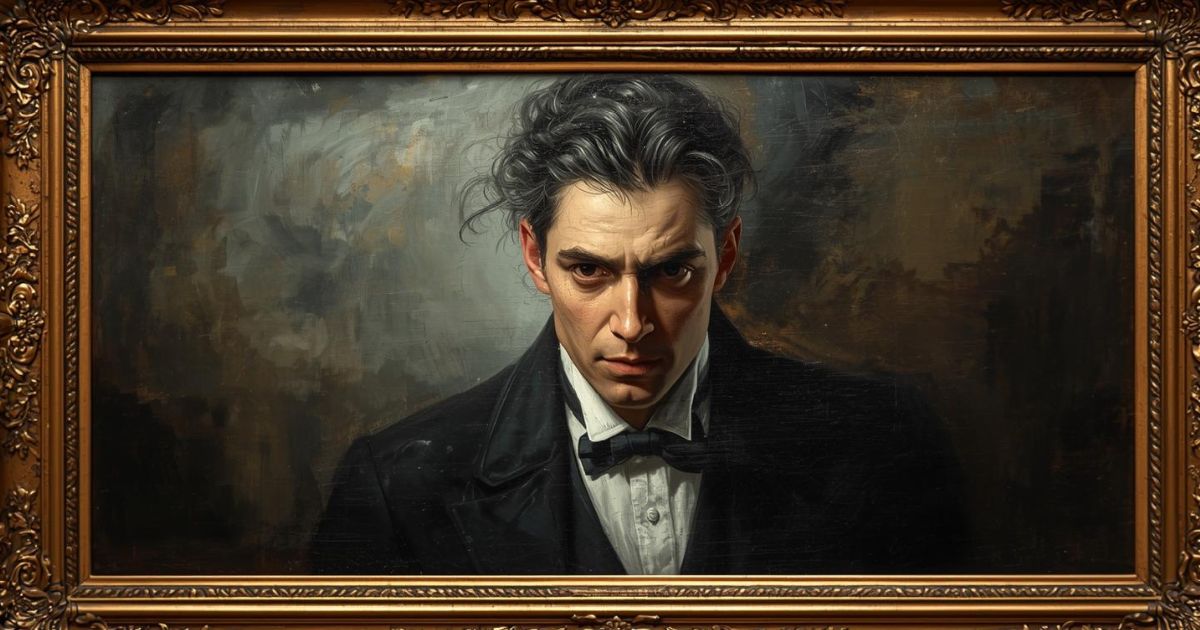
An excerpt from the original text.(complete · 2760 words)
t was on the ninth of November, the eve of his own thirty-eighth
birthday, as he often remembered afterwards.
He was walking home about eleven o’clock from Lord Henry’s, where he
had been dining, and was wrapped in heavy furs, as the night was cold
and foggy. At the corner of Grosvenor Square and South Audley Street, a
man passed him in the mist, walking very fast and with the collar of
his grey ulster turned up. He had a bag in his hand. Dorian recognized
him. It was Basil Hallward. A strange sense of fear, for which he could
not account, came over him. He made no sign of recognition and went on
quickly in the direction of his own house.
But Hallward had seen him. Dorian heard him first stopping on the
pavement and then hurrying after him. In a few moments, his hand was on
his arm.
“Dorian! What an extraordinary piece of luck! I have been waiting for
you in your library ever since nine o’clock. Finally I took pity on
your tired servant and told him to go to bed, as he let me out. I am
off to Paris by the midnight train, and I particularly wanted to see
you before I left. I thought it was you, or rather your fur coat, as
you passed me. But I wasn’t quite sure. Didn’t you recognize me?”
“In this fog, my dear Basil? Why, I can’t even recognize Grosvenor
Square. I believe my house is somewhere about here, but I don’t feel at
all certain about it. I am sorry you are going away, as I have not seen
you for ages. But I suppose you will be back soon?”
“No: I am going to be out of England for six months. I intend to take a
studio in Paris and shut myself up till I have finished a great picture
I have in my head. However, it wasn’t about myself I wanted to talk.
Here we are at your door. Let me come in for a moment. I have something
to say to you.”
“I shall be charmed. But won’t you miss your train?” said Dorian Gray
languidly as he passed up the steps and opened the door with his
latch-key.
The lamplight struggled out through the fog, and Hallward looked at his
watch. “I have heaps of time,” he answered. “The train doesn’t go till
twelve-fifteen, and it is only just eleven. In fact, I was on my way to
the club to look for you, when I met you. You see, I shan’t have any
delay about luggage, as I have sent on my heavy things. All I have with
me is in this bag, and I can easily get to Victoria in twenty minutes.”
Dorian looked at him and smiled. “What a way for a fashionable painter
to travel! A Gladstone bag and an ulster! Come in, or the fog will get
into the house. And mind you don’t talk about anything serious. Nothing
is serious nowadays. At least nothing should be.”
Hallward shook his head, as he entered, and followed Dorian into the
library. There was a bright wood fire blazing in the large open hearth.
The lamps were lit, and an open Dutch silver spirit-case stood, with
some siphons of soda-water and large cut-glass tumblers, on a little
marqueterie table.
“You see your servant made me quite at home, Dorian. He gave me
everything I wanted, including your best gold-tipped cigarettes. He is
a most hospitable creature. I like him much better than the Frenchman
you used to have. What has become of the Frenchman, by the bye?”
Dorian shrugged his shoulders. “I believe he married Lady Radley’s
maid, and has established her in Paris as an English dressmaker.
Anglomanie is very fashionable over there now, I hear. It seems silly
of the French, doesn’t it? But—do you know?—he was not at all a bad
servant. I never liked him, but I had nothing to complain about. One
often imagines things that are quite absurd. He was really very devoted
to me and seemed quite sorry when he went away. Have another
brandy-and-soda? Or would you like hock-and-seltzer? I always take
hock-and-seltzer myself. There is sure to be some in the next room.”
“Thanks, I won’t have anything more,” said the painter, taking his cap
and coat off and throwing them on the bag that he had placed in the
corner. “And now, my dear fellow, I want to speak to you seriously.
Don’t frown like that. You make it so much more difficult for me.”
“What is it all about?” cried Dorian in his petulant way, flinging
himself down on the sofa. “I hope it is not about myself. I am tired of
myself to-night. I should like to be somebody else.”
“It is about yourself,” answered Hallward in his grave deep voice, “and
I must say it to you. I shall only keep you half an hour.”
Dorian sighed and lit a cigarette. “Half an hour!” he murmured.
“It is not much to ask of you, Dorian, and it is entirely for your own
sake that I am speaking. I think it right that you should know that the
most dreadful things are being said against you in London.”
“I don’t wish to know anything about them. I love scandals about other
people, but scandals about myself don’t interest me. They have not got
the charm of novelty.”
“They must interest you, Dorian. Every gentleman is interested in his
good name. You don’t want people to talk of you as something vile and
degraded. Of course, you have your position, and your wealth, and all
that kind of thing. But position and wealth are not everything. Mind
you, I don’t believe these rumours at all. At least, I can’t believe
them when I see you. Sin is a thing that writes itself across a man’s
face. It cannot be concealed. People talk sometimes of secret vices.
There are no such things. If a wretched man has a vice, it shows itself
in the lines of his mouth, the droop of his eyelids, the moulding of
his hands even. Somebody—I won’t mention his name, but you know
him—came to me last year to have his portrait done. I had never seen
him before, and had never heard anything about him at the time, though
I have heard a good deal since. He offered an extravagant price. I
refused him. There was something in the shape of his fingers that I
hated. I know now that I was quite right in what I fancied about him.
His life is dreadful. But you, Dorian, with your pure, bright, innocent
face, and your marvellous untroubled youth—I can’t believe anything
against you. And yet I see you very seldom, and you never come down to
the studio now, and when I am away from you, and I hear all these
hideous things that people are whispering about you, I don’t know what
to say. Why is it, Dorian, that a man like the Duke of Berwick leaves
the room of a club when you enter it? Why is it that so many gentlemen
in London will neither go to your house or invite you to theirs? You
used to be a friend of Lord Staveley. I met him at dinner last week.
Your name happened to come up in conversation, in connection with the
miniatures you have lent to the exhibition at the Dudley. Staveley
curled his lip and said that you might have the most artistic tastes,
but that you were a man whom no pure-minded girl should be allowed to
know, and whom no chaste woman should sit in the same room with. I
reminded him that I was a friend of yours, and asked him what he meant.
He told me. He told me right out before everybody. It was horrible! Why
is your friendship so fatal to young men? There was that wretched boy
in the Guards who committed suicide. You were his great friend. There
was Sir Henry Ashton, who had to leave England with a tarnished name.
You and he were inseparable. What about Adrian Singleton and his
dreadful end? What about Lord Kent’s only son and his career? I met his
father yesterday in St. James’s Street. He seemed broken with shame and
sorrow. What about the young Duke of Perth? What sort of life has he
got now? What gentleman would associate with him?”
“Stop, Basil. You are talking about things of which you know nothing,”
said Dorian Gray, biting his lip, and with a note of infinite contempt
in his voice. “You ask me why Berwick leaves a room when I enter it. It
is because I know everything about his life, not because he knows
anything about mine. With such blood as he has in his veins, how could
his record be clean? You ask me about Henry Ashton and young Perth. Did
I teach the one his vices, and the other his debauchery? If Kent’s
silly son takes his wife from the streets, what is that to me? If
Adrian Singleton writes his friend’s name across a bill, am I his
keeper? I know how people chatter in England. The middle classes air
their moral prejudices over their gross dinner-tables, and whisper
about what they call the profligacies of their betters in order to try
and pretend that they are in smart society and on intimate terms with
the people they slander. In this country, it is enough for a man to
have distinction and brains for every common tongue to wag against him.
And what sort of lives do these people, who pose as being moral, lead
themselves? My dear fellow, you forget that we are in the native land
of the hypocrite.”
“Dorian,” cried Hallward, “that is not the question. England is bad
enough I know, and English society is all wrong. That is the reason why
I want you to be fine. You have not been fine. One has a right to judge
of a man by the effect he has over his friends. Yours seem to lose all
sense of honour, of goodness, of purity. You have filled them with a
madness for pleasure. They have gone down into the depths. You led them
there. Yes: you led them there, and yet you can smile, as you are
smiling now. And there is worse behind. I know you and Harry are
inseparable. Surely for that reason, if for none other, you should not
have made his sister’s name a by-word.”
“Take care, Basil. You go too far.”
“I must speak, and you must listen. You shall listen. When you met Lady
Gwendolen, not a breath of scandal had ever touched her. Is there a
single decent woman in London now who would drive with her in the park?
Why, even her children are not allowed to live with her. Then there are
other stories—stories that you have been seen creeping at dawn out of
dreadful houses and slinking in disguise into the foulest dens in
London. Are they true? Can they be true? When I first heard them, I
laughed. I hear them now, and they make me shudder. What about your
country-house and the life that is led there? Dorian, you don’t know
what is said about you. I won’t tell you that I don’t want to preach to
you. I remember Harry saying once that every man who turned himself
into an amateur curate for the moment always began by saying that, and
then proceeded to break his word. I do want to preach to you. I want
you to lead such a life as will make the world respect you. I want you
to have a clean name and a fair record. I want you to get rid of the
dreadful people you associate with. Don’t shrug your shoulders like
that. Don’t be so indifferent. You have a wonderful influence. Let it
be for good, not for evil. They say that you corrupt every one with
whom you become intimate, and that it is quite sufficient for you to
enter a house for shame of some kind to follow after. I don’t know
whether it is so or not. How should I know? But it is said of you. I am
told things that it seems impossible to doubt. Lord Gloucester was one
of my greatest friends at Oxford. He showed me a letter that his wife
had written to him when she was dying alone in her villa at Mentone.
Your name was implicated in the most terrible confession I ever read. I
told him that it was absurd—that I knew you thoroughly, and that you
were incapable of anything of the kind. Know you? I wonder do I know
you? Before I could answer that, I should have to see your soul.”
“To see my soul!” muttered Dorian Gray, starting up from the sofa and
turning almost white from fear.
“Yes,” answered Hallward gravely, and with deep-toned sorrow in his
voice, “to see your soul. But only God can do that.”
A bitter laugh of mockery broke from the lips of the younger man. “You
shall see it yourself, to-night!” he cried, seizing a lamp from the
table. “Come: it is your own handiwork. Why shouldn’t you look at it?
You can tell the world all about it afterwards, if you choose. Nobody
would believe you. If they did believe you, they would like me all the
better for it. I know the age better than you do, though you will prate
about it so tediously. Come, I tell you. You have chattered enough
about corruption. Now you shall look on it face to face.”
There was the madness of pride in every word he uttered. He stamped his
foot upon the ground in his boyish insolent manner. He felt a terrible
joy at the thought that some one else was to share his secret, and that
the man who had painted the portrait that was the origin of all his
shame was to be burdened for the rest of his life with the hideous
memory of what he had done.
“Yes,” he continued, coming closer to him and looking steadfastly into
his stern eyes, “I shall show you my soul. You shall see the thing that
you fancy only God can see.”
Hallward started back. “This is blasphemy, Dorian!” he cried. “You must
not say things like that. They are horrible, and they don’t mean
anything.”
“You think so?” He laughed again.
“I know so. As for what I said to you to-night, I said it for your
good. You know I have been always a stanch friend to you.”
“Don’t touch me. Finish what you have to say.”
A twisted flash of pain shot across the painter’s face. He paused for a
moment, and a wild feeling of pity came over him. After all, what right
had he to pry into the life of Dorian Gray? If he had done a tithe of
what was rumoured about him, how much he must have suffered! Then he
straightened himself up, and walked over to the fire-place, and stood
there, looking at the burning logs with their frostlike ashes and their
throbbing cores of flame.
“I am waiting, Basil,” said the young man in a hard clear voice.
He turned round. “What I have to say is this,” he cried. “You must give
me some answer to these horrible charges that are made against you. If
you tell me that they are absolutely untrue from beginning to end, I
shall believe you. Deny them, Dorian, deny them! Can’t you see what I
am going through? My God! don’t tell me that you are bad, and corrupt,
and shameful.”
Dorian Gray smiled. There was a curl of contempt in his lips. “Come
upstairs, Basil,” he said quietly. “I keep a diary of my life from day
to day, and it never leaves the room in which it is written. I shall
show it to you if you come with me.”
“I shall come with you, Dorian, if you wish it. I see I have missed my
train. That makes no matter. I can go to-morrow. But don’t ask me to
read anything to-night. All I want is a plain answer to my question.”
“That shall be given to you upstairs. I could not give it here. You
will not have to read long.”
Master this chapter. Complete your experience
Purchase the complete book to access all chapters and support classic literature
As an Amazon Associate, we earn a small commission from qualifying purchases at no additional cost to you.
Available in paperback, hardcover, and e-book formats
Let's Analyse the Pattern
The belief that you can indefinitely avoid consequences by hiding the damage your choices create.
Why This Matters
Connect literature to life
This chapter teaches how to spot when someone (including yourself) is accumulating hidden damage while maintaining perfect appearances.
Practice This Today
This week, notice when you feel the urge to hide mistakes rather than address them immediately—that's consequence debt building up.
Now let's explore the literary elements.
Key Quotes & Analysis
"It was his beauty that had ruined him, his beauty and the youth that he had prayed for."
Context: As Dorian stares at his corrupted portrait, reflecting on how his wish for eternal youth led to his downfall
This reveals the central irony of the story - the very thing Dorian thought would save him became his destruction. His beauty allowed him to escape consequences, which enabled his corruption.
In Today's Words:
Getting everything you want can actually destroy you if it means you never learn from your mistakes.
"He would destroy this monstrous soul-life, and without its hideous warnings, he would be at peace."
Context: Dorian decides to stab the portrait, believing this will free him from his guilt
This shows Dorian's final act of self-deception - thinking he can destroy the evidence of his corruption without facing the reality of what he's done. He still doesn't understand that true peace requires accountability.
In Today's Words:
If I just get rid of the proof, maybe I can pretend it never happened and feel better about myself.
"Each of us has heaven and hell in him."
Context: Reflecting on the dual nature of human beings as shown through Dorian's story
Wilde suggests that everyone has the capacity for both good and evil. Dorian's tragedy is that he fed only his worst impulses while ignoring his better angels, until the evil consumed him entirely.
In Today's Words:
We all have the potential to be saints or monsters - it depends on which side we choose to feed.
Thematic Threads
Self-Deception
In This Chapter
Dorian believes destroying the portrait will somehow erase his sins and restore his innocence
Development
Evolved from earlier chapters where he rationalized each cruel act—now he's attempting the ultimate self-deception
In Your Life:
You might tell yourself that avoiding a difficult conversation will make the problem disappear on its own
Hidden Truth
In This Chapter
The portrait has become so grotesque it's barely recognizable as human, revealing the full scope of Dorian's corruption
Development
Developed from subtle changes in early chapters to complete moral transformation
In Your Life:
You might be shocked by how much damage you've caused when you finally face the full truth about your behavior
Consequences
In This Chapter
Dorian's attempt to escape accountability through destruction backfires catastrophically
Development
Built throughout the book as Dorian avoided each consequence—now they all come due at once
In Your Life:
You might find that trying to eliminate evidence of your mistakes only makes things worse
Moral Accountability
In This Chapter
The supernatural connection between Dorian and the portrait proves that some debts cannot be escaped
Development
Culmination of the book's exploration of whether actions have lasting moral weight
In Your Life:
You might discover that the person you've become through your choices is inescapable
Identity
In This Chapter
Dorian can no longer separate his beautiful exterior from his corrupted interior—they violently reunite
Development
Resolution of the split identity that has driven the entire narrative
In Your Life:
You might realize that who you pretend to be and who you really are will eventually have to reconcile
You now have the context. Time to form your own thoughts.
Discussion Questions
- 1
What finally drives Dorian to attack his portrait with a knife, and what happens when he does?
analysis • surface - 2
Why do you think Dorian believed destroying the portrait would solve his problems rather than face what he had become?
analysis • medium - 3
Where do you see people today trying to 'destroy the evidence' of their poor choices instead of addressing the root problem?
application • medium - 4
If you noticed someone in your life accumulating hidden damage from their choices, how would you approach them about it?
application • deep - 5
What does Dorian's fate suggest about whether we can truly escape the consequences of our actions, even when nobody else knows about them?
reflection • deep
Critical Thinking Exercise
Audit Your Hidden Costs
Think of a choice you're making repeatedly that feels harmless because the negative effects aren't immediately visible. Write down what you're doing, what damage might be accumulating unseen, and what the eventual reckoning could look like if you continue. Then identify one small step you could take this week to address it honestly.
Consider:
- •Focus on patterns, not one-time mistakes
- •Consider effects on relationships, health, reputation, or self-respect
- •Think about what you'd advise a friend doing the same thing
Journaling Prompt
Write about a time when you tried to hide or ignore the consequences of your choices. What eventually forced you to face reality, and what did you learn from that experience?
Coming Up Next...
Chapter 13
The servants' discovery reveals the true cost of Dorian's bargain in a shocking twist that brings his story full circle. The final chapter shows what happens when someone tries to cheat the natural order of things.



