
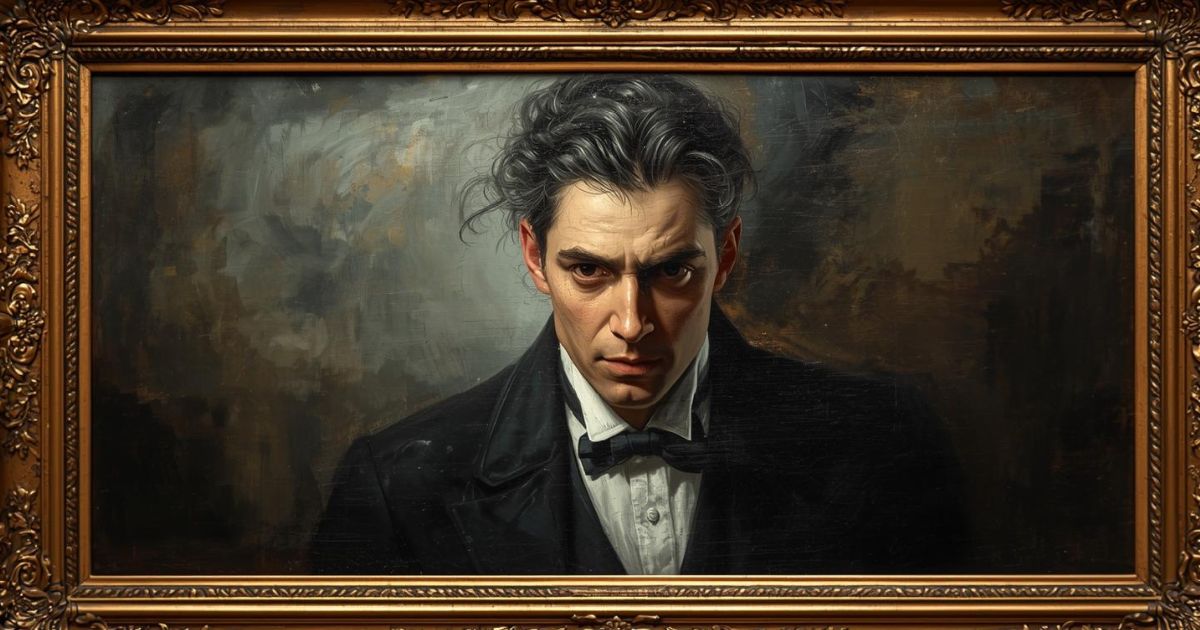
An excerpt from the original text.(complete · 2499 words)
e passed out of the room and began the ascent, Basil Hallward
following close behind. They walked softly, as men do instinctively at
night. The lamp cast fantastic shadows on the wall and staircase. A
rising wind made some of the windows rattle.
When they reached the top landing, Dorian set the lamp down on the
floor, and taking out the key, turned it in the lock. “You insist on
knowing, Basil?” he asked in a low voice.
“Yes.”
“I am delighted,” he answered, smiling. Then he added, somewhat
harshly, “You are the one man in the world who is entitled to know
everything about me. You have had more to do with my life than you
think”; and, taking up the lamp, he opened the door and went in. A cold
current of air passed them, and the light shot up for a moment in a
flame of murky orange. He shuddered. “Shut the door behind you,” he
whispered, as he placed the lamp on the table.
Hallward glanced round him with a puzzled expression. The room looked
as if it had not been lived in for years. A faded Flemish tapestry, a
curtained picture, an old Italian cassone, and an almost empty
book-case—that was all that it seemed to contain, besides a chair and a
table. As Dorian Gray was lighting a half-burned candle that was
standing on the mantelshelf, he saw that the whole place was covered
with dust and that the carpet was in holes. A mouse ran scuffling
behind the wainscoting. There was a damp odour of mildew.
“So you think that it is only God who sees the soul, Basil? Draw that
curtain back, and you will see mine.”
The voice that spoke was cold and cruel. “You are mad, Dorian, or
playing a part,” muttered Hallward, frowning.
“You won’t? Then I must do it myself,” said the young man, and he tore
the curtain from its rod and flung it on the ground.
An exclamation of horror broke from the painter’s lips as he saw in the
dim light the hideous face on the canvas grinning at him. There was
something in its expression that filled him with disgust and loathing.
Good heavens! it was Dorian Gray’s own face that he was looking at! The
horror, whatever it was, had not yet entirely spoiled that marvellous
beauty. There was still some gold in the thinning hair and some scarlet
on the sensual mouth. The sodden eyes had kept something of the
loveliness of their blue, the noble curves had not yet completely
passed away from chiselled nostrils and from plastic throat. Yes, it
was Dorian himself. But who had done it? He seemed to recognize his own
brushwork, and the frame was his own design. The idea was monstrous,
yet he felt afraid. He seized the lighted candle, and held it to the
picture. In the left-hand corner was his own name, traced in long
letters of bright vermilion.
It was some foul parody, some infamous ignoble satire. He had never
done that. Still, it was his own picture. He knew it, and he felt as if
his blood had changed in a moment from fire to sluggish ice. His own
picture! What did it mean? Why had it altered? He turned and looked at
Dorian Gray with the eyes of a sick man. His mouth twitched, and his
parched tongue seemed unable to articulate. He passed his hand across
his forehead. It was dank with clammy sweat.
The young man was leaning against the mantelshelf, watching him with
that strange expression that one sees on the faces of those who are
absorbed in a play when some great artist is acting. There was neither
real sorrow in it nor real joy. There was simply the passion of the
spectator, with perhaps a flicker of triumph in his eyes. He had taken
the flower out of his coat, and was smelling it, or pretending to do
so.
“What does this mean?” cried Hallward, at last. His own voice sounded
shrill and curious in his ears.
“Years ago, when I was a boy,” said Dorian Gray, crushing the flower in
his hand, “you met me, flattered me, and taught me to be vain of my
good looks. One day you introduced me to a friend of yours, who
explained to me the wonder of youth, and you finished a portrait of me
that revealed to me the wonder of beauty. In a mad moment that, even
now, I don’t know whether I regret or not, I made a wish, perhaps you
would call it a prayer....”
“I remember it! Oh, how well I remember it! No! the thing is
impossible. The room is damp. Mildew has got into the canvas. The
paints I used had some wretched mineral poison in them. I tell you the
thing is impossible.”
“Ah, what is impossible?” murmured the young man, going over to the
window and leaning his forehead against the cold, mist-stained glass.
“You told me you had destroyed it.”
“I was wrong. It has destroyed me.”
“I don’t believe it is my picture.”
“Can’t you see your ideal in it?” said Dorian bitterly.
“My ideal, as you call it...”
“As you called it.”
“There was nothing evil in it, nothing shameful. You were to me such an
ideal as I shall never meet again. This is the face of a satyr.”
“It is the face of my soul.”
“Christ! what a thing I must have worshipped! It has the eyes of a
devil.”
“Each of us has heaven and hell in him, Basil,” cried Dorian with a
wild gesture of despair.
Hallward turned again to the portrait and gazed at it. “My God! If it
is true,” he exclaimed, “and this is what you have done with your life,
why, you must be worse even than those who talk against you fancy you
to be!” He held the light up again to the canvas and examined it. The
surface seemed to be quite undisturbed and as he had left it. It was
from within, apparently, that the foulness and horror had come. Through
some strange quickening of inner life the leprosies of sin were slowly
eating the thing away. The rotting of a corpse in a watery grave was
not so fearful.
His hand shook, and the candle fell from its socket on the floor and
lay there sputtering. He placed his foot on it and put it out. Then he
flung himself into the rickety chair that was standing by the table and
buried his face in his hands.
“Good God, Dorian, what a lesson! What an awful lesson!” There was no
answer, but he could hear the young man sobbing at the window. “Pray,
Dorian, pray,” he murmured. “What is it that one was taught to say in
one’s boyhood? ‘Lead us not into temptation. Forgive us our sins. Wash
away our iniquities.’ Let us say that together. The prayer of your
pride has been answered. The prayer of your repentance will be answered
also. I worshipped you too much. I am punished for it. You worshipped
yourself too much. We are both punished.”
Dorian Gray turned slowly around and looked at him with tear-dimmed
eyes. “It is too late, Basil,” he faltered.
“It is never too late, Dorian. Let us kneel down and try if we cannot
remember a prayer. Isn’t there a verse somewhere, ‘Though your sins be
as scarlet, yet I will make them as white as snow’?”
“Those words mean nothing to me now.”
“Hush! Don’t say that. You have done enough evil in your life. My God!
Don’t you see that accursed thing leering at us?”
Dorian Gray glanced at the picture, and suddenly an uncontrollable
feeling of hatred for Basil Hallward came over him, as though it had
been suggested to him by the image on the canvas, whispered into his
ear by those grinning lips. The mad passions of a hunted animal stirred
within him, and he loathed the man who was seated at the table, more
than in his whole life he had ever loathed anything. He glanced wildly
around. Something glimmered on the top of the painted chest that faced
him. His eye fell on it. He knew what it was. It was a knife that he
had brought up, some days before, to cut a piece of cord, and had
forgotten to take away with him. He moved slowly towards it, passing
Hallward as he did so. As soon as he got behind him, he seized it and
turned round. Hallward stirred in his chair as if he was going to rise.
He rushed at him and dug the knife into the great vein that is behind
the ear, crushing the man’s head down on the table and stabbing again
and again.
There was a stifled groan and the horrible sound of some one choking
with blood. Three times the outstretched arms shot up convulsively,
waving grotesque, stiff-fingered hands in the air. He stabbed him twice
more, but the man did not move. Something began to trickle on the
floor. He waited for a moment, still pressing the head down. Then he
threw the knife on the table, and listened.
He could hear nothing, but the drip, drip on the threadbare carpet. He
opened the door and went out on the landing. The house was absolutely
quiet. No one was about. For a few seconds he stood bending over the
balustrade and peering down into the black seething well of darkness.
Then he took out the key and returned to the room, locking himself in
as he did so.
The thing was still seated in the chair, straining over the table with
bowed head, and humped back, and long fantastic arms. Had it not been
for the red jagged tear in the neck and the clotted black pool that was
slowly widening on the table, one would have said that the man was
simply asleep.
How quickly it had all been done! He felt strangely calm, and walking
over to the window, opened it and stepped out on the balcony. The wind
had blown the fog away, and the sky was like a monstrous peacock’s
tail, starred with myriads of golden eyes. He looked down and saw the
policeman going his rounds and flashing the long beam of his lantern on
the doors of the silent houses. The crimson spot of a prowling hansom
gleamed at the corner and then vanished. A woman in a fluttering shawl
was creeping slowly by the railings, staggering as she went. Now and
then she stopped and peered back. Once, she began to sing in a hoarse
voice. The policeman strolled over and said something to her. She
stumbled away, laughing. A bitter blast swept across the square. The
gas-lamps flickered and became blue, and the leafless trees shook their
black iron branches to and fro. He shivered and went back, closing the
window behind him.
Having reached the door, he turned the key and opened it. He did not
even glance at the murdered man. He felt that the secret of the whole
thing was not to realize the situation. The friend who had painted the
fatal portrait to which all his misery had been due had gone out of his
life. That was enough.
Then he remembered the lamp. It was a rather curious one of Moorish
workmanship, made of dull silver inlaid with arabesques of burnished
steel, and studded with coarse turquoises. Perhaps it might be missed
by his servant, and questions would be asked. He hesitated for a
moment, then he turned back and took it from the table. He could not
help seeing the dead thing. How still it was! How horribly white the
long hands looked! It was like a dreadful wax image.
Having locked the door behind him, he crept quietly downstairs. The
woodwork creaked and seemed to cry out as if in pain. He stopped
several times and waited. No: everything was still. It was merely the
sound of his own footsteps.
When he reached the library, he saw the bag and coat in the corner.
They must be hidden away somewhere. He unlocked a secret press that was
in the wainscoting, a press in which he kept his own curious disguises,
and put them into it. He could easily burn them afterwards. Then he
pulled out his watch. It was twenty minutes to two.
He sat down and began to think. Every year—every month, almost—men were
strangled in England for what he had done. There had been a madness of
murder in the air. Some red star had come too close to the earth....
And yet, what evidence was there against him? Basil Hallward had left
the house at eleven. No one had seen him come in again. Most of the
servants were at Selby Royal. His valet had gone to bed.... Paris! Yes.
It was to Paris that Basil had gone, and by the midnight train, as he
had intended. With his curious reserved habits, it would be months
before any suspicions would be roused. Months! Everything could be
destroyed long before then.
A sudden thought struck him. He put on his fur coat and hat and went
out into the hall. There he paused, hearing the slow heavy tread of the
policeman on the pavement outside and seeing the flash of the
bull’s-eye reflected in the window. He waited and held his breath.
After a few moments he drew back the latch and slipped out, shutting
the door very gently behind him. Then he began ringing the bell. In
about five minutes his valet appeared, half-dressed and looking very
drowsy.
“I am sorry to have had to wake you up, Francis,” he said, stepping in;
“but I had forgotten my latch-key. What time is it?”
“Ten minutes past two, sir,” answered the man, looking at the clock and
blinking.
“Ten minutes past two? How horribly late! You must wake me at nine
to-morrow. I have some work to do.”
“All right, sir.”
“Did any one call this evening?”
“Mr. Hallward, sir. He stayed here till eleven, and then he went away
to catch his train.”
“Oh! I am sorry I didn’t see him. Did he leave any message?”
“No, sir, except that he would write to you from Paris, if he did not
find you at the club.”
“That will do, Francis. Don’t forget to call me at nine to-morrow.”
“No, sir.”
The man shambled down the passage in his slippers.
Dorian Gray threw his hat and coat upon the table and passed into the
library. For a quarter of an hour he walked up and down the room,
biting his lip and thinking. Then he took down the Blue Book from one
of the shelves and began to turn over the leaves. “Alan Campbell, 152,
Hertford Street, Mayfair.” Yes; that was the man he wanted.
Master this chapter. Complete your experience
Purchase the complete book to access all chapters and support classic literature
As an Amazon Associate, we earn a small commission from qualifying purchases at no additional cost to you.
Available in paperback, hardcover, and e-book formats
Let's Analyse the Pattern
The gradual loss of moral compass through treating ethical violations as practical problems while emotionally detaching from human consequences.
Why This Matters
Connect literature to life
This chapter teaches how to spot the dangerous pattern of treating ethical violations as practical problems while emotionally detaching from human impact.
Practice This Today
This week, notice when you or others use phrases like 'just business' or 'being practical' to justify actions that hurt people—that's compartmentalization in action.
Now let's explore the literary elements.
Key Quotes & Analysis
"He felt that the secret of the whole thing was not to realize the situation."
Context: Describing Dorian's mindset as he plans the cover-up
This reveals Dorian's strategy of psychological denial. He stays calm by refusing to acknowledge the full horror of what he's done, treating murder like a practical problem to solve.
In Today's Words:
The trick is not to think too hard about what you've actually done.
"Murder! The very word was like a firebrand in his brain."
Context: Dorian's brief moment of recognition about what he's done
Shows that despite his detachment, Dorian isn't completely numb to his crime. The word itself still has power to disturb him, suggesting some buried humanity remains.
In Today's Words:
Just hearing the word 'murder' hit him like a punch to the gut.
"You are the one man who is able to save me. I am forced to bring you into the matter."
Context: Manipulating Campbell into helping with the body
Classic manipulation language - Dorian presents himself as the victim who needs saving while forcing Campbell to become complicit. He makes his demand sound like Campbell's choice.
In Today's Words:
You're my only option here, so you're going to help me whether you like it or not.
Thematic Threads
Power
In This Chapter
Dorian uses Alan Campbell's secrets as weapons, demonstrating how corruption transforms relationships into tools for manipulation
Development
Evolved from seeking power over his appearance to wielding power over others through blackmail
In Your Life:
You might see this when someone uses your vulnerabilities or mistakes against you to get what they want
Identity
In This Chapter
Dorian has become completely detached from his former self, operating as a cold manipulator without genuine remorse
Development
Progressed from vanity about appearance to complete moral transformation
In Your Life:
You might recognize this when you realize you're acting in ways that would have horrified your younger self
Social Expectations
In This Chapter
Dorian maintains his charming social facade while committing murder, showing how surface respectability can mask moral decay
Development
Continued theme of appearance versus reality, now at its most extreme
In Your Life:
You might see this in people who seem perfect publicly but are cruel privately, or in maintaining your own false image
Consequences
In This Chapter
Dorian treats murder as a logistical problem rather than a moral catastrophe, completely divorced from natural consequences
Development
Escalated from avoiding social consequences to believing he can escape all consequences
In Your Life:
You might notice this pattern when you start treating serious problems as mere inconveniences rather than facing their real impact
Human Relationships
In This Chapter
Campbell is reduced to a tool for body disposal, showing how corruption destroys the ability to see others as human beings
Development
Continued degradation from using people for pleasure to using them for criminal cover-ups
In Your Life:
You might recognize this when you find yourself viewing people primarily for what they can do for you rather than as individuals
You now have the context. Time to form your own thoughts.
Discussion Questions
- 1
How does Dorian handle the morning after murdering Basil, and what does his emotional state reveal about where he is mentally?
analysis • surface - 2
Why is Dorian able to treat disposing of Basil's body like a practical problem rather than wrestling with guilt over what he's done?
analysis • medium - 3
Where do you see people today treating serious moral issues as mere inconveniences to manage rather than facing the human impact of their choices?
application • medium - 4
If you noticed yourself starting to emotionally detach from the consequences of your actions, what specific steps would you take to reconnect with your moral compass?
application • deep - 5
What does Dorian's ability to blackmail Campbell and then calmly play piano teach us about how evil often operates in real life?
reflection • deep
Critical Thinking Exercise
Map Your Moral Warning System
Think of a recent situation where you had to make a choice that affected others. Write down the decision, then trace your emotional process. Did you feel the full weight of how your choice would impact others, or did you find ways to minimize or avoid those feelings? Identify the specific moments where you either stayed connected to consequences or started detaching from them.
Consider:
- •Notice if you used phrases like 'it's just business' or 'they'll get over it' to distance yourself from impact
- •Pay attention to whether you sought out or avoided hearing from people affected by your decision
- •Consider whether you would make the same choice if you had to personally deliver the consequences
Journaling Prompt
Write about a time when you caught yourself starting to emotionally detach from a difficult situation. What pulled you back to caring about the human impact, and how can you build those reconnection habits into your daily life?
Coming Up Next...
Chapter 14
With Basil's body disposed of, Dorian must now face the social consequences of his friend's mysterious disappearance. But maintaining his facade of innocence becomes increasingly difficult as questions arise about what really happened to the missing artist.



