
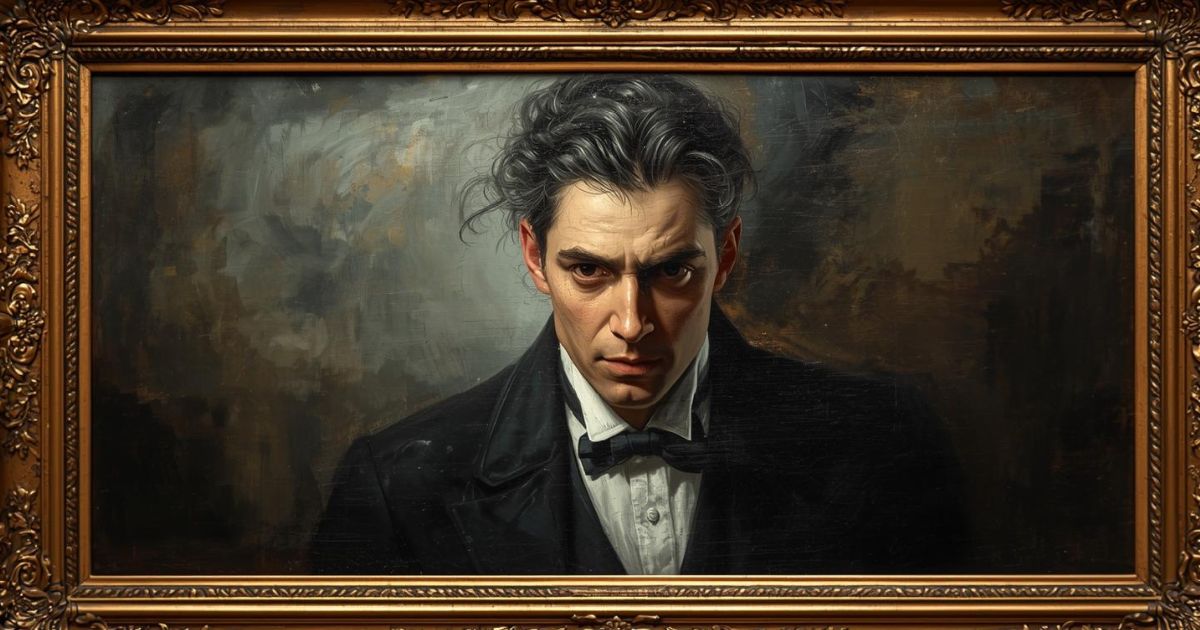
An excerpt from the original text.(complete · 4528 words)
t nine o’clock the next morning his servant came in with a cup of
chocolate on a tray and opened the shutters. Dorian was sleeping quite
peacefully, lying on his right side, with one hand underneath his
cheek. He looked like a boy who had been tired out with play, or study.
The man had to touch him twice on the shoulder before he woke, and as
he opened his eyes a faint smile passed across his lips, as though he
had been lost in some delightful dream. Yet he had not dreamed at all.
His night had been untroubled by any images of pleasure or of pain. But
youth smiles without any reason. It is one of its chiefest charms.
He turned round, and leaning upon his elbow, began to sip his
chocolate. The mellow November sun came streaming into the room. The
sky was bright, and there was a genial warmth in the air. It was almost
like a morning in May.
Gradually the events of the preceding night crept with silent,
blood-stained feet into his brain and reconstructed themselves there
with terrible distinctness. He winced at the memory of all that he had
suffered, and for a moment the same curious feeling of loathing for
Basil Hallward that had made him kill him as he sat in the chair came
back to him, and he grew cold with passion. The dead man was still
sitting there, too, and in the sunlight now. How horrible that was!
Such hideous things were for the darkness, not for the day.
He felt that if he brooded on what he had gone through he would sicken
or grow mad. There were sins whose fascination was more in the memory
than in the doing of them, strange triumphs that gratified the pride
more than the passions, and gave to the intellect a quickened sense of
joy, greater than any joy they brought, or could ever bring, to the
senses. But this was not one of them. It was a thing to be driven out
of the mind, to be drugged with poppies, to be strangled lest it might
strangle one itself.
When the half-hour struck, he passed his hand across his forehead, and
then got up hastily and dressed himself with even more than his usual
care, giving a good deal of attention to the choice of his necktie and
scarf-pin and changing his rings more than once. He spent a long time
also over breakfast, tasting the various dishes, talking to his valet
about some new liveries that he was thinking of getting made for the
servants at Selby, and going through his correspondence. At some of the
letters, he smiled. Three of them bored him. One he read several times
over and then tore up with a slight look of annoyance in his face.
“That awful thing, a woman’s memory!” as Lord Henry had once said.
After he had drunk his cup of black coffee, he wiped his lips slowly
with a napkin, motioned to his servant to wait, and going over to the
table, sat down and wrote two letters. One he put in his pocket, the
other he handed to the valet.
“Take this round to 152, Hertford Street, Francis, and if Mr. Campbell
is out of town, get his address.”
As soon as he was alone, he lit a cigarette and began sketching upon a
piece of paper, drawing first flowers and bits of architecture, and
then human faces. Suddenly he remarked that every face that he drew
seemed to have a fantastic likeness to Basil Hallward. He frowned, and
getting up, went over to the book-case and took out a volume at hazard.
He was determined that he would not think about what had happened until
it became absolutely necessary that he should do so.
When he had stretched himself on the sofa, he looked at the title-page
of the book. It was Gautier’s “Émaux et Camées”, Charpentier’s
Japanese-paper edition, with the Jacquemart etching. The binding was of
citron-green leather, with a design of gilt trellis-work and dotted
pomegranates. It had been given to him by Adrian Singleton. As he
turned over the pages, his eye fell on the poem about the hand of
Lacenaire, the cold yellow hand “du supplice encore mal lavée,” with
its downy red hairs and its “doigts de faune.” He glanced at his own
white taper fingers, shuddering slightly in spite of himself, and
passed on, till he came to those lovely stanzas upon Venice:
Sur une gamme chromatique,
Le sein de perles ruisselant,
La Vénus de l’Adriatique
Sort de l’eau son corps rose et blanc.
Les dômes, sur l’azur des ondes
Suivant la phrase au pur contour,
S’enflent comme des gorges rondes
Que soulève un soupir d’amour.
L’esquif aborde et me dépose,
Jetant son amarre au pilier,
Devant une façade rose,
Sur le marbre d’un escalier.
How exquisite they were! As one read them, one seemed to be floating
down the green water-ways of the pink and pearl city, seated in a black
gondola with silver prow and trailing curtains. The mere lines looked
to him like those straight lines of turquoise-blue that follow one as
one pushes out to the Lido. The sudden flashes of colour reminded him
of the gleam of the opal-and-iris-throated birds that flutter round the
tall honeycombed Campanile, or stalk, with such stately grace, through
the dim, dust-stained arcades. Leaning back with half-closed eyes, he
kept saying over and over to himself:
“Devant une façade rose,
Sur le marbre d’un escalier.”
The whole of Venice was in those two lines. He remembered the autumn
that he had passed there, and a wonderful love that had stirred him to
mad delightful follies. There was romance in every place. But Venice,
like Oxford, had kept the background for romance, and, to the true
romantic, background was everything, or almost everything. Basil had
been with him part of the time, and had gone wild over Tintoret. Poor
Basil! What a horrible way for a man to die!
He sighed, and took up the volume again, and tried to forget. He read
of the swallows that fly in and out of the little café at Smyrna
where the Hadjis sit counting their amber beads and the turbaned
merchants smoke their long tasselled pipes and talk gravely to each
other; he read of the Obelisk in the Place de la Concorde that weeps
tears of granite in its lonely sunless exile and longs to be back by
the hot, lotus-covered Nile, where there are Sphinxes, and rose-red
ibises, and white vultures with gilded claws, and crocodiles with small
beryl eyes that crawl over the green steaming mud; he began to brood
over those verses which, drawing music from kiss-stained marble, tell
of that curious statue that Gautier compares to a contralto voice, the
“monstre charmant” that couches in the porphyry-room of the Louvre.
But after a time the book fell from his hand. He grew nervous, and a
horrible fit of terror came over him. What if Alan Campbell should be
out of England? Days would elapse before he could come back. Perhaps he
might refuse to come. What could he do then? Every moment was of vital
importance.
They had been great friends once, five years before—almost inseparable,
indeed. Then the intimacy had come suddenly to an end. When they met in
society now, it was only Dorian Gray who smiled: Alan Campbell never
did.
He was an extremely clever young man, though he had no real
appreciation of the visible arts, and whatever little sense of the
beauty of poetry he possessed he had gained entirely from Dorian. His
dominant intellectual passion was for science. At Cambridge he had
spent a great deal of his time working in the laboratory, and had taken
a good class in the Natural Science Tripos of his year. Indeed, he was
still devoted to the study of chemistry, and had a laboratory of his
own in which he used to shut himself up all day long, greatly to the
annoyance of his mother, who had set her heart on his standing for
Parliament and had a vague idea that a chemist was a person who made up
prescriptions. He was an excellent musician, however, as well, and
played both the violin and the piano better than most amateurs. In
fact, it was music that had first brought him and Dorian Gray
together—music and that indefinable attraction that Dorian seemed to be
able to exercise whenever he wished—and, indeed, exercised often
without being conscious of it. They had met at Lady Berkshire’s the
night that Rubinstein played there, and after that used to be always
seen together at the opera and wherever good music was going on. For
eighteen months their intimacy lasted. Campbell was always either at
Selby Royal or in Grosvenor Square. To him, as to many others, Dorian
Gray was the type of everything that is wonderful and fascinating in
life. Whether or not a quarrel had taken place between them no one ever
knew. But suddenly people remarked that they scarcely spoke when they
met and that Campbell seemed always to go away early from any party at
which Dorian Gray was present. He had changed, too—was strangely
melancholy at times, appeared almost to dislike hearing music, and
would never himself play, giving as his excuse, when he was called
upon, that he was so absorbed in science that he had no time left in
which to practise. And this was certainly true. Every day he seemed to
become more interested in biology, and his name appeared once or twice
in some of the scientific reviews in connection with certain curious
experiments.
This was the man Dorian Gray was waiting for. Every second he kept
glancing at the clock. As the minutes went by he became horribly
agitated. At last he got up and began to pace up and down the room,
looking like a beautiful caged thing. He took long stealthy strides.
His hands were curiously cold.
The suspense became unbearable. Time seemed to him to be crawling with
feet of lead, while he by monstrous winds was being swept towards the
jagged edge of some black cleft of precipice. He knew what was waiting
for him there; saw it, indeed, and, shuddering, crushed with dank hands
his burning lids as though he would have robbed the very brain of sight
and driven the eyeballs back into their cave. It was useless. The brain
had its own food on which it battened, and the imagination, made
grotesque by terror, twisted and distorted as a living thing by pain,
danced like some foul puppet on a stand and grinned through moving
masks. Then, suddenly, time stopped for him. Yes: that blind,
slow-breathing thing crawled no more, and horrible thoughts, time being
dead, raced nimbly on in front, and dragged a hideous future from its
grave, and showed it to him. He stared at it. Its very horror made him
stone.
At last the door opened and his servant entered. He turned glazed eyes
upon him.
“Mr. Campbell, sir,” said the man.
A sigh of relief broke from his parched lips, and the colour came back
to his cheeks.
“Ask him to come in at once, Francis.” He felt that he was himself
again. His mood of cowardice had passed away.
The man bowed and retired. In a few moments, Alan Campbell walked in,
looking very stern and rather pale, his pallor being intensified by his
coal-black hair and dark eyebrows.
“Alan! This is kind of you. I thank you for coming.”
“I had intended never to enter your house again, Gray. But you said it
was a matter of life and death.” His voice was hard and cold. He spoke
with slow deliberation. There was a look of contempt in the steady
searching gaze that he turned on Dorian. He kept his hands in the
pockets of his Astrakhan coat, and seemed not to have noticed the
gesture with which he had been greeted.
“Yes: it is a matter of life and death, Alan, and to more than one
person. Sit down.”
Campbell took a chair by the table, and Dorian sat opposite to him. The
two men’s eyes met. In Dorian’s there was infinite pity. He knew that
what he was going to do was dreadful.
After a strained moment of silence, he leaned across and said, very
quietly, but watching the effect of each word upon the face of him he
had sent for, “Alan, in a locked room at the top of this house, a room
to which nobody but myself has access, a dead man is seated at a table.
He has been dead ten hours now. Don’t stir, and don’t look at me like
that. Who the man is, why he died, how he died, are matters that do not
concern you. What you have to do is this—”
“Stop, Gray. I don’t want to know anything further. Whether what you
have told me is true or not true doesn’t concern me. I entirely decline
to be mixed up in your life. Keep your horrible secrets to yourself.
They don’t interest me any more.”
“Alan, they will have to interest you. This one will have to interest
you. I am awfully sorry for you, Alan. But I can’t help myself. You are
the one man who is able to save me. I am forced to bring you into the
matter. I have no option. Alan, you are scientific. You know about
chemistry and things of that kind. You have made experiments. What you
have got to do is to destroy the thing that is upstairs—to destroy it
so that not a vestige of it will be left. Nobody saw this person come
into the house. Indeed, at the present moment he is supposed to be in
Paris. He will not be missed for months. When he is missed, there must
be no trace of him found here. You, Alan, you must change him, and
everything that belongs to him, into a handful of ashes that I may
scatter in the air.”
“You are mad, Dorian.”
“Ah! I was waiting for you to call me Dorian.”
“You are mad, I tell you—mad to imagine that I would raise a finger to
help you, mad to make this monstrous confession. I will have nothing to
do with this matter, whatever it is. Do you think I am going to peril
my reputation for you? What is it to me what devil’s work you are up
to?”
“It was suicide, Alan.”
“I am glad of that. But who drove him to it? You, I should fancy.”
“Do you still refuse to do this for me?”
“Of course I refuse. I will have absolutely nothing to do with it. I
don’t care what shame comes on you. You deserve it all. I should not be
sorry to see you disgraced, publicly disgraced. How dare you ask me, of
all men in the world, to mix myself up in this horror? I should have
thought you knew more about people’s characters. Your friend Lord Henry
Wotton can’t have taught you much about psychology, whatever else he
has taught you. Nothing will induce me to stir a step to help you. You
have come to the wrong man. Go to some of your friends. Don’t come to
me.”
“Alan, it was murder. I killed him. You don’t know what he had made me
suffer. Whatever my life is, he had more to do with the making or the
marring of it than poor Harry has had. He may not have intended it, the
result was the same.”
“Murder! Good God, Dorian, is that what you have come to? I shall not
inform upon you. It is not my business. Besides, without my stirring in
the matter, you are certain to be arrested. Nobody ever commits a crime
without doing something stupid. But I will have nothing to do with it.”
“You must have something to do with it. Wait, wait a moment; listen to
me. Only listen, Alan. All I ask of you is to perform a certain
scientific experiment. You go to hospitals and dead-houses, and the
horrors that you do there don’t affect you. If in some hideous
dissecting-room or fetid laboratory you found this man lying on a
leaden table with red gutters scooped out in it for the blood to flow
through, you would simply look upon him as an admirable subject. You
would not turn a hair. You would not believe that you were doing
anything wrong. On the contrary, you would probably feel that you were
benefiting the human race, or increasing the sum of knowledge in the
world, or gratifying intellectual curiosity, or something of that kind.
What I want you to do is merely what you have often done before.
Indeed, to destroy a body must be far less horrible than what you are
accustomed to work at. And, remember, it is the only piece of evidence
against me. If it is discovered, I am lost; and it is sure to be
discovered unless you help me.”
“I have no desire to help you. You forget that. I am simply indifferent
to the whole thing. It has nothing to do with me.”
“Alan, I entreat you. Think of the position I am in. Just before you
came I almost fainted with terror. You may know terror yourself some
day. No! don’t think of that. Look at the matter purely from the
scientific point of view. You don’t inquire where the dead things on
which you experiment come from. Don’t inquire now. I have told you too
much as it is. But I beg of you to do this. We were friends once,
Alan.”
“Don’t speak about those days, Dorian—they are dead.”
“The dead linger sometimes. The man upstairs will not go away. He is
sitting at the table with bowed head and outstretched arms. Alan! Alan!
If you don’t come to my assistance, I am ruined. Why, they will hang
me, Alan! Don’t you understand? They will hang me for what I have
done.”
“There is no good in prolonging this scene. I absolutely refuse to do
anything in the matter. It is insane of you to ask me.”
“You refuse?”
“Yes.”
“I entreat you, Alan.”
“It is useless.”
The same look of pity came into Dorian Gray’s eyes. Then he stretched
out his hand, took a piece of paper, and wrote something on it. He read
it over twice, folded it carefully, and pushed it across the table.
Having done this, he got up and went over to the window.
Campbell looked at him in surprise, and then took up the paper, and
opened it. As he read it, his face became ghastly pale and he fell back
in his chair. A horrible sense of sickness came over him. He felt as if
his heart was beating itself to death in some empty hollow.
After two or three minutes of terrible silence, Dorian turned round and
came and stood behind him, putting his hand upon his shoulder.
“I am so sorry for you, Alan,” he murmured, “but you leave me no
alternative. I have a letter written already. Here it is. You see the
address. If you don’t help me, I must send it. If you don’t help me, I
will send it. You know what the result will be. But you are going to
help me. It is impossible for you to refuse now. I tried to spare you.
You will do me the justice to admit that. You were stern, harsh,
offensive. You treated me as no man has ever dared to treat me—no
living man, at any rate. I bore it all. Now it is for me to dictate
terms.”
Campbell buried his face in his hands, and a shudder passed through
him.
“Yes, it is my turn to dictate terms, Alan. You know what they are. The
thing is quite simple. Come, don’t work yourself into this fever. The
thing has to be done. Face it, and do it.”
A groan broke from Campbell’s lips and he shivered all over. The
ticking of the clock on the mantelpiece seemed to him to be dividing
time into separate atoms of agony, each of which was too terrible to be
borne. He felt as if an iron ring was being slowly tightened round his
forehead, as if the disgrace with which he was threatened had already
come upon him. The hand upon his shoulder weighed like a hand of lead.
It was intolerable. It seemed to crush him.
“Come, Alan, you must decide at once.”
“I cannot do it,” he said, mechanically, as though words could alter
things.
“You must. You have no choice. Don’t delay.”
He hesitated a moment. “Is there a fire in the room upstairs?”
“Yes, there is a gas-fire with asbestos.”
“I shall have to go home and get some things from the laboratory.”
“No, Alan, you must not leave the house. Write out on a sheet of
notepaper what you want and my servant will take a cab and bring the
things back to you.”
Campbell scrawled a few lines, blotted them, and addressed an envelope
to his assistant. Dorian took the note up and read it carefully. Then
he rang the bell and gave it to his valet, with orders to return as
soon as possible and to bring the things with him.
As the hall door shut, Campbell started nervously, and having got up
from the chair, went over to the chimney-piece. He was shivering with a
kind of ague. For nearly twenty minutes, neither of the men spoke. A
fly buzzed noisily about the room, and the ticking of the clock was
like the beat of a hammer.
As the chime struck one, Campbell turned round, and looking at Dorian
Gray, saw that his eyes were filled with tears. There was something in
the purity and refinement of that sad face that seemed to enrage him.
“You are infamous, absolutely infamous!” he muttered.
“Hush, Alan. You have saved my life,” said Dorian.
“Your life? Good heavens! what a life that is! You have gone from
corruption to corruption, and now you have culminated in crime. In
doing what I am going to do—what you force me to do—it is not of your
life that I am thinking.”
“Ah, Alan,” murmured Dorian with a sigh, “I wish you had a thousandth
part of the pity for me that I have for you.” He turned away as he
spoke and stood looking out at the garden. Campbell made no answer.
After about ten minutes a knock came to the door, and the servant
entered, carrying a large mahogany chest of chemicals, with a long coil
of steel and platinum wire and two rather curiously shaped iron clamps.
“Shall I leave the things here, sir?” he asked Campbell.
“Yes,” said Dorian. “And I am afraid, Francis, that I have another
errand for you. What is the name of the man at Richmond who supplies
Selby with orchids?”
“Harden, sir.”
“Yes—Harden. You must go down to Richmond at once, see Harden
personally, and tell him to send twice as many orchids as I ordered,
and to have as few white ones as possible. In fact, I don’t want any
white ones. It is a lovely day, Francis, and Richmond is a very pretty
place—otherwise I wouldn’t bother you about it.”
“No trouble, sir. At what time shall I be back?”
Dorian looked at Campbell. “How long will your experiment take, Alan?”
he said in a calm indifferent voice. The presence of a third person in
the room seemed to give him extraordinary courage.
Campbell frowned and bit his lip. “It will take about five hours,” he
answered.
“It will be time enough, then, if you are back at half-past seven,
Francis. Or stay: just leave my things out for dressing. You can have
the evening to yourself. I am not dining at home, so I shall not want
you.”
“Thank you, sir,” said the man, leaving the room.
“Now, Alan, there is not a moment to be lost. How heavy this chest is!
I’ll take it for you. You bring the other things.” He spoke rapidly and
in an authoritative manner. Campbell felt dominated by him. They left
the room together.
When they reached the top landing, Dorian took out the key and turned
it in the lock. Then he stopped, and a troubled look came into his
eyes. He shuddered. “I don’t think I can go in, Alan,” he murmured.
“It is nothing to me. I don’t require you,” said Campbell coldly.
Dorian half opened the door. As he did so, he saw the face of his
portrait leering in the sunlight. On the floor in front of it the torn
curtain was lying. He remembered that the night before he had
forgotten, for the first time in his life, to hide the fatal canvas,
and was about to rush forward, when he drew back with a shudder.
What was that loathsome red dew that gleamed, wet and glistening, on
one of the hands, as though the canvas had sweated blood? How horrible
it was!—more horrible, it seemed to him for the moment, than the silent
thing that he knew was stretched across the table, the thing whose
grotesque misshapen shadow on the spotted carpet showed him that it had
not stirred, but was still there, as he had left it.
He heaved a deep breath, opened the door a little wider, and with
half-closed eyes and averted head, walked quickly in, determined that
he would not look even once upon the dead man. Then, stooping down and
taking up the gold-and-purple hanging, he flung it right over the
picture.
There he stopped, feeling afraid to turn round, and his eyes fixed
themselves on the intricacies of the pattern before him. He heard
Campbell bringing in the heavy chest, and the irons, and the other
things that he had required for his dreadful work. He began to wonder
if he and Basil Hallward had ever met, and, if so, what they had
thought of each other.
“Leave me now,” said a stern voice behind him.
He turned and hurried out, just conscious that the dead man had been
thrust back into the chair and that Campbell was gazing into a
glistening yellow face. As he was going downstairs, he heard the key
being turned in the lock.
It was long after seven when Campbell came back into the library. He
was pale, but absolutely calm. “I have done what you asked me to do,”
he muttered. “And now, good-bye. Let us never see each other again.”
“You have saved me from ruin, Alan. I cannot forget that,” said Dorian
simply.
As soon as Campbell had left, he went upstairs. There was a horrible
smell of nitric acid in the room. But the thing that had been sitting
at the table was gone.
Master this chapter. Complete your experience
Purchase the complete book to access all chapters and support classic literature
As an Amazon Associate, we earn a small commission from qualifying purchases at no additional cost to you.
Available in paperback, hardcover, and e-book formats
Let's Analyse the Pattern
The inevitable moment when accumulated avoided accountability crashes down all at once, often destroying the person who tried to escape it.
Why This Matters
Connect literature to life
This chapter teaches how to recognize when someone (including yourself) is accumulating accountability that will eventually demand payment.
Practice This Today
This week, notice when you or others consistently avoid facing the results of behavior—ask yourself what debt is building and create small accountability moments before the crash.
Now let's explore the literary elements.
Key Quotes & Analysis
"It had been like conscience to him. Yes, it had been conscience. He would destroy it."
Context: Dorian stares at the portrait before deciding to destroy it
This reveals that Dorian understands the portrait represents his moral conscience, but rather than face his guilt, he chooses to eliminate it entirely. It shows his complete rejection of accountability.
In Today's Words:
This thing keeps reminding me of all the bad stuff I've done. I need to get rid of it so I can stop feeling guilty.
"He seized the thing, and stabbed the picture with it."
Context: Dorian attacks the portrait with the knife he used to kill Basil
The violent act mirrors his murder of Basil, showing how his attempt to destroy evidence only creates more destruction. The 'thing' reference shows his detachment from the weapon and his actions.
In Today's Words:
He grabbed the knife and went after the painting with it.
"When they entered, they found hanging upon the wall a splendid portrait of their master as they had last seen him, in all the wonder of his exquisite youth and beauty."
Context: The servants discover the scene after Dorian's death
The portrait's return to beauty while Dorian lies dead and withered shows that his attempt to separate image from reality ultimately failed. True beauty requires moral integrity.
In Today's Words:
The painting looked perfect again, showing him young and gorgeous like he used to be.
Thematic Threads
Identity
In This Chapter
Dorian's complete disconnection from his authentic self leads to his destruction when he tries to eliminate his shadow identity
Development
Culmination of the identity split that began in Chapter 1—the final proof that you cannot separate who you are from what you do
In Your Life:
You might recognize this when you feel like you're living multiple versions of yourself that don't align with each other
Social Expectations
In This Chapter
Dorian's obsession with maintaining his beautiful public image while hiding his true nature finally becomes impossible to sustain
Development
The ultimate failure of the performance that has driven the entire novel—appearances can no longer be maintained
In Your Life:
You see this when the energy required to maintain your public persona becomes exhausting and unsustainable
Personal Growth
In This Chapter
Dorian's refusal to grow morally or emotionally throughout the novel leads to his complete destruction rather than development
Development
The tragic end of a character who chose stagnation over growth, showing the ultimate cost of avoiding personal development
In Your Life:
This appears when you realize that avoiding difficult growth experiences has left you less capable of handling life's challenges
Class
In This Chapter
Dorian's privileged position allowed him to avoid consequences for years, but even class cannot ultimately protect from moral collapse
Development
Shows the limits of class privilege—it can delay accountability but cannot eliminate it forever
In Your Life:
You might see this when advantages that once protected you from consequences no longer provide that same shield
You now have the context. Time to form your own thoughts.
Discussion Questions
- 1
What happens when Dorian tries to destroy the portrait, and why is this outcome significant?
analysis • surface - 2
Why couldn't Dorian simply destroy the evidence of his crimes and continue living as before?
analysis • medium - 3
Where do you see people today trying to separate their actions from consequences, and what usually happens?
application • medium - 4
How would you recognize when you're building up a 'consequence debt' in your own life, and what would you do about it?
application • deep - 5
What does Dorian's fate teach us about the relationship between our authentic self and our moral choices?
reflection • deep
Critical Thinking Exercise
Map Your Avoidance Patterns
Think of an area in your life where you've been avoiding consequences or difficult conversations. Draw two columns: 'What I'm Avoiding' and 'What Might Happen If This Continues.' Be honest about one situation where you're acting like Dorian—hoping the problem will stay hidden or go away on its own.
Consider:
- •Small avoided conversations often become big relationship problems
- •Financial, health, or work issues rarely resolve themselves
- •The longer you wait, the more dramatic the eventual reckoning becomes
Journaling Prompt
Write about a time when avoiding a difficult situation made it much worse when you finally had to face it. What would you do differently now, knowing what you know about consequence collapse?
Coming Up Next...
Chapter 15
In the next chapter, you'll discover key events and character development in this chapter, and learn thematic elements and literary techniques. These insights reveal timeless patterns that resonate in our own lives and relationships.



