
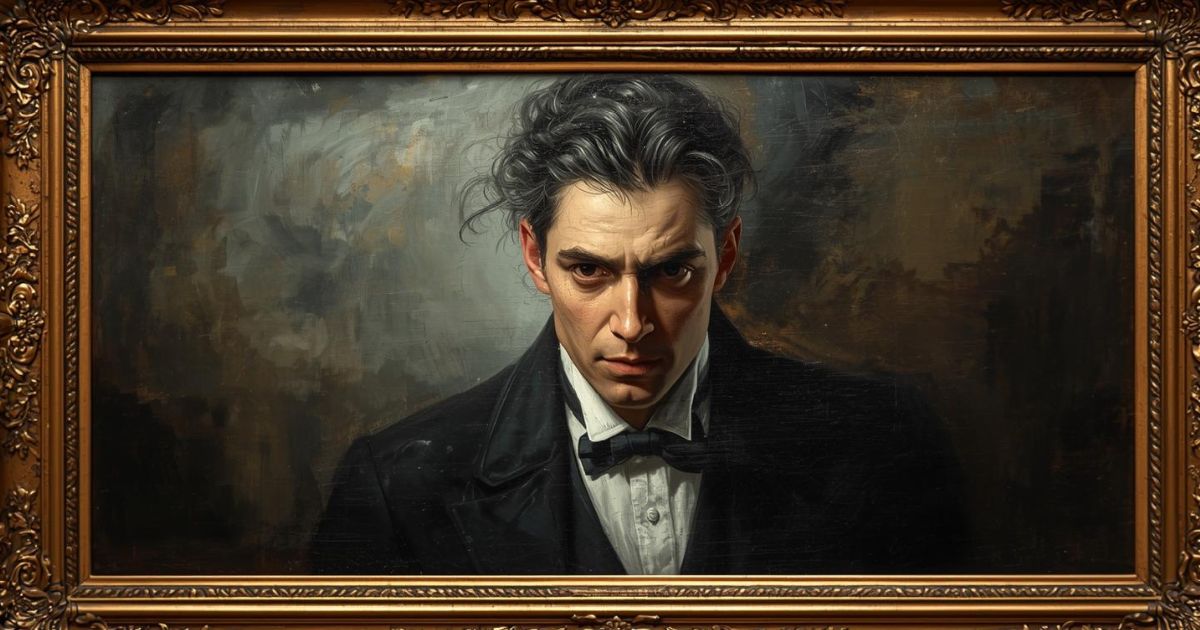
An excerpt from the original text.(complete · 3135 words)
hat evening, at eight-thirty, exquisitely dressed and wearing a large
button-hole of Parma violets, Dorian Gray was ushered into Lady
Narborough’s drawing-room by bowing servants. His forehead was
throbbing with maddened nerves, and he felt wildly excited, but his
manner as he bent over his hostess’s hand was as easy and graceful as
ever. Perhaps one never seems so much at one’s ease as when one has to
play a part. Certainly no one looking at Dorian Gray that night could
have believed that he had passed through a tragedy as horrible as any
tragedy of our age. Those finely shaped fingers could never have
clutched a knife for sin, nor those smiling lips have cried out on God
and goodness. He himself could not help wondering at the calm of his
demeanour, and for a moment felt keenly the terrible pleasure of a
double life.
It was a small party, got up rather in a hurry by Lady Narborough, who
was a very clever woman with what Lord Henry used to describe as the
remains of really remarkable ugliness. She had proved an excellent wife
to one of our most tedious ambassadors, and having buried her husband
properly in a marble mausoleum, which she had herself designed, and
married off her daughters to some rich, rather elderly men, she devoted
herself now to the pleasures of French fiction, French cookery, and
French esprit when she could get it.
Dorian was one of her especial favourites, and she always told him that
she was extremely glad she had not met him in early life. “I know, my
dear, I should have fallen madly in love with you,” she used to say,
“and thrown my bonnet right over the mills for your sake. It is most
fortunate that you were not thought of at the time. As it was, our
bonnets were so unbecoming, and the mills were so occupied in trying to
raise the wind, that I never had even a flirtation with anybody.
However, that was all Narborough’s fault. He was dreadfully
short-sighted, and there is no pleasure in taking in a husband who
never sees anything.”
Her guests this evening were rather tedious. The fact was, as she
explained to Dorian, behind a very shabby fan, one of her married
daughters had come up quite suddenly to stay with her, and, to make
matters worse, had actually brought her husband with her. “I think it
is most unkind of her, my dear,” she whispered. “Of course I go and
stay with them every summer after I come from Homburg, but then an old
woman like me must have fresh air sometimes, and besides, I really wake
them up. You don’t know what an existence they lead down there. It is
pure unadulterated country life. They get up early, because they have
so much to do, and go to bed early, because they have so little to
think about. There has not been a scandal in the neighbourhood since
the time of Queen Elizabeth, and consequently they all fall asleep
after dinner. You shan’t sit next either of them. You shall sit by me
and amuse me.”
Dorian murmured a graceful compliment and looked round the room. Yes:
it was certainly a tedious party. Two of the people he had never seen
before, and the others consisted of Ernest Harrowden, one of those
middle-aged mediocrities so common in London clubs who have no enemies,
but are thoroughly disliked by their friends; Lady Ruxton, an
overdressed woman of forty-seven, with a hooked nose, who was always
trying to get herself compromised, but was so peculiarly plain that to
her great disappointment no one would ever believe anything against
her; Mrs. Erlynne, a pushing nobody, with a delightful lisp and
Venetian-red hair; Lady Alice Chapman, his hostess’s daughter, a dowdy
dull girl, with one of those characteristic British faces that, once
seen, are never remembered; and her husband, a red-cheeked,
white-whiskered creature who, like so many of his class, was under the
impression that inordinate joviality can atone for an entire lack of
ideas.
He was rather sorry he had come, till Lady Narborough, looking at the
great ormolu gilt clock that sprawled in gaudy curves on the
mauve-draped mantelshelf, exclaimed: “How horrid of Henry Wotton to be
so late! I sent round to him this morning on chance and he promised
faithfully not to disappoint me.”
It was some consolation that Harry was to be there, and when the door
opened and he heard his slow musical voice lending charm to some
insincere apology, he ceased to feel bored.
But at dinner he could not eat anything. Plate after plate went away
untasted. Lady Narborough kept scolding him for what she called “an
insult to poor Adolphe, who invented the menu specially for you,” and
now and then Lord Henry looked across at him, wondering at his silence
and abstracted manner. From time to time the butler filled his glass
with champagne. He drank eagerly, and his thirst seemed to increase.
“Dorian,” said Lord Henry at last, as the chaud-froid was being
handed round, “what is the matter with you to-night? You are quite out
of sorts.”
“I believe he is in love,” cried Lady Narborough, “and that he is
afraid to tell me for fear I should be jealous. He is quite right. I
certainly should.”
“Dear Lady Narborough,” murmured Dorian, smiling, “I have not been in
love for a whole week—not, in fact, since Madame de Ferrol left town.”
“How you men can fall in love with that woman!” exclaimed the old lady.
“I really cannot understand it.”
“It is simply because she remembers you when you were a little girl,
Lady Narborough,” said Lord Henry. “She is the one link between us and
your short frocks.”
“She does not remember my short frocks at all, Lord Henry. But I
remember her very well at Vienna thirty years ago, and how décolletée
she was then.”
“She is still décolletée,” he answered, taking an olive in his long
fingers; “and when she is in a very smart gown she looks like an
édition de luxe of a bad French novel. She is really wonderful, and
full of surprises. Her capacity for family affection is extraordinary.
When her third husband died, her hair turned quite gold from grief.”
“How can you, Harry!” cried Dorian.
“It is a most romantic explanation,” laughed the hostess. “But her
third husband, Lord Henry! You don’t mean to say Ferrol is the fourth?”
“Certainly, Lady Narborough.”
“I don’t believe a word of it.”
“Well, ask Mr. Gray. He is one of her most intimate friends.”
“Is it true, Mr. Gray?”
“She assures me so, Lady Narborough,” said Dorian. “I asked her
whether, like Marguerite de Navarre, she had their hearts embalmed and
hung at her girdle. She told me she didn’t, because none of them had
had any hearts at all.”
“Four husbands! Upon my word that is trop de zêle.”
“Trop d’audace, I tell her,” said Dorian.
“Oh! she is audacious enough for anything, my dear. And what is Ferrol
like? I don’t know him.”
“The husbands of very beautiful women belong to the criminal classes,”
said Lord Henry, sipping his wine.
Lady Narborough hit him with her fan. “Lord Henry, I am not at all
surprised that the world says that you are extremely wicked.”
“But what world says that?” asked Lord Henry, elevating his eyebrows.
“It can only be the next world. This world and I are on excellent
terms.”
“Everybody I know says you are very wicked,” cried the old lady,
shaking her head.
Lord Henry looked serious for some moments. “It is perfectly
monstrous,” he said, at last, “the way people go about nowadays saying
things against one behind one’s back that are absolutely and entirely
true.”
“Isn’t he incorrigible?” cried Dorian, leaning forward in his chair.
“I hope so,” said his hostess, laughing. “But really, if you all
worship Madame de Ferrol in this ridiculous way, I shall have to marry
again so as to be in the fashion.”
“You will never marry again, Lady Narborough,” broke in Lord Henry.
“You were far too happy. When a woman marries again, it is because she
detested her first husband. When a man marries again, it is because he
adored his first wife. Women try their luck; men risk theirs.”
“Narborough wasn’t perfect,” cried the old lady.
“If he had been, you would not have loved him, my dear lady,” was the
rejoinder. “Women love us for our defects. If we have enough of them,
they will forgive us everything, even our intellects. You will never
ask me to dinner again after saying this, I am afraid, Lady Narborough,
but it is quite true.”
“Of course it is true, Lord Henry. If we women did not love you for
your defects, where would you all be? Not one of you would ever be
married. You would be a set of unfortunate bachelors. Not, however,
that that would alter you much. Nowadays all the married men live like
bachelors, and all the bachelors like married men.”
“Fin de siêcle,” murmured Lord Henry.
“Fin du globe,” answered his hostess.
“I wish it were fin du globe,” said Dorian with a sigh. “Life is a
great disappointment.”
“Ah, my dear,” cried Lady Narborough, putting on her gloves, “don’t
tell me that you have exhausted life. When a man says that one knows
that life has exhausted him. Lord Henry is very wicked, and I sometimes
wish that I had been; but you are made to be good—you look so good. I
must find you a nice wife. Lord Henry, don’t you think that Mr. Gray
should get married?”
“I am always telling him so, Lady Narborough,” said Lord Henry with a
bow.
“Well, we must look out for a suitable match for him. I shall go
through Debrett carefully to-night and draw out a list of all the
eligible young ladies.”
“With their ages, Lady Narborough?” asked Dorian.
“Of course, with their ages, slightly edited. But nothing must be done
in a hurry. I want it to be what The Morning Post calls a suitable
alliance, and I want you both to be happy.”
“What nonsense people talk about happy marriages!” exclaimed Lord
Henry. “A man can be happy with any woman, as long as he does not love
her.”
“Ah! what a cynic you are!” cried the old lady, pushing back her chair
and nodding to Lady Ruxton. “You must come and dine with me soon again.
You are really an admirable tonic, much better than what Sir Andrew
prescribes for me. You must tell me what people you would like to meet,
though. I want it to be a delightful gathering.”
“I like men who have a future and women who have a past,” he answered.
“Or do you think that would make it a petticoat party?”
“I fear so,” she said, laughing, as she stood up. “A thousand pardons,
my dear Lady Ruxton,” she added, “I didn’t see you hadn’t finished your
cigarette.”
“Never mind, Lady Narborough. I smoke a great deal too much. I am going
to limit myself, for the future.”
“Pray don’t, Lady Ruxton,” said Lord Henry. “Moderation is a fatal
thing. Enough is as bad as a meal. More than enough is as good as a
feast.”
Lady Ruxton glanced at him curiously. “You must come and explain that
to me some afternoon, Lord Henry. It sounds a fascinating theory,” she
murmured, as she swept out of the room.
“Now, mind you don’t stay too long over your politics and scandal,”
cried Lady Narborough from the door. “If you do, we are sure to
squabble upstairs.”
The men laughed, and Mr. Chapman got up solemnly from the foot of the
table and came up to the top. Dorian Gray changed his seat and went and
sat by Lord Henry. Mr. Chapman began to talk in a loud voice about the
situation in the House of Commons. He guffawed at his adversaries. The
word doctrinaire—word full of terror to the British mind—reappeared
from time to time between his explosions. An alliterative prefix served
as an ornament of oratory. He hoisted the Union Jack on the pinnacles
of thought. The inherited stupidity of the race—sound English common
sense he jovially termed it—was shown to be the proper bulwark for
society.
A smile curved Lord Henry’s lips, and he turned round and looked at
Dorian.
“Are you better, my dear fellow?” he asked. “You seemed rather out of
sorts at dinner.”
“I am quite well, Harry. I am tired. That is all.”
“You were charming last night. The little duchess is quite devoted to
you. She tells me she is going down to Selby.”
“She has promised to come on the twentieth.”
“Is Monmouth to be there, too?”
“Oh, yes, Harry.”
“He bores me dreadfully, almost as much as he bores her. She is very
clever, too clever for a woman. She lacks the indefinable charm of
weakness. It is the feet of clay that make the gold of the image
precious. Her feet are very pretty, but they are not feet of clay.
White porcelain feet, if you like. They have been through the fire, and
what fire does not destroy, it hardens. She has had experiences.”
“How long has she been married?” asked Dorian.
“An eternity, she tells me. I believe, according to the peerage, it is
ten years, but ten years with Monmouth must have been like eternity,
with time thrown in. Who else is coming?”
“Oh, the Willoughbys, Lord Rugby and his wife, our hostess, Geoffrey
Clouston, the usual set. I have asked Lord Grotrian.”
“I like him,” said Lord Henry. “A great many people don’t, but I find
him charming. He atones for being occasionally somewhat overdressed by
being always absolutely over-educated. He is a very modern type.”
“I don’t know if he will be able to come, Harry. He may have to go to
Monte Carlo with his father.”
“Ah! what a nuisance people’s people are! Try and make him come. By the
way, Dorian, you ran off very early last night. You left before eleven.
What did you do afterwards? Did you go straight home?”
Dorian glanced at him hurriedly and frowned.
“No, Harry,” he said at last, “I did not get home till nearly three.”
“Did you go to the club?”
“Yes,” he answered. Then he bit his lip. “No, I don’t mean that. I
didn’t go to the club. I walked about. I forget what I did.... How
inquisitive you are, Harry! You always want to know what one has been
doing. I always want to forget what I have been doing. I came in at
half-past two, if you wish to know the exact time. I had left my
latch-key at home, and my servant had to let me in. If you want any
corroborative evidence on the subject, you can ask him.”
Lord Henry shrugged his shoulders. “My dear fellow, as if I cared! Let
us go up to the drawing-room. No sherry, thank you, Mr. Chapman.
Something has happened to you, Dorian. Tell me what it is. You are not
yourself to-night.”
“Don’t mind me, Harry. I am irritable, and out of temper. I shall come
round and see you to-morrow, or next day. Make my excuses to Lady
Narborough. I shan’t go upstairs. I shall go home. I must go home.”
“All right, Dorian. I dare say I shall see you to-morrow at tea-time.
The duchess is coming.”
“I will try to be there, Harry,” he said, leaving the room. As he drove
back to his own house, he was conscious that the sense of terror he
thought he had strangled had come back to him. Lord Henry’s casual
questioning had made him lose his nerve for the moment, and he wanted
his nerve still. Things that were dangerous had to be destroyed. He
winced. He hated the idea of even touching them.
Yet it had to be done. He realized that, and when he had locked the
door of his library, he opened the secret press into which he had
thrust Basil Hallward’s coat and bag. A huge fire was blazing. He piled
another log on it. The smell of the singeing clothes and burning
leather was horrible. It took him three-quarters of an hour to consume
everything. At the end he felt faint and sick, and having lit some
Algerian pastilles in a pierced copper brazier, he bathed his hands and
forehead with a cool musk-scented vinegar.
Suddenly he started. His eyes grew strangely bright, and he gnawed
nervously at his underlip. Between two of the windows stood a large
Florentine cabinet, made out of ebony and inlaid with ivory and blue
lapis. He watched it as though it were a thing that could fascinate and
make afraid, as though it held something that he longed for and yet
almost loathed. His breath quickened. A mad craving came over him. He
lit a cigarette and then threw it away. His eyelids drooped till the
long fringed lashes almost touched his cheek. But he still watched the
cabinet. At last he got up from the sofa on which he had been lying,
went over to it, and having unlocked it, touched some hidden spring. A
triangular drawer passed slowly out. His fingers moved instinctively
towards it, dipped in, and closed on something. It was a small Chinese
box of black and gold-dust lacquer, elaborately wrought, the sides
patterned with curved waves, and the silken cords hung with round
crystals and tasselled in plaited metal threads. He opened it. Inside
was a green paste, waxy in lustre, the odour curiously heavy and
persistent.
He hesitated for some moments, with a strangely immobile smile upon his
face. Then shivering, though the atmosphere of the room was terribly
hot, he drew himself up and glanced at the clock. It was twenty minutes
to twelve. He put the box back, shutting the cabinet doors as he did
so, and went into his bedroom.
As midnight was striking bronze blows upon the dusky air, Dorian Gray,
dressed commonly, and with a muffler wrapped round his throat, crept
quietly out of his house. In Bond Street he found a hansom with a good
horse. He hailed it and in a low voice gave the driver an address.
The man shook his head. “It is too far for me,” he muttered.
“Here is a sovereign for you,” said Dorian. “You shall have another if
you drive fast.”
“All right, sir,” answered the man, “you will be there in an hour,” and
after his fare had got in he turned his horse round and drove rapidly
towards the river.
Master this chapter. Complete your experience
Purchase the complete book to access all chapters and support classic literature
As an Amazon Associate, we earn a small commission from qualifying purchases at no additional cost to you.
Available in paperback, hardcover, and e-book formats
Let's Analyse the Pattern
The tendency to avoid facing consequences through increasingly harmful distractions that compound the original problems.
Why This Matters
Connect literature to life
This chapter teaches how to spot when your escape mechanisms are actually making your problems worse and trapping you in cycles of guilt and increasingly harmful behavior.
Practice This Today
This week, notice when you feel the urge to escape or numb something uncomfortable - pause and ask 'What am I trying not to feel?' instead of automatically reaching for your usual distraction.
Now let's explore the literary elements.
Key Quotes & Analysis
"There were moments when he looked on evil simply as a mode of procuring sensations."
Context: Describing how Dorian has reached the point where he does terrible things just to feel something
This shows how completely Dorian has lost his moral compass. He's not even doing evil for gain anymore - he's doing it just to feel alive, like an addiction to drama and destruction.
In Today's Words:
Sometimes he did bad things just to feel something, anything at all.
"The soul is a terrible reality. It can be bought, and sold, and bartered away."
Context: Reflecting on his spiritual destruction while in the opium den
Dorian realizes he's literally traded his soul for pleasure and youth. This moment of clarity shows he understands what he's lost, even if he can't figure out how to get it back.
In Today's Words:
Your conscience and values are real things - and you can lose them if you're not careful.
"I can resist everything except temptation."
Context: Explaining his complete lack of self-control
This perfectly captures Dorian's fatal weakness - he has no willpower when it comes to pleasure or desire. It's both a confession and an excuse for his behavior.
In Today's Words:
I have zero self-control when I want something.
Thematic Threads
Class
In This Chapter
Dorian abandons his aristocratic world for the lowest social depths, showing how moral corruption transcends class boundaries
Development
Evolution from using class privilege to hide sins to abandoning class entirely in desperation
In Your Life:
You might find yourself changing social circles or environments to avoid facing problems rather than solving them.
Identity
In This Chapter
Dorian becomes everything he once despised—a desperate addict hiding in shadows
Development
Complete transformation from the beautiful, privileged young man to a broken soul seeking escape
In Your Life:
You might notice yourself becoming someone you don't recognize when avoiding difficult truths about your behavior.
Consequences
In This Chapter
Adrian Singleton's presence forces Dorian to see the human cost of his influence on others
Development
First direct confrontation with the trail of destruction Dorian has left behind
In Your Life:
You might encounter people whose lives were negatively affected by your past choices, forcing uncomfortable recognition.
Escape
In This Chapter
The opium den represents the ultimate retreat from reality and responsibility
Development
Introduced here as Dorian's final refuge when guilt becomes unbearable
In Your Life:
You might recognize your own patterns of seeking increasingly intense distractions when facing difficult emotions.
Moral Decay
In This Chapter
The squalid environment mirrors Dorian's internal corruption, showing that external beauty can't hide spiritual rot
Development
Physical manifestation of the moral deterioration that's been building throughout the story
In Your Life:
You might notice how your external circumstances start reflecting your internal struggles when you avoid dealing with problems.
You now have the context. Time to form your own thoughts.
Discussion Questions
- 1
What drives Dorian to seek out the opium den, and what does he hope to find there?
analysis • surface - 2
Why is Dorian's encounter with Adrian Singleton particularly devastating, and what does it reveal about the consequences of his influence?
analysis • medium - 3
Where do you see people today using destructive escapes to avoid facing uncomfortable truths about their actions?
application • medium - 4
If you were Dorian's friend and discovered him in this situation, how would you approach helping him break the cycle of destructive escape?
application • deep - 5
What does this chapter teach us about the relationship between guilt, accountability, and the human tendency to seek numbing rather than healing?
reflection • deep
Critical Thinking Exercise
Map Your Own Escape Patterns
Think about a time when you avoided dealing with a problem by diving into something else - work, social media, shopping, relationships, substances, or any other distraction. Create a simple timeline showing: the original problem you didn't want to face, what you used to escape, how that escape made things worse, and what the real cost was. Then identify what you wish you had done instead.
Consider:
- •Be honest about what you were really trying to avoid feeling or confronting
- •Notice how the escape temporarily worked but created new problems
- •Consider what support or courage you would have needed to face the original issue directly
Journaling Prompt
Write about a current situation where you might be using escape tactics instead of facing something difficult. What would it look like to choose the harder but healthier path forward?
Coming Up Next...
Chapter 16
Dorian's attempt to escape his guilt through opium fails, and he's forced to confront someone from his past who knows exactly what kind of man he's become. The confrontation threatens to expose everything he's tried to hide.



