
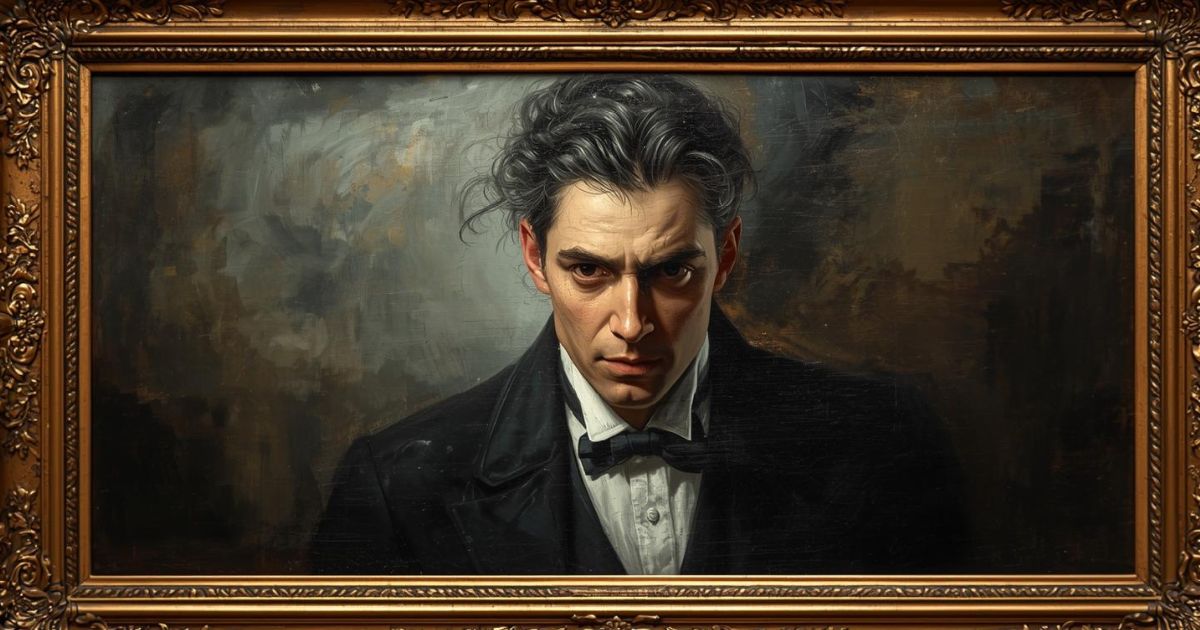
An excerpt from the original text.(complete · 3105 words)
cold rain began to fall, and the blurred street-lamps looked ghastly
in the dripping mist. The public-houses were just closing, and dim men
and women were clustering in broken groups round their doors. From some
of the bars came the sound of horrible laughter. In others, drunkards
brawled and screamed.
Lying back in the hansom, with his hat pulled over his forehead, Dorian
Gray watched with listless eyes the sordid shame of the great city, and
now and then he repeated to himself the words that Lord Henry had said
to him on the first day they had met, “To cure the soul by means of the
senses, and the senses by means of the soul.” Yes, that was the secret.
He had often tried it, and would try it again now. There were opium
dens where one could buy oblivion, dens of horror where the memory of
old sins could be destroyed by the madness of sins that were new.
The moon hung low in the sky like a yellow skull. From time to time a
huge misshapen cloud stretched a long arm across and hid it. The
gas-lamps grew fewer, and the streets more narrow and gloomy. Once the
man lost his way and had to drive back half a mile. A steam rose from
the horse as it splashed up the puddles. The sidewindows of the hansom
were clogged with a grey-flannel mist.
“To cure the soul by means of the senses, and the senses by means of
the soul!” How the words rang in his ears! His soul, certainly, was
sick to death. Was it true that the senses could cure it? Innocent
blood had been spilled. What could atone for that? Ah! for that there
was no atonement; but though forgiveness was impossible, forgetfulness
was possible still, and he was determined to forget, to stamp the thing
out, to crush it as one would crush the adder that had stung one.
Indeed, what right had Basil to have spoken to him as he had done? Who
had made him a judge over others? He had said things that were
dreadful, horrible, not to be endured.
On and on plodded the hansom, going slower, it seemed to him, at each
step. He thrust up the trap and called to the man to drive faster. The
hideous hunger for opium began to gnaw at him. His throat burned and
his delicate hands twitched nervously together. He struck at the horse
madly with his stick. The driver laughed and whipped up. He laughed in
answer, and the man was silent.
The way seemed interminable, and the streets like the black web of some
sprawling spider. The monotony became unbearable, and as the mist
thickened, he felt afraid.
Then they passed by lonely brickfields. The fog was lighter here, and
he could see the strange, bottle-shaped kilns with their orange,
fanlike tongues of fire. A dog barked as they went by, and far away in
the darkness some wandering sea-gull screamed. The horse stumbled in a
rut, then swerved aside and broke into a gallop.
After some time they left the clay road and rattled again over
rough-paven streets. Most of the windows were dark, but now and then
fantastic shadows were silhouetted against some lamplit blind. He
watched them curiously. They moved like monstrous marionettes and made
gestures like live things. He hated them. A dull rage was in his heart.
As they turned a corner, a woman yelled something at them from an open
door, and two men ran after the hansom for about a hundred yards. The
driver beat at them with his whip.
It is said that passion makes one think in a circle. Certainly with
hideous iteration the bitten lips of Dorian Gray shaped and reshaped
those subtle words that dealt with soul and sense, till he had found in
them the full expression, as it were, of his mood, and justified, by
intellectual approval, passions that without such justification would
still have dominated his temper. From cell to cell of his brain crept
the one thought; and the wild desire to live, most terrible of all
man’s appetites, quickened into force each trembling nerve and fibre.
Ugliness that had once been hateful to him because it made things real,
became dear to him now for that very reason. Ugliness was the one
reality. The coarse brawl, the loathsome den, the crude violence of
disordered life, the very vileness of thief and outcast, were more
vivid, in their intense actuality of impression, than all the gracious
shapes of art, the dreamy shadows of song. They were what he needed for
forgetfulness. In three days he would be free.
Suddenly the man drew up with a jerk at the top of a dark lane. Over
the low roofs and jagged chimney-stacks of the houses rose the black
masts of ships. Wreaths of white mist clung like ghostly sails to the
yards.
“Somewhere about here, sir, ain’t it?” he asked huskily through the
trap.
Dorian started and peered round. “This will do,” he answered, and
having got out hastily and given the driver the extra fare he had
promised him, he walked quickly in the direction of the quay. Here and
there a lantern gleamed at the stern of some huge merchantman. The
light shook and splintered in the puddles. A red glare came from an
outward-bound steamer that was coaling. The slimy pavement looked like
a wet mackintosh.
He hurried on towards the left, glancing back now and then to see if he
was being followed. In about seven or eight minutes he reached a small
shabby house that was wedged in between two gaunt factories. In one of
the top-windows stood a lamp. He stopped and gave a peculiar knock.
After a little time he heard steps in the passage and the chain being
unhooked. The door opened quietly, and he went in without saying a word
to the squat misshapen figure that flattened itself into the shadow as
he passed. At the end of the hall hung a tattered green curtain that
swayed and shook in the gusty wind which had followed him in from the
street. He dragged it aside and entered a long low room which looked as
if it had once been a third-rate dancing-saloon. Shrill flaring
gas-jets, dulled and distorted in the fly-blown mirrors that faced
them, were ranged round the walls. Greasy reflectors of ribbed tin
backed them, making quivering disks of light. The floor was covered
with ochre-coloured sawdust, trampled here and there into mud, and
stained with dark rings of spilled liquor. Some Malays were crouching
by a little charcoal stove, playing with bone counters and showing
their white teeth as they chattered. In one corner, with his head
buried in his arms, a sailor sprawled over a table, and by the tawdrily
painted bar that ran across one complete side stood two haggard women,
mocking an old man who was brushing the sleeves of his coat with an
expression of disgust. “He thinks he’s got red ants on him,” laughed
one of them, as Dorian passed by. The man looked at her in terror and
began to whimper.
At the end of the room there was a little staircase, leading to a
darkened chamber. As Dorian hurried up its three rickety steps, the
heavy odour of opium met him. He heaved a deep breath, and his nostrils
quivered with pleasure. When he entered, a young man with smooth yellow
hair, who was bending over a lamp lighting a long thin pipe, looked up
at him and nodded in a hesitating manner.
“You here, Adrian?” muttered Dorian.
“Where else should I be?” he answered, listlessly. “None of the chaps
will speak to me now.”
“I thought you had left England.”
“Darlington is not going to do anything. My brother paid the bill at
last. George doesn’t speak to me either.... I don’t care,” he added
with a sigh. “As long as one has this stuff, one doesn’t want friends.
I think I have had too many friends.”
Dorian winced and looked round at the grotesque things that lay in such
fantastic postures on the ragged mattresses. The twisted limbs, the
gaping mouths, the staring lustreless eyes, fascinated him. He knew in
what strange heavens they were suffering, and what dull hells were
teaching them the secret of some new joy. They were better off than he
was. He was prisoned in thought. Memory, like a horrible malady, was
eating his soul away. From time to time he seemed to see the eyes of
Basil Hallward looking at him. Yet he felt he could not stay. The
presence of Adrian Singleton troubled him. He wanted to be where no one
would know who he was. He wanted to escape from himself.
“I am going on to the other place,” he said after a pause.
“On the wharf?”
“Yes.”
“That mad-cat is sure to be there. They won’t have her in this place
now.”
Dorian shrugged his shoulders. “I am sick of women who love one. Women
who hate one are much more interesting. Besides, the stuff is better.”
“Much the same.”
“I like it better. Come and have something to drink. I must have
something.”
“I don’t want anything,” murmured the young man.
“Never mind.”
Adrian Singleton rose up wearily and followed Dorian to the bar. A
half-caste, in a ragged turban and a shabby ulster, grinned a hideous
greeting as he thrust a bottle of brandy and two tumblers in front of
them. The women sidled up and began to chatter. Dorian turned his back
on them and said something in a low voice to Adrian Singleton.
A crooked smile, like a Malay crease, writhed across the face of one of
the women. “We are very proud to-night,” she sneered.
“For God’s sake don’t talk to me,” cried Dorian, stamping his foot on
the ground. “What do you want? Money? Here it is. Don’t ever talk to me
again.”
Two red sparks flashed for a moment in the woman’s sodden eyes, then
flickered out and left them dull and glazed. She tossed her head and
raked the coins off the counter with greedy fingers. Her companion
watched her enviously.
“It’s no use,” sighed Adrian Singleton. “I don’t care to go back. What
does it matter? I am quite happy here.”
“You will write to me if you want anything, won’t you?” said Dorian,
after a pause.
“Perhaps.”
“Good night, then.”
“Good night,” answered the young man, passing up the steps and wiping
his parched mouth with a handkerchief.
Dorian walked to the door with a look of pain in his face. As he drew
the curtain aside, a hideous laugh broke from the painted lips of the
woman who had taken his money. “There goes the devil’s bargain!” she
hiccoughed, in a hoarse voice.
“Curse you!” he answered, “don’t call me that.”
She snapped her fingers. “Prince Charming is what you like to be
called, ain’t it?” she yelled after him.
The drowsy sailor leaped to his feet as she spoke, and looked wildly
round. The sound of the shutting of the hall door fell on his ear. He
rushed out as if in pursuit.
Dorian Gray hurried along the quay through the drizzling rain. His
meeting with Adrian Singleton had strangely moved him, and he wondered
if the ruin of that young life was really to be laid at his door, as
Basil Hallward had said to him with such infamy of insult. He bit his
lip, and for a few seconds his eyes grew sad. Yet, after all, what did
it matter to him? One’s days were too brief to take the burden of
another’s errors on one’s shoulders. Each man lived his own life and
paid his own price for living it. The only pity was one had to pay so
often for a single fault. One had to pay over and over again, indeed.
In her dealings with man, destiny never closed her accounts.
There are moments, psychologists tell us, when the passion for sin, or
for what the world calls sin, so dominates a nature that every fibre of
the body, as every cell of the brain, seems to be instinct with fearful
impulses. Men and women at such moments lose the freedom of their will.
They move to their terrible end as automatons move. Choice is taken
from them, and conscience is either killed, or, if it lives at all,
lives but to give rebellion its fascination and disobedience its charm.
For all sins, as theologians weary not of reminding us, are sins of
disobedience. When that high spirit, that morning star of evil, fell
from heaven, it was as a rebel that he fell.
Callous, concentrated on evil, with stained mind, and soul hungry for
rebellion, Dorian Gray hastened on, quickening his step as he went, but
as he darted aside into a dim archway, that had served him often as a
short cut to the ill-famed place where he was going, he felt himself
suddenly seized from behind, and before he had time to defend himself,
he was thrust back against the wall, with a brutal hand round his
throat.
He struggled madly for life, and by a terrible effort wrenched the
tightening fingers away. In a second he heard the click of a revolver,
and saw the gleam of a polished barrel, pointing straight at his head,
and the dusky form of a short, thick-set man facing him.
“What do you want?” he gasped.
“Keep quiet,” said the man. “If you stir, I shoot you.”
“You are mad. What have I done to you?”
“You wrecked the life of Sibyl Vane,” was the answer, “and Sibyl Vane
was my sister. She killed herself. I know it. Her death is at your
door. I swore I would kill you in return. For years I have sought you.
I had no clue, no trace. The two people who could have described you
were dead. I knew nothing of you but the pet name she used to call you.
I heard it to-night by chance. Make your peace with God, for to-night
you are going to die.”
Dorian Gray grew sick with fear. “I never knew her,” he stammered. “I
never heard of her. You are mad.”
“You had better confess your sin, for as sure as I am James Vane, you
are going to die.” There was a horrible moment. Dorian did not know
what to say or do. “Down on your knees!” growled the man. “I give you
one minute to make your peace—no more. I go on board to-night for
India, and I must do my job first. One minute. That’s all.”
Dorian’s arms fell to his side. Paralysed with terror, he did not know
what to do. Suddenly a wild hope flashed across his brain. “Stop,” he
cried. “How long ago is it since your sister died? Quick, tell me!”
“Eighteen years,” said the man. “Why do you ask me? What do years
matter?”
“Eighteen years,” laughed Dorian Gray, with a touch of triumph in his
voice. “Eighteen years! Set me under the lamp and look at my face!”
James Vane hesitated for a moment, not understanding what was meant.
Then he seized Dorian Gray and dragged him from the archway.
Dim and wavering as was the wind-blown light, yet it served to show him
the hideous error, as it seemed, into which he had fallen, for the face
of the man he had sought to kill had all the bloom of boyhood, all the
unstained purity of youth. He seemed little more than a lad of twenty
summers, hardly older, if older indeed at all, than his sister had been
when they had parted so many years ago. It was obvious that this was
not the man who had destroyed her life.
He loosened his hold and reeled back. “My God! my God!” he cried, “and
I would have murdered you!”
Dorian Gray drew a long breath. “You have been on the brink of
committing a terrible crime, my man,” he said, looking at him sternly.
“Let this be a warning to you not to take vengeance into your own
hands.”
“Forgive me, sir,” muttered James Vane. “I was deceived. A chance word
I heard in that damned den set me on the wrong track.”
“You had better go home and put that pistol away, or you may get into
trouble,” said Dorian, turning on his heel and going slowly down the
street.
James Vane stood on the pavement in horror. He was trembling from head
to foot. After a little while, a black shadow that had been creeping
along the dripping wall moved out into the light and came close to him
with stealthy footsteps. He felt a hand laid on his arm and looked
round with a start. It was one of the women who had been drinking at
the bar.
“Why didn’t you kill him?” she hissed out, putting haggard face quite
close to his. “I knew you were following him when you rushed out from
Daly’s. You fool! You should have killed him. He has lots of money, and
he’s as bad as bad.”
“He is not the man I am looking for,” he answered, “and I want no man’s
money. I want a man’s life. The man whose life I want must be nearly
forty now. This one is little more than a boy. Thank God, I have not
got his blood upon my hands.”
The woman gave a bitter laugh. “Little more than a boy!” she sneered.
“Why, man, it’s nigh on eighteen years since Prince Charming made me
what I am.”
“You lie!” cried James Vane.
She raised her hand up to heaven. “Before God I am telling the truth,”
she cried.
“Before God?”
“Strike me dumb if it ain’t so. He is the worst one that comes here.
They say he has sold himself to the devil for a pretty face. It’s nigh
on eighteen years since I met him. He hasn’t changed much since then. I
have, though,” she added, with a sickly leer.
“You swear this?”
“I swear it,” came in hoarse echo from her flat mouth. “But don’t give
me away to him,” she whined; “I am afraid of him. Let me have some
money for my night’s lodging.”
He broke from her with an oath and rushed to the corner of the street,
but Dorian Gray had disappeared. When he looked back, the woman had
vanished also.
Master this chapter. Complete your experience
Purchase the complete book to access all chapters and support classic literature
As an Amazon Associate, we earn a small commission from qualifying purchases at no additional cost to you.
Available in paperback, hardcover, and e-book formats
Let's Analyse the Pattern
The illusion that privilege or power can indefinitely shield us from the consequences of harming others, until those consequences inevitably surface through unexpected channels.
Why This Matters
Connect literature to life
This chapter teaches how to map the hidden networks of people affected by our actions, understanding that harm doesn't end with the immediate victim.
Practice This Today
This week, notice when you hear about someone's family member or friend—ask yourself what ripple effects your own actions might be creating through people you can't see.
Now let's explore the literary elements.
Key Quotes & Analysis
"How strange! I had a brother who was seeking to kill me, and now he is dead."
Context: After learning the identity of the man killed in the hunting accident
Shows Dorian's emotional detachment even when facing his own mortality. He's more fascinated than horrified by the coincidence. The word 'strange' reveals how disconnected he is from normal human emotions like guilt or relief.
In Today's Words:
Weird how that worked out - the guy trying to kill me just died instead.
"The dead man was a sailor, and had come from Newcastle. He was called James Vane."
Context: When Dorian learns who was killed in the hunting accident
The simple, factual tone makes the revelation more chilling. These few words connect Dorian's past sins to his present, showing that his actions have consequences he never considered - like creating enemies he didn't even know existed.
In Today's Words:
The dead guy was Sibyl's brother, and he'd been hunting Dorian for years.
"Death had come very near to him, and the thought made him sick with horror."
Context: Dorian's reaction to realizing how close he came to being killed
First time we see Dorian genuinely afraid of death rather than fascinated by it. His horror comes from realizing his charmed life might actually end, that his supernatural protection has limits. The proximity of death makes it real in a way it never was before.
In Today's Words:
Holy crap, I almost died, and that scares the hell out of me.
Thematic Threads
Consequences
In This Chapter
Dorian's past literally comes hunting him through Sibyl's vengeful brother, shattering his illusion of immunity
Development
Evolved from abstract corruption in the portrait to concrete, physical threat in the real world
In Your Life:
That moment when someone you wronged years ago suddenly reappears in your life, demanding accountability.
Privilege
In This Chapter
Dorian's wealth and beauty have protected him from facing the human cost of his actions until now
Development
Consistent theme showing how class and beauty create dangerous blindness to others' humanity
In Your Life:
When your advantages make you forget that your choices have real impacts on people with less power.
Justice
In This Chapter
The brother's death in a hunting accident becomes dark irony—the hunter becomes the hunted
Development
Justice theme emerges powerfully as past wrongs actively seek resolution
In Your Life:
Realizing that the universe has a way of balancing scales, even when we think we've escaped judgment.
Fear
In This Chapter
For the first time, Dorian experiences genuine fear as his sense of invincibility cracks
Development
Fear evolves from abstract anxiety about aging to concrete terror of retribution
In Your Life:
That cold realization that you're not as untouchable as you thought you were.
Recognition
In This Chapter
Dorian is forced to see Sibyl as someone's beloved sister, not just a disposable plaything
Development
Growing theme of being forced to acknowledge the full humanity of people he's damaged
In Your Life:
When you suddenly understand that the person you hurt was someone's whole world.
You now have the context. Time to form your own thoughts.
Discussion Questions
- 1
What happens when Sibyl's brother finally tracks down Dorian, and how does this encounter end?
analysis • surface - 2
Why has Dorian been able to hurt people for years without facing consequences, and what changes in this chapter?
analysis • medium - 3
Where do you see people today using wealth, status, or power to avoid facing the real impact of their harmful actions?
application • medium - 4
If you were advising someone who keeps getting hurt by people who never seem to face consequences, what would you tell them about building protection and seeking justice?
application • deep - 5
What does this chapter reveal about how privilege can make us blind to the human cost of our actions, and why that blindness eventually becomes dangerous?
reflection • deep
Critical Thinking Exercise
Map the Ripple Effects
Think of a time when someone with more power than you made a decision that hurt you or someone you care about. Draw or write out all the people that decision actually affected - not just the immediate target, but family members, friends, coworkers, anyone who felt the impact. Then flip it: think of a recent decision you made that might have affected others. Map out who might have been impacted beyond what you initially considered.
Consider:
- •People in power often can't afford to see the full human cost of their decisions
- •We all have blind spots about how our actions affect others
- •Understanding these ripple effects helps us make better choices and protect ourselves
Journaling Prompt
Write about a situation where you realized the consequences of someone's actions (including your own) were much wider than originally apparent. How did this realization change your perspective?
Coming Up Next...
Chapter 17
Shaken by his brush with death and revenge, Dorian makes a desperate decision to change his ways. But can someone who has lived so long without consequences truly transform, or is it already too late?



