
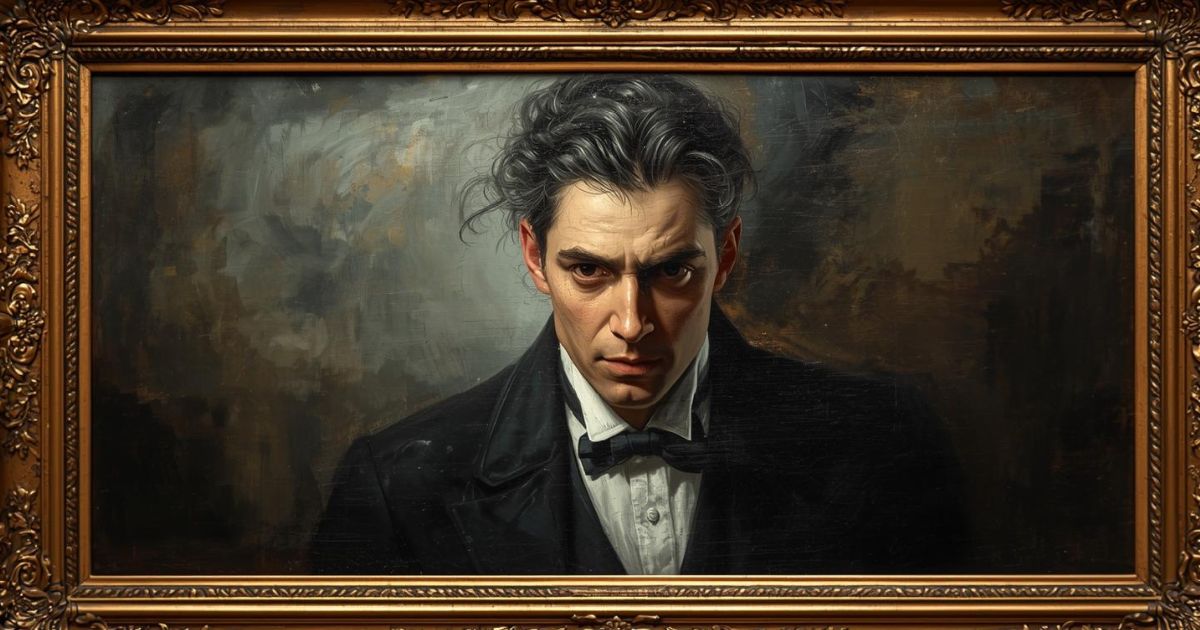
An excerpt from the original text.(complete · 1794 words)
week later Dorian Gray was sitting in the conservatory at Selby
Royal, talking to the pretty Duchess of Monmouth, who with her husband,
a jaded-looking man of sixty, was amongst his guests. It was tea-time,
and the mellow light of the huge, lace-covered lamp that stood on the
table lit up the delicate china and hammered silver of the service at
which the duchess was presiding. Her white hands were moving daintily
among the cups, and her full red lips were smiling at something that
Dorian had whispered to her. Lord Henry was lying back in a silk-draped
wicker chair, looking at them. On a peach-coloured divan sat Lady
Narborough, pretending to listen to the duke’s description of the last
Brazilian beetle that he had added to his collection. Three young men
in elaborate smoking-suits were handing tea-cakes to some of the women.
The house-party consisted of twelve people, and there were more
expected to arrive on the next day.
“What are you two talking about?” said Lord Henry, strolling over to
the table and putting his cup down. “I hope Dorian has told you about
my plan for rechristening everything, Gladys. It is a delightful idea.”
“But I don’t want to be rechristened, Harry,” rejoined the duchess,
looking up at him with her wonderful eyes. “I am quite satisfied with
my own name, and I am sure Mr. Gray should be satisfied with his.”
“My dear Gladys, I would not alter either name for the world. They are
both perfect. I was thinking chiefly of flowers. Yesterday I cut an
orchid, for my button-hole. It was a marvellous spotted thing, as
effective as the seven deadly sins. In a thoughtless moment I asked one
of the gardeners what it was called. He told me it was a fine specimen
of Robinsoniana, or something dreadful of that kind. It is a sad
truth, but we have lost the faculty of giving lovely names to things.
Names are everything. I never quarrel with actions. My one quarrel is
with words. That is the reason I hate vulgar realism in literature. The
man who could call a spade a spade should be compelled to use one. It
is the only thing he is fit for.”
“Then what should we call you, Harry?” she asked.
“His name is Prince Paradox,” said Dorian.
“I recognize him in a flash,” exclaimed the duchess.
“I won’t hear of it,” laughed Lord Henry, sinking into a chair. “From a
label there is no escape! I refuse the title.”
“Royalties may not abdicate,” fell as a warning from pretty lips.
“You wish me to defend my throne, then?”
“Yes.”
“I give the truths of to-morrow.”
“I prefer the mistakes of to-day,” she answered.
“You disarm me, Gladys,” he cried, catching the wilfulness of her mood.
“Of your shield, Harry, not of your spear.”
“I never tilt against beauty,” he said, with a wave of his hand.
“That is your error, Harry, believe me. You value beauty far too much.”
“How can you say that? I admit that I think that it is better to be
beautiful than to be good. But on the other hand, no one is more ready
than I am to acknowledge that it is better to be good than to be ugly.”
“Ugliness is one of the seven deadly sins, then?” cried the duchess.
“What becomes of your simile about the orchid?”
“Ugliness is one of the seven deadly virtues, Gladys. You, as a good
Tory, must not underrate them. Beer, the Bible, and the seven deadly
virtues have made our England what she is.”
“You don’t like your country, then?” she asked.
“I live in it.”
“That you may censure it the better.”
“Would you have me take the verdict of Europe on it?” he inquired.
“What do they say of us?”
“That Tartuffe has emigrated to England and opened a shop.”
“Is that yours, Harry?”
“I give it to you.”
“I could not use it. It is too true.”
“You need not be afraid. Our countrymen never recognize a description.”
“They are practical.”
“They are more cunning than practical. When they make up their ledger,
they balance stupidity by wealth, and vice by hypocrisy.”
“Still, we have done great things.”
“Great things have been thrust on us, Gladys.”
“We have carried their burden.”
“Only as far as the Stock Exchange.”
She shook her head. “I believe in the race,” she cried.
“It represents the survival of the pushing.”
“It has development.”
“Decay fascinates me more.”
“What of art?” she asked.
“It is a malady.”
“Love?”
“An illusion.”
“Religion?”
“The fashionable substitute for belief.”
“You are a sceptic.”
“Never! Scepticism is the beginning of faith.”
“What are you?”
“To define is to limit.”
“Give me a clue.”
“Threads snap. You would lose your way in the labyrinth.”
“You bewilder me. Let us talk of some one else.”
“Our host is a delightful topic. Years ago he was christened Prince
Charming.”
“Ah! don’t remind me of that,” cried Dorian Gray.
“Our host is rather horrid this evening,” answered the duchess,
colouring. “I believe he thinks that Monmouth married me on purely
scientific principles as the best specimen he could find of a modern
butterfly.”
“Well, I hope he won’t stick pins into you, Duchess,” laughed Dorian.
“Oh! my maid does that already, Mr. Gray, when she is annoyed with me.”
“And what does she get annoyed with you about, Duchess?”
“For the most trivial things, Mr. Gray, I assure you. Usually because I
come in at ten minutes to nine and tell her that I must be dressed by
half-past eight.”
“How unreasonable of her! You should give her warning.”
“I daren’t, Mr. Gray. Why, she invents hats for me. You remember the
one I wore at Lady Hilstone’s garden-party? You don’t, but it is nice
of you to pretend that you do. Well, she made it out of nothing. All
good hats are made out of nothing.”
“Like all good reputations, Gladys,” interrupted Lord Henry. “Every
effect that one produces gives one an enemy. To be popular one must be
a mediocrity.”
“Not with women,” said the duchess, shaking her head; “and women rule
the world. I assure you we can’t bear mediocrities. We women, as some
one says, love with our ears, just as you men love with your eyes, if
you ever love at all.”
“It seems to me that we never do anything else,” murmured Dorian.
“Ah! then, you never really love, Mr. Gray,” answered the duchess with
mock sadness.
“My dear Gladys!” cried Lord Henry. “How can you say that? Romance
lives by repetition, and repetition converts an appetite into an art.
Besides, each time that one loves is the only time one has ever loved.
Difference of object does not alter singleness of passion. It merely
intensifies it. We can have in life but one great experience at best,
and the secret of life is to reproduce that experience as often as
possible.”
“Even when one has been wounded by it, Harry?” asked the duchess after
a pause.
“Especially when one has been wounded by it,” answered Lord Henry.
The duchess turned and looked at Dorian Gray with a curious expression
in her eyes. “What do you say to that, Mr. Gray?” she inquired.
Dorian hesitated for a moment. Then he threw his head back and laughed.
“I always agree with Harry, Duchess.”
“Even when he is wrong?”
“Harry is never wrong, Duchess.”
“And does his philosophy make you happy?”
“I have never searched for happiness. Who wants happiness? I have
searched for pleasure.”
“And found it, Mr. Gray?”
“Often. Too often.”
The duchess sighed. “I am searching for peace,” she said, “and if I
don’t go and dress, I shall have none this evening.”
“Let me get you some orchids, Duchess,” cried Dorian, starting to his
feet and walking down the conservatory.
“You are flirting disgracefully with him,” said Lord Henry to his
cousin. “You had better take care. He is very fascinating.”
“If he were not, there would be no battle.”
“Greek meets Greek, then?”
“I am on the side of the Trojans. They fought for a woman.”
“They were defeated.”
“There are worse things than capture,” she answered.
“You gallop with a loose rein.”
“Pace gives life,” was the riposte.
“I shall write it in my diary to-night.”
“What?”
“That a burnt child loves the fire.”
“I am not even singed. My wings are untouched.”
“You use them for everything, except flight.”
“Courage has passed from men to women. It is a new experience for us.”
“You have a rival.”
“Who?”
He laughed. “Lady Narborough,” he whispered. “She perfectly adores
him.”
“You fill me with apprehension. The appeal to antiquity is fatal to us
who are romanticists.”
“Romanticists! You have all the methods of science.”
“Men have educated us.”
“But not explained you.”
“Describe us as a sex,” was her challenge.
“Sphinxes without secrets.”
She looked at him, smiling. “How long Mr. Gray is!” she said. “Let us
go and help him. I have not yet told him the colour of my frock.”
“Ah! you must suit your frock to his flowers, Gladys.”
“That would be a premature surrender.”
“Romantic art begins with its climax.”
“I must keep an opportunity for retreat.”
“In the Parthian manner?”
“They found safety in the desert. I could not do that.”
“Women are not always allowed a choice,” he answered, but hardly had he
finished the sentence before from the far end of the conservatory came
a stifled groan, followed by the dull sound of a heavy fall. Everybody
started up. The duchess stood motionless in horror. And with fear in
his eyes, Lord Henry rushed through the flapping palms to find Dorian
Gray lying face downwards on the tiled floor in a deathlike swoon.
He was carried at once into the blue drawing-room and laid upon one of
the sofas. After a short time, he came to himself and looked round with
a dazed expression.
“What has happened?” he asked. “Oh! I remember. Am I safe here, Harry?”
He began to tremble.
“My dear Dorian,” answered Lord Henry, “you merely fainted. That was
all. You must have overtired yourself. You had better not come down to
dinner. I will take your place.”
“No, I will come down,” he said, struggling to his feet. “I would
rather come down. I must not be alone.”
He went to his room and dressed. There was a wild recklessness of
gaiety in his manner as he sat at table, but now and then a thrill of
terror ran through him when he remembered that, pressed against the
window of the conservatory, like a white handkerchief, he had seen the
face of James Vane watching him.
Master this chapter. Complete your experience
Purchase the complete book to access all chapters and support classic literature
As an Amazon Associate, we earn a small commission from qualifying purchases at no additional cost to you.
Available in paperback, hardcover, and e-book formats
Let's Analyse the Pattern
The devastating moment when self-awareness arrives only after the damage is irreversible.
Why This Matters
Connect literature to life
This chapter teaches how to see beyond immediate gratification to count the real casualties of our decisions—the relationships damaged, the values compromised, the person we're becoming.
Practice This Today
This week, notice when you're justifying a choice by focusing only on the benefits while ignoring who might be hurt or what you're sacrificing internally.
Now let's explore the literary elements.
Key Quotes & Analysis
"It was his beauty that had ruined him, his beauty and the youth that he had prayed for."
Context: Dorian reflects on how his wish for eternal youth has become his curse
This quote reveals the central irony of Dorian's story - the very thing he thought would give him everything has actually destroyed him. His beauty allowed him to escape consequences, which prevented him from developing morally.
In Today's Words:
Getting everything you want without earning it or facing consequences will ruin you.
"He felt that the time had really come for making his choice. Or had his choice already been made?"
Context: Dorian realizes he must decide whether to continue his current path or change
This shows Dorian's growing awareness that he's reached a crossroads, but also his fear that he may have already gone too far to turn back. It captures the moment when someone realizes they need to change but wonders if it's too late.
In Today's Words:
Do I still have a chance to turn my life around, or have I already gone too far?
"The awful thing was that he could see no way out."
Context: Dorian feels trapped by the consequences of his past actions
This reflects the despair that comes when someone finally sees clearly what they've done but feels powerless to change or make amends. It shows how destructive choices can create a prison of consequences.
In Today's Words:
I've dug myself into such a deep hole that I can't see any way to climb out.
Thematic Threads
Isolation
In This Chapter
Dorian sits completely alone, realizing he has no real friends left, only people who fear him or serve his purposes
Development
Evolved from early social connections to complete emotional isolation
In Your Life:
You might notice this when you realize you have many contacts but no one you can call with real problems.
Consequences
In This Chapter
The weight of Basil's murder and Alan's suicide finally catches up with Dorian in undeniable ways
Development
Progressed from avoided consequences to inescapable reckoning
In Your Life:
You see this when past choices you thought you'd escaped suddenly resurface to affect your present.
Identity
In This Chapter
Dorian confronts the gap between his beautiful exterior and his corrupted interior self
Development
Climaxed from early identity confusion to complete self-recognition
In Your Life:
This appears when you realize the persona you present to the world no longer matches who you actually are.
Emptiness
In This Chapter
Despite all his experiences with art, philosophy, and pleasure, Dorian feels completely hollow inside
Development
Reached final stage where all external pursuits fail to provide meaning
In Your Life:
You might feel this when achievements or acquisitions that once excited you now leave you feeling nothing.
Trapped
In This Chapter
Dorian realizes his bargain for eternal youth has become a prison rather than a gift
Development
Transformed from perceived blessing to recognized curse
In Your Life:
This happens when something you thought would solve your problems becomes the source of new, worse problems.
You now have the context. Time to form your own thoughts.
Discussion Questions
- 1
What specific crimes and consequences is Dorian finally acknowledging in this chapter?
analysis • surface - 2
Why does Dorian's self-awareness come too late to change his situation?
analysis • medium - 3
Where do you see people in your life or community pursuing external validation while ignoring their internal compass?
application • medium - 4
How would you design early warning systems in your own life to catch yourself before reaching Dorian's point of no return?
application • deep - 5
What does Dorian's isolation teach us about the relationship between moral choices and genuine human connection?
reflection • deep
Critical Thinking Exercise
Create Your Integrity Alarm System
Design a personal early warning system to catch yourself before you reach a 'Dorian moment.' List three specific behaviors or choices you make that could lead you away from your values. For each one, identify what the warning signs would look like and who in your life could serve as an honest mirror to point them out.
Consider:
- •Think about times you've rationalized choices that didn't feel quite right
- •Consider what external pressures make you most likely to compromise your values
- •Identify people in your life who care enough to tell you hard truths
Journaling Prompt
Write about a time when you caught yourself heading in the wrong direction and successfully course-corrected. What helped you recognize the pattern early, and how can you apply that wisdom to future situations?
Coming Up Next...
Chapter 18
Dorian's desperation reaches a breaking point as he contemplates the one action that might free him from his cursed existence. The portrait holds the key to his fate, but using it will require a choice that could cost him everything.



