
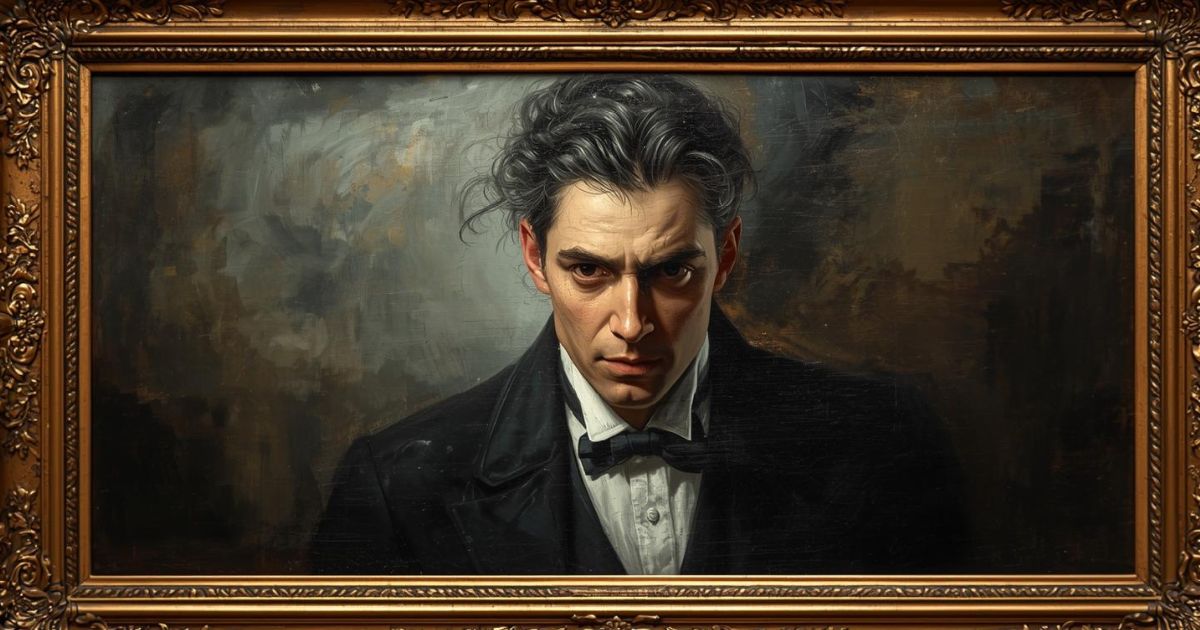
An excerpt from the original text.(complete · 3323 words)
he next day he did not leave the house, and, indeed, spent most of the
time in his own room, sick with a wild terror of dying, and yet
indifferent to life itself. The consciousness of being hunted, snared,
tracked down, had begun to dominate him. If the tapestry did but
tremble in the wind, he shook. The dead leaves that were blown against
the leaded panes seemed to him like his own wasted resolutions and wild
regrets. When he closed his eyes, he saw again the sailor’s face
peering through the mist-stained glass, and horror seemed once more to
lay its hand upon his heart.
But perhaps it had been only his fancy that had called vengeance out of
the night and set the hideous shapes of punishment before him. Actual
life was chaos, but there was something terribly logical in the
imagination. It was the imagination that set remorse to dog the feet of
sin. It was the imagination that made each crime bear its misshapen
brood. In the common world of fact the wicked were not punished, nor
the good rewarded. Success was given to the strong, failure thrust upon
the weak. That was all. Besides, had any stranger been prowling round
the house, he would have been seen by the servants or the keepers. Had
any foot-marks been found on the flower-beds, the gardeners would have
reported it. Yes, it had been merely fancy. Sibyl Vane’s brother had
not come back to kill him. He had sailed away in his ship to founder in
some winter sea. From him, at any rate, he was safe. Why, the man did
not know who he was, could not know who he was. The mask of youth had
saved him.
And yet if it had been merely an illusion, how terrible it was to think
that conscience could raise such fearful phantoms, and give them
visible form, and make them move before one! What sort of life would
his be if, day and night, shadows of his crime were to peer at him from
silent corners, to mock him from secret places, to whisper in his ear
as he sat at the feast, to wake him with icy fingers as he lay asleep!
As the thought crept through his brain, he grew pale with terror, and
the air seemed to him to have become suddenly colder. Oh! in what a
wild hour of madness he had killed his friend! How ghastly the mere
memory of the scene! He saw it all again. Each hideous detail came back
to him with added horror. Out of the black cave of time, terrible and
swathed in scarlet, rose the image of his sin. When Lord Henry came in
at six o’clock, he found him crying as one whose heart will break.
It was not till the third day that he ventured to go out. There was
something in the clear, pine-scented air of that winter morning that
seemed to bring him back his joyousness and his ardour for life. But it
was not merely the physical conditions of environment that had caused
the change. His own nature had revolted against the excess of anguish
that had sought to maim and mar the perfection of its calm. With subtle
and finely wrought temperaments it is always so. Their strong passions
must either bruise or bend. They either slay the man, or themselves
die. Shallow sorrows and shallow loves live on. The loves and sorrows
that are great are destroyed by their own plenitude. Besides, he had
convinced himself that he had been the victim of a terror-stricken
imagination, and looked back now on his fears with something of pity
and not a little of contempt.
After breakfast, he walked with the duchess for an hour in the garden
and then drove across the park to join the shooting-party. The crisp
frost lay like salt upon the grass. The sky was an inverted cup of blue
metal. A thin film of ice bordered the flat, reed-grown lake.
At the corner of the pine-wood he caught sight of Sir Geoffrey
Clouston, the duchess’s brother, jerking two spent cartridges out of
his gun. He jumped from the cart, and having told the groom to take the
mare home, made his way towards his guest through the withered bracken
and rough undergrowth.
“Have you had good sport, Geoffrey?” he asked.
“Not very good, Dorian. I think most of the birds have gone to the
open. I dare say it will be better after lunch, when we get to new
ground.”
Dorian strolled along by his side. The keen aromatic air, the brown and
red lights that glimmered in the wood, the hoarse cries of the beaters
ringing out from time to time, and the sharp snaps of the guns that
followed, fascinated him and filled him with a sense of delightful
freedom. He was dominated by the carelessness of happiness, by the high
indifference of joy.
Suddenly from a lumpy tussock of old grass some twenty yards in front
of them, with black-tipped ears erect and long hinder limbs throwing it
forward, started a hare. It bolted for a thicket of alders. Sir
Geoffrey put his gun to his shoulder, but there was something in the
animal’s grace of movement that strangely charmed Dorian Gray, and he
cried out at once, “Don’t shoot it, Geoffrey. Let it live.”
“What nonsense, Dorian!” laughed his companion, and as the hare bounded
into the thicket, he fired. There were two cries heard, the cry of a
hare in pain, which is dreadful, the cry of a man in agony, which is
worse.
“Good heavens! I have hit a beater!” exclaimed Sir Geoffrey. “What an
ass the man was to get in front of the guns! Stop shooting there!” he
called out at the top of his voice. “A man is hurt.”
The head-keeper came running up with a stick in his hand.
“Where, sir? Where is he?” he shouted. At the same time, the firing
ceased along the line.
“Here,” answered Sir Geoffrey angrily, hurrying towards the thicket.
“Why on earth don’t you keep your men back? Spoiled my shooting for the
day.”
Dorian watched them as they plunged into the alder-clump, brushing the
lithe swinging branches aside. In a few moments they emerged, dragging
a body after them into the sunlight. He turned away in horror. It
seemed to him that misfortune followed wherever he went. He heard Sir
Geoffrey ask if the man was really dead, and the affirmative answer of
the keeper. The wood seemed to him to have become suddenly alive with
faces. There was the trampling of myriad feet and the low buzz of
voices. A great copper-breasted pheasant came beating through the
boughs overhead.
After a few moments—that were to him, in his perturbed state, like
endless hours of pain—he felt a hand laid on his shoulder. He started
and looked round.
“Dorian,” said Lord Henry, “I had better tell them that the shooting is
stopped for to-day. It would not look well to go on.”
“I wish it were stopped for ever, Harry,” he answered bitterly. “The
whole thing is hideous and cruel. Is the man ...?”
He could not finish the sentence.
“I am afraid so,” rejoined Lord Henry. “He got the whole charge of shot
in his chest. He must have died almost instantaneously. Come; let us go
home.”
They walked side by side in the direction of the avenue for nearly
fifty yards without speaking. Then Dorian looked at Lord Henry and
said, with a heavy sigh, “It is a bad omen, Harry, a very bad omen.”
“What is?” asked Lord Henry. “Oh! this accident, I suppose. My dear
fellow, it can’t be helped. It was the man’s own fault. Why did he get
in front of the guns? Besides, it is nothing to us. It is rather
awkward for Geoffrey, of course. It does not do to pepper beaters. It
makes people think that one is a wild shot. And Geoffrey is not; he
shoots very straight. But there is no use talking about the matter.”
Dorian shook his head. “It is a bad omen, Harry. I feel as if something
horrible were going to happen to some of us. To myself, perhaps,” he
added, passing his hand over his eyes, with a gesture of pain.
The elder man laughed. “The only horrible thing in the world is
ennui, Dorian. That is the one sin for which there is no forgiveness.
But we are not likely to suffer from it unless these fellows keep
chattering about this thing at dinner. I must tell them that the
subject is to be tabooed. As for omens, there is no such thing as an
omen. Destiny does not send us heralds. She is too wise or too cruel
for that. Besides, what on earth could happen to you, Dorian? You have
everything in the world that a man can want. There is no one who would
not be delighted to change places with you.”
“There is no one with whom I would not change places, Harry. Don’t
laugh like that. I am telling you the truth. The wretched peasant who
has just died is better off than I am. I have no terror of death. It is
the coming of death that terrifies me. Its monstrous wings seem to
wheel in the leaden air around me. Good heavens! don’t you see a man
moving behind the trees there, watching me, waiting for me?”
Lord Henry looked in the direction in which the trembling gloved hand
was pointing. “Yes,” he said, smiling, “I see the gardener waiting for
you. I suppose he wants to ask you what flowers you wish to have on the
table to-night. How absurdly nervous you are, my dear fellow! You must
come and see my doctor, when we get back to town.”
Dorian heaved a sigh of relief as he saw the gardener approaching. The
man touched his hat, glanced for a moment at Lord Henry in a hesitating
manner, and then produced a letter, which he handed to his master. “Her
Grace told me to wait for an answer,” he murmured.
Dorian put the letter into his pocket. “Tell her Grace that I am coming
in,” he said, coldly. The man turned round and went rapidly in the
direction of the house.
“How fond women are of doing dangerous things!” laughed Lord Henry. “It
is one of the qualities in them that I admire most. A woman will flirt
with anybody in the world as long as other people are looking on.”
“How fond you are of saying dangerous things, Harry! In the present
instance, you are quite astray. I like the duchess very much, but I
don’t love her.”
“And the duchess loves you very much, but she likes you less, so you
are excellently matched.”
“You are talking scandal, Harry, and there is never any basis for
scandal.”
“The basis of every scandal is an immoral certainty,” said Lord Henry,
lighting a cigarette.
“You would sacrifice anybody, Harry, for the sake of an epigram.”
“The world goes to the altar of its own accord,” was the answer.
“I wish I could love,” cried Dorian Gray with a deep note of pathos in
his voice. “But I seem to have lost the passion and forgotten the
desire. I am too much concentrated on myself. My own personality has
become a burden to me. I want to escape, to go away, to forget. It was
silly of me to come down here at all. I think I shall send a wire to
Harvey to have the yacht got ready. On a yacht one is safe.”
“Safe from what, Dorian? You are in some trouble. Why not tell me what
it is? You know I would help you.”
“I can’t tell you, Harry,” he answered sadly. “And I dare say it is
only a fancy of mine. This unfortunate accident has upset me. I have a
horrible presentiment that something of the kind may happen to me.”
“What nonsense!”
“I hope it is, but I can’t help feeling it. Ah! here is the duchess,
looking like Artemis in a tailor-made gown. You see we have come back,
Duchess.”
“I have heard all about it, Mr. Gray,” she answered. “Poor Geoffrey is
terribly upset. And it seems that you asked him not to shoot the hare.
How curious!”
“Yes, it was very curious. I don’t know what made me say it. Some whim,
I suppose. It looked the loveliest of little live things. But I am
sorry they told you about the man. It is a hideous subject.”
“It is an annoying subject,” broke in Lord Henry. “It has no
psychological value at all. Now if Geoffrey had done the thing on
purpose, how interesting he would be! I should like to know some one
who had committed a real murder.”
“How horrid of you, Harry!” cried the duchess. “Isn’t it, Mr. Gray?
Harry, Mr. Gray is ill again. He is going to faint.”
Dorian drew himself up with an effort and smiled. “It is nothing,
Duchess,” he murmured; “my nerves are dreadfully out of order. That is
all. I am afraid I walked too far this morning. I didn’t hear what
Harry said. Was it very bad? You must tell me some other time. I think
I must go and lie down. You will excuse me, won’t you?”
They had reached the great flight of steps that led from the
conservatory on to the terrace. As the glass door closed behind Dorian,
Lord Henry turned and looked at the duchess with his slumberous eyes.
“Are you very much in love with him?” he asked.
She did not answer for some time, but stood gazing at the landscape. “I
wish I knew,” she said at last.
He shook his head. “Knowledge would be fatal. It is the uncertainty
that charms one. A mist makes things wonderful.”
“One may lose one’s way.”
“All ways end at the same point, my dear Gladys.”
“What is that?”
“Disillusion.”
“It was my début in life,” she sighed.
“It came to you crowned.”
“I am tired of strawberry leaves.”
“They become you.”
“Only in public.”
“You would miss them,” said Lord Henry.
“I will not part with a petal.”
“Monmouth has ears.”
“Old age is dull of hearing.”
“Has he never been jealous?”
“I wish he had been.”
He glanced about as if in search of something. “What are you looking
for?” she inquired.
“The button from your foil,” he answered. “You have dropped it.”
She laughed. “I have still the mask.”
“It makes your eyes lovelier,” was his reply.
She laughed again. Her teeth showed like white seeds in a scarlet
fruit.
Upstairs, in his own room, Dorian Gray was lying on a sofa, with terror
in every tingling fibre of his body. Life had suddenly become too
hideous a burden for him to bear. The dreadful death of the unlucky
beater, shot in the thicket like a wild animal, had seemed to him to
pre-figure death for himself also. He had nearly swooned at what Lord
Henry had said in a chance mood of cynical jesting.
At five o’clock he rang his bell for his servant and gave him orders to
pack his things for the night-express to town, and to have the brougham
at the door by eight-thirty. He was determined not to sleep another
night at Selby Royal. It was an ill-omened place. Death walked there in
the sunlight. The grass of the forest had been spotted with blood.
Then he wrote a note to Lord Henry, telling him that he was going up to
town to consult his doctor and asking him to entertain his guests in
his absence. As he was putting it into the envelope, a knock came to
the door, and his valet informed him that the head-keeper wished to see
him. He frowned and bit his lip. “Send him in,” he muttered, after some
moments’ hesitation.
As soon as the man entered, Dorian pulled his chequebook out of a
drawer and spread it out before him.
“I suppose you have come about the unfortunate accident of this
morning, Thornton?” he said, taking up a pen.
“Yes, sir,” answered the gamekeeper.
“Was the poor fellow married? Had he any people dependent on him?”
asked Dorian, looking bored. “If so, I should not like them to be left
in want, and will send them any sum of money you may think necessary.”
“We don’t know who he is, sir. That is what I took the liberty of
coming to you about.”
“Don’t know who he is?” said Dorian, listlessly. “What do you mean?
Wasn’t he one of your men?”
“No, sir. Never saw him before. Seems like a sailor, sir.”
The pen dropped from Dorian Gray’s hand, and he felt as if his heart
had suddenly stopped beating. “A sailor?” he cried out. “Did you say a
sailor?”
“Yes, sir. He looks as if he had been a sort of sailor; tattooed on
both arms, and that kind of thing.”
“Was there anything found on him?” said Dorian, leaning forward and
looking at the man with startled eyes. “Anything that would tell his
name?”
“Some money, sir—not much, and a six-shooter. There was no name of any
kind. A decent-looking man, sir, but rough-like. A sort of sailor we
think.”
Dorian started to his feet. A terrible hope fluttered past him. He
clutched at it madly. “Where is the body?” he exclaimed. “Quick! I must
see it at once.”
“It is in an empty stable in the Home Farm, sir. The folk don’t like to
have that sort of thing in their houses. They say a corpse brings bad
luck.”
“The Home Farm! Go there at once and meet me. Tell one of the grooms to
bring my horse round. No. Never mind. I’ll go to the stables myself. It
will save time.”
In less than a quarter of an hour, Dorian Gray was galloping down the
long avenue as hard as he could go. The trees seemed to sweep past him
in spectral procession, and wild shadows to fling themselves across his
path. Once the mare swerved at a white gate-post and nearly threw him.
He lashed her across the neck with his crop. She cleft the dusky air
like an arrow. The stones flew from her hoofs.
At last he reached the Home Farm. Two men were loitering in the yard.
He leaped from the saddle and threw the reins to one of them. In the
farthest stable a light was glimmering. Something seemed to tell him
that the body was there, and he hurried to the door and put his hand
upon the latch.
There he paused for a moment, feeling that he was on the brink of a
discovery that would either make or mar his life. Then he thrust the
door open and entered.
On a heap of sacking in the far corner was lying the dead body of a man
dressed in a coarse shirt and a pair of blue trousers. A spotted
handkerchief had been placed over the face. A coarse candle, stuck in a
bottle, sputtered beside it.
Dorian Gray shuddered. He felt that his could not be the hand to take
the handkerchief away, and called out to one of the farm-servants to
come to him.
“Take that thing off the face. I wish to see it,” he said, clutching at
the door-post for support.
When the farm-servant had done so, he stepped forward. A cry of joy
broke from his lips. The man who had been shot in the thicket was James
Vane.
He stood there for some minutes looking at the dead body. As he rode
home, his eyes were full of tears, for he knew he was safe.
Master this chapter. Complete your experience
Purchase the complete book to access all chapters and support classic literature
As an Amazon Associate, we earn a small commission from qualifying purchases at no additional cost to you.
Available in paperback, hardcover, and e-book formats
Let's Analyse the Pattern
The belief that we can indefinitely separate our actions from their results, leading to catastrophic reckoning when reality finally catches up.
Why This Matters
Connect literature to life
This chapter teaches how to calculate what you're really paying to maintain a false version of yourself.
Practice This Today
This week, notice when you feel exhausted after social interactions or social media posts - that exhaustion often signals the gap between your real self and your performed self.
Now let's explore the literary elements.
Key Quotes & Analysis
"It would kill the past, and when that was dead, he would be free."
Context: Dorian's thoughts as he prepares to destroy the portrait
This shows Dorian's fundamental misunderstanding of how accountability works. He believes he can literally destroy the evidence of his corruption and start fresh, but the corruption was always part of him, not just recorded in the painting.
In Today's Words:
If I just get rid of the evidence, I can pretend it never happened and move on.
"As it had killed the painter, so it would kill the painter's work, and all that that meant."
Context: Dorian's reasoning for stabbing the portrait with the same knife he used to kill Basil
Dorian sees a twisted logic in using the murder weapon on the painting, as if completing some circle. But this reveals how violence has become his solution to problems, showing how far he's fallen from his innocent beginning.
In Today's Words:
I'll use the same method that got me into this mess to get me out of it.
"When they entered, they found hanging upon the wall a splendid portrait of their master as they had last seen him, in all the wonder of his exquisite youth and beauty."
Context: The servants discover the portrait has returned to its original, innocent state
The portrait's restoration to innocence while Dorian lies dead shows that his corruption was never truly part of his essential self - it was the result of choices he made. The painting returns to what he could have been.
In Today's Words:
They found a picture of how he used to be, before everything went wrong.
Thematic Threads
Accountability
In This Chapter
Dorian finally faces the full weight of all his avoided consequences when he tries to destroy the portrait
Development
Evolved from early denial to desperate avoidance to final catastrophic reckoning
In Your Life:
Every time you blame circumstances instead of examining your choices, you're delaying your own reckoning.
Identity
In This Chapter
Dorian discovers his true self was always connected to his corrupted actions, not separate from them
Development
Culmination of his journey from authentic youth to fractured self to final integration through destruction
In Your Life:
The person you pretend to be and the person you really are will eventually have to reconcile.
Consequences
In This Chapter
All of Dorian's delayed consequences manifest simultaneously in his death
Development
Progressed from immediate pleasure to mounting hidden costs to catastrophic payment
In Your Life:
Small consequences ignored become large consequences that can't be avoided.
Self-Deception
In This Chapter
Dorian's final realization that he couldn't actually separate himself from his moral decay
Development
Evolved from initial bargain through years of denial to final moment of devastating clarity
In Your Life:
The stories you tell yourself about why your actions don't count will eventually stop working.
Moral Corruption
In This Chapter
The portrait returns to innocence while Dorian's body reveals the true cost of his choices
Development
Completed the full cycle from innocence through corruption to final revelation of true cost
In Your Life:
Every compromise with your values leaves a mark, even when you can't see it immediately.
You now have the context. Time to form your own thoughts.
Discussion Questions
- 1
Why does Dorian decide to destroy the portrait, and what does he expect to happen when he stabs it?
analysis • surface - 2
What does the connection between Dorian and the portrait reveal about the true nature of his bargain?
analysis • medium - 3
Where do you see people today trying to separate their actions from consequences - in relationships, work, or personal choices?
application • medium - 4
How can someone recognize when they're falling into the Consequence Avoidance Trap before it's too late?
application • deep - 5
What does Dorian's fate teach us about the relationship between our choices and our identity?
reflection • deep
Critical Thinking Exercise
Map Your Consequence Avoidance
Think of an area in your life where you might be avoiding or delaying consequences - a difficult conversation, a health issue, a financial problem, or a relationship conflict. Draw a simple map showing: the original action or choice, the immediate consequence you avoided, where that consequence went instead, and what might happen if you continue avoiding it.
Consider:
- •Consider how the avoided consequence might be affecting others in your life
- •Think about whether the consequence is growing larger over time
- •Reflect on what facing it now might look like versus waiting longer
Journaling Prompt
Write about a time when you finally faced something you'd been avoiding. What made you stop running from it, and what did you learn about yourself in the process?
Coming Up Next...
Chapter 19
Moving forward, we'll examine key events and character development in this chapter, and understand thematic elements and literary techniques. These insights bridge the gap between classic literature and modern experience.



