
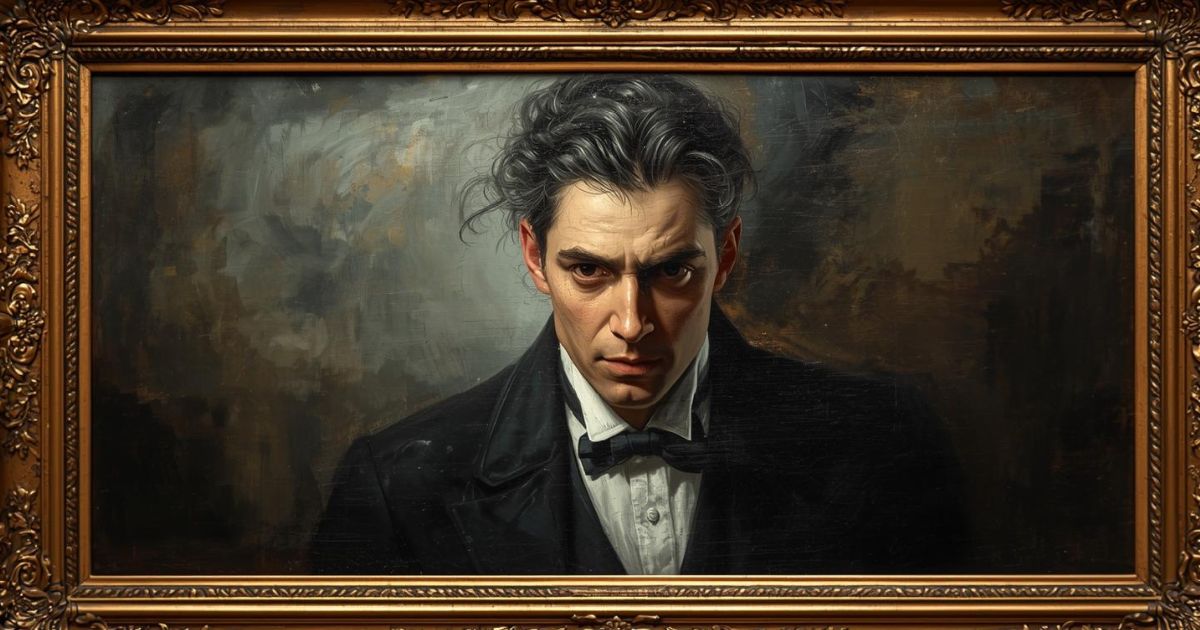
An excerpt from the original text.(complete · 5283 words)
t was long past noon when he awoke. His valet had crept several times
on tiptoe into the room to see if he was stirring, and had wondered
what made his young master sleep so late. Finally his bell sounded, and
Victor came in softly with a cup of tea, and a pile of letters, on a
small tray of old Sevres china, and drew back the olive-satin curtains,
with their shimmering blue lining, that hung in front of the three tall
windows.
“Monsieur has well slept this morning,” he said, smiling.
“What o’clock is it, Victor?” asked Dorian Gray drowsily.
“One hour and a quarter, Monsieur.”
How late it was! He sat up, and having sipped some tea, turned over his
letters. One of them was from Lord Henry, and had been brought by hand
that morning. He hesitated for a moment, and then put it aside. The
others he opened listlessly. They contained the usual collection of
cards, invitations to dinner, tickets for private views, programmes of
charity concerts, and the like that are showered on fashionable young
men every morning during the season. There was a rather heavy bill for
a chased silver Louis-Quinze toilet-set that he had not yet had the
courage to send on to his guardians, who were extremely old-fashioned
people and did not realize that we live in an age when unnecessary
things are our only necessities; and there were several very
courteously worded communications from Jermyn Street money-lenders
offering to advance any sum of money at a moment’s notice and at the
most reasonable rates of interest.
After about ten minutes he got up, and throwing on an elaborate
dressing-gown of silk-embroidered cashmere wool, passed into the
onyx-paved bathroom. The cool water refreshed him after his long sleep.
He seemed to have forgotten all that he had gone through. A dim sense
of having taken part in some strange tragedy came to him once or twice,
but there was the unreality of a dream about it.
As soon as he was dressed, he went into the library and sat down to a
light French breakfast that had been laid out for him on a small round
table close to the open window. It was an exquisite day. The warm air
seemed laden with spices. A bee flew in and buzzed round the
blue-dragon bowl that, filled with sulphur-yellow roses, stood before
him. He felt perfectly happy.
Suddenly his eye fell on the screen that he had placed in front of the
portrait, and he started.
“Too cold for Monsieur?” asked his valet, putting an omelette on the
table. “I shut the window?”
Dorian shook his head. “I am not cold,” he murmured.
Was it all true? Had the portrait really changed? Or had it been simply
his own imagination that had made him see a look of evil where there
had been a look of joy? Surely a painted canvas could not alter? The
thing was absurd. It would serve as a tale to tell Basil some day. It
would make him smile.
And, yet, how vivid was his recollection of the whole thing! First in
the dim twilight, and then in the bright dawn, he had seen the touch of
cruelty round the warped lips. He almost dreaded his valet leaving the
room. He knew that when he was alone he would have to examine the
portrait. He was afraid of certainty. When the coffee and cigarettes
had been brought and the man turned to go, he felt a wild desire to
tell him to remain. As the door was closing behind him, he called him
back. The man stood waiting for his orders. Dorian looked at him for a
moment. “I am not at home to any one, Victor,” he said with a sigh. The
man bowed and retired.
Then he rose from the table, lit a cigarette, and flung himself down on
a luxuriously cushioned couch that stood facing the screen. The screen
was an old one, of gilt Spanish leather, stamped and wrought with a
rather florid Louis-Quatorze pattern. He scanned it curiously,
wondering if ever before it had concealed the secret of a man’s life.
Should he move it aside, after all? Why not let it stay there? What was
the use of knowing? If the thing was true, it was terrible. If it was
not true, why trouble about it? But what if, by some fate or deadlier
chance, eyes other than his spied behind and saw the horrible change?
What should he do if Basil Hallward came and asked to look at his own
picture? Basil would be sure to do that. No; the thing had to be
examined, and at once. Anything would be better than this dreadful
state of doubt.
He got up and locked both doors. At least he would be alone when he
looked upon the mask of his shame. Then he drew the screen aside and
saw himself face to face. It was perfectly true. The portrait had
altered.
As he often remembered afterwards, and always with no small wonder, he
found himself at first gazing at the portrait with a feeling of almost
scientific interest. That such a change should have taken place was
incredible to him. And yet it was a fact. Was there some subtle
affinity between the chemical atoms that shaped themselves into form
and colour on the canvas and the soul that was within him? Could it be
that what that soul thought, they realized?—that what it dreamed, they
made true? Or was there some other, more terrible reason? He shuddered,
and felt afraid, and, going back to the couch, lay there, gazing at the
picture in sickened horror.
One thing, however, he felt that it had done for him. It had made him
conscious how unjust, how cruel, he had been to Sibyl Vane. It was not
too late to make reparation for that. She could still be his wife. His
unreal and selfish love would yield to some higher influence, would be
transformed into some nobler passion, and the portrait that Basil
Hallward had painted of him would be a guide to him through life, would
be to him what holiness is to some, and conscience to others, and the
fear of God to us all. There were opiates for remorse, drugs that could
lull the moral sense to sleep. But here was a visible symbol of the
degradation of sin. Here was an ever-present sign of the ruin men
brought upon their souls.
Three o’clock struck, and four, and the half-hour rang its double
chime, but Dorian Gray did not stir. He was trying to gather up the
scarlet threads of life and to weave them into a pattern; to find his
way through the sanguine labyrinth of passion through which he was
wandering. He did not know what to do, or what to think. Finally, he
went over to the table and wrote a passionate letter to the girl he had
loved, imploring her forgiveness and accusing himself of madness. He
covered page after page with wild words of sorrow and wilder words of
pain. There is a luxury in self-reproach. When we blame ourselves, we
feel that no one else has a right to blame us. It is the confession,
not the priest, that gives us absolution. When Dorian had finished the
letter, he felt that he had been forgiven.
Suddenly there came a knock to the door, and he heard Lord Henry’s
voice outside. “My dear boy, I must see you. Let me in at once. I can’t
bear your shutting yourself up like this.”
He made no answer at first, but remained quite still. The knocking
still continued and grew louder. Yes, it was better to let Lord Henry
in, and to explain to him the new life he was going to lead, to quarrel
with him if it became necessary to quarrel, to part if parting was
inevitable. He jumped up, drew the screen hastily across the picture,
and unlocked the door.
“I am so sorry for it all, Dorian,” said Lord Henry as he entered. “But
you must not think too much about it.”
“Do you mean about Sibyl Vane?” asked the lad.
“Yes, of course,” answered Lord Henry, sinking into a chair and slowly
pulling off his yellow gloves. “It is dreadful, from one point of view,
but it was not your fault. Tell me, did you go behind and see her,
after the play was over?”
“Yes.”
“I felt sure you had. Did you make a scene with her?”
“I was brutal, Harry—perfectly brutal. But it is all right now. I am
not sorry for anything that has happened. It has taught me to know
myself better.”
“Ah, Dorian, I am so glad you take it in that way! I was afraid I would
find you plunged in remorse and tearing that nice curly hair of yours.”
“I have got through all that,” said Dorian, shaking his head and
smiling. “I am perfectly happy now. I know what conscience is, to begin
with. It is not what you told me it was. It is the divinest thing in
us. Don’t sneer at it, Harry, any more—at least not before me. I want
to be good. I can’t bear the idea of my soul being hideous.”
“A very charming artistic basis for ethics, Dorian! I congratulate you
on it. But how are you going to begin?”
“By marrying Sibyl Vane.”
“Marrying Sibyl Vane!” cried Lord Henry, standing up and looking at him
in perplexed amazement. “But, my dear Dorian—”
“Yes, Harry, I know what you are going to say. Something dreadful about
marriage. Don’t say it. Don’t ever say things of that kind to me again.
Two days ago I asked Sibyl to marry me. I am not going to break my word
to her. She is to be my wife.”
“Your wife! Dorian! ... Didn’t you get my letter? I wrote to you this
morning, and sent the note down by my own man.”
“Your letter? Oh, yes, I remember. I have not read it yet, Harry. I was
afraid there might be something in it that I wouldn’t like. You cut
life to pieces with your epigrams.”
“You know nothing then?”
“What do you mean?”
Lord Henry walked across the room, and sitting down by Dorian Gray,
took both his hands in his own and held them tightly. “Dorian,” he
said, “my letter—don’t be frightened—was to tell you that Sibyl Vane is
dead.”
A cry of pain broke from the lad’s lips, and he leaped to his feet,
tearing his hands away from Lord Henry’s grasp. “Dead! Sibyl dead! It
is not true! It is a horrible lie! How dare you say it?”
“It is quite true, Dorian,” said Lord Henry, gravely. “It is in all the
morning papers. I wrote down to you to ask you not to see any one till
I came. There will have to be an inquest, of course, and you must not
be mixed up in it. Things like that make a man fashionable in Paris.
But in London people are so prejudiced. Here, one should never make
one’s début with a scandal. One should reserve that to give an
interest to one’s old age. I suppose they don’t know your name at the
theatre? If they don’t, it is all right. Did any one see you going
round to her room? That is an important point.”
Dorian did not answer for a few moments. He was dazed with horror.
Finally he stammered, in a stifled voice, “Harry, did you say an
inquest? What did you mean by that? Did Sibyl—? Oh, Harry, I can’t bear
it! But be quick. Tell me everything at once.”
“I have no doubt it was not an accident, Dorian, though it must be put
in that way to the public. It seems that as she was leaving the theatre
with her mother, about half-past twelve or so, she said she had
forgotten something upstairs. They waited some time for her, but she
did not come down again. They ultimately found her lying dead on the
floor of her dressing-room. She had swallowed something by mistake,
some dreadful thing they use at theatres. I don’t know what it was, but
it had either prussic acid or white lead in it. I should fancy it was
prussic acid, as she seems to have died instantaneously.”
“Harry, Harry, it is terrible!” cried the lad.
“Yes; it is very tragic, of course, but you must not get yourself mixed
up in it. I see by The Standard that she was seventeen. I should have
thought she was almost younger than that. She looked such a child, and
seemed to know so little about acting. Dorian, you mustn’t let this
thing get on your nerves. You must come and dine with me, and
afterwards we will look in at the opera. It is a Patti night, and
everybody will be there. You can come to my sister’s box. She has got
some smart women with her.”
“So I have murdered Sibyl Vane,” said Dorian Gray, half to himself,
“murdered her as surely as if I had cut her little throat with a knife.
Yet the roses are not less lovely for all that. The birds sing just as
happily in my garden. And to-night I am to dine with you, and then go
on to the opera, and sup somewhere, I suppose, afterwards. How
extraordinarily dramatic life is! If I had read all this in a book,
Harry, I think I would have wept over it. Somehow, now that it has
happened actually, and to me, it seems far too wonderful for tears.
Here is the first passionate love-letter I have ever written in my
life. Strange, that my first passionate love-letter should have been
addressed to a dead girl. Can they feel, I wonder, those white silent
people we call the dead? Sibyl! Can she feel, or know, or listen? Oh,
Harry, how I loved her once! It seems years ago to me now. She was
everything to me. Then came that dreadful night—was it really only last
night?—when she played so badly, and my heart almost broke. She
explained it all to me. It was terribly pathetic. But I was not moved a
bit. I thought her shallow. Suddenly something happened that made me
afraid. I can’t tell you what it was, but it was terrible. I said I
would go back to her. I felt I had done wrong. And now she is dead. My
God! My God! Harry, what shall I do? You don’t know the danger I am in,
and there is nothing to keep me straight. She would have done that for
me. She had no right to kill herself. It was selfish of her.”
“My dear Dorian,” answered Lord Henry, taking a cigarette from his case
and producing a gold-latten matchbox, “the only way a woman can ever
reform a man is by boring him so completely that he loses all possible
interest in life. If you had married this girl, you would have been
wretched. Of course, you would have treated her kindly. One can always
be kind to people about whom one cares nothing. But she would have soon
found out that you were absolutely indifferent to her. And when a woman
finds that out about her husband, she either becomes dreadfully dowdy,
or wears very smart bonnets that some other woman’s husband has to pay
for. I say nothing about the social mistake, which would have been
abject—which, of course, I would not have allowed—but I assure you that
in any case the whole thing would have been an absolute failure.”
“I suppose it would,” muttered the lad, walking up and down the room
and looking horribly pale. “But I thought it was my duty. It is not my
fault that this terrible tragedy has prevented my doing what was right.
I remember your saying once that there is a fatality about good
resolutions—that they are always made too late. Mine certainly were.”
“Good resolutions are useless attempts to interfere with scientific
laws. Their origin is pure vanity. Their result is absolutely nil.
They give us, now and then, some of those luxurious sterile emotions
that have a certain charm for the weak. That is all that can be said
for them. They are simply cheques that men draw on a bank where they
have no account.”
“Harry,” cried Dorian Gray, coming over and sitting down beside him,
“why is it that I cannot feel this tragedy as much as I want to? I
don’t think I am heartless. Do you?”
“You have done too many foolish things during the last fortnight to be
entitled to give yourself that name, Dorian,” answered Lord Henry with
his sweet melancholy smile.
The lad frowned. “I don’t like that explanation, Harry,” he rejoined,
“but I am glad you don’t think I am heartless. I am nothing of the
kind. I know I am not. And yet I must admit that this thing that has
happened does not affect me as it should. It seems to me to be simply
like a wonderful ending to a wonderful play. It has all the terrible
beauty of a Greek tragedy, a tragedy in which I took a great part, but
by which I have not been wounded.”
“It is an interesting question,” said Lord Henry, who found an
exquisite pleasure in playing on the lad’s unconscious egotism, “an
extremely interesting question. I fancy that the true explanation is
this: It often happens that the real tragedies of life occur in such an
inartistic manner that they hurt us by their crude violence, their
absolute incoherence, their absurd want of meaning, their entire lack
of style. They affect us just as vulgarity affects us. They give us an
impression of sheer brute force, and we revolt against that. Sometimes,
however, a tragedy that possesses artistic elements of beauty crosses
our lives. If these elements of beauty are real, the whole thing simply
appeals to our sense of dramatic effect. Suddenly we find that we are
no longer the actors, but the spectators of the play. Or rather we are
both. We watch ourselves, and the mere wonder of the spectacle
enthralls us. In the present case, what is it that has really happened?
Some one has killed herself for love of you. I wish that I had ever had
such an experience. It would have made me in love with love for the
rest of my life. The people who have adored me—there have not been very
many, but there have been some—have always insisted on living on, long
after I had ceased to care for them, or they to care for me. They have
become stout and tedious, and when I meet them, they go in at once for
reminiscences. That awful memory of woman! What a fearful thing it is!
And what an utter intellectual stagnation it reveals! One should absorb
the colour of life, but one should never remember its details. Details
are always vulgar.”
“I must sow poppies in my garden,” sighed Dorian.
“There is no necessity,” rejoined his companion. “Life has always
poppies in her hands. Of course, now and then things linger. I once
wore nothing but violets all through one season, as a form of artistic
mourning for a romance that would not die. Ultimately, however, it did
die. I forget what killed it. I think it was her proposing to sacrifice
the whole world for me. That is always a dreadful moment. It fills one
with the terror of eternity. Well—would you believe it?—a week ago, at
Lady Hampshire’s, I found myself seated at dinner next the lady in
question, and she insisted on going over the whole thing again, and
digging up the past, and raking up the future. I had buried my romance
in a bed of asphodel. She dragged it out again and assured me that I
had spoiled her life. I am bound to state that she ate an enormous
dinner, so I did not feel any anxiety. But what a lack of taste she
showed! The one charm of the past is that it is the past. But women
never know when the curtain has fallen. They always want a sixth act,
and as soon as the interest of the play is entirely over, they propose
to continue it. If they were allowed their own way, every comedy would
have a tragic ending, and every tragedy would culminate in a farce.
They are charmingly artificial, but they have no sense of art. You are
more fortunate than I am. I assure you, Dorian, that not one of the
women I have known would have done for me what Sibyl Vane did for you.
Ordinary women always console themselves. Some of them do it by going
in for sentimental colours. Never trust a woman who wears mauve,
whatever her age may be, or a woman over thirty-five who is fond of
pink ribbons. It always means that they have a history. Others find a
great consolation in suddenly discovering the good qualities of their
husbands. They flaunt their conjugal felicity in one’s face, as if it
were the most fascinating of sins. Religion consoles some. Its
mysteries have all the charm of a flirtation, a woman once told me, and
I can quite understand it. Besides, nothing makes one so vain as being
told that one is a sinner. Conscience makes egotists of us all. Yes;
there is really no end to the consolations that women find in modern
life. Indeed, I have not mentioned the most important one.”
“What is that, Harry?” said the lad listlessly.
“Oh, the obvious consolation. Taking some one else’s admirer when one
loses one’s own. In good society that always whitewashes a woman. But
really, Dorian, how different Sibyl Vane must have been from all the
women one meets! There is something to me quite beautiful about her
death. I am glad I am living in a century when such wonders happen.
They make one believe in the reality of the things we all play with,
such as romance, passion, and love.”
“I was terribly cruel to her. You forget that.”
“I am afraid that women appreciate cruelty, downright cruelty, more
than anything else. They have wonderfully primitive instincts. We have
emancipated them, but they remain slaves looking for their masters, all
the same. They love being dominated. I am sure you were splendid. I
have never seen you really and absolutely angry, but I can fancy how
delightful you looked. And, after all, you said something to me the day
before yesterday that seemed to me at the time to be merely fanciful,
but that I see now was absolutely true, and it holds the key to
everything.”
“What was that, Harry?”
“You said to me that Sibyl Vane represented to you all the heroines of
romance—that she was Desdemona one night, and Ophelia the other; that
if she died as Juliet, she came to life as Imogen.”
“She will never come to life again now,” muttered the lad, burying his
face in his hands.
“No, she will never come to life. She has played her last part. But you
must think of that lonely death in the tawdry dressing-room simply as a
strange lurid fragment from some Jacobean tragedy, as a wonderful scene
from Webster, or Ford, or Cyril Tourneur. The girl never really lived,
and so she has never really died. To you at least she was always a
dream, a phantom that flitted through Shakespeare’s plays and left them
lovelier for its presence, a reed through which Shakespeare’s music
sounded richer and more full of joy. The moment she touched actual
life, she marred it, and it marred her, and so she passed away. Mourn
for Ophelia, if you like. Put ashes on your head because Cordelia was
strangled. Cry out against Heaven because the daughter of Brabantio
died. But don’t waste your tears over Sibyl Vane. She was less real
than they are.”
There was a silence. The evening darkened in the room. Noiselessly, and
with silver feet, the shadows crept in from the garden. The colours
faded wearily out of things.
After some time Dorian Gray looked up. “You have explained me to
myself, Harry,” he murmured with something of a sigh of relief. “I felt
all that you have said, but somehow I was afraid of it, and I could not
express it to myself. How well you know me! But we will not talk again
of what has happened. It has been a marvellous experience. That is all.
I wonder if life has still in store for me anything as marvellous.”
“Life has everything in store for you, Dorian. There is nothing that
you, with your extraordinary good looks, will not be able to do.”
“But suppose, Harry, I became haggard, and old, and wrinkled? What
then?”
“Ah, then,” said Lord Henry, rising to go, “then, my dear Dorian, you
would have to fight for your victories. As it is, they are brought to
you. No, you must keep your good looks. We live in an age that reads
too much to be wise, and that thinks too much to be beautiful. We
cannot spare you. And now you had better dress and drive down to the
club. We are rather late, as it is.”
“I think I shall join you at the opera, Harry. I feel too tired to eat
anything. What is the number of your sister’s box?”
“Twenty-seven, I believe. It is on the grand tier. You will see her
name on the door. But I am sorry you won’t come and dine.”
“I don’t feel up to it,” said Dorian listlessly. “But I am awfully
obliged to you for all that you have said to me. You are certainly my
best friend. No one has ever understood me as you have.”
“We are only at the beginning of our friendship, Dorian,” answered Lord
Henry, shaking him by the hand. “Good-bye. I shall see you before
nine-thirty, I hope. Remember, Patti is singing.”
As he closed the door behind him, Dorian Gray touched the bell, and in
a few minutes Victor appeared with the lamps and drew the blinds down.
He waited impatiently for him to go. The man seemed to take an
interminable time over everything.
As soon as he had left, he rushed to the screen and drew it back. No;
there was no further change in the picture. It had received the news of
Sibyl Vane’s death before he had known of it himself. It was conscious
of the events of life as they occurred. The vicious cruelty that marred
the fine lines of the mouth had, no doubt, appeared at the very moment
that the girl had drunk the poison, whatever it was. Or was it
indifferent to results? Did it merely take cognizance of what passed
within the soul? He wondered, and hoped that some day he would see the
change taking place before his very eyes, shuddering as he hoped it.
Poor Sibyl! What a romance it had all been! She had often mimicked
death on the stage. Then Death himself had touched her and taken her
with him. How had she played that dreadful last scene? Had she cursed
him, as she died? No; she had died for love of him, and love would
always be a sacrament to him now. She had atoned for everything by the
sacrifice she had made of her life. He would not think any more of what
she had made him go through, on that horrible night at the theatre.
When he thought of her, it would be as a wonderful tragic figure sent
on to the world’s stage to show the supreme reality of love. A
wonderful tragic figure? Tears came to his eyes as he remembered her
childlike look, and winsome fanciful ways, and shy tremulous grace. He
brushed them away hastily and looked again at the picture.
He felt that the time had really come for making his choice. Or had his
choice already been made? Yes, life had decided that for him—life, and
his own infinite curiosity about life. Eternal youth, infinite passion,
pleasures subtle and secret, wild joys and wilder sins—he was to have
all these things. The portrait was to bear the burden of his shame:
that was all.
A feeling of pain crept over him as he thought of the desecration that
was in store for the fair face on the canvas. Once, in boyish mockery
of Narcissus, he had kissed, or feigned to kiss, those painted lips
that now smiled so cruelly at him. Morning after morning he had sat
before the portrait wondering at its beauty, almost enamoured of it, as
it seemed to him at times. Was it to alter now with every mood to which
he yielded? Was it to become a monstrous and loathsome thing, to be
hidden away in a locked room, to be shut out from the sunlight that had
so often touched to brighter gold the waving wonder of its hair? The
pity of it! the pity of it!
For a moment, he thought of praying that the horrible sympathy that
existed between him and the picture might cease. It had changed in
answer to a prayer; perhaps in answer to a prayer it might remain
unchanged. And yet, who, that knew anything about life, would surrender
the chance of remaining always young, however fantastic that chance
might be, or with what fateful consequences it might be fraught?
Besides, was it really under his control? Had it indeed been prayer
that had produced the substitution? Might there not be some curious
scientific reason for it all? If thought could exercise its influence
upon a living organism, might not thought exercise an influence upon
dead and inorganic things? Nay, without thought or conscious desire,
might not things external to ourselves vibrate in unison with our moods
and passions, atom calling to atom in secret love or strange affinity?
But the reason was of no importance. He would never again tempt by a
prayer any terrible power. If the picture was to alter, it was to
alter. That was all. Why inquire too closely into it?
For there would be a real pleasure in watching it. He would be able to
follow his mind into its secret places. This portrait would be to him
the most magical of mirrors. As it had revealed to him his own body, so
it would reveal to him his own soul. And when winter came upon it, he
would still be standing where spring trembles on the verge of summer.
When the blood crept from its face, and left behind a pallid mask of
chalk with leaden eyes, he would keep the glamour of boyhood. Not one
blossom of his loveliness would ever fade. Not one pulse of his life
would ever weaken. Like the gods of the Greeks, he would be strong, and
fleet, and joyous. What did it matter what happened to the coloured
image on the canvas? He would be safe. That was everything.
He drew the screen back into its former place in front of the picture,
smiling as he did so, and passed into his bedroom, where his valet was
already waiting for him. An hour later he was at the opera, and Lord
Henry was leaning over his chair.
Master this chapter. Complete your experience
Purchase the complete book to access all chapters and support classic literature
As an Amazon Associate, we earn a small commission from qualifying purchases at no additional cost to you.
Available in paperback, hardcover, and e-book formats
Let's Analyse the Pattern
Surrendering your moral judgment to someone who reframes questionable behavior in flattering terms.
Why This Matters
Connect literature to life
This chapter teaches how to recognize when someone else is redefining your conscience for their benefit.
Practice This Today
This week, notice when someone reframes your uncomfortable feelings about a situation - they might be helping you ignore your moral compass for their agenda.
Now let's explore the literary elements.
Key Quotes & Analysis
"It was true that the portrait had altered. It was not a mere fancy of his own. The thing was horribly apparent."
Context: Dorian examining his portrait the morning after Sibyl's death
This moment confirms that Dorian's deal is real - his sins will show on the portrait while he stays beautiful. It's the point of no return where fantasy becomes terrifying reality.
In Today's Words:
Holy crap, this is actually happening. I can't pretend this isn't real anymore.
"The girl never really lived, and so she has never really died. To you at least she was always a dream."
Context: Henry dismissing Sibyl's suicide to make Dorian feel better
Henry dehumanizes Sibyl to protect Dorian from guilt. This is classic manipulation - making the victim seem less real so the harm seems less significant.
In Today's Words:
She wasn't a real person anyway, just your fantasy. Don't feel bad about it.
"He would be able to follow his mind into its secret places. This portrait would be to him the most magical of mirrors."
Context: Dorian realizing the portrait will show his true moral state
The portrait becomes Dorian's hidden conscience - showing him truths about himself he doesn't want others to see. It's both liberation and curse.
In Today's Words:
This thing will show me who I really am, even when I'm lying to everyone else.
"What did it matter what happened to the coloured image on the canvas? He would not see it. Why should he watch the hideous corruption of his soul?"
Context: Dorian deciding to hide the portrait in the schoolroom
This is the moment Dorian chooses willful ignorance over self-awareness. By hiding the portrait, he's choosing to ignore his moral decay rather than confront it.
In Today's Words:
If I don't look at the damage I'm doing, then it doesn't really count, right?
Thematic Threads
Identity
In This Chapter
Dorian's identity splits between his public face and his hidden corruption, symbolized by the concealed portrait
Development
Evolved from earlier innocent vanity into active deception and self-division
In Your Life:
You might maintain different versions of yourself for different people, hiding parts you're ashamed of
Influence
In This Chapter
Lord Henry's sophisticated arguments override Dorian's natural guilt and moral instincts
Development
Henry's manipulation deepens from playful corruption to active moral destruction
In Your Life:
You might find yourself adopting the values of whoever speaks most confidently or charmingly
Conscience
In This Chapter
The portrait becomes Dorian's externalized conscience, which he literally hides from view
Development
Introduced here as the physical manifestation of moral accountability
In Your Life:
You might avoid situations, people, or reminders that make you confront uncomfortable truths about yourself
Class
In This Chapter
Upper-class aestheticism is used to justify callousness toward working-class Sibyl's death
Development
Continues theme of how class privilege enables moral detachment from consequences
In Your Life:
You might use education, status, or sophistication to justify treating others as less important
Appearance
In This Chapter
Dorian chooses to preserve his beautiful exterior while hiding his moral decay
Development
Deepens from vanity into active deception about his true nature
In Your Life:
You might prioritize how things look over how they actually are, especially when facing difficult truths
You now have the context. Time to form your own thoughts.
Discussion Questions
- 1
How does Dorian's reaction to Sibyl's death change from the night before to the morning after, and what causes this shift?
analysis • surface - 2
What specific techniques does Lord Henry use to convince Dorian that feeling guilty about Sibyl's death would be 'vulgar'?
analysis • medium - 3
Think about a time when someone convinced you to ignore your gut feeling about right and wrong. What words or arguments did they use?
application • medium - 4
If you were Dorian's friend instead of Lord Henry, how would you help him process Sibyl's death in a healthier way?
application • deep - 5
What does Dorian's decision to hide the portrait reveal about how we handle shame and moral discomfort in our own lives?
reflection • deep
Critical Thinking Exercise
Spot the Moral Reframe
Think of a recent situation where you felt uncomfortable about something you did or didn't do. Write down what your gut reaction was. Now imagine Lord Henry trying to convince you that feeling was wrong. What fancy words or sophisticated arguments would he use to make your questionable choice sound elegant or intelligent?
Consider:
- •Notice how reframing often uses flattering language about your intelligence or sophistication
- •Pay attention to arguments that make you feel special or above ordinary moral concerns
- •Recognize when someone dismisses your discomfort as weakness rather than wisdom
Journaling Prompt
Write about a time when you let someone talk you out of your moral instincts. What was the cost of ignoring that inner voice, and how do you protect it now?
Coming Up Next...
Chapter 9
Years pass, and Dorian's reputation in London society becomes increasingly complex. While he remains beautiful and charming on the surface, whispers follow him wherever he goes, and the portrait upstairs continues its horrifying transformation.



