
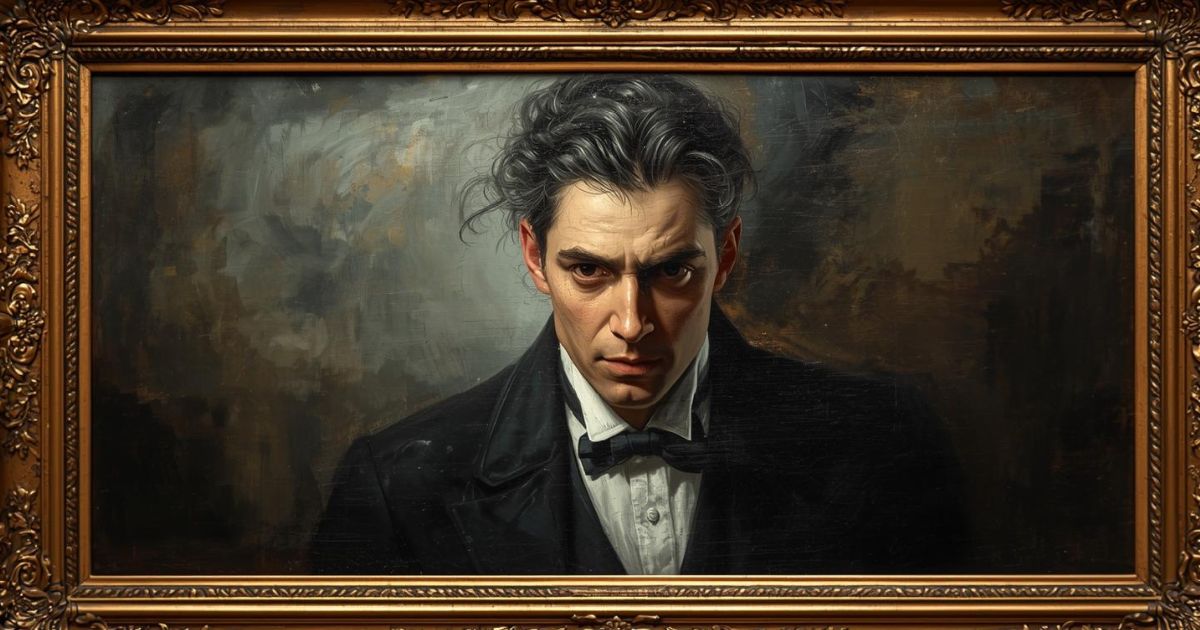
An excerpt from the original text.(complete · 4419 words)
or some reason or other, the house was crowded that night, and the fat
Jew manager who met them at the door was beaming from ear to ear with
an oily tremulous smile. He escorted them to their box with a sort of
pompous humility, waving his fat jewelled hands and talking at the top
of his voice. Dorian Gray loathed him more than ever. He felt as if he
had come to look for Miranda and had been met by Caliban. Lord Henry,
upon the other hand, rather liked him. At least he declared he did, and
insisted on shaking him by the hand and assuring him that he was proud
to meet a man who had discovered a real genius and gone bankrupt over a
poet. Hallward amused himself with watching the faces in the pit. The
heat was terribly oppressive, and the huge sunlight flamed like a
monstrous dahlia with petals of yellow fire. The youths in the gallery
had taken off their coats and waistcoats and hung them over the side.
They talked to each other across the theatre and shared their oranges
with the tawdry girls who sat beside them. Some women were laughing in
the pit. Their voices were horribly shrill and discordant. The sound of
the popping of corks came from the bar.
“What a place to find one’s divinity in!” said Lord Henry.
“Yes!” answered Dorian Gray. “It was here I found her, and she is
divine beyond all living things. When she acts, you will forget
everything. These common rough people, with their coarse faces and
brutal gestures, become quite different when she is on the stage. They
sit silently and watch her. They weep and laugh as she wills them to
do. She makes them as responsive as a violin. She spiritualizes them,
and one feels that they are of the same flesh and blood as one’s self.”
“The same flesh and blood as one’s self! Oh, I hope not!” exclaimed
Lord Henry, who was scanning the occupants of the gallery through his
opera-glass.
“Don’t pay any attention to him, Dorian,” said the painter. “I
understand what you mean, and I believe in this girl. Any one you love
must be marvellous, and any girl who has the effect you describe must
be fine and noble. To spiritualize one’s age—that is something worth
doing. If this girl can give a soul to those who have lived without
one, if she can create the sense of beauty in people whose lives have
been sordid and ugly, if she can strip them of their selfishness and
lend them tears for sorrows that are not their own, she is worthy of
all your adoration, worthy of the adoration of the world. This marriage
is quite right. I did not think so at first, but I admit it now. The
gods made Sibyl Vane for you. Without her you would have been
incomplete.”
“Thanks, Basil,” answered Dorian Gray, pressing his hand. “I knew that
you would understand me. Harry is so cynical, he terrifies me. But here
is the orchestra. It is quite dreadful, but it only lasts for about
five minutes. Then the curtain rises, and you will see the girl to whom
I am going to give all my life, to whom I have given everything that is
good in me.”
A quarter of an hour afterwards, amidst an extraordinary turmoil of
applause, Sibyl Vane stepped on to the stage. Yes, she was certainly
lovely to look at—one of the loveliest creatures, Lord Henry thought,
that he had ever seen. There was something of the fawn in her shy grace
and startled eyes. A faint blush, like the shadow of a rose in a mirror
of silver, came to her cheeks as she glanced at the crowded
enthusiastic house. She stepped back a few paces and her lips seemed to
tremble. Basil Hallward leaped to his feet and began to applaud.
Motionless, and as one in a dream, sat Dorian Gray, gazing at her. Lord
Henry peered through his glasses, murmuring, “Charming! charming!”
The scene was the hall of Capulet’s house, and Romeo in his pilgrim’s
dress had entered with Mercutio and his other friends. The band, such
as it was, struck up a few bars of music, and the dance began. Through
the crowd of ungainly, shabbily dressed actors, Sibyl Vane moved like a
creature from a finer world. Her body swayed, while she danced, as a
plant sways in the water. The curves of her throat were the curves of a
white lily. Her hands seemed to be made of cool ivory.
Yet she was curiously listless. She showed no sign of joy when her eyes
rested on Romeo. The few words she had to speak—
Good pilgrim, you do wrong your hand too much,
Which mannerly devotion shows in this;
For saints have hands that pilgrims’ hands do touch,
And palm to palm is holy palmers’ kiss—
with the brief dialogue that follows, were spoken in a thoroughly
artificial manner. The voice was exquisite, but from the point of view
of tone it was absolutely false. It was wrong in colour. It took away
all the life from the verse. It made the passion unreal.
Dorian Gray grew pale as he watched her. He was puzzled and anxious.
Neither of his friends dared to say anything to him. She seemed to them
to be absolutely incompetent. They were horribly disappointed.
Yet they felt that the true test of any Juliet is the balcony scene of
the second act. They waited for that. If she failed there, there was
nothing in her.
She looked charming as she came out in the moonlight. That could not be
denied. But the staginess of her acting was unbearable, and grew worse
as she went on. Her gestures became absurdly artificial. She
overemphasized everything that she had to say. The beautiful passage—
Thou knowest the mask of night is on my face,
Else would a maiden blush bepaint my cheek
For that which thou hast heard me speak to-night—
was declaimed with the painful precision of a schoolgirl who has been
taught to recite by some second-rate professor of elocution. When she
leaned over the balcony and came to those wonderful lines—
Although I joy in thee,
I have no joy of this contract to-night:
It is too rash, too unadvised, too sudden;
Too like the lightning, which doth cease to be
Ere one can say, “It lightens.” Sweet, good-night!
This bud of love by summer’s ripening breath
May prove a beauteous flower when next we meet—
she spoke the words as though they conveyed no meaning to her. It was
not nervousness. Indeed, so far from being nervous, she was absolutely
self-contained. It was simply bad art. She was a complete failure.
Even the common uneducated audience of the pit and gallery lost their
interest in the play. They got restless, and began to talk loudly and
to whistle. The Jew manager, who was standing at the back of the
dress-circle, stamped and swore with rage. The only person unmoved was
the girl herself.
When the second act was over, there came a storm of hisses, and Lord
Henry got up from his chair and put on his coat. “She is quite
beautiful, Dorian,” he said, “but she can’t act. Let us go.”
“I am going to see the play through,” answered the lad, in a hard
bitter voice. “I am awfully sorry that I have made you waste an
evening, Harry. I apologize to you both.”
“My dear Dorian, I should think Miss Vane was ill,” interrupted
Hallward. “We will come some other night.”
“I wish she were ill,” he rejoined. “But she seems to me to be simply
callous and cold. She has entirely altered. Last night she was a great
artist. This evening she is merely a commonplace mediocre actress.”
“Don’t talk like that about any one you love, Dorian. Love is a more
wonderful thing than art.”
“They are both simply forms of imitation,” remarked Lord Henry. “But do
let us go. Dorian, you must not stay here any longer. It is not good
for one’s morals to see bad acting. Besides, I don’t suppose you will
want your wife to act, so what does it matter if she plays Juliet like
a wooden doll? She is very lovely, and if she knows as little about
life as she does about acting, she will be a delightful experience.
There are only two kinds of people who are really fascinating—people
who know absolutely everything, and people who know absolutely nothing.
Good heavens, my dear boy, don’t look so tragic! The secret of
remaining young is never to have an emotion that is unbecoming. Come to
the club with Basil and myself. We will smoke cigarettes and drink to
the beauty of Sibyl Vane. She is beautiful. What more can you want?”
“Go away, Harry,” cried the lad. “I want to be alone. Basil, you must
go. Ah! can’t you see that my heart is breaking?” The hot tears came to
his eyes. His lips trembled, and rushing to the back of the box, he
leaned up against the wall, hiding his face in his hands.
“Let us go, Basil,” said Lord Henry with a strange tenderness in his
voice, and the two young men passed out together.
A few moments afterwards the footlights flared up and the curtain rose
on the third act. Dorian Gray went back to his seat. He looked pale,
and proud, and indifferent. The play dragged on, and seemed
interminable. Half of the audience went out, tramping in heavy boots
and laughing. The whole thing was a fiasco. The last act was played
to almost empty benches. The curtain went down on a titter and some
groans.
As soon as it was over, Dorian Gray rushed behind the scenes into the
greenroom. The girl was standing there alone, with a look of triumph on
her face. Her eyes were lit with an exquisite fire. There was a
radiance about her. Her parted lips were smiling over some secret of
their own.
When he entered, she looked at him, and an expression of infinite joy
came over her. “How badly I acted to-night, Dorian!” she cried.
“Horribly!” he answered, gazing at her in amazement. “Horribly! It was
dreadful. Are you ill? You have no idea what it was. You have no idea
what I suffered.”
The girl smiled. “Dorian,” she answered, lingering over his name with
long-drawn music in her voice, as though it were sweeter than honey to
the red petals of her mouth. “Dorian, you should have understood. But
you understand now, don’t you?”
“Understand what?” he asked, angrily.
“Why I was so bad to-night. Why I shall always be bad. Why I shall
never act well again.”
He shrugged his shoulders. “You are ill, I suppose. When you are ill
you shouldn’t act. You make yourself ridiculous. My friends were bored.
I was bored.”
She seemed not to listen to him. She was transfigured with joy. An
ecstasy of happiness dominated her.
“Dorian, Dorian,” she cried, “before I knew you, acting was the one
reality of my life. It was only in the theatre that I lived. I thought
that it was all true. I was Rosalind one night and Portia the other.
The joy of Beatrice was my joy, and the sorrows of Cordelia were mine
also. I believed in everything. The common people who acted with me
seemed to me to be godlike. The painted scenes were my world. I knew
nothing but shadows, and I thought them real. You came—oh, my beautiful
love!—and you freed my soul from prison. You taught me what reality
really is. To-night, for the first time in my life, I saw through the
hollowness, the sham, the silliness of the empty pageant in which I had
always played. To-night, for the first time, I became conscious that
the Romeo was hideous, and old, and painted, that the moonlight in the
orchard was false, that the scenery was vulgar, and that the words I
had to speak were unreal, were not my words, were not what I wanted to
say. You had brought me something higher, something of which all art is
but a reflection. You had made me understand what love really is. My
love! My love! Prince Charming! Prince of life! I have grown sick of
shadows. You are more to me than all art can ever be. What have I to do
with the puppets of a play? When I came on to-night, I could not
understand how it was that everything had gone from me. I thought that
I was going to be wonderful. I found that I could do nothing. Suddenly
it dawned on my soul what it all meant. The knowledge was exquisite to
me. I heard them hissing, and I smiled. What could they know of love
such as ours? Take me away, Dorian—take me away with you, where we can
be quite alone. I hate the stage. I might mimic a passion that I do not
feel, but I cannot mimic one that burns me like fire. Oh, Dorian,
Dorian, you understand now what it signifies? Even if I could do it, it
would be profanation for me to play at being in love. You have made me
see that.”
He flung himself down on the sofa and turned away his face. “You have
killed my love,” he muttered.
She looked at him in wonder and laughed. He made no answer. She came
across to him, and with her little fingers stroked his hair. She knelt
down and pressed his hands to her lips. He drew them away, and a
shudder ran through him.
Then he leaped up and went to the door. “Yes,” he cried, “you have
killed my love. You used to stir my imagination. Now you don’t even
stir my curiosity. You simply produce no effect. I loved you because
you were marvellous, because you had genius and intellect, because you
realized the dreams of great poets and gave shape and substance to the
shadows of art. You have thrown it all away. You are shallow and
stupid. My God! how mad I was to love you! What a fool I have been! You
are nothing to me now. I will never see you again. I will never think
of you. I will never mention your name. You don’t know what you were to
me, once. Why, once ... Oh, I can’t bear to think of it! I wish I had
never laid eyes upon you! You have spoiled the romance of my life. How
little you can know of love, if you say it mars your art! Without your
art, you are nothing. I would have made you famous, splendid,
magnificent. The world would have worshipped you, and you would have
borne my name. What are you now? A third-rate actress with a pretty
face.”
The girl grew white, and trembled. She clenched her hands together, and
her voice seemed to catch in her throat. “You are not serious, Dorian?”
she murmured. “You are acting.”
“Acting! I leave that to you. You do it so well,” he answered bitterly.
She rose from her knees and, with a piteous expression of pain in her
face, came across the room to him. She put her hand upon his arm and
looked into his eyes. He thrust her back. “Don’t touch me!” he cried.
A low moan broke from her, and she flung herself at his feet and lay
there like a trampled flower. “Dorian, Dorian, don’t leave me!” she
whispered. “I am so sorry I didn’t act well. I was thinking of you all
the time. But I will try—indeed, I will try. It came so suddenly across
me, my love for you. I think I should never have known it if you had
not kissed me—if we had not kissed each other. Kiss me again, my love.
Don’t go away from me. I couldn’t bear it. Oh! don’t go away from me.
My brother ... No; never mind. He didn’t mean it. He was in jest....
But you, oh! can’t you forgive me for to-night? I will work so hard and
try to improve. Don’t be cruel to me, because I love you better than
anything in the world. After all, it is only once that I have not
pleased you. But you are quite right, Dorian. I should have shown
myself more of an artist. It was foolish of me, and yet I couldn’t help
it. Oh, don’t leave me, don’t leave me.” A fit of passionate sobbing
choked her. She crouched on the floor like a wounded thing, and Dorian
Gray, with his beautiful eyes, looked down at her, and his chiselled
lips curled in exquisite disdain. There is always something ridiculous
about the emotions of people whom one has ceased to love. Sibyl Vane
seemed to him to be absurdly melodramatic. Her tears and sobs annoyed
him.
“I am going,” he said at last in his calm clear voice. “I don’t wish to
be unkind, but I can’t see you again. You have disappointed me.”
She wept silently, and made no answer, but crept nearer. Her little
hands stretched blindly out, and appeared to be seeking for him. He
turned on his heel and left the room. In a few moments he was out of
the theatre.
Where he went to he hardly knew. He remembered wandering through dimly
lit streets, past gaunt, black-shadowed archways and evil-looking
houses. Women with hoarse voices and harsh laughter had called after
him. Drunkards had reeled by, cursing and chattering to themselves like
monstrous apes. He had seen grotesque children huddled upon door-steps,
and heard shrieks and oaths from gloomy courts.
As the dawn was just breaking, he found himself close to Covent Garden.
The darkness lifted, and, flushed with faint fires, the sky hollowed
itself into a perfect pearl. Huge carts filled with nodding lilies
rumbled slowly down the polished empty street. The air was heavy with
the perfume of the flowers, and their beauty seemed to bring him an
anodyne for his pain. He followed into the market and watched the men
unloading their waggons. A white-smocked carter offered him some
cherries. He thanked him, wondered why he refused to accept any money
for them, and began to eat them listlessly. They had been plucked at
midnight, and the coldness of the moon had entered into them. A long
line of boys carrying crates of striped tulips, and of yellow and red
roses, defiled in front of him, threading their way through the huge,
jade-green piles of vegetables. Under the portico, with its grey,
sun-bleached pillars, loitered a troop of draggled bareheaded girls,
waiting for the auction to be over. Others crowded round the swinging
doors of the coffee-house in the piazza. The heavy cart-horses slipped
and stamped upon the rough stones, shaking their bells and trappings.
Some of the drivers were lying asleep on a pile of sacks. Iris-necked
and pink-footed, the pigeons ran about picking up seeds.
After a little while, he hailed a hansom and drove home. For a few
moments he loitered upon the doorstep, looking round at the silent
square, with its blank, close-shuttered windows and its staring blinds.
The sky was pure opal now, and the roofs of the houses glistened like
silver against it. From some chimney opposite a thin wreath of smoke
was rising. It curled, a violet riband, through the nacre-coloured air.
In the huge gilt Venetian lantern, spoil of some Doge’s barge, that
hung from the ceiling of the great, oak-panelled hall of entrance,
lights were still burning from three flickering jets: thin blue petals
of flame they seemed, rimmed with white fire. He turned them out and,
having thrown his hat and cape on the table, passed through the library
towards the door of his bedroom, a large octagonal chamber on the
ground floor that, in his new-born feeling for luxury, he had just had
decorated for himself and hung with some curious Renaissance tapestries
that had been discovered stored in a disused attic at Selby Royal. As
he was turning the handle of the door, his eye fell upon the portrait
Basil Hallward had painted of him. He started back as if in surprise.
Then he went on into his own room, looking somewhat puzzled. After he
had taken the button-hole out of his coat, he seemed to hesitate.
Finally, he came back, went over to the picture, and examined it. In
the dim arrested light that struggled through the cream-coloured silk
blinds, the face appeared to him to be a little changed. The expression
looked different. One would have said that there was a touch of cruelty
in the mouth. It was certainly strange.
He turned round and, walking to the window, drew up the blind. The
bright dawn flooded the room and swept the fantastic shadows into dusky
corners, where they lay shuddering. But the strange expression that he
had noticed in the face of the portrait seemed to linger there, to be
more intensified even. The quivering ardent sunlight showed him the
lines of cruelty round the mouth as clearly as if he had been looking
into a mirror after he had done some dreadful thing.
He winced and, taking up from the table an oval glass framed in ivory
Cupids, one of Lord Henry’s many presents to him, glanced hurriedly
into its polished depths. No line like that warped his red lips. What
did it mean?
He rubbed his eyes, and came close to the picture, and examined it
again. There were no signs of any change when he looked into the actual
painting, and yet there was no doubt that the whole expression had
altered. It was not a mere fancy of his own. The thing was horribly
apparent.
He threw himself into a chair and began to think. Suddenly there
flashed across his mind what he had said in Basil Hallward’s studio the
day the picture had been finished. Yes, he remembered it perfectly. He
had uttered a mad wish that he himself might remain young, and the
portrait grow old; that his own beauty might be untarnished, and the
face on the canvas bear the burden of his passions and his sins; that
the painted image might be seared with the lines of suffering and
thought, and that he might keep all the delicate bloom and loveliness
of his then just conscious boyhood. Surely his wish had not been
fulfilled? Such things were impossible. It seemed monstrous even to
think of them. And, yet, there was the picture before him, with the
touch of cruelty in the mouth.
Cruelty! Had he been cruel? It was the girl’s fault, not his. He had
dreamed of her as a great artist, had given his love to her because he
had thought her great. Then she had disappointed him. She had been
shallow and unworthy. And, yet, a feeling of infinite regret came over
him, as he thought of her lying at his feet sobbing like a little
child. He remembered with what callousness he had watched her. Why had
he been made like that? Why had such a soul been given to him? But he
had suffered also. During the three terrible hours that the play had
lasted, he had lived centuries of pain, aeon upon aeon of torture. His
life was well worth hers. She had marred him for a moment, if he had
wounded her for an age. Besides, women were better suited to bear
sorrow than men. They lived on their emotions. They only thought of
their emotions. When they took lovers, it was merely to have some one
with whom they could have scenes. Lord Henry had told him that, and
Lord Henry knew what women were. Why should he trouble about Sibyl
Vane? She was nothing to him now.
But the picture? What was he to say of that? It held the secret of his
life, and told his story. It had taught him to love his own beauty.
Would it teach him to loathe his own soul? Would he ever look at it
again?
No; it was merely an illusion wrought on the troubled senses. The
horrible night that he had passed had left phantoms behind it. Suddenly
there had fallen upon his brain that tiny scarlet speck that makes men
mad. The picture had not changed. It was folly to think so.
Yet it was watching him, with its beautiful marred face and its cruel
smile. Its bright hair gleamed in the early sunlight. Its blue eyes met
his own. A sense of infinite pity, not for himself, but for the painted
image of himself, came over him. It had altered already, and would
alter more. Its gold would wither into grey. Its red and white roses
would die. For every sin that he committed, a stain would fleck and
wreck its fairness. But he would not sin. The picture, changed or
unchanged, would be to him the visible emblem of conscience. He would
resist temptation. He would not see Lord Henry any more—would not, at
any rate, listen to those subtle poisonous theories that in Basil
Hallward’s garden had first stirred within him the passion for
impossible things. He would go back to Sibyl Vane, make her amends,
marry her, try to love her again. Yes, it was his duty to do so. She
must have suffered more than he had. Poor child! He had been selfish
and cruel to her. The fascination that she had exercised over him would
return. They would be happy together. His life with her would be
beautiful and pure.
He got up from his chair and drew a large screen right in front of the
portrait, shuddering as he glanced at it. “How horrible!” he murmured
to himself, and he walked across to the window and opened it. When he
stepped out on to the grass, he drew a deep breath. The fresh morning
air seemed to drive away all his sombre passions. He thought only of
Sibyl. A faint echo of his love came back to him. He repeated her name
over and over again. The birds that were singing in the dew-drenched
garden seemed to be telling the flowers about her.
Master this chapter. Complete your experience
Purchase the complete book to access all chapters and support classic literature
As an Amazon Associate, we earn a small commission from qualifying purchases at no additional cost to you.
Available in paperback, hardcover, and e-book formats
Let's Analyse the Pattern
How persuasive ideas at vulnerable moments can completely reshape someone's identity and moral compass.
Why This Matters
Connect literature to life
This chapter teaches how manipulators use philosophical-sounding arguments and appeals to urgency to make harmful choices seem sophisticated and inevitable.
Practice This Today
This week, notice when someone tries to sell you a worldview that conveniently benefits them - ask yourself what values they're asking you to abandon and why.
Now let's explore the literary elements.
Key Quotes & Analysis
"Youth! There is nothing like it. It's absurd to talk of the ignorance of youth. The only people to whose opinions I listen now with any respect are people much younger than myself."
Context: Lord Henry is charming Dorian with his philosophy about the supreme value of being young
This reveals Lord Henry's manipulative nature - he's flattering Dorian by saying youth is everything, which makes Dorian feel special and important. It's the beginning of the corruption process.
In Today's Words:
Being young is the only thing that matters - older people are just jealous and don't understand what life is really about.
"The only way to get rid of a temptation is to yield to it."
Context: Lord Henry is explaining his philosophy of giving in to every desire
This is a complete reversal of moral teaching, which usually says to resist temptation. Lord Henry is teaching Dorian that self-control is pointless and that he should indulge every impulse.
In Today's Words:
Don't fight your urges - just do whatever you want and get it out of your system.
"I can resist everything except temptation."
Context: Lord Henry is being witty about his own lack of self-control
This clever paradox shows how Lord Henry uses humor and wit to make destructive behavior sound sophisticated and appealing. He's making weakness look like strength.
In Today's Words:
I have no willpower and I'm proud of it.
Thematic Threads
Identity
In This Chapter
Dorian's self-concept shifts from innocent unconsciousness to dangerous self-awareness through Lord Henry's influence
Development
Building from earlier hints of Dorian's special nature - now crystallizing into active self-recognition
In Your Life:
You might recognize this when you catch yourself adopting new attitudes or behaviors after spending time with certain people.
Class
In This Chapter
The dinner party reveals how high society treats beauty as entertainment and people as curiosities rather than individuals
Development
Expanding the class dynamics - showing how privilege creates environments where moral corruption can flourish unchecked
In Your Life:
You see this in any group where status or appearance matters more than character or competence.
Corruption
In This Chapter
Lord Henry begins Dorian's moral corruption not through force but through seductive philosophy about pleasure and youth
Development
Introduced here as the central mechanism that will drive the entire story
In Your Life:
You might notice this when someone makes destructive choices seem sophisticated or inevitable rather than wrong.
Youth
In This Chapter
Dorian becomes acutely aware that his beauty and youth are temporary, creating urgency around experiencing pleasure
Development
Moving from unconscious youth to anxious awareness of time's passage
In Your Life:
You feel this whenever you realize time is passing and you haven't achieved what you thought you would by now.
Influence
In This Chapter
Lord Henry demonstrates how the right words at the right moment can completely redirect someone's life path
Development
Introduced here as a key dynamic - the power of mentorship and suggestion
In Your Life:
You experience this whenever you find yourself changing your opinions or behaviors after exposure to a persuasive person or idea.
You now have the context. Time to form your own thoughts.
Discussion Questions
- 1
What changes in Dorian during this dinner party, and what specific things does Lord Henry say that cause this shift?
analysis • surface - 2
Why is Dorian particularly vulnerable to Lord Henry's influence at this moment in his life?
analysis • medium - 3
Where do you see this pattern today - someone's worldview being shaped by a charismatic person who makes destructive ideas sound sophisticated?
application • medium - 4
If you were Dorian's friend and witnessed this conversation, what would you say or do to counter Lord Henry's influence?
application • deep - 5
What does this chapter reveal about how our sense of self can be shaped by the people we admire, and why timing matters so much in influence?
reflection • deep
Critical Thinking Exercise
Influence Audit: Map Your Mentors
List three people who have significantly influenced your thinking or values in the past year. For each person, write down one specific idea or attitude you adopted from them. Then evaluate: Did this influence move you toward or away from your core values? Was the timing significant - were you in a vulnerable or transitional moment when their influence took hold?
Consider:
- •Consider both positive and negative influences - sometimes harmful mentors are more charismatic
- •Think about whether you examined these new ideas before adopting them, or just absorbed them naturally
- •Notice if any influences came during stressful times, career changes, or other vulnerable moments
Journaling Prompt
Write about a time when someone's words or philosophy significantly changed how you saw yourself or the world. What made their influence so powerful, and do you still agree with what they taught you?
Coming Up Next...
Chapter 8
Dorian's fascination with Lord Henry's philosophy deepens as he visits the older man's home, where he'll encounter ideas that will fundamentally change how he sees himself and his place in the world. A fateful artistic commission is about to enter Dorian's life.



