
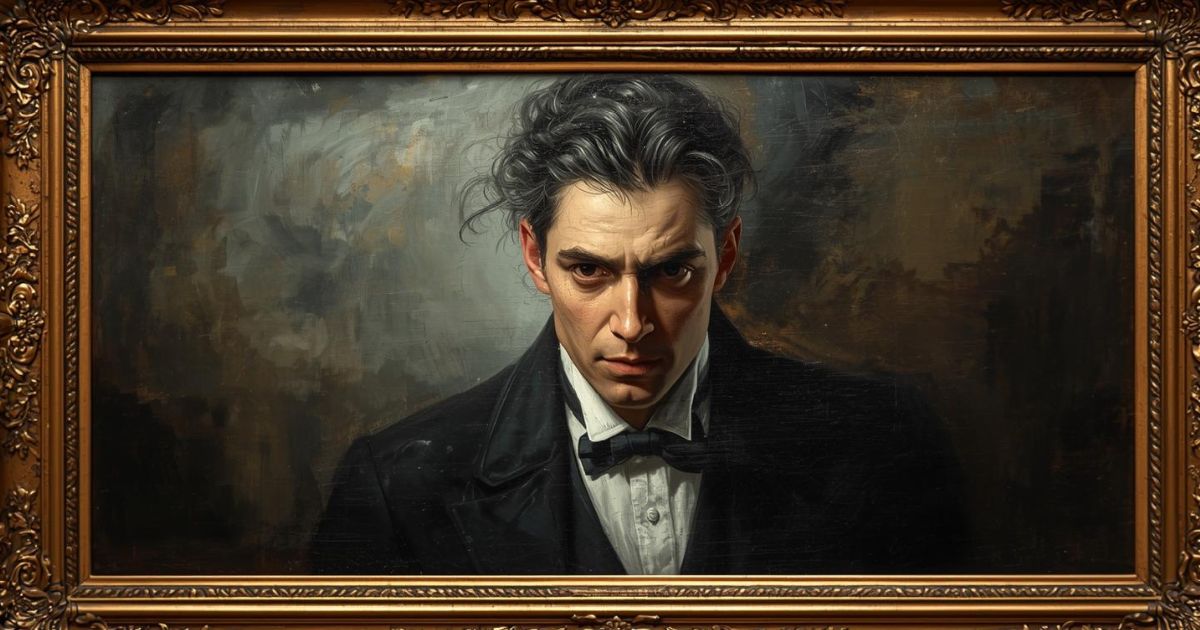
An excerpt from the original text.(complete · 5556 words)
ne afternoon, a month later, Dorian Gray was reclining in a luxurious
arm-chair, in the little library of Lord Henry’s house in Mayfair. It
was, in its way, a very charming room, with its high panelled
wainscoting of olive-stained oak, its cream-coloured frieze and ceiling
of raised plasterwork, and its brickdust felt carpet strewn with silk,
long-fringed Persian rugs. On a tiny satinwood table stood a statuette
by Clodion, and beside it lay a copy of Les Cent Nouvelles, bound for
Margaret of Valois by Clovis Eve and powdered with the gilt daisies
that Queen had selected for her device. Some large blue china jars and
parrot-tulips were ranged on the mantelshelf, and through the small
leaded panes of the window streamed the apricot-coloured light of a
summer day in London.
Lord Henry had not yet come in. He was always late on principle, his
principle being that punctuality is the thief of time. So the lad was
looking rather sulky, as with listless fingers he turned over the pages
of an elaborately illustrated edition of Manon Lescaut that he had
found in one of the book-cases. The formal monotonous ticking of the
Louis Quatorze clock annoyed him. Once or twice he thought of going
away.
At last he heard a step outside, and the door opened. “How late you
are, Harry!” he murmured.
“I am afraid it is not Harry, Mr. Gray,” answered a shrill voice.
He glanced quickly round and rose to his feet. “I beg your pardon. I
thought—”
“You thought it was my husband. It is only his wife. You must let me
introduce myself. I know you quite well by your photographs. I think my
husband has got seventeen of them.”
“Not seventeen, Lady Henry?”
“Well, eighteen, then. And I saw you with him the other night at the
opera.” She laughed nervously as she spoke, and watched him with her
vague forget-me-not eyes. She was a curious woman, whose dresses always
looked as if they had been designed in a rage and put on in a tempest.
She was usually in love with somebody, and, as her passion was never
returned, she had kept all her illusions. She tried to look
picturesque, but only succeeded in being untidy. Her name was Victoria,
and she had a perfect mania for going to church.
“That was at Lohengrin, Lady Henry, I think?”
“Yes; it was at dear Lohengrin. I like Wagner’s music better than
anybody’s. It is so loud that one can talk the whole time without other
people hearing what one says. That is a great advantage, don’t you
think so, Mr. Gray?”
The same nervous staccato laugh broke from her thin lips, and her
fingers began to play with a long tortoise-shell paper-knife.
Dorian smiled and shook his head: “I am afraid I don’t think so, Lady
Henry. I never talk during music—at least, during good music. If one
hears bad music, it is one’s duty to drown it in conversation.”
“Ah! that is one of Harry’s views, isn’t it, Mr. Gray? I always hear
Harry’s views from his friends. It is the only way I get to know of
them. But you must not think I don’t like good music. I adore it, but I
am afraid of it. It makes me too romantic. I have simply worshipped
pianists—two at a time, sometimes, Harry tells me. I don’t know what it
is about them. Perhaps it is that they are foreigners. They all are,
ain’t they? Even those that are born in England become foreigners after
a time, don’t they? It is so clever of them, and such a compliment to
art. Makes it quite cosmopolitan, doesn’t it? You have never been to
any of my parties, have you, Mr. Gray? You must come. I can’t afford
orchids, but I spare no expense in foreigners. They make one’s rooms
look so picturesque. But here is Harry! Harry, I came in to look for
you, to ask you something—I forget what it was—and I found Mr. Gray
here. We have had such a pleasant chat about music. We have quite the
same ideas. No; I think our ideas are quite different. But he has been
most pleasant. I am so glad I’ve seen him.”
“I am charmed, my love, quite charmed,” said Lord Henry, elevating his
dark, crescent-shaped eyebrows and looking at them both with an amused
smile. “So sorry I am late, Dorian. I went to look after a piece of old
brocade in Wardour Street and had to bargain for hours for it. Nowadays
people know the price of everything and the value of nothing.”
“I am afraid I must be going,” exclaimed Lady Henry, breaking an
awkward silence with her silly sudden laugh. “I have promised to drive
with the duchess. Good-bye, Mr. Gray. Good-bye, Harry. You are dining
out, I suppose? So am I. Perhaps I shall see you at Lady Thornbury’s.”
“I dare say, my dear,” said Lord Henry, shutting the door behind her
as, looking like a bird of paradise that had been out all night in the
rain, she flitted out of the room, leaving a faint odour of
frangipanni. Then he lit a cigarette and flung himself down on the
sofa.
“Never marry a woman with straw-coloured hair, Dorian,” he said after a
few puffs.
“Why, Harry?”
“Because they are so sentimental.”
“But I like sentimental people.”
“Never marry at all, Dorian. Men marry because they are tired; women,
because they are curious: both are disappointed.”
“I don’t think I am likely to marry, Harry. I am too much in love. That
is one of your aphorisms. I am putting it into practice, as I do
everything that you say.”
“Who are you in love with?” asked Lord Henry after a pause.
“With an actress,” said Dorian Gray, blushing.
Lord Henry shrugged his shoulders. “That is a rather commonplace
début.”
“You would not say so if you saw her, Harry.”
“Who is she?”
“Her name is Sibyl Vane.”
“Never heard of her.”
“No one has. People will some day, however. She is a genius.”
“My dear boy, no woman is a genius. Women are a decorative sex. They
never have anything to say, but they say it charmingly. Women represent
the triumph of matter over mind, just as men represent the triumph of
mind over morals.”
“Harry, how can you?”
“My dear Dorian, it is quite true. I am analysing women at present, so
I ought to know. The subject is not so abstruse as I thought it was. I
find that, ultimately, there are only two kinds of women, the plain and
the coloured. The plain women are very useful. If you want to gain a
reputation for respectability, you have merely to take them down to
supper. The other women are very charming. They commit one mistake,
however. They paint in order to try and look young. Our grandmothers
painted in order to try and talk brilliantly. Rouge and esprit used
to go together. That is all over now. As long as a woman can look ten
years younger than her own daughter, she is perfectly satisfied. As for
conversation, there are only five women in London worth talking to, and
two of these can’t be admitted into decent society. However, tell me
about your genius. How long have you known her?”
“Ah! Harry, your views terrify me.”
“Never mind that. How long have you known her?”
“About three weeks.”
“And where did you come across her?”
“I will tell you, Harry, but you mustn’t be unsympathetic about it.
After all, it never would have happened if I had not met you. You
filled me with a wild desire to know everything about life. For days
after I met you, something seemed to throb in my veins. As I lounged in
the park, or strolled down Piccadilly, I used to look at every one who
passed me and wonder, with a mad curiosity, what sort of lives they
led. Some of them fascinated me. Others filled me with terror. There
was an exquisite poison in the air. I had a passion for sensations....
Well, one evening about seven o’clock, I determined to go out in search
of some adventure. I felt that this grey monstrous London of ours, with
its myriads of people, its sordid sinners, and its splendid sins, as
you once phrased it, must have something in store for me. I fancied a
thousand things. The mere danger gave me a sense of delight. I
remembered what you had said to me on that wonderful evening when we
first dined together, about the search for beauty being the real secret
of life. I don’t know what I expected, but I went out and wandered
eastward, soon losing my way in a labyrinth of grimy streets and black
grassless squares. About half-past eight I passed by an absurd little
theatre, with great flaring gas-jets and gaudy play-bills. A hideous
Jew, in the most amazing waistcoat I ever beheld in my life, was
standing at the entrance, smoking a vile cigar. He had greasy ringlets,
and an enormous diamond blazed in the centre of a soiled shirt. ‘Have a
box, my Lord?’ he said, when he saw me, and he took off his hat with an
air of gorgeous servility. There was something about him, Harry, that
amused me. He was such a monster. You will laugh at me, I know, but I
really went in and paid a whole guinea for the stage-box. To the
present day I can’t make out why I did so; and yet if I hadn’t—my dear
Harry, if I hadn’t—I should have missed the greatest romance of my
life. I see you are laughing. It is horrid of you!”
“I am not laughing, Dorian; at least I am not laughing at you. But you
should not say the greatest romance of your life. You should say the
first romance of your life. You will always be loved, and you will
always be in love with love. A grande passion is the privilege of
people who have nothing to do. That is the one use of the idle classes
of a country. Don’t be afraid. There are exquisite things in store for
you. This is merely the beginning.”
“Do you think my nature so shallow?” cried Dorian Gray angrily.
“No; I think your nature so deep.”
“How do you mean?”
“My dear boy, the people who love only once in their lives are really
the shallow people. What they call their loyalty, and their fidelity, I
call either the lethargy of custom or their lack of imagination.
Faithfulness is to the emotional life what consistency is to the life
of the intellect—simply a confession of failure. Faithfulness! I must
analyse it some day. The passion for property is in it. There are many
things that we would throw away if we were not afraid that others might
pick them up. But I don’t want to interrupt you. Go on with your
story.”
“Well, I found myself seated in a horrid little private box, with a
vulgar drop-scene staring me in the face. I looked out from behind the
curtain and surveyed the house. It was a tawdry affair, all Cupids and
cornucopias, like a third-rate wedding-cake. The gallery and pit were
fairly full, but the two rows of dingy stalls were quite empty, and
there was hardly a person in what I suppose they called the
dress-circle. Women went about with oranges and ginger-beer, and there
was a terrible consumption of nuts going on.”
“It must have been just like the palmy days of the British drama.”
“Just like, I should fancy, and very depressing. I began to wonder what
on earth I should do when I caught sight of the play-bill. What do you
think the play was, Harry?”
“I should think ‘The Idiot Boy’, or ‘Dumb but Innocent’. Our fathers
used to like that sort of piece, I believe. The longer I live, Dorian,
the more keenly I feel that whatever was good enough for our fathers is
not good enough for us. In art, as in politics, les grandpères ont
toujours tort.”
“This play was good enough for us, Harry. It was Romeo and Juliet. I
must admit that I was rather annoyed at the idea of seeing Shakespeare
done in such a wretched hole of a place. Still, I felt interested, in a
sort of way. At any rate, I determined to wait for the first act. There
was a dreadful orchestra, presided over by a young Hebrew who sat at a
cracked piano, that nearly drove me away, but at last the drop-scene
was drawn up and the play began. Romeo was a stout elderly gentleman,
with corked eyebrows, a husky tragedy voice, and a figure like a
beer-barrel. Mercutio was almost as bad. He was played by the
low-comedian, who had introduced gags of his own and was on most
friendly terms with the pit. They were both as grotesque as the
scenery, and that looked as if it had come out of a country-booth. But
Juliet! Harry, imagine a girl, hardly seventeen years of age, with a
little, flowerlike face, a small Greek head with plaited coils of
dark-brown hair, eyes that were violet wells of passion, lips that were
like the petals of a rose. She was the loveliest thing I had ever seen
in my life. You said to me once that pathos left you unmoved, but that
beauty, mere beauty, could fill your eyes with tears. I tell you,
Harry, I could hardly see this girl for the mist of tears that came
across me. And her voice—I never heard such a voice. It was very low at
first, with deep mellow notes that seemed to fall singly upon one’s
ear. Then it became a little louder, and sounded like a flute or a
distant hautboy. In the garden-scene it had all the tremulous ecstasy
that one hears just before dawn when nightingales are singing. There
were moments, later on, when it had the wild passion of violins. You
know how a voice can stir one. Your voice and the voice of Sibyl Vane
are two things that I shall never forget. When I close my eyes, I hear
them, and each of them says something different. I don’t know which to
follow. Why should I not love her? Harry, I do love her. She is
everything to me in life. Night after night I go to see her play. One
evening she is Rosalind, and the next evening she is Imogen. I have
seen her die in the gloom of an Italian tomb, sucking the poison from
her lover’s lips. I have watched her wandering through the forest of
Arden, disguised as a pretty boy in hose and doublet and dainty cap.
She has been mad, and has come into the presence of a guilty king, and
given him rue to wear and bitter herbs to taste of. She has been
innocent, and the black hands of jealousy have crushed her reedlike
throat. I have seen her in every age and in every costume. Ordinary
women never appeal to one’s imagination. They are limited to their
century. No glamour ever transfigures them. One knows their minds as
easily as one knows their bonnets. One can always find them. There is
no mystery in any of them. They ride in the park in the morning and
chatter at tea-parties in the afternoon. They have their stereotyped
smile and their fashionable manner. They are quite obvious. But an
actress! How different an actress is! Harry! why didn’t you tell me
that the only thing worth loving is an actress?”
“Because I have loved so many of them, Dorian.”
“Oh, yes, horrid people with dyed hair and painted faces.”
“Don’t run down dyed hair and painted faces. There is an extraordinary
charm in them, sometimes,” said Lord Henry.
“I wish now I had not told you about Sibyl Vane.”
“You could not have helped telling me, Dorian. All through your life
you will tell me everything you do.”
“Yes, Harry, I believe that is true. I cannot help telling you things.
You have a curious influence over me. If I ever did a crime, I would
come and confess it to you. You would understand me.”
“People like you—the wilful sunbeams of life—don’t commit crimes,
Dorian. But I am much obliged for the compliment, all the same. And now
tell me—reach me the matches, like a good boy—thanks—what are your
actual relations with Sibyl Vane?”
Dorian Gray leaped to his feet, with flushed cheeks and burning eyes.
“Harry! Sibyl Vane is sacred!”
“It is only the sacred things that are worth touching, Dorian,” said
Lord Henry, with a strange touch of pathos in his voice. “But why
should you be annoyed? I suppose she will belong to you some day. When
one is in love, one always begins by deceiving one’s self, and one
always ends by deceiving others. That is what the world calls a
romance. You know her, at any rate, I suppose?”
“Of course I know her. On the first night I was at the theatre, the
horrid old Jew came round to the box after the performance was over and
offered to take me behind the scenes and introduce me to her. I was
furious with him, and told him that Juliet had been dead for hundreds
of years and that her body was lying in a marble tomb in Verona. I
think, from his blank look of amazement, that he was under the
impression that I had taken too much champagne, or something.”
“I am not surprised.”
“Then he asked me if I wrote for any of the newspapers. I told him I
never even read them. He seemed terribly disappointed at that, and
confided to me that all the dramatic critics were in a conspiracy
against him, and that they were every one of them to be bought.”
“I should not wonder if he was quite right there. But, on the other
hand, judging from their appearance, most of them cannot be at all
expensive.”
“Well, he seemed to think they were beyond his means,” laughed Dorian.
“By this time, however, the lights were being put out in the theatre,
and I had to go. He wanted me to try some cigars that he strongly
recommended. I declined. The next night, of course, I arrived at the
place again. When he saw me, he made me a low bow and assured me that I
was a munificent patron of art. He was a most offensive brute, though
he had an extraordinary passion for Shakespeare. He told me once, with
an air of pride, that his five bankruptcies were entirely due to ‘The
Bard,’ as he insisted on calling him. He seemed to think it a
distinction.”
“It was a distinction, my dear Dorian—a great distinction. Most people
become bankrupt through having invested too heavily in the prose of
life. To have ruined one’s self over poetry is an honour. But when did
you first speak to Miss Sibyl Vane?”
“The third night. She had been playing Rosalind. I could not help going
round. I had thrown her some flowers, and she had looked at me—at least
I fancied that she had. The old Jew was persistent. He seemed
determined to take me behind, so I consented. It was curious my not
wanting to know her, wasn’t it?”
“No; I don’t think so.”
“My dear Harry, why?”
“I will tell you some other time. Now I want to know about the girl.”
“Sibyl? Oh, she was so shy and so gentle. There is something of a child
about her. Her eyes opened wide in exquisite wonder when I told her
what I thought of her performance, and she seemed quite unconscious of
her power. I think we were both rather nervous. The old Jew stood
grinning at the doorway of the dusty greenroom, making elaborate
speeches about us both, while we stood looking at each other like
children. He would insist on calling me ‘My Lord,’ so I had to assure
Sibyl that I was not anything of the kind. She said quite simply to me,
‘You look more like a prince. I must call you Prince Charming.’”
“Upon my word, Dorian, Miss Sibyl knows how to pay compliments.”
“You don’t understand her, Harry. She regarded me merely as a person in
a play. She knows nothing of life. She lives with her mother, a faded
tired woman who played Lady Capulet in a sort of magenta
dressing-wrapper on the first night, and looks as if she had seen
better days.”
“I know that look. It depresses me,” murmured Lord Henry, examining his
rings.
“The Jew wanted to tell me her history, but I said it did not interest
me.”
“You were quite right. There is always something infinitely mean about
other people’s tragedies.”
“Sibyl is the only thing I care about. What is it to me where she came
from? From her little head to her little feet, she is absolutely and
entirely divine. Every night of my life I go to see her act, and every
night she is more marvellous.”
“That is the reason, I suppose, that you never dine with me now. I
thought you must have some curious romance on hand. You have; but it is
not quite what I expected.”
“My dear Harry, we either lunch or sup together every day, and I have
been to the opera with you several times,” said Dorian, opening his
blue eyes in wonder.
“You always come dreadfully late.”
“Well, I can’t help going to see Sibyl play,” he cried, “even if it is
only for a single act. I get hungry for her presence; and when I think
of the wonderful soul that is hidden away in that little ivory body, I
am filled with awe.”
“You can dine with me to-night, Dorian, can’t you?”
He shook his head. “To-night she is Imogen,” he answered, “and
to-morrow night she will be Juliet.”
“When is she Sibyl Vane?”
“Never.”
“I congratulate you.”
“How horrid you are! She is all the great heroines of the world in one.
She is more than an individual. You laugh, but I tell you she has
genius. I love her, and I must make her love me. You, who know all the
secrets of life, tell me how to charm Sibyl Vane to love me! I want to
make Romeo jealous. I want the dead lovers of the world to hear our
laughter and grow sad. I want a breath of our passion to stir their
dust into consciousness, to wake their ashes into pain. My God, Harry,
how I worship her!” He was walking up and down the room as he spoke.
Hectic spots of red burned on his cheeks. He was terribly excited.
Lord Henry watched him with a subtle sense of pleasure. How different
he was now from the shy frightened boy he had met in Basil Hallward’s
studio! His nature had developed like a flower, had borne blossoms of
scarlet flame. Out of its secret hiding-place had crept his soul, and
desire had come to meet it on the way.
“And what do you propose to do?” said Lord Henry at last.
“I want you and Basil to come with me some night and see her act. I
have not the slightest fear of the result. You are certain to
acknowledge her genius. Then we must get her out of the Jew’s hands.
She is bound to him for three years—at least for two years and eight
months—from the present time. I shall have to pay him something, of
course. When all that is settled, I shall take a West End theatre and
bring her out properly. She will make the world as mad as she has made
me.”
“That would be impossible, my dear boy.”
“Yes, she will. She has not merely art, consummate art-instinct, in
her, but she has personality also; and you have often told me that it
is personalities, not principles, that move the age.”
“Well, what night shall we go?”
“Let me see. To-day is Tuesday. Let us fix to-morrow. She plays Juliet
to-morrow.”
“All right. The Bristol at eight o’clock; and I will get Basil.”
“Not eight, Harry, please. Half-past six. We must be there before the
curtain rises. You must see her in the first act, where she meets
Romeo.”
“Half-past six! What an hour! It will be like having a meat-tea, or
reading an English novel. It must be seven. No gentleman dines before
seven. Shall you see Basil between this and then? Or shall I write to
him?”
“Dear Basil! I have not laid eyes on him for a week. It is rather
horrid of me, as he has sent me my portrait in the most wonderful
frame, specially designed by himself, and, though I am a little jealous
of the picture for being a whole month younger than I am, I must admit
that I delight in it. Perhaps you had better write to him. I don’t want
to see him alone. He says things that annoy me. He gives me good
advice.”
Lord Henry smiled. “People are very fond of giving away what they need
most themselves. It is what I call the depth of generosity.”
“Oh, Basil is the best of fellows, but he seems to me to be just a bit
of a Philistine. Since I have known you, Harry, I have discovered
that.”
“Basil, my dear boy, puts everything that is charming in him into his
work. The consequence is that he has nothing left for life but his
prejudices, his principles, and his common sense. The only artists I
have ever known who are personally delightful are bad artists. Good
artists exist simply in what they make, and consequently are perfectly
uninteresting in what they are. A great poet, a really great poet, is
the most unpoetical of all creatures. But inferior poets are absolutely
fascinating. The worse their rhymes are, the more picturesque they
look. The mere fact of having published a book of second-rate sonnets
makes a man quite irresistible. He lives the poetry that he cannot
write. The others write the poetry that they dare not realize.”
“I wonder is that really so, Harry?” said Dorian Gray, putting some
perfume on his handkerchief out of a large, gold-topped bottle that
stood on the table. “It must be, if you say it. And now I am off.
Imogen is waiting for me. Don’t forget about to-morrow. Good-bye.”
As he left the room, Lord Henry’s heavy eyelids drooped, and he began
to think. Certainly few people had ever interested him so much as
Dorian Gray, and yet the lad’s mad adoration of some one else caused
him not the slightest pang of annoyance or jealousy. He was pleased by
it. It made him a more interesting study. He had been always enthralled
by the methods of natural science, but the ordinary subject-matter of
that science had seemed to him trivial and of no import. And so he had
begun by vivisecting himself, as he had ended by vivisecting others.
Human life—that appeared to him the one thing worth investigating.
Compared to it there was nothing else of any value. It was true that as
one watched life in its curious crucible of pain and pleasure, one
could not wear over one’s face a mask of glass, nor keep the sulphurous
fumes from troubling the brain and making the imagination turbid with
monstrous fancies and misshapen dreams. There were poisons so subtle
that to know their properties one had to sicken of them. There were
maladies so strange that one had to pass through them if one sought to
understand their nature. And, yet, what a great reward one received!
How wonderful the whole world became to one! To note the curious hard
logic of passion, and the emotional coloured life of the intellect—to
observe where they met, and where they separated, at what point they
were in unison, and at what point they were at discord—there was a
delight in that! What matter what the cost was? One could never pay too
high a price for any sensation.
He was conscious—and the thought brought a gleam of pleasure into his
brown agate eyes—that it was through certain words of his, musical
words said with musical utterance, that Dorian Gray’s soul had turned
to this white girl and bowed in worship before her. To a large extent
the lad was his own creation. He had made him premature. That was
something. Ordinary people waited till life disclosed to them its
secrets, but to the few, to the elect, the mysteries of life were
revealed before the veil was drawn away. Sometimes this was the effect
of art, and chiefly of the art of literature, which dealt immediately
with the passions and the intellect. But now and then a complex
personality took the place and assumed the office of art, was indeed,
in its way, a real work of art, life having its elaborate masterpieces,
just as poetry has, or sculpture, or painting.
Yes, the lad was premature. He was gathering his harvest while it was
yet spring. The pulse and passion of youth were in him, but he was
becoming self-conscious. It was delightful to watch him. With his
beautiful face, and his beautiful soul, he was a thing to wonder at. It
was no matter how it all ended, or was destined to end. He was like one
of those gracious figures in a pageant or a play, whose joys seem to be
remote from one, but whose sorrows stir one’s sense of beauty, and
whose wounds are like red roses.
Soul and body, body and soul—how mysterious they were! There was
animalism in the soul, and the body had its moments of spirituality.
The senses could refine, and the intellect could degrade. Who could say
where the fleshly impulse ceased, or the psychical impulse began? How
shallow were the arbitrary definitions of ordinary psychologists! And
yet how difficult to decide between the claims of the various schools!
Was the soul a shadow seated in the house of sin? Or was the body
really in the soul, as Giordano Bruno thought? The separation of spirit
from matter was a mystery, and the union of spirit with matter was a
mystery also.
He began to wonder whether we could ever make psychology so absolute a
science that each little spring of life would be revealed to us. As it
was, we always misunderstood ourselves and rarely understood others.
Experience was of no ethical value. It was merely the name men gave to
their mistakes. Moralists had, as a rule, regarded it as a mode of
warning, had claimed for it a certain ethical efficacy in the formation
of character, had praised it as something that taught us what to follow
and showed us what to avoid. But there was no motive power in
experience. It was as little of an active cause as conscience itself.
All that it really demonstrated was that our future would be the same
as our past, and that the sin we had done once, and with loathing, we
would do many times, and with joy.
It was clear to him that the experimental method was the only method by
which one could arrive at any scientific analysis of the passions; and
certainly Dorian Gray was a subject made to his hand, and seemed to
promise rich and fruitful results. His sudden mad love for Sibyl Vane
was a psychological phenomenon of no small interest. There was no doubt
that curiosity had much to do with it, curiosity and the desire for new
experiences, yet it was not a simple, but rather a very complex
passion. What there was in it of the purely sensuous instinct of
boyhood had been transformed by the workings of the imagination,
changed into something that seemed to the lad himself to be remote from
sense, and was for that very reason all the more dangerous. It was the
passions about whose origin we deceived ourselves that tyrannized most
strongly over us. Our weakest motives were those of whose nature we
were conscious. It often happened that when we thought we were
experimenting on others we were really experimenting on ourselves.
While Lord Henry sat dreaming on these things, a knock came to the
door, and his valet entered and reminded him it was time to dress for
dinner. He got up and looked out into the street. The sunset had
smitten into scarlet gold the upper windows of the houses opposite. The
panes glowed like plates of heated metal. The sky above was like a
faded rose. He thought of his friend’s young fiery-coloured life and
wondered how it was all going to end.
When he arrived home, about half-past twelve o’clock, he saw a telegram
lying on the hall table. He opened it and found it was from Dorian
Gray. It was to tell him that he was engaged to be married to Sibyl
Vane.
Master this chapter. Complete your experience
Purchase the complete book to access all chapters and support classic literature
As an Amazon Associate, we earn a small commission from qualifying purchases at no additional cost to you.
Available in paperback, hardcover, and e-book formats
Let's Analyse the Pattern
When healthy self-appreciation becomes toxic obsession with external validation, leading to desperate attempts to control the uncontrollable.
Why This Matters
Connect literature to life
This chapter teaches how to distinguish between healthy self-care and destructive obsession with appearance or status.
Practice This Today
This week, notice when compliments make you feel desperate for more versus simply appreciated—that's the difference between confidence and addiction to validation.
Now let's explore the literary elements.
Key Quotes & Analysis
"How sad it is! I shall grow old, and horrible, and dreadful. But this picture will remain always young."
Context: Dorian's first reaction upon seeing his completed portrait
This is the moment Dorian's vanity transforms into something toxic. He's not just admiring his beauty - he's devastated by the thought of losing it. This fear of aging will drive every terrible decision he makes.
In Today's Words:
I'm going to get old and ugly, but this photo will always show me at my best.
"If it were I who was to be always young, and the picture that was to grow old! For that - for that - I would give everything!"
Context: Dorian making his desperate wish to trade places with the portrait
This is the Faustian bargain at the heart of the story. Dorian is literally willing to give up everything - including his soul - to stay young. It shows how completely Lord Henry's philosophy has corrupted his thinking.
In Today's Words:
I'd give anything to stay young forever while something else ages instead of me.
"Youth! Youth! There is absolutely nothing in the world but youth!"
Context: Dorian's obsessive reaction to realizing he will age
This shows how completely Dorian has absorbed Lord Henry's toxic philosophy. He's reducing all of life's value to just one thing - youth. This narrow focus will blind him to everything else that matters.
In Today's Words:
Being young is the only thing that matters - nothing else counts for anything.
Thematic Threads
Identity
In This Chapter
Dorian's identity becomes completely tied to his physical beauty and youth
Development
Evolved from earlier innocent self-discovery to dangerous obsession
In Your Life:
You might see this when you define yourself entirely by your job title, appearance, or achievements
Class
In This Chapter
Lord Henry's aristocratic philosophy of pleasure corrupts Dorian's middle-class values
Development
Building from previous chapters where class differences created vulnerability
In Your Life:
You might see this when trying to fit in with people from different economic backgrounds changes your values
Social Expectations
In This Chapter
Dorian feels pressure to maintain his reputation as the beautiful young man everyone admires
Development
Introduced here as Dorian realizes others expect him to stay perfect
In Your Life:
You might see this when you feel trapped by others' expectations of who you should be
Personal Growth
In This Chapter
Dorian chooses external perfection over internal development, stunting his growth
Development
Marks the turning point where growth becomes regression
In Your Life:
You might see this when you avoid challenges that could help you grow because they might make you look imperfect
Human Relationships
In This Chapter
Dorian's obsession with himself begins to eclipse his capacity for genuine connection with others
Development
Shows how narcissism isolates us from meaningful relationships
In Your Life:
You might see this when you're so focused on how you appear to others that you stop actually listening to them
You now have the context. Time to form your own thoughts.
Discussion Questions
- 1
What specific moment triggers Dorian's desperate wish about the portrait, and what does he actually ask for?
analysis • surface - 2
How has Lord Henry's influence already changed the way Dorian sees himself and his future?
analysis • medium - 3
Where do you see this same pattern today - people making desperate trades to avoid facing natural changes or limitations?
application • medium - 4
When you feel that panic about losing something that defines you, what practical steps could help you respond differently than Dorian did?
application • deep - 5
What does Dorian's reaction to his own portrait reveal about the difference between healthy self-awareness and toxic self-obsession?
reflection • deep
Critical Thinking Exercise
Map Your Own Vanity Triggers
Think about the last time you felt genuinely threatened by aging, losing status, or not measuring up to others. Write down what you were actually afraid of losing and what desperate thoughts crossed your mind. Then identify what healthy response you could have chosen instead.
Consider:
- •Notice the difference between caring about yourself and being controlled by how others see you
- •Consider what identity you've built around things that naturally change over time
- •Think about what aspects of yourself remain valuable regardless of external circumstances
Journaling Prompt
Write about a time when you caught yourself making your worth dependent on something you couldn't control forever. What would you tell your younger self about finding security in things that can't be taken away?
Coming Up Next...
Chapter 5
Dorian's wish is about to be tested in ways he never imagined. A chance encounter will introduce him to the world of theater and a young actress whose talent and beauty will awaken feelings he's never experienced before.



