
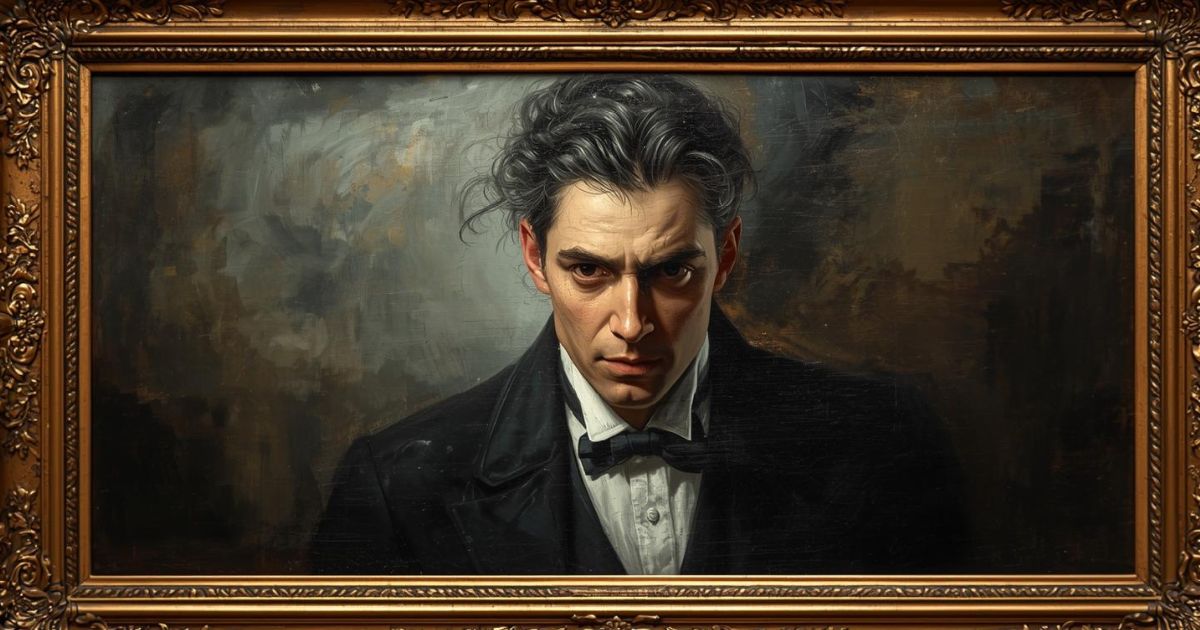
An excerpt from the original text.(complete · 4420 words)
t half-past twelve next day Lord Henry Wotton strolled from Curzon
Street over to the Albany to call on his uncle, Lord Fermor, a genial
if somewhat rough-mannered old bachelor, whom the outside world called
selfish because it derived no particular benefit from him, but who was
considered generous by Society as he fed the people who amused him. His
father had been our ambassador at Madrid when Isabella was young and
Prim unthought of, but had retired from the diplomatic service in a
capricious moment of annoyance on not being offered the Embassy at
Paris, a post to which he considered that he was fully entitled by
reason of his birth, his indolence, the good English of his dispatches,
and his inordinate passion for pleasure. The son, who had been his
father’s secretary, had resigned along with his chief, somewhat
foolishly as was thought at the time, and on succeeding some months
later to the title, had set himself to the serious study of the great
aristocratic art of doing absolutely nothing. He had two large town
houses, but preferred to live in chambers as it was less trouble, and
took most of his meals at his club. He paid some attention to the
management of his collieries in the Midland counties, excusing himself
for this taint of industry on the ground that the one advantage of
having coal was that it enabled a gentleman to afford the decency of
burning wood on his own hearth. In politics he was a Tory, except when
the Tories were in office, during which period he roundly abused them
for being a pack of Radicals. He was a hero to his valet, who bullied
him, and a terror to most of his relations, whom he bullied in turn.
Only England could have produced him, and he always said that the
country was going to the dogs. His principles were out of date, but
there was a good deal to be said for his prejudices.
When Lord Henry entered the room, he found his uncle sitting in a rough
shooting-coat, smoking a cheroot and grumbling over The Times. “Well,
Harry,” said the old gentleman, “what brings you out so early? I
thought you dandies never got up till two, and were not visible till
five.”
“Pure family affection, I assure you, Uncle George. I want to get
something out of you.”
“Money, I suppose,” said Lord Fermor, making a wry face. “Well, sit
down and tell me all about it. Young people, nowadays, imagine that
money is everything.”
“Yes,” murmured Lord Henry, settling his button-hole in his coat; “and
when they grow older they know it. But I don’t want money. It is only
people who pay their bills who want that, Uncle George, and I never pay
mine. Credit is the capital of a younger son, and one lives charmingly
upon it. Besides, I always deal with Dartmoor’s tradesmen, and
consequently they never bother me. What I want is information: not
useful information, of course; useless information.”
“Well, I can tell you anything that is in an English Blue Book, Harry,
although those fellows nowadays write a lot of nonsense. When I was in
the Diplomatic, things were much better. But I hear they let them in
now by examination. What can you expect? Examinations, sir, are pure
humbug from beginning to end. If a man is a gentleman, he knows quite
enough, and if he is not a gentleman, whatever he knows is bad for
him.”
“Mr. Dorian Gray does not belong to Blue Books, Uncle George,” said
Lord Henry languidly.
“Mr. Dorian Gray? Who is he?” asked Lord Fermor, knitting his bushy
white eyebrows.
“That is what I have come to learn, Uncle George. Or rather, I know who
he is. He is the last Lord Kelso’s grandson. His mother was a Devereux,
Lady Margaret Devereux. I want you to tell me about his mother. What
was she like? Whom did she marry? You have known nearly everybody in
your time, so you might have known her. I am very much interested in
Mr. Gray at present. I have only just met him.”
“Kelso’s grandson!” echoed the old gentleman. “Kelso’s grandson! ... Of
course.... I knew his mother intimately. I believe I was at her
christening. She was an extraordinarily beautiful girl, Margaret
Devereux, and made all the men frantic by running away with a penniless
young fellow—a mere nobody, sir, a subaltern in a foot regiment, or
something of that kind. Certainly. I remember the whole thing as if it
happened yesterday. The poor chap was killed in a duel at Spa a few
months after the marriage. There was an ugly story about it. They said
Kelso got some rascally adventurer, some Belgian brute, to insult his
son-in-law in public—paid him, sir, to do it, paid him—and that the
fellow spitted his man as if he had been a pigeon. The thing was hushed
up, but, egad, Kelso ate his chop alone at the club for some time
afterwards. He brought his daughter back with him, I was told, and she
never spoke to him again. Oh, yes; it was a bad business. The girl
died, too, died within a year. So she left a son, did she? I had
forgotten that. What sort of boy is he? If he is like his mother, he
must be a good-looking chap.”
“He is very good-looking,” assented Lord Henry.
“I hope he will fall into proper hands,” continued the old man. “He
should have a pot of money waiting for him if Kelso did the right thing
by him. His mother had money, too. All the Selby property came to her,
through her grandfather. Her grandfather hated Kelso, thought him a
mean dog. He was, too. Came to Madrid once when I was there. Egad, I
was ashamed of him. The Queen used to ask me about the English noble
who was always quarrelling with the cabmen about their fares. They made
quite a story of it. I didn’t dare show my face at Court for a month. I
hope he treated his grandson better than he did the jarvies.”
“I don’t know,” answered Lord Henry. “I fancy that the boy will be well
off. He is not of age yet. He has Selby, I know. He told me so. And ...
his mother was very beautiful?”
“Margaret Devereux was one of the loveliest creatures I ever saw,
Harry. What on earth induced her to behave as she did, I never could
understand. She could have married anybody she chose. Carlington was
mad after her. She was romantic, though. All the women of that family
were. The men were a poor lot, but, egad! the women were wonderful.
Carlington went on his knees to her. Told me so himself. She laughed at
him, and there wasn’t a girl in London at the time who wasn’t after
him. And by the way, Harry, talking about silly marriages, what is this
humbug your father tells me about Dartmoor wanting to marry an
American? Ain’t English girls good enough for him?”
“It is rather fashionable to marry Americans just now, Uncle George.”
“I’ll back English women against the world, Harry,” said Lord Fermor,
striking the table with his fist.
“The betting is on the Americans.”
“They don’t last, I am told,” muttered his uncle.
“A long engagement exhausts them, but they are capital at a
steeplechase. They take things flying. I don’t think Dartmoor has a
chance.”
“Who are her people?” grumbled the old gentleman. “Has she got any?”
Lord Henry shook his head. “American girls are as clever at concealing
their parents, as English women are at concealing their past,” he said,
rising to go.
“They are pork-packers, I suppose?”
“I hope so, Uncle George, for Dartmoor’s sake. I am told that
pork-packing is the most lucrative profession in America, after
politics.”
“Is she pretty?”
“She behaves as if she was beautiful. Most American women do. It is the
secret of their charm.”
“Why can’t these American women stay in their own country? They are
always telling us that it is the paradise for women.”
“It is. That is the reason why, like Eve, they are so excessively
anxious to get out of it,” said Lord Henry. “Good-bye, Uncle George. I
shall be late for lunch, if I stop any longer. Thanks for giving me the
information I wanted. I always like to know everything about my new
friends, and nothing about my old ones.”
“Where are you lunching, Harry?”
“At Aunt Agatha’s. I have asked myself and Mr. Gray. He is her latest
protégé.”
“Humph! tell your Aunt Agatha, Harry, not to bother me any more with
her charity appeals. I am sick of them. Why, the good woman thinks that
I have nothing to do but to write cheques for her silly fads.”
“All right, Uncle George, I’ll tell her, but it won’t have any effect.
Philanthropic people lose all sense of humanity. It is their
distinguishing characteristic.”
The old gentleman growled approvingly and rang the bell for his
servant. Lord Henry passed up the low arcade into Burlington Street and
turned his steps in the direction of Berkeley Square.
So that was the story of Dorian Gray’s parentage. Crudely as it had
been told to him, it had yet stirred him by its suggestion of a
strange, almost modern romance. A beautiful woman risking everything
for a mad passion. A few wild weeks of happiness cut short by a
hideous, treacherous crime. Months of voiceless agony, and then a child
born in pain. The mother snatched away by death, the boy left to
solitude and the tyranny of an old and loveless man. Yes; it was an
interesting background. It posed the lad, made him more perfect, as it
were. Behind every exquisite thing that existed, there was something
tragic. Worlds had to be in travail, that the meanest flower might
blow.... And how charming he had been at dinner the night before, as
with startled eyes and lips parted in frightened pleasure he had sat
opposite to him at the club, the red candleshades staining to a richer
rose the wakening wonder of his face. Talking to him was like playing
upon an exquisite violin. He answered to every touch and thrill of the
bow.... There was something terribly enthralling in the exercise of
influence. No other activity was like it. To project one’s soul into
some gracious form, and let it tarry there for a moment; to hear one’s
own intellectual views echoed back to one with all the added music of
passion and youth; to convey one’s temperament into another as though
it were a subtle fluid or a strange perfume: there was a real joy in
that—perhaps the most satisfying joy left to us in an age so limited
and vulgar as our own, an age grossly carnal in its pleasures, and
grossly common in its aims.... He was a marvellous type, too, this lad,
whom by so curious a chance he had met in Basil’s studio, or could be
fashioned into a marvellous type, at any rate. Grace was his, and the
white purity of boyhood, and beauty such as old Greek marbles kept for
us. There was nothing that one could not do with him. He could be made
a Titan or a toy. What a pity it was that such beauty was destined to
fade! ... And Basil? From a psychological point of view, how
interesting he was! The new manner in art, the fresh mode of looking at
life, suggested so strangely by the merely visible presence of one who
was unconscious of it all; the silent spirit that dwelt in dim
woodland, and walked unseen in open field, suddenly showing herself,
Dryadlike and not afraid, because in his soul who sought for her there
had been wakened that wonderful vision to which alone are wonderful
things revealed; the mere shapes and patterns of things becoming, as it
were, refined, and gaining a kind of symbolical value, as though they
were themselves patterns of some other and more perfect form whose
shadow they made real: how strange it all was! He remembered something
like it in history. Was it not Plato, that artist in thought, who had
first analyzed it? Was it not Buonarotti who had carved it in the
coloured marbles of a sonnet-sequence? But in our own century it was
strange.... Yes; he would try to be to Dorian Gray what, without
knowing it, the lad was to the painter who had fashioned the wonderful
portrait. He would seek to dominate him—had already, indeed, half done
so. He would make that wonderful spirit his own. There was something
fascinating in this son of love and death.
Suddenly he stopped and glanced up at the houses. He found that he had
passed his aunt’s some distance, and, smiling to himself, turned back.
When he entered the somewhat sombre hall, the butler told him that they
had gone in to lunch. He gave one of the footmen his hat and stick and
passed into the dining-room.
“Late as usual, Harry,” cried his aunt, shaking her head at him.
He invented a facile excuse, and having taken the vacant seat next to
her, looked round to see who was there. Dorian bowed to him shyly from
the end of the table, a flush of pleasure stealing into his cheek.
Opposite was the Duchess of Harley, a lady of admirable good-nature and
good temper, much liked by every one who knew her, and of those ample
architectural proportions that in women who are not duchesses are
described by contemporary historians as stoutness. Next to her sat, on
her right, Sir Thomas Burdon, a Radical member of Parliament, who
followed his leader in public life and in private life followed the
best cooks, dining with the Tories and thinking with the Liberals, in
accordance with a wise and well-known rule. The post on her left was
occupied by Mr. Erskine of Treadley, an old gentleman of considerable
charm and culture, who had fallen, however, into bad habits of silence,
having, as he explained once to Lady Agatha, said everything that he
had to say before he was thirty. His own neighbour was Mrs. Vandeleur,
one of his aunt’s oldest friends, a perfect saint amongst women, but so
dreadfully dowdy that she reminded one of a badly bound hymn-book.
Fortunately for him she had on the other side Lord Faudel, a most
intelligent middle-aged mediocrity, as bald as a ministerial statement
in the House of Commons, with whom she was conversing in that intensely
earnest manner which is the one unpardonable error, as he remarked once
himself, that all really good people fall into, and from which none of
them ever quite escape.
“We are talking about poor Dartmoor, Lord Henry,” cried the duchess,
nodding pleasantly to him across the table. “Do you think he will
really marry this fascinating young person?”
“I believe she has made up her mind to propose to him, Duchess.”
“How dreadful!” exclaimed Lady Agatha. “Really, some one should
interfere.”
“I am told, on excellent authority, that her father keeps an American
dry-goods store,” said Sir Thomas Burdon, looking supercilious.
“My uncle has already suggested pork-packing, Sir Thomas.”
“Dry-goods! What are American dry-goods?” asked the duchess, raising
her large hands in wonder and accentuating the verb.
“American novels,” answered Lord Henry, helping himself to some quail.
The duchess looked puzzled.
“Don’t mind him, my dear,” whispered Lady Agatha. “He never means
anything that he says.”
“When America was discovered,” said the Radical member—and he began to
give some wearisome facts. Like all people who try to exhaust a
subject, he exhausted his listeners. The duchess sighed and exercised
her privilege of interruption. “I wish to goodness it never had been
discovered at all!” she exclaimed. “Really, our girls have no chance
nowadays. It is most unfair.”
“Perhaps, after all, America never has been discovered,” said Mr.
Erskine; “I myself would say that it had merely been detected.”
“Oh! but I have seen specimens of the inhabitants,” answered the
duchess vaguely. “I must confess that most of them are extremely
pretty. And they dress well, too. They get all their dresses in Paris.
I wish I could afford to do the same.”
“They say that when good Americans die they go to Paris,” chuckled Sir
Thomas, who had a large wardrobe of Humour’s cast-off clothes.
“Really! And where do bad Americans go to when they die?” inquired the
duchess.
“They go to America,” murmured Lord Henry.
Sir Thomas frowned. “I am afraid that your nephew is prejudiced against
that great country,” he said to Lady Agatha. “I have travelled all over
it in cars provided by the directors, who, in such matters, are
extremely civil. I assure you that it is an education to visit it.”
“But must we really see Chicago in order to be educated?” asked Mr.
Erskine plaintively. “I don’t feel up to the journey.”
Sir Thomas waved his hand. “Mr. Erskine of Treadley has the world on
his shelves. We practical men like to see things, not to read about
them. The Americans are an extremely interesting people. They are
absolutely reasonable. I think that is their distinguishing
characteristic. Yes, Mr. Erskine, an absolutely reasonable people. I
assure you there is no nonsense about the Americans.”
“How dreadful!” cried Lord Henry. “I can stand brute force, but brute
reason is quite unbearable. There is something unfair about its use. It
is hitting below the intellect.”
“I do not understand you,” said Sir Thomas, growing rather red.
“I do, Lord Henry,” murmured Mr. Erskine, with a smile.
“Paradoxes are all very well in their way....” rejoined the baronet.
“Was that a paradox?” asked Mr. Erskine. “I did not think so. Perhaps
it was. Well, the way of paradoxes is the way of truth. To test reality
we must see it on the tight rope. When the verities become acrobats, we
can judge them.”
“Dear me!” said Lady Agatha, “how you men argue! I am sure I never can
make out what you are talking about. Oh! Harry, I am quite vexed with
you. Why do you try to persuade our nice Mr. Dorian Gray to give up the
East End? I assure you he would be quite invaluable. They would love
his playing.”
“I want him to play to me,” cried Lord Henry, smiling, and he looked
down the table and caught a bright answering glance.
“But they are so unhappy in Whitechapel,” continued Lady Agatha.
“I can sympathize with everything except suffering,” said Lord Henry,
shrugging his shoulders. “I cannot sympathize with that. It is too
ugly, too horrible, too distressing. There is something terribly morbid
in the modern sympathy with pain. One should sympathize with the
colour, the beauty, the joy of life. The less said about life’s sores,
the better.”
“Still, the East End is a very important problem,” remarked Sir Thomas
with a grave shake of the head.
“Quite so,” answered the young lord. “It is the problem of slavery, and
we try to solve it by amusing the slaves.”
The politician looked at him keenly. “What change do you propose,
then?” he asked.
Lord Henry laughed. “I don’t desire to change anything in England
except the weather,” he answered. “I am quite content with philosophic
contemplation. But, as the nineteenth century has gone bankrupt through
an over-expenditure of sympathy, I would suggest that we should appeal
to science to put us straight. The advantage of the emotions is that
they lead us astray, and the advantage of science is that it is not
emotional.”
“But we have such grave responsibilities,” ventured Mrs. Vandeleur
timidly.
“Terribly grave,” echoed Lady Agatha.
Lord Henry looked over at Mr. Erskine. “Humanity takes itself too
seriously. It is the world’s original sin. If the caveman had known how
to laugh, history would have been different.”
“You are really very comforting,” warbled the duchess. “I have always
felt rather guilty when I came to see your dear aunt, for I take no
interest at all in the East End. For the future I shall be able to look
her in the face without a blush.”
“A blush is very becoming, Duchess,” remarked Lord Henry.
“Only when one is young,” she answered. “When an old woman like myself
blushes, it is a very bad sign. Ah! Lord Henry, I wish you would tell
me how to become young again.”
He thought for a moment. “Can you remember any great error that you
committed in your early days, Duchess?” he asked, looking at her across
the table.
“A great many, I fear,” she cried.
“Then commit them over again,” he said gravely. “To get back one’s
youth, one has merely to repeat one’s follies.”
“A delightful theory!” she exclaimed. “I must put it into practice.”
“A dangerous theory!” came from Sir Thomas’s tight lips. Lady Agatha
shook her head, but could not help being amused. Mr. Erskine listened.
“Yes,” he continued, “that is one of the great secrets of life.
Nowadays most people die of a sort of creeping common sense, and
discover when it is too late that the only things one never regrets are
one’s mistakes.”
A laugh ran round the table.
He played with the idea and grew wilful; tossed it into the air and
transformed it; let it escape and recaptured it; made it iridescent
with fancy and winged it with paradox. The praise of folly, as he went
on, soared into a philosophy, and philosophy herself became young, and
catching the mad music of pleasure, wearing, one might fancy, her
wine-stained robe and wreath of ivy, danced like a Bacchante over the
hills of life, and mocked the slow Silenus for being sober. Facts fled
before her like frightened forest things. Her white feet trod the huge
press at which wise Omar sits, till the seething grape-juice rose round
her bare limbs in waves of purple bubbles, or crawled in red foam over
the vat’s black, dripping, sloping sides. It was an extraordinary
improvisation. He felt that the eyes of Dorian Gray were fixed on him,
and the consciousness that amongst his audience there was one whose
temperament he wished to fascinate seemed to give his wit keenness and
to lend colour to his imagination. He was brilliant, fantastic,
irresponsible. He charmed his listeners out of themselves, and they
followed his pipe, laughing. Dorian Gray never took his gaze off him,
but sat like one under a spell, smiles chasing each other over his lips
and wonder growing grave in his darkening eyes.
At last, liveried in the costume of the age, reality entered the room
in the shape of a servant to tell the duchess that her carriage was
waiting. She wrung her hands in mock despair. “How annoying!” she
cried. “I must go. I have to call for my husband at the club, to take
him to some absurd meeting at Willis’s Rooms, where he is going to be
in the chair. If I am late he is sure to be furious, and I couldn’t
have a scene in this bonnet. It is far too fragile. A harsh word would
ruin it. No, I must go, dear Agatha. Good-bye, Lord Henry, you are
quite delightful and dreadfully demoralizing. I am sure I don’t know
what to say about your views. You must come and dine with us some
night. Tuesday? Are you disengaged Tuesday?”
“For you I would throw over anybody, Duchess,” said Lord Henry with a
bow.
“Ah! that is very nice, and very wrong of you,” she cried; “so mind you
come”; and she swept out of the room, followed by Lady Agatha and the
other ladies.
When Lord Henry had sat down again, Mr. Erskine moved round, and taking
a chair close to him, placed his hand upon his arm.
“You talk books away,” he said; “why don’t you write one?”
“I am too fond of reading books to care to write them, Mr. Erskine. I
should like to write a novel certainly, a novel that would be as lovely
as a Persian carpet and as unreal. But there is no literary public in
England for anything except newspapers, primers, and encyclopaedias. Of
all people in the world the English have the least sense of the beauty
of literature.”
“I fear you are right,” answered Mr. Erskine. “I myself used to have
literary ambitions, but I gave them up long ago. And now, my dear young
friend, if you will allow me to call you so, may I ask if you really
meant all that you said to us at lunch?”
“I quite forget what I said,” smiled Lord Henry. “Was it all very bad?”
“Very bad indeed. In fact I consider you extremely dangerous, and if
anything happens to our good duchess, we shall all look on you as being
primarily responsible. But I should like to talk to you about life. The
generation into which I was born was tedious. Some day, when you are
tired of London, come down to Treadley and expound to me your
philosophy of pleasure over some admirable Burgundy I am fortunate
enough to possess.”
“I shall be charmed. A visit to Treadley would be a great privilege. It
has a perfect host, and a perfect library.”
“You will complete it,” answered the old gentleman with a courteous
bow. “And now I must bid good-bye to your excellent aunt. I am due at
the Athenaeum. It is the hour when we sleep there.”
“All of you, Mr. Erskine?”
“Forty of us, in forty arm-chairs. We are practising for an English
Academy of Letters.”
Lord Henry laughed and rose. “I am going to the park,” he cried.
As he was passing out of the door, Dorian Gray touched him on the arm.
“Let me come with you,” he murmured.
“But I thought you had promised Basil Hallward to go and see him,”
answered Lord Henry.
“I would sooner come with you; yes, I feel I must come with you. Do let
me. And you will promise to talk to me all the time? No one talks so
wonderfully as you do.”
“Ah! I have talked quite enough for to-day,” said Lord Henry, smiling.
“All I want now is to look at life. You may come and look at it with
me, if you care to.”
Master this chapter. Complete your experience
Purchase the complete book to access all chapters and support classic literature
As an Amazon Associate, we earn a small commission from qualifying purchases at no additional cost to you.
Available in paperback, hardcover, and e-book formats
Let's Analyse the Pattern
When someone uses flattery and partial truths to gradually corrupt your values and priorities for their own agenda.
Why This Matters
Connect literature to life
This chapter teaches how manipulators use targeted praise to make you question your values and priorities.
Practice This Today
This week, notice when someone compliments you while simultaneously suggesting you deserve better than your current situation - that's often manipulation disguised as empowerment.
Now let's explore the literary elements.
Key Quotes & Analysis
"The only way to get rid of a temptation is to yield to it."
Context: He's explaining his philosophy of life to Dorian
This reveals Lord Henry's core belief that self-control is pointless and that we should indulge every desire. It's the opposite of traditional moral teaching and shows how he justifies selfish behavior.
In Today's Words:
Don't fight your urges - just give in to whatever you want.
"Youth! There is nothing like it. It's absurd to talk of the ignorance of youth. The only people to whose opinions I listen now with any respect are people much younger than myself."
Context: He's flattering Dorian while criticizing the value of experience and wisdom
Lord Henry is deliberately inflating Dorian's ego while dismissing the value of maturity and wisdom. He's making youth seem like the only thing that matters.
In Today's Words:
Young people are the only ones worth listening to - older people don't know anything.
"I can resist everything except temptation."
Context: He's describing his own approach to life's pleasures
This witty paradox reveals Lord Henry's complete rejection of self-discipline. He's proud of his inability to control himself and is modeling this behavior for Dorian.
In Today's Words:
I have no willpower and I'm proud of it.
Thematic Threads
Influence
In This Chapter
Lord Henry's seductive philosophy completely reshapes how Dorian sees himself and his purpose in life
Development
Introduced here as the central corrupting force
In Your Life:
You might recognize this when someone makes you feel special while encouraging you to abandon your principles.
Identity
In This Chapter
Dorian transforms from innocent young man to someone obsessed with his own beauty and power
Development
Builds on Chapter 1's introduction of Dorian as Basil's pure muse
In Your Life:
You might see this when external validation starts changing how you define your worth.
Class
In This Chapter
Lord Henry's aristocratic worldview dismisses conventional morality as beneath sophisticated people
Development
Develops from earlier hints about social hierarchy and artistic circles
In Your Life:
You might encounter this when people suggest that rules don't apply to you because you're special.
Corruption
In This Chapter
The subtle shift from innocent self-awareness to narcissistic self-obsession begins
Development
Introduced here as the book's central moral concern
In Your Life:
You might notice this when small compromises start feeling like enlightenment rather than moral drift.
Friendship
In This Chapter
Basil fails to protect Dorian from Lord Henry's influence, too absorbed in his art to notice the danger
Development
Complicates the devoted friendship established in earlier chapters
In Your Life:
You might see this when good friends miss warning signs because they're distracted by their own priorities.
You now have the context. Time to form your own thoughts.
Discussion Questions
- 1
What specific words and ideas does Lord Henry use to change how Dorian sees himself and his life?
analysis • surface - 2
Why is Dorian so receptive to Lord Henry's philosophy, and what makes this conversation so powerful?
analysis • medium - 3
Where do you see people using flattery and partial truths to influence others in your daily life - at work, online, or in relationships?
application • medium - 4
If you were Dorian's friend watching this conversation, how would you help him see what's happening without sounding jealous or controlling?
application • deep - 5
What does this chapter reveal about how our values can be gradually shifted by people who make us feel special?
reflection • deep
Critical Thinking Exercise
Rewrite the Influence Attempt
Think of a time someone tried to influence you by making you feel special or superior to others. Rewrite that conversation from their perspective - what were they really trying to accomplish? Then rewrite it from the perspective of someone who genuinely cared about your wellbeing. Notice how the same situation can be framed completely differently depending on the speaker's motives.
Consider:
- •What did the influencer gain if you followed their advice?
- •How did they make you feel about your current situation or relationships?
- •What questions would a genuine friend have asked instead?
Journaling Prompt
Write about a time when someone's flattery or special attention changed how you saw yourself. Looking back, were they building you up or breaking down your existing values and relationships? What red flags do you recognize now?
Coming Up Next...
Chapter 4
Dorian's new way of thinking leads him to make a desperate wish about his portrait that will have consequences beyond his wildest imagination. The seeds of his corruption are about to bloom in ways that will shock even Lord Henry.



