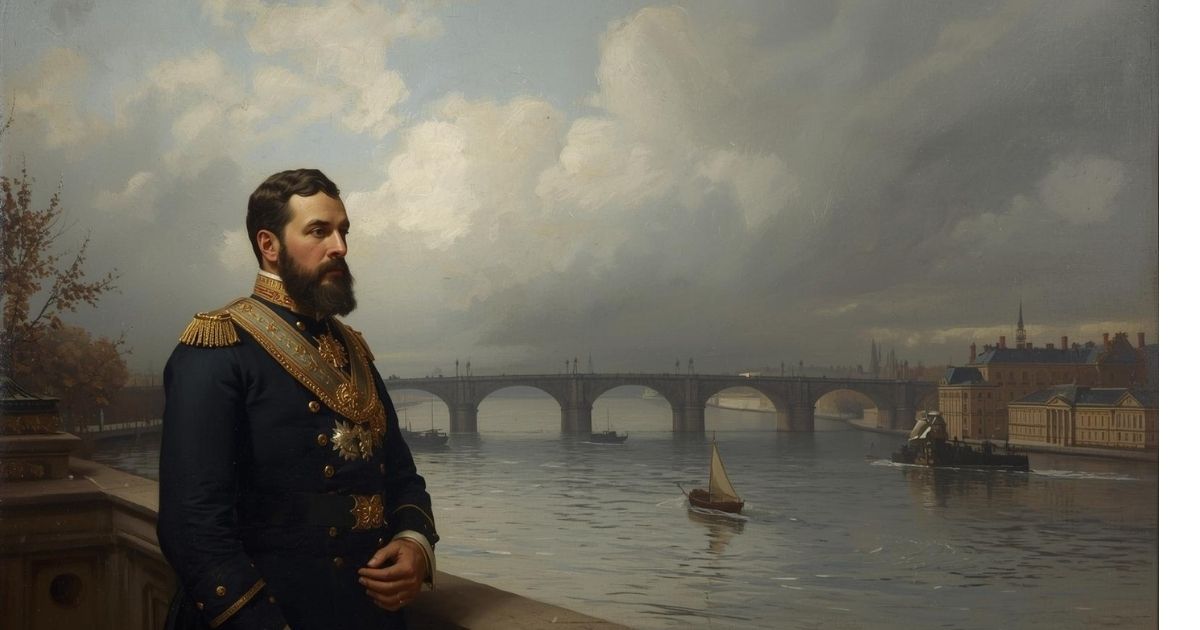
An excerpt from the original text.(complete · 7079 words)
hile he feasted his eyes upon Aglaya, as she talked merrily with
Evgenie and Prince N., suddenly the old anglomaniac, who was talking to
the dignitary in another corner of the room, apparently telling him a
story about something or other—suddenly this gentleman pronounced the
name of “Nicolai Andreevitch Pavlicheff” aloud. The prince quickly
turned towards him, and listened.
The conversation had been on the subject of land, and the present
disorders, and there must have been something amusing said, for the old
man had begun to laugh at his companion’s heated expressions.
The latter was describing in eloquent words how, in consequence of
recent legislation, he was obliged to sell a beautiful estate in the N.
province, not because he wanted ready money—in fact, he was obliged to
sell it at half its value. “To avoid another lawsuit about the
Pavlicheff estate, I ran away,” he said. “With a few more inheritances
of that kind I should soon be ruined!”
At this point General Epanchin, noticing how interested Muishkin had
become in the conversation, said to him, in a low tone:
“That gentleman—Ivan Petrovitch—is a relation of your late friend, Mr.
Pavlicheff. You wanted to find some of his relations, did you not?”
The general, who had been talking to his chief up to this moment, had
observed the prince’s solitude and silence, and was anxious to draw him
into the conversation, and so introduce him again to the notice of some
of the important personages.
“Lef Nicolaievitch was a ward of Nicolai Andreevitch Pavlicheff, after
the death of his own parents,” he remarked, meeting Ivan Petrovitch’s
eye.
“Very happy to meet him, I’m sure,” remarked the latter. “I remember
Lef Nicolaievitch well. When General Epanchin introduced us just now, I
recognized you at once, prince. You are very little changed, though I
saw you last as a child of some ten or eleven years old. There was
something in your features, I suppose, that—”
“You saw me as a child!” exclaimed the prince, with surprise.
“Oh! yes, long ago,” continued Ivan Petrovitch, “while you were living
with my cousin at Zlatoverhoff. You don’t remember me? No, I dare say
you don’t; you had some malady at the time, I remember. It was so
serious that I was surprised—”
“No; I remember nothing!” said the prince. A few more words of
explanation followed, words which were spoken without the smallest
excitement by his companion, but which evoked the greatest agitation in
the prince; and it was discovered that two old ladies to whose care the
prince had been left by Pavlicheff, and who lived at Zlatoverhoff, were
also relations of Ivan Petrovitch.
The latter had no idea and could give no information as to why
Pavlicheff had taken so great an interest in the little prince, his
ward.
“In point of fact I don’t think I thought much about it,” said the old
fellow. He seemed to have a wonderfully good memory, however, for he
told the prince all about the two old ladies, Pavlicheff’s cousins, who
had taken care of him, and whom, he declared, he had taken to task for
being too severe with the prince as a small sickly boy—the elder
sister, at least; the younger had been kind, he recollected. They both
now lived in another province, on a small estate left to them by
Pavlicheff. The prince listened to all this with eyes sparkling with
emotion and delight.
He declared with unusual warmth that he would never forgive himself for
having travelled about in the central provinces during these last six
months without having hunted up his two old friends.
He declared, further, that he had intended to go every day, but had
always been prevented by circumstances; but that now he would promise
himself the pleasure—however far it was, he would find them out. And so
Ivan Petrovitch really knew Natalia Nikitishna!—what a saintly nature
was hers!—and Martha Nikitishna! Ivan Petrovitch must excuse him, but
really he was not quite fair on dear old Martha. She was severe,
perhaps; but then what else could she be with such a little idiot as he
was then? (Ha, ha.) He really was an idiot then, Ivan Petrovitch must
know, though he might not believe it. (Ha, ha.) So he had really seen
him there! Good heavens! And was he really and truly and actually a
cousin of Pavlicheff’s?
“I assure you of it,” laughed Ivan Petrovitch, gazing amusedly at the
prince.
“Oh! I didn’t say it because I doubt the fact, you know. (Ha, ha.)
How could I doubt such a thing? (Ha, ha, ha.) I made the remark
because—because Nicolai Andreevitch Pavlicheff was such a splendid man,
don’t you see! Such a high-souled man, he really was, I assure you.”
The prince did not exactly pant for breath, but he “seemed almost to
choke out of pure simplicity and goodness of heart,” as Adelaida
expressed it, on talking the party over with her fiance, the Prince S.,
next morning.
“But, my goodness me,” laughed Ivan Petrovitch, “why can’t I be cousin
to even a splendid man?”
“Oh, dear!” cried the prince, confused, trying to hurry his words out,
and growing more and more eager every moment: “I’ve gone and said
another stupid thing. I don’t know what to say. I—I didn’t mean that,
you know—I—I—he really was such a splendid man, wasn’t he?”
The prince trembled all over. Why was he so agitated? Why had he flown
into such transports of delight without any apparent reason? He had far
outshot the measure of joy and emotion consistent with the occasion.
Why this was it would be difficult to say.
He seemed to feel warmly and deeply grateful to someone for something
or other—perhaps to Ivan Petrovitch; but likely enough to all the
guests, individually, and collectively. He was much too happy.
Ivan Petrovitch began to stare at him with some surprise; the
dignitary, too, looked at him with considerable attention; Princess
Bielokonski glared at him angrily, and compressed her lips. Prince N.,
Evgenie, Prince S., and the girls, all broke off their own
conversations and listened. Aglaya seemed a little startled; as for
Lizabetha Prokofievna, her heart sank within her.
This was odd of Lizabetha Prokofievna and her daughters. They had
themselves decided that it would be better if the prince did not talk
all the evening. Yet seeing him sitting silent and alone, but perfectly
happy, they had been on the point of exerting themselves to draw him
into one of the groups of talkers around the room. Now that he was in
the midst of a talk they became more than ever anxious and perturbed.
“That he was a splendid man is perfectly true; you are quite right,”
repeated Ivan Petrovitch, but seriously this time. “He was a fine and a
worthy fellow—worthy, one may say, of the highest respect,” he added,
more and more seriously at each pause; “and it is agreeable to see, on
your part, such—”
“Wasn’t it this same Pavlicheff about whom there was a strange story in
connection with some abbot? I don’t remember who the abbot was, but I
remember at one time everybody was talking about it,” remarked the old
dignitary.
“Yes—Abbot Gurot, a Jesuit,” said Ivan Petrovitch. “Yes, that’s the
sort of thing our best men are apt to do. A man of rank, too, and
rich—a man who, if he had continued to serve, might have done anything;
and then to throw up the service and everything else in order to go
over to Roman Catholicism and turn Jesuit—openly, too—almost
triumphantly. By Jove! it was positively a mercy that he died when he
did—it was indeed—everyone said so at the time.”
The prince was beside himself.
“Pavlicheff?—Pavlicheff turned Roman Catholic? Impossible!” he cried,
in horror.
“H’m! impossible is rather a strong word,” said Ivan Petrovitch. “You
must allow, my dear prince... However, of course you value the memory
of the deceased so very highly; and he certainly was the kindest of
men; to which fact, by the way, I ascribe, more than to anything else,
the success of the abbot in influencing his religious convictions. But
you may ask me, if you please, how much trouble and worry I,
personally, had over that business, and especially with this same
Gurot! Would you believe it,” he continued, addressing the dignitary,
“they actually tried to put in a claim under the deceased’s will, and I
had to resort to the very strongest measures in order to bring them to
their senses? I assure you they knew their cue, did these
gentlemen—wonderful! Thank goodness all this was in Moscow, and I got
the Court, you know, to help me, and we soon brought them to their
senses.”
“You wouldn’t believe how you have pained and astonished me,” cried the
prince.
“Very sorry; but in point of fact, you know, it was all nonsense and
would have ended in smoke, as usual—I’m sure of that. Last year,”—he
turned to the old man again,—“Countess K. joined some Roman Convent
abroad. Our people never seem to be able to offer any resistance so
soon as they get into the hands of these—intriguers—especially abroad.”
“That is all thanks to our lassitude, I think,” replied the old man,
with authority. “And then their way of preaching; they have a skilful
manner of doing it! And they know how to startle one, too. I got quite
a fright myself in ’32, in Vienna, I assure you; but I didn’t cave in
to them, I ran away instead, ha, ha!”
“Come, come, I’ve always heard that you ran away with the beautiful
Countess Levitsky that time—throwing up everything in order to do
it—and not from the Jesuits at all,” said Princess Bielokonski,
suddenly.
“Well, yes—but we call it from the Jesuits, you know; it comes to the
same thing,” laughed the old fellow, delighted with the pleasant
recollection.
“You seem to be very religious,” he continued, kindly, addressing the
prince, “which is a thing one meets so seldom nowadays among young
people.”
The prince was listening open-mouthed, and still in a condition of
excited agitation. The old man was evidently interested in him, and
anxious to study him more closely.
“Pavlicheff was a man of bright intellect and a good Christian, a
sincere Christian,” said the prince, suddenly. “How could he possibly
embrace a faith which is unchristian? Roman Catholicism is, so to
speak, simply the same thing as unchristianity,” he added with flashing
eyes, which seemed to take in everybody in the room.
“Come, that’s a little too strong, isn’t it?” murmured the old man,
glancing at General Epanchin in surprise.
“How do you make out that the Roman Catholic religion is unchristian?
What is it, then?” asked Ivan Petrovitch, turning to the prince.
“It is not a Christian religion, in the first place,” said the latter,
in extreme agitation, quite out of proportion to the necessity of the
moment. “And in the second place, Roman Catholicism is, in my opinion,
worse than Atheism itself. Yes—that is my opinion. Atheism only
preaches a negation, but Romanism goes further; it preaches a
disfigured, distorted Christ—it preaches Anti-Christ—I assure you, I
swear it! This is my own personal conviction, and it has long
distressed me. The Roman Catholic believes that the Church on earth
cannot stand without universal temporal Power. He cries ‘non possumus!’
In my opinion the Roman Catholic religion is not a faith at all, but
simply a continuation of the Roman Empire, and everything is
subordinated to this idea—beginning with faith. The Pope has seized
territories and an earthly throne, and has held them with the sword.
And so the thing has gone on, only that to the sword they have added
lying, intrigue, deceit, fanaticism, superstition, swindling;—they have
played fast and loose with the most sacred and sincere feelings of
men;—they have exchanged everything—everything for money, for base
earthly power! And is this not the teaching of Anti-Christ? How could
the upshot of all this be other than Atheism? Atheism is the child of
Roman Catholicism—it proceeded from these Romans themselves, though
perhaps they would not believe it. It grew and fattened on hatred of
its parents; it is the progeny of their lies and spiritual feebleness.
Atheism! In our country it is only among the upper classes that you
find unbelievers; men who have lost the root or spirit of their faith;
but abroad whole masses of the people are beginning to profess
unbelief—at first because of the darkness and lies by which they were
surrounded; but now out of fanaticism, out of loathing for the Church
and Christianity!”
The prince paused to get breath. He had spoken with extraordinary
rapidity, and was very pale.
All present interchanged glances, but at last the old dignitary burst
out laughing frankly. Prince N. took out his eye-glass to have a good
look at the speaker. The German poet came out of his corner and crept
nearer to the table, with a spiteful smile.
“You exaggerate the matter very much,” said Ivan Petrovitch, with
rather a bored air. “There are, in the foreign Churches, many
representatives of their faith who are worthy of respect and esteem.”
“Oh, but I did not speak of individual representatives. I was merely
talking about Roman Catholicism, and its essence—of Rome itself. A
Church can never entirely disappear; I never hinted at that!”
“Agreed that all this may be true; but we need not discuss a subject
which belongs to the domain of theology.”
“Oh, no; oh, no! Not to theology alone, I assure you! Why, Socialism is
the progeny of Romanism and of the Romanistic spirit. It and its
brother Atheism proceed from Despair in opposition to Catholicism. It
seeks to replace in itself the moral power of religion, in order to
appease the spiritual thirst of parched humanity and save it; not by
Christ, but by force. ‘Don’t dare to believe in God, don’t dare to
possess any individuality, any property! Fraternité ou la Mort; two
million heads. ‘By their works ye shall know them’—we are told. And we
must not suppose that all this is harmless and without danger to
ourselves. Oh, no; we must resist, and quickly, quickly! We must let
our Christ shine forth upon the Western nations, our Christ whom we
have preserved intact, and whom they have never known. Not as slaves,
allowing ourselves to be caught by the hooks of the Jesuits, but
carrying our Russian civilization to them, we must stand before them,
not letting it be said among us that their preaching is ‘skilful,’ as
someone expressed it just now.”
“But excuse me, excuse me;” cried Ivan Petrovitch considerably
disturbed, and looking around uneasily. “Your ideas are, of course,
most praiseworthy, and in the highest degree patriotic; but you
exaggerate the matter terribly. It would be better if we dropped the
subject.”
“No, sir, I do not exaggerate, I understate the matter, if anything,
undoubtedly understate it; simply because I cannot express myself as I
should like, but—”
“Allow me!”
The prince was silent. He sat straight up in his chair and gazed
fervently at Ivan Petrovitch.
“It seems to me that you have been too painfully impressed by the news
of what happened to your good benefactor,” said the old dignitary,
kindly, and with the utmost calmness of demeanour. “You are excitable,
perhaps as the result of your solitary life. If you would make up your
mind to live more among your fellows in society, I trust, I am sure,
that the world would be glad to welcome you, as a remarkable young man;
and you would soon find yourself able to look at things more calmly.
You would see that all these things are much simpler than you think;
and, besides, these rare cases come about, in my opinion, from ennui
and from satiety.”
“Exactly, exactly! That is a true thought!” cried the prince. “From
ennui, from our ennui but not from satiety! Oh, no, you are wrong
there! Say from thirst if you like; the thirst of fever! And please
do not suppose that this is so small a matter that we may have a laugh
at it and dismiss it; we must be able to foresee our disasters and arm
against them. We Russians no sooner arrive at the brink of the water,
and realize that we are really at the brink, than we are so delighted
with the outlook that in we plunge and swim to the farthest point we
can see. Why is this? You say you are surprised at Pavlicheff’s action;
you ascribe it to madness, to kindness of heart, and what not, but it
is not so.
“Our Russian intensity not only astonishes ourselves; all Europe
wonders at our conduct in such cases! For, if one of us goes over to
Roman Catholicism, he is sure to become a Jesuit at once, and a rabid
one into the bargain. If one of us becomes an Atheist, he must needs
begin to insist on the prohibition of faith in God by force, that is,
by the sword. Why is this? Why does he then exceed all bounds at once?
Because he has found land at last, the fatherland that he sought in
vain before; and, because his soul is rejoiced to find it, he throws
himself upon it and kisses it! Oh, it is not from vanity alone, it is
not from feelings of vanity that Russians become Atheists and Jesuits!
But from spiritual thirst, from anguish of longing for higher things,
for dry firm land, for foothold on a fatherland which they never
believed in because they never knew it. It is easier for a Russian to
become an Atheist, than for any other nationality in the world. And not
only does a Russian ‘become an Atheist,’ but he actually believes in
Atheism, just as though he had found a new faith, not perceiving that
he has pinned his faith to a negation. Such is our anguish of thirst!
‘Whoso has no country has no God.’ That is not my own expression; it is
the expression of a merchant, one of the Old Believers, whom I once met
while travelling. He did not say exactly these words. I think his
expression was:
“‘Whoso forsakes his country forsakes his God.’
“But let these thirsty Russian souls find, like Columbus’ discoverers,
a new world; let them find the Russian world, let them search and
discover all the gold and treasure that lies hid in the bosom of their
own land! Show them the restitution of lost humanity, in the future, by
Russian thought alone, and by means of the God and of the Christ of our
Russian faith, and you will see how mighty and just and wise and good a
giant will rise up before the eyes of the astonished and frightened
world; astonished because they expect nothing but the sword from us,
because they think they will get nothing out of us but barbarism. This
has been the case up to now, and the longer matters go on as they are
now proceeding, the more clear will be the truth of what I say; and I—”
But at this moment something happened which put a most unexpected end
to the orator’s speech. All this heated tirade, this outflow of
passionate words and ecstatic ideas which seemed to hustle and tumble
over each other as they fell from his lips, bore evidence of some
unusually disturbed mental condition in the young fellow who had
“boiled over” in such a remarkable manner, without any apparent reason.
Of those who were present, such as knew the prince listened to his
outburst in a state of alarm, some with a feeling of mortification. It
was so unlike his usual timid self-constraint; so inconsistent with his
usual taste and tact, and with his instinctive feeling for the higher
proprieties. They could not understand the origin of the outburst; it
could not be simply the news of Pavlicheff’s perversion. By the ladies
the prince was regarded as little better than a lunatic, and Princess
Bielokonski admitted afterwards that “in another minute she would have
bolted.”
The two old gentlemen looked quite alarmed. The old general (Epanchin’s
chief) sat and glared at the prince in severe displeasure. The colonel
sat immovable. Even the German poet grew a little pale, though he wore
his usual artificial smile as he looked around to see what the others
would do.
In point of fact it is quite possible that the matter would have ended
in a very commonplace and natural way in a few minutes. The undoubtedly
astonished, but now more collected, General Epanchin had several times
endeavoured to interrupt the prince, and not having succeeded he was
now preparing to take firmer and more vigorous measures to attain his
end. In another minute or two he would probably have made up his mind
to lead the prince quietly out of the room, on the plea of his being
ill (and it was more than likely that the general was right in his
belief that the prince was actually ill), but it so happened that
destiny had something different in store.
At the beginning of the evening, when the prince first came into the
room, he had sat down as far as possible from the Chinese vase which
Aglaya had spoken of the day before.
Will it be believed that, after Aglaya’s alarming words, an
ineradicable conviction had taken possession of his mind that, however
he might try to avoid this vase next day, he must certainly break it?
But so it was.
During the evening other impressions began to awaken in his mind, as we
have seen, and he forgot his presentiment. But when Pavlicheff was
mentioned and the general introduced him to Ivan Petrovitch, he had
changed his place, and went over nearer to the table; when, it so
happened, he took the chair nearest to the beautiful vase, which stood
on a pedestal behind him, just about on a level with his elbow.
As he spoke his last words he had risen suddenly from his seat with a
wave of his arm, and there was a general cry of horror.
The huge vase swayed backwards and forwards; it seemed to be uncertain
whether or no to topple over on to the head of one of the old men, but
eventually determined to go the other way, and came crashing over
towards the German poet, who darted out of the way in terror.
The crash, the cry, the sight of the fragments of valuable china
covering the carpet, the alarm of the company—what all this meant to
the poor prince it would be difficult to convey to the mind of the
reader, or for him to imagine.
But one very curious fact was that all the shame and vexation and
mortification which he felt over the accident were less powerful than
the deep impression of the almost supernatural truth of his
premonition. He stood still in alarm—in almost superstitious alarm, for
a moment; then all mists seemed to clear away from his eyes; he was
conscious of nothing but light and joy and ecstasy; his breath came and
went; but the moment passed. Thank God it was not that! He drew a long
breath and looked around.
For some minutes he did not seem to comprehend the excitement around
him; that is, he comprehended it and saw everything, but he stood
aside, as it were, like someone invisible in a fairy tale, as though he
had nothing to do with what was going on, though it pleased him to take
an interest in it.
He saw them gather up the broken bits of china; he heard the loud
talking of the guests and observed how pale Aglaya looked, and how very
strangely she was gazing at him. There was no hatred in her expression,
and no anger whatever. It was full of alarm for him, and sympathy and
affection, while she looked around at the others with flashing, angry
eyes. His heart filled with a sweet pain as he gazed at her.
At length he observed, to his amazement, that all had taken their seats
again, and were laughing and talking as though nothing had happened.
Another minute and the laughter grew louder—they were laughing at him,
at his dumb stupor—laughing kindly and merrily. Several of them spoke
to him, and spoke so kindly and cordially, especially Lizabetha
Prokofievna—she was saying the kindest possible things to him.
Suddenly he became aware that General Epanchin was tapping him on the
shoulder; Ivan Petrovitch was laughing too, but still more kind and
sympathizing was the old dignitary. He took the prince by the hand and
pressed it warmly; then he patted it, and quietly urged him to
recollect himself—speaking to him exactly as he would have spoken to a
little frightened child, which pleased the prince wonderfully; and next
seated him beside himself.
The prince gazed into his face with pleasure, but still seemed to have
no power to speak. His breath failed him. The old man’s face pleased
him greatly.
“Do you really forgive me?” he said at last. “And—and Lizabetha
Prokofievna too?” The laugh increased, tears came into the prince’s
eyes, he could not believe in all this kindness—he was enchanted.
“The vase certainly was a very beautiful one. I remember it here for
fifteen years—yes, quite that!” remarked Ivan Petrovitch.
“Oh, what a dreadful calamity! A wretched vase smashed, and a man half
dead with remorse about it,” said Lizabetha Prokofievna, loudly. “What
made you so dreadfully startled, Lef Nicolaievitch?” she added, a
little timidly. “Come, my dear boy! cheer up. You really alarm me,
taking the accident so to heart.”
“Do you forgive me all—all, besides the vase, I mean?” said the
prince, rising from his seat once more, but the old gentleman caught
his hand and drew him down again—he seemed unwilling to let him go.
“C’est très-curieux et c’est très-sérieux,” he whispered across the
table to Ivan Petrovitch, rather loudly. Probably the prince heard him.
“So that I have not offended any of you? You will not believe how happy
I am to be able to think so. It is as it should be. As if I could
offend anyone here! I should offend you again by even suggesting such a
thing.”
“Calm yourself, my dear fellow. You are exaggerating again; you really
have no occasion to be so grateful to us. It is a feeling which does
you great credit, but an exaggeration, for all that.”
“I am not exactly thanking you, I am only feeling a growing admiration
for you—it makes me happy to look at you. I dare say I am speaking very
foolishly, but I must speak—I must explain, if it be out of nothing
better than self-respect.”
All he said and did was abrupt, confused, feverish—very likely the
words he spoke, as often as not, were not those he wished to say. He
seemed to inquire whether he might speak. His eyes lighted on
Princess Bielokonski.
“All right, my friend, talk away, talk away!” she remarked. “Only don’t
lose your breath; you were in such a hurry when you began, and look
what you’ve come to now! Don’t be afraid of speaking—all these ladies
and gentlemen have seen far stranger people than yourself; you don’t
astonish them. You are nothing out-of-the-way remarkable, you know.
You’ve done nothing but break a vase, and give us all a fright.”
The prince listened, smiling.
“Wasn’t it you,” he said, suddenly turning to the old gentleman, “who
saved the student Porkunoff and a clerk called Shoabrin from being sent
to Siberia, two or three months since?”
The old dignitary blushed a little, and murmured that the prince had
better not excite himself further.
“And I have heard of you,” continued the prince, addressing Ivan
Petrovitch, “that when some of your villagers were burned out you gave
them wood to build up their houses again, though they were no longer
your serfs and had behaved badly towards you.”
“Oh, come, come! You are exaggerating,” said Ivan Petrovitch, beaming
with satisfaction, all the same. He was right, however, in this
instance, for the report had reached the prince’s ears in an incorrect
form.
“And you, princess,” he went on, addressing Princess Bielokonski, “was
it not you who received me in Moscow, six months since, as kindly as
though I had been your own son, in response to a letter from Lizabetha
Prokofievna; and gave me one piece of advice, again as to your own son,
which I shall never forget? Do you remember?”
“What are you making such a fuss about?” said the old lady, with
annoyance. “You are a good fellow, but very silly. One gives you a
halfpenny, and you are as grateful as though one had saved your life.
You think this is praiseworthy on your part, but it is not—it is not,
indeed.”
She seemed to be very angry, but suddenly burst out laughing, quite
good-humouredly.
Lizabetha Prokofievna’s face brightened up, too; so did that of General
Epanchin.
“I told you Lef Nicolaievitch was a man—a man—if only he would not be
in such a hurry, as the princess remarked,” said the latter, with
delight.
Aglaya alone seemed sad and depressed; her face was flushed, perhaps
with indignation.
“He really is very charming,” whispered the old dignitary to Ivan
Petrovitch.
“I came into this room with anguish in my heart,” continued the prince,
with ever-growing agitation, speaking quicker and quicker, and with
increasing strangeness. “I—I was afraid of you all, and afraid of
myself. I was most afraid of myself. When I returned to Petersburg, I
promised myself to make a point of seeing our greatest men, and members
of our oldest families—the old families like my own. I am now among
princes like myself, am I not? I wished to know you, and it was
necessary, very, very necessary. I had always heard so much that was
evil said of you all—more evil than good; as to how small and petty
were your interests, how absurd your habits, how shallow your
education, and so on. There is so much written and said about you! I
came here today with anxious curiosity; I wished to see for myself and
form my own convictions as to whether it were true that the whole of
this upper stratum of Russian society is worthless, has outlived its
time, has existed too long, and is only fit to die—and yet is dying
with petty, spiteful warring against that which is destined to
supersede it and take its place—hindering the Coming Men, and knowing
not that itself is in a dying condition. I did not fully believe in
this view even before, for there never was such a class among
us—excepting perhaps at court, by accident—or by uniform; but now there
is not even that, is there? It has vanished, has it not?”
“No, not a bit of it,” said Ivan Petrovitch, with a sarcastic laugh.
“Good Lord, he’s off again!” said Princess Bielokonski, impatiently.
“Laissez-le dire! He is trembling all over,” said the old man, in a
warning whisper.
The prince certainly was beside himself.
“Well? What have I seen?” he continued. “I have seen men of graceful
simplicity of intellect; I have seen an old man who is not above
speaking kindly and even listening to a boy like myself; I see before
me persons who can understand, who can forgive—kind, good Russian
hearts—hearts almost as kind and cordial as I met abroad. Imagine how
delighted I must have been, and how surprised! Oh, let me express this
feeling! I have so often heard, and I have even believed, that in
society there was nothing but empty forms, and that reality had
vanished; but I now see for myself that this can never be the case
here, among us—it may be the order elsewhere, but not in Russia.
Surely you are not all Jesuits and deceivers! I heard Prince N.‘s story
just now. Was it not simple-minded, spontaneous humour? Could such
words come from the lips of a man who is dead?—a man whose heart and
talents are dried up? Could dead men and women have treated me so
kindly as you have all been treating me to-day? Is there not material
for the future in all this—for hope? Can such people fail to
understand? Can such men fall away from reality?”
“Once more let us beg you to be calm, my dear boy. We’ll talk of all
this another time—I shall do so with the greatest pleasure, for one,”
said the old dignitary, with a smile.
Ivan Petrovitch grunted and twisted round in his chair. General
Epanchin moved nervously. The latter’s chief had started a conversation
with the wife of the dignitary, and took no notice whatever of the
prince, but the old lady very often glanced at him, and listened to
what he was saying.
“No, I had better speak,” continued the prince, with a new outburst of
feverish emotion, and turning towards the old man with an air of
confidential trustfulness. “Yesterday, Aglaya Ivanovna forbade me to
talk, and even specified the particular subjects I must not touch
upon—she knows well enough that I am odd when I get upon these matters.
I am nearly twenty-seven years old, and yet I know I am little better
than a child. I have no right to express my ideas, and said so long
ago. Only in Moscow, with Rogojin, did I ever speak absolutely freely!
He and I read Pushkin together—all his works. Rogojin knew nothing of
Pushkin, had not even heard his name. I am always afraid of spoiling a
great Thought or Idea by my absurd manner. I have no eloquence, I know.
I always make the wrong gestures—inappropriate gestures—and therefore I
degrade the Thought, and raise a laugh instead of doing my subject
justice. I have no sense of proportion either, and that is the chief
thing. I know it would be much better if I were always to sit still and
say nothing. When I do so, I appear to be quite a sensible sort of a
person, and what’s more, I think about things. But now I must speak; it
is better that I should. I began to speak because you looked so kindly
at me; you have such a beautiful face. I promised Aglaya Ivanovna
yesterday that I would not speak all the evening.”
“Really?” said the old man, smiling.
“But, at times, I can’t help thinking that I am wrong in feeling so
about it, you know. Sincerity is more important than elocution, isn’t
it?”
“Sometimes.”
“I want to explain all to you—everything—everything! I know you think
me Utopian, don’t you—an idealist? Oh, no! I’m not, indeed—my ideas are
all so simple. You don’t believe me? You are smiling. Do you know, I am
sometimes very wicked—for I lose my faith? This evening as I came here,
I thought to myself, ‘What shall I talk about? How am I to begin, so
that they may be able to understand partially, at all events?’ How
afraid I was—dreadfully afraid! And yet, how could I be afraid—was it
not shameful of me? Was I afraid of finding a bottomless abyss of empty
selfishness? Ah! that’s why I am so happy at this moment, because I
find there is no bottomless abyss at all—but good, healthy material,
full of life.
“It is not such a very dreadful circumstance that we are odd people, is
it? For we really are odd, you know—careless, reckless, easily wearied
of anything. We don’t look thoroughly into matters—don’t care to
understand things. We are all like this—you and I, and all of them!
Why, here are you, now—you are not a bit angry with me for calling you
‘odd,’ are you? And, if so, surely there is good material in you? Do
you know, I sometimes think it is a good thing to be odd. We can
forgive one another more easily, and be more humble. No one can begin
by being perfect—there is much one cannot understand in life at first.
In order to attain to perfection, one must begin by failing to
understand much. And if we take in knowledge too quickly, we very
likely are not taking it in at all. I say all this to you—you who by
this time understand so much—and doubtless have failed to understand so
much, also. I am not afraid of you any longer. You are not angry that a
mere boy should say such words to you, are you? Of course not! You know
how to forget and to forgive. You are laughing, Ivan Petrovitch? You
think I am a champion of other classes of people—that I am their
advocate, a democrat, and an orator of Equality?” The prince laughed
hysterically; he had several times burst into these little, short
nervous laughs. “Oh, no—it is for you, for myself, and for all of us
together, that I am alarmed. I am a prince of an old family myself, and
I am sitting among my peers; and I am talking like this in the hope of
saving us all; in the hope that our class will not disappear
altogether—into the darkness—unguessing its danger—blaming everything
around it, and losing ground every day. Why should we disappear and
give place to others, when we may still, if we choose, remain in the
front rank and lead the battle? Let us be servants, that we may become
lords in due season!”
He tried to get upon his feet again, but the old man still restrained
him, gazing at him with increasing perturbation as he went on.
“Listen—I know it is best not to speak! It is best simply to give a
good example—simply to begin the work. I have done this—I have begun,
and—and—oh! can anyone be unhappy, really? Oh! what does grief
matter—what does misfortune matter, if one knows how to be happy? Do
you know, I cannot understand how anyone can pass by a green tree, and
not feel happy only to look at it! How anyone can talk to a man and not
feel happy in loving him! Oh, it is my own fault that I cannot express
myself well enough! But there are lovely things at every step I
take—things which even the most miserable man must recognize as
beautiful. Look at a little child—look at God’s day dawn—look at the
grass growing—look at the eyes that love you, as they gaze back into
your eyes!”
He had risen, and was speaking standing up. The old gentleman was
looking at him now in unconcealed alarm. Lizabetha Prokofievna wrung
her hands. “Oh, my God!” she cried. She had guessed the state of the
case before anyone else.
Aglaya rushed quickly up to him, and was just in time to receive him in
her arms, and to hear with dread and horror that awful, wild cry as he
fell writhing to the ground.
There he lay on the carpet, and someone quickly placed a cushion under
his head.
No one had expected this.
In a quarter of an hour or so Prince N. and Evgenie Pavlovitch and the
old dignitary were hard at work endeavouring to restore the harmony of
the evening, but it was of no avail, and very soon after the guests
separated and went their ways.
A great deal of sympathy was expressed; a considerable amount of advice
was volunteered; Ivan Petrovitch expressed his opinion that the young
man was “a Slavophile, or something of that sort”; but that it was not
a dangerous development. The old dignitary said nothing.
True enough, most of the guests, next day and the day after, were not
in very good humour. Ivan Petrovitch was a little offended, but not
seriously so. General Epanchin’s chief was rather cool towards him for
some while after the occurrence. The old dignitary, as patron of the
family, took the opportunity of murmuring some kind of admonition to
the general, and added, in flattering terms, that he was most
interested in Aglaya’s future. He was a man who really did possess a
kind heart, although his interest in the prince, in the earlier part of
the evening, was due, among other reasons, to the latter’s connection
with Nastasia Philipovna, according to popular report. He had heard a
good deal of this story here and there, and was greatly interested in
it, so much so that he longed to ask further questions about it.
Princess Bielokonski, as she drove away on this eventful evening, took
occasion to say to Lizabetha Prokofievna:
“Well—he’s a good match—and a bad one; and if you want my opinion, more
bad than good. You can see for yourself the man is an invalid.”
Lizabetha therefore decided that the prince was impossible as a husband
for Aglaya; and during the ensuing night she made a vow that never
while she lived should he marry Aglaya. With this resolve firmly
impressed upon her mind, she awoke next day; but during the morning,
after her early lunch, she fell into a condition of remarkable
inconsistency.
In reply to a very guarded question of her sisters’, Aglaya had
answered coldly, but exceedingly haughtily:
“I have never given him my word at all, nor have I ever counted him as
my future husband—never in my life. He is just as little to me as all
the rest.”
Lizabetha Prokofievna suddenly flared up.
“I did not expect that of you, Aglaya,” she said. “He is an impossible
husband for you,—I know it; and thank God that we agree upon that
point; but I did not expect to hear such words from you. I thought I
should hear a very different tone from you. I would have turned out
everyone who was in the room last night and kept him,—that’s the sort
of man he is, in my opinion!”
Here she suddenly paused, afraid of what she had just said. But she
little knew how unfair she was to her daughter at that moment. It was
all settled in Aglaya’s mind. She was only waiting for the hour that
would bring the matter to a final climax; and every hint, every
careless probing of her wound, did but further lacerate her heart.
Master this chapter. Complete your experience
Purchase the complete book to access all chapters and support classic literature
As an Amazon Associate, we earn a small commission from qualifying purchases at no additional cost to you.
Available in paperback, hardcover, and e-book formats
Let's Analyse the Pattern
When our deepest convictions bypass our judgment, causing us to alienate the very people we're trying to reach through uncontrolled emotional intensity.
Why This Matters
Connect literature to life
This chapter teaches how to identify when strong emotions are about to bypass your judgment and damage your credibility.
Practice This Today
This week, notice when you feel that surge of passionate intensity about something you care about - that's your warning to pause and consider your actual goal before speaking.
Now let's explore the literary elements.
Key Quotes & Analysis
"Catholicism is even worse than atheism itself! Yes, that is my opinion! Atheism only preaches a negation, but Catholicism goes further: it preaches a distorted Christ, a Christ calumniated and defamed by themselves, the opposite of Christ!"
Context: Myshkin becomes agitated when he learns his benefactor converted to Catholicism
This quote shows how Myshkin's passionate nature makes him unable to discuss sensitive topics calmly. His extreme reaction reveals both his deep faith and his inability to navigate social situations diplomatically.
In Today's Words:
That's not just wrong, it's worse than having no beliefs at all! They've completely twisted everything good into something evil!
"The Roman Catholic Church has sold Christ for earthly dominion. The Pope has grasped the earth, an earthly throne, and grasped the sword; everything has been going on in that way ever since."
Context: Continuing his passionate denunciation of Catholicism to the shocked gathering
Myshkin's words become increasingly heated and political, showing how his religious passion transforms into a rant that makes everyone uncomfortable. He's lost all awareness of his audience.
In Today's Words:
The church leaders care more about money and power than actually helping people - they've been corrupt for centuries!
"The vase! The vase!"
Context: Multiple voices cry out as Myshkin accidentally breaks an expensive Chinese vase during his agitation
This moment marks the transition from social embarrassment to physical disaster. The broken vase symbolizes how Myshkin's presence disrupts the careful order of high society.
In Today's Words:
Oh no! You broke it!
Thematic Threads
Social Expectations
In This Chapter
Myshkin's religious outburst violates every rule of polite society, shocking the sophisticated gathering
Development
Earlier chapters showed subtle social missteps; now we see complete social breakdown
In Your Life:
You might recognize this when your strong opinions make others uncomfortable at dinner parties or work events
Authenticity vs Acceptance
In This Chapter
Myshkin's genuine spiritual passion makes him completely unfit for the artificial world he's trying to enter
Development
This tension has been building as Myshkin tried to navigate high society while remaining true to himself
In Your Life:
You face this when being yourself at work or in new social circles feels like it might cost you acceptance
Physical Vulnerability
In This Chapter
The epileptic seizure exposes Myshkin's medical condition and ends his marriage prospects
Development
His condition was hinted at before but now becomes undeniably public
In Your Life:
You might relate when health issues, mental health struggles, or other vulnerabilities become visible to others
Religious Identity
In This Chapter
Myshkin's passionate defense of Russian Orthodox Christianity against Catholicism reveals his deep spiritual convictions
Development
Introduced here as a core part of his character and worldview
In Your Life:
You might see this when your religious, political, or cultural beliefs clash with those around you
Class Mobility
In This Chapter
Despite his noble birth, Myshkin's behavior proves he cannot successfully navigate elite society
Development
This chapter definitively ends his attempt to rise in social status through marriage
In Your Life:
You might recognize this when trying to fit into professional or social circles that feel foreign to your background
You now have the context. Time to form your own thoughts.
Discussion Questions
- 1
What triggers Prince Myshkin's passionate outburst about religion, and how do the other guests react to his intensity?
analysis • surface - 2
Why does Myshkin's genuine care about his faith end up damaging his reputation and relationships at the party?
analysis • medium - 3
Where have you seen someone's passion for a cause or belief actually work against them in convincing others?
application • medium - 4
How could Myshkin have shared his religious concerns in a way that wouldn't have alienated everyone present?
application • deep - 5
What does this scene reveal about the difference between caring deeply about something and communicating about it effectively?
reflection • deep
Critical Thinking Exercise
Rewrite the Conversation
Imagine you're coaching Prince Myshkin before this party. Write out how he could have responded when Ivan Petrovitch mentioned Pavlicheff's conversion to Catholicism. Your goal is to help Myshkin express his concerns without alienating the entire room. Focus on tone, timing, and word choice that would keep people listening rather than backing away.
Consider:
- •Consider what Myshkin's actual goal was versus what his emotions made him do
- •Think about how the setting and audience should influence the approach
- •Notice the difference between expressing personal beliefs and attacking others' beliefs
Journaling Prompt
Write about a time when your passion for something important backfired because of how you expressed it. What would you do differently now, knowing what you know about reading the room and choosing your moments?
Coming Up Next...
Chapter 46: The Confrontation of Two Worlds
The aftermath of the seizure forces difficult decisions about Myshkin's future, while Aglaya must confront her true feelings about a man society deems unsuitable. A final confrontation looms that will determine the fate of their relationship.