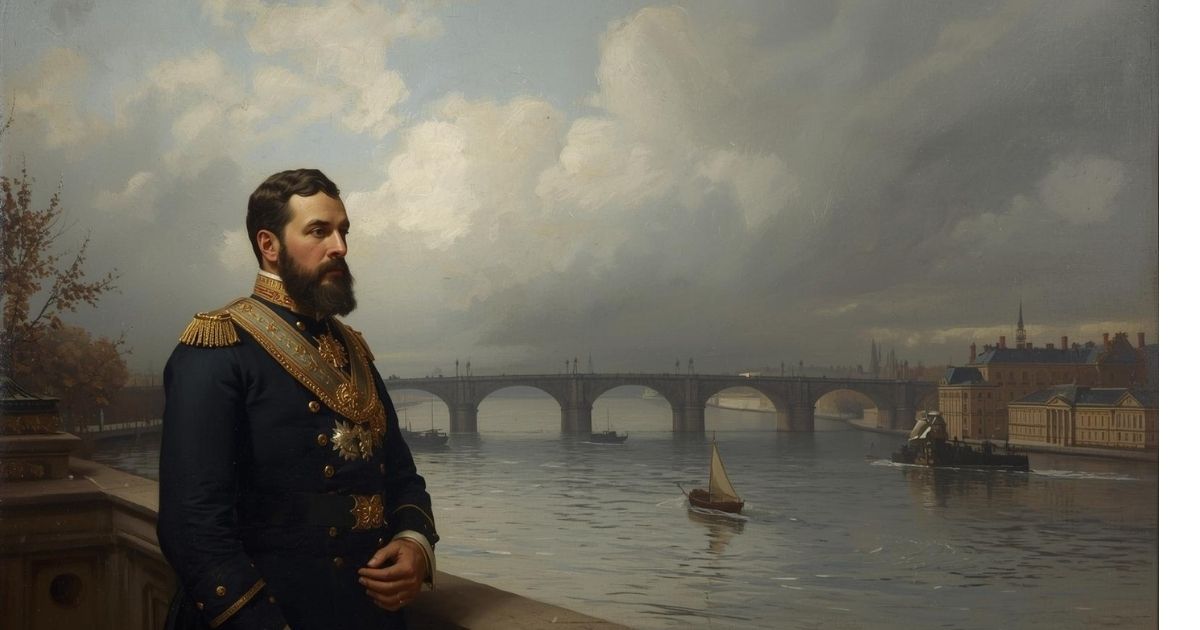
An excerpt from the original text.(complete · 5686 words)
t was the beginning of June, and for a whole week the weather in St.
Petersburg had been magnificent. The Epanchins had a luxurious
country-house at Pavlofsk, [One of the fashionable summer resorts near
St. Petersburg.] and to this spot Mrs. Epanchin determined to proceed
without further delay. In a couple of days all was ready, and the
family had left town. A day or two after this removal to Pavlofsk,
Prince Muishkin arrived in St. Petersburg by the morning train from
Moscow. No one met him; but, as he stepped out of the carriage, he
suddenly became aware of two strangely glowing eyes fixed upon him from
among the crowd that met the train. On endeavouring to re-discover the
eyes, and see to whom they belonged, he could find nothing to guide
him. It must have been a hallucination. But the disagreeable impression
remained, and without this, the prince was sad and thoughtful already,
and seemed to be much preoccupied.
His cab took him to a small and bad hotel near the Litaynaya. Here he
engaged a couple of rooms, dark and badly furnished. He washed and
changed, and hurriedly left the hotel again, as though anxious to waste
no time. Anyone who now saw him for the first time since he left
Petersburg would judge that he had improved vastly so far as his
exterior was concerned. His clothes certainly were very different; they
were more fashionable, perhaps even too much so, and anyone inclined to
mockery might have found something to smile at in his appearance. But
what is there that people will not smile at?
The prince took a cab and drove to a street near the Nativity, where he
soon discovered the house he was seeking. It was a small wooden villa,
and he was struck by its attractive and clean appearance; it stood in a
pleasant little garden, full of flowers. The windows looking on the
street were open, and the sound of a voice, reading aloud or making a
speech, came through them. It rose at times to a shout, and was
interrupted occasionally by bursts of laughter.
Prince Muishkin entered the court-yard, and ascended the steps. A cook
with her sleeves turned up to the elbows opened the door. The visitor
asked if Mr. Lebedeff were at home.
“He is in there,” said she, pointing to the salon.
The room had a blue wall-paper, and was well, almost pretentiously,
furnished, with its round table, its divan, and its bronze clock under
a glass shade. There was a narrow pier-glass against the wall, and a
chandelier adorned with lustres hung by a bronze chain from the
ceiling.
When the prince entered, Lebedeff was standing in the middle of the
room, his back to the door. He was in his shirt-sleeves, on account of
the extreme heat, and he seemed to have just reached the peroration of
his speech, and was impressively beating his breast.
His audience consisted of a youth of about fifteen years of age with a
clever face, who had a book in his hand, though he was not reading; a
young lady of twenty, in deep mourning, stood near him with an infant
in her arms; another girl of thirteen, also in black, was laughing
loudly, her mouth wide open; and on the sofa lay a handsome young man,
with black hair and eyes, and a suspicion of beard and whiskers. He
frequently interrupted the speaker and argued with him, to the great
delight of the others.
“Lukian Timofeyovitch! Lukian Timofeyovitch! Here’s someone to see you!
Look here!... a gentleman to speak to you!... Well, it’s not my fault!”
and the cook turned and went away red with anger.
Lebedeff started, and at sight of the prince stood like a statue for a
moment. Then he moved up to him with an ingratiating smile, but stopped
short again.
“Prince! ex-ex-excellency!” he stammered. Then suddenly he ran towards
the girl with the infant, a movement so unexpected by her that she
staggered and fell back, but next moment he was threatening the other
child, who was standing, still laughing, in the doorway. She screamed,
and ran towards the kitchen. Lebedeff stamped his foot angrily; then,
seeing the prince regarding him with amazement, he murmured
apologetically—“Pardon to show respect!... he-he!”
“You are quite wrong...” began the prince.
“At once... at once... in one moment!”
He rushed like a whirlwind from the room, and Muishkin looked
inquiringly at the others.
They were all laughing, and the guest joined in the chorus.
“He has gone to get his coat,” said the boy.
“How annoying!” exclaimed the prince. “I thought... Tell me, is he...”
“You think he is drunk?” cried the young man on the sofa. “Not in the
least. He’s only had three or four small glasses, perhaps five; but
what is that? The usual thing!”
As the prince opened his mouth to answer, he was interrupted by the
girl, whose sweet face wore an expression of absolute frankness.
“He never drinks much in the morning; if you have come to talk business
with him, do it now. It is the best time. He sometimes comes back drunk
in the evening; but just now he passes the greater part of the evening
in tears, and reads passages of Holy Scripture aloud, because our
mother died five weeks ago.”
“No doubt he ran off because he did not know what to say to you,” said
the youth on the divan. “I bet he is trying to cheat you, and is
thinking how best to do it.”
Just then Lebedeff returned, having put on his coat.
“Five weeks!” said he, wiping his eyes. “Only five weeks! Poor
orphans!”
“But why wear a coat in holes,” asked the girl, “when your new one is
hanging behind the door? Did you not see it?”
“Hold your tongue, dragon-fly!” he scolded. “What a plague you are!” He
stamped his foot irritably, but she only laughed, and answered:
“Are you trying to frighten me? I am not Tania, you know, and I don’t
intend to run away. Look, you are waking Lubotchka, and she will have
convulsions again. Why do you shout like that?”
“Well, well! I won’t again,” said the master of the house, his anxiety
getting the better of his temper. He went up to his daughter, and
looked at the child in her arms, anxiously making the sign of the cross
over her three times. “God bless her! God bless her!” he cried with
emotion. “This little creature is my daughter Luboff,” addressing the
prince. “My wife, Helena, died—at her birth; and this is my big
daughter Vera, in mourning, as you see; and this, this, oh, this,”
pointing to the young man on the divan...
“Well, go on! never mind me!” mocked the other. “Don’t be afraid!”
“Excellency! Have you read that account of the murder of the Zemarin
family, in the newspaper?” cried Lebedeff, all of a sudden.
“Yes,” said Muishkin, with some surprise.
“Well, that is the murderer! It is he—in fact—”
“What do you mean?” asked the visitor.
“I am speaking allegorically, of course; but he will be the murderer of
a Zemarin family in the future. He is getting ready. ...”
They all laughed, and the thought crossed the prince’s mind that
perhaps Lebedeff was really trifling in this way because he foresaw
inconvenient questions, and wanted to gain time.
“He is a traitor! a conspirator!” shouted Lebedeff, who seemed to have
lost all control over himself. “A monster! a slanderer! Ought I to
treat him as a nephew, the son of my sister Anisia?”
“Oh! do be quiet! You must be drunk! He has taken it into his head to
play the lawyer, prince, and he practices speechifying, and is always
repeating his eloquent pleadings to his children. And who do you think
was his last client? An old woman who had been robbed of five hundred
roubles, her all, by some rogue of a usurer, besought him to take up
her case, instead of which he defended the usurer himself, a Jew named
Zeidler, because this Jew promised to give him fifty roubles....”
“It was to be fifty if I won the case, only five if I lost,”
interrupted Lebedeff, speaking in a low tone, a great contrast to his
earlier manner.
“Well! naturally he came to grief: the law is not administered as it
used to be, and he only got laughed at for his pains. But he was much
pleased with himself in spite of that. ‘Most learned judge!’ said he,
‘picture this unhappy man, crippled by age and infirmities, who gains
his living by honourable toil—picture him, I repeat, robbed of his all,
of his last mouthful; remember, I entreat you, the words of that
learned legislator, “Let mercy and justice alike rule the courts of
law.”’ Now, would you believe it, excellency, every morning he recites
this speech to us from beginning to end, exactly as he spoke it before
the magistrate. To-day we have heard it for the fifth time. He was just
starting again when you arrived, so much does he admire it. He is now
preparing to undertake another case. I think, by the way, that you are
Prince Muishkin? Colia tells me you are the cleverest man he has ever
known....”
“The cleverest in the world,” interrupted his uncle hastily.
“I do not pay much attention to that opinion,” continued the young man
calmly. “Colia is very fond of you, but he,” pointing to Lebedeff, “is
flattering you. I can assure you I have no intention of flattering you,
or anyone else, but at least you have some common-sense. Well, will you
judge between us? Shall we ask the prince to act as arbitrator?” he
went on, addressing his uncle.
“I am so glad you chanced to come here, prince.”
“I agree,” said Lebedeff, firmly, looking round involuntarily at his
daughter, who had come nearer, and was listening attentively to the
conversation.
“What is it all about?” asked the prince, frowning. His head ached, and
he felt sure that Lebedeff was trying to cheat him in some way, and
only talking to put off the explanation that he had come for.
“I will tell you all the story. I am his nephew; he did speak the truth
there, although he is generally telling lies. I am at the University,
and have not yet finished my course. I mean to do so, and I shall, for
I have a determined character. I must, however, find something to do
for the present, and therefore I have got employment on the railway at
twenty-four roubles a month. I admit that my uncle has helped me once
or twice before. Well, I had twenty roubles in my pocket, and I gambled
them away. Can you believe that I should be so low, so base, as to lose
money in that way?”
“And the man who won it is a rogue, a rogue whom you ought not to have
paid!” cried Lebedeff.
“Yes, he is a rogue, but I was obliged to pay him,” said the young man.
“As to his being a rogue, he is assuredly that, and I am not saying it
because he beat you. He is an ex-lieutenant, prince, dismissed from the
service, a teacher of boxing, and one of Rogojin’s followers. They are
all lounging about the pavements now that Rogojin has turned them off.
Of course, the worst of it is that, knowing he was a rascal, and a
card-sharper, I none the less played palki with him, and risked my last
rouble. To tell the truth, I thought to myself, ‘If I lose, I will go
to my uncle, and I am sure he will not refuse to help me.’ Now that was
base—cowardly and base!”
“That is so,” observed Lebedeff quietly; “cowardly and base.”
“Well, wait a bit, before you begin to triumph,” said the nephew
viciously; for the words seemed to irritate him. “He is delighted! I
came to him here and told him everything: I acted honourably, for I did
not excuse myself. I spoke most severely of my conduct, as everyone
here can witness. But I must smarten myself up before I take up my new
post, for I am really like a tramp. Just look at my boots! I cannot
possibly appear like this, and if I am not at the bureau at the time
appointed, the job will be given to someone else; and I shall have to
try for another. Now I only beg for fifteen roubles, and I give my word
that I will never ask him for anything again. I am also ready to
promise to repay my debt in three months’ time, and I will keep my
word, even if I have to live on bread and water. My salary will amount
to seventy-five roubles in three months. The sum I now ask, added to
what I have borrowed already, will make a total of about thirty-five
roubles, so you see I shall have enough to pay him and confound him! if
he wants interest, he shall have that, too! Haven’t I always paid back
the money he lent me before? Why should he be so mean now? He grudges
my having paid that lieutenant; there can be no other reason! That’s
the kind he is—a dog in the manger!”
“And he won’t go away!” cried Lebedeff. “He has installed himself here,
and here he remains!”
“I have told you already, that I will not go away until I have got what
I ask. Why are you smiling, prince? You look as if you disapproved of
me.”
“I am not smiling, but I really think you are in the wrong, somewhat,”
replied Muishkin, reluctantly.
“Don’t shuffle! Say plainly that you think that I am quite wrong,
without any ‘somewhat’! Why ‘somewhat’?”
“I will say you are quite wrong, if you wish.”
“If I wish! That’s good, I must say! Do you think I am deceived as to
the flagrant impropriety of my conduct? I am quite aware that his money
is his own, and that my action—is much like an attempt at extortion.
But you-you don’t know what life is! If people don’t learn by
experience, they never understand. They must be taught. My intentions
are perfectly honest; on my conscience he will lose nothing, and I will
pay back the money with interest. Added to which he has had the moral
satisfaction of seeing me disgraced. What does he want more? and what
is he good for if he never helps anyone? Look what he does himself!
just ask him about his dealings with others, how he deceives people!
How did he manage to buy this house? You may cut off my head if he has
not let you in for something—and if he is not trying to cheat you
again. You are smiling. You don’t believe me?”
“It seems to me that all this has nothing to do with your affairs,”
remarked the prince.
“I have lain here now for three days,” cried the young man without
noticing, “and I have seen a lot! Fancy! he suspects his daughter, that
angel, that orphan, my cousin—he suspects her, and every evening he
searches her room, to see if she has a lover hidden in it! He comes
here too on tiptoe, creeping softly—oh, so softly—and looks under the
sofa—my bed, you know. He is mad with suspicion, and sees a thief in
every corner. He runs about all night long; he was up at least seven
times last night, to satisfy himself that the windows and doors were
barred, and to peep into the oven. That man who appears in court for
scoundrels, rushes in here in the night and prays, lying prostrate,
banging his head on the ground by the half-hour—and for whom do you
think he prays? Who are the sinners figuring in his drunken petitions?
I have heard him with my own ears praying for the repose of the soul of
the Countess du Barry! Colia heard it too. He is as mad as a March
hare!”
“You hear how he slanders me, prince,” said Lebedeff, almost beside
himself with rage. “I may be a drunkard, an evil-doer, a thief, but at
least I can say one thing for myself. He does not know—how should he,
mocker that he is?—that when he came into the world it was I who washed
him, and dressed him in his swathing-bands, for my sister Anisia had
lost her husband, and was in great poverty. I was very little better
off than she, but I sat up night after night with her, and nursed both
mother and child; I used to go downstairs and steal wood for them from
the house-porter. How often did I sing him to sleep when I was half
dead with hunger! In short, I was more than a father to him, and
now—now he jeers at me! Even if I did cross myself, and pray for the
repose of the soul of the Comtesse du Barry, what does it matter? Three
days ago, for the first time in my life, I read her biography in an
historical dictionary. Do you know who she was? You there!” addressing
his nephew. “Speak! do you know?”
“Of course no one knows anything about her but you,” muttered the young
man in a would-be jeering tone.
“She was a Countess who rose from shame to reign like a Queen. An
Empress wrote to her, with her own hand, as ‘Ma chère cousine.’ At a
lever-du-roi one morning (do you know what a lever-du-roi was?)—a
Cardinal, a Papal legate, offered to put on her stockings; a high and
holy person like that looked on it as an honour! Did you know this? I
see by your expression that you did not! Well, how did she die?
Answer!”
“Oh! do stop—you are too absurd!”
“This is how she died. After all this honour and glory, after having
been almost a Queen, she was guillotined by that butcher, Samson. She
was quite innocent, but it had to be done, for the satisfaction of the
fishwives of Paris. She was so terrified, that she did not understand
what was happening. But when Samson seized her head, and pushed her
under the knife with his foot, she cried out: ‘Wait a moment! wait a
moment, monsieur!’ Well, because of that moment of bitter suffering,
perhaps the Saviour will pardon her other faults, for one cannot
imagine a greater agony. As I read the story my heart bled for her. And
what does it matter to you, little worm, if I implored the Divine mercy
for her, great sinner as she was, as I said my evening prayer? I might
have done it because I doubted if anyone had ever crossed himself for
her sake before. It may be that in the other world she will rejoice to
think that a sinner like herself has cried to heaven for the salvation
of her soul. Why are you laughing? You believe nothing, atheist! And
your story was not even correct! If you had listened to what I was
saying, you would have heard that I did not only pray for the Comtesse
du Barry. I said, ‘Oh Lord! give rest to the soul of that great sinner,
the Comtesse du Barry, and to all unhappy ones like her.’ You see that
is quite a different thing, for how many sinners there are, how many
women, who have passed through the trials of this life, are now
suffering and groaning in purgatory! I prayed for you, too, in spite of
your insolence and impudence, also for your fellows, as it seems that
you claim to know how I pray...”
“Oh! that’s enough in all conscience! Pray for whom you choose, and the
devil take them and you! We have a scholar here; you did not know that,
prince?” he continued, with a sneer. “He reads all sorts of books and
memoirs now.”
“At any rate, your uncle has a kind heart,” remarked the prince, who
really had to force himself to speak to the nephew, so much did he
dislike him.
“Oh, now you are going to praise him! He will be set up! He puts his
hand on his heart, and he is delighted! I never said he was a man
without heart, but he is a rascal—that’s the pity of it. And then, he
is addicted to drink, and his mind is unhinged, like that of most
people who have taken more than is good for them for years. He loves
his children—oh, I know that well enough! He respected my aunt, his
late wife... and he even has a sort of affection for me. He has
remembered me in his will.”
“I shall leave you nothing!” exclaimed his uncle angrily.
“Listen to me, Lebedeff,” said the prince in a decided voice, turning
his back on the young man. “I know by experience that when you choose,
you can be business-like... I have very little time to spare, and if
you... By the way—excuse me—what is your Christian name? I have
forgotten it.”
“Ti-Ti-Timofey.”
“And?”
“Lukianovitch.”
Everyone in the room began to laugh.
“He is telling lies!” cried the nephew. “Even now he cannot speak the
truth. He is not called Timofey Lukianovitch, prince, but Lukian
Timofeyovitch. Now do tell us why you must needs lie about it? Lukian
or Timofey, it is all the same to you, and what difference can it make
to the prince? He tells lies without the least necessity, simply by
force of habit, I assure you.”
“Is that true?” said the prince impatiently.
“My name really is Lukian Timofeyovitch,” acknowledged Lebedeff,
lowering his eyes, and putting his hand on his heart.
“Well, for God’s sake, what made you say the other?”
“To humble myself,” murmured Lebedeff.
“What on earth do you mean? Oh I if only I knew where Colia was at this
moment!” cried the prince, standing up, as if to go.
“I can tell you all about Colia,” said the young man
“Oh! no, no!” said Lebedeff, hurriedly.
“Colia spent the night here, and this morning went after his father,
whom you let out of prison by paying his debts—Heaven only knows why!
Yesterday the general promised to come and lodge here, but he did not
appear. Most probably he slept at the hotel close by. No doubt Colia is
there, unless he has gone to Pavlofsk to see the Epanchins. He had a
little money, and was intending to go there yesterday. He must be
either at the hotel or at Pavlofsk.”
“At Pavlofsk! He is at Pavlofsk, undoubtedly!” interrupted Lebedeff....
“But come—let us go into the garden—we will have coffee there....” And
Lebedeff seized the prince’s arm, and led him from the room. They went
across the yard, and found themselves in a delightful little garden
with the trees already in their summer dress of green, thanks to the
unusually fine weather. Lebedeff invited his guest to sit down on a
green seat before a table of the same colour fixed in the earth, and
took a seat facing him. In a few minutes the coffee appeared, and the
prince did not refuse it. The host kept his eyes fixed on Muishkin,
with an expression of passionate servility.
“I knew nothing about your home before,” said the prince absently, as
if he were thinking of something else.
“Poor orphans,” began Lebedeff, his face assuming a mournful air, but
he stopped short, for the other looked at him inattentively, as if he
had already forgotten his own remark. They waited a few minutes in
silence, while Lebedeff sat with his eyes fixed mournfully on the young
man’s face.
“Well!” said the latter, at last rousing himself. “Ah! yes! You know
why I came, Lebedeff. Your letter brought me. Speak! Tell me all about
it.”
The clerk, rather confused, tried to say something, hesitated, began to
speak, and again stopped. The prince looked at him gravely.
“I think I understand, Lukian Timofeyovitch: you were not sure that I
should come. You did not think I should start at the first word from
you, and you merely wrote to relieve your conscience. However, you see
now that I have come, and I have had enough of trickery. Give up
serving, or trying to serve, two masters. Rogojin has been here these
three weeks. Have you managed to sell her to him as you did before?
Tell me the truth.”
“He discovered everything, the monster... himself......”
“Don’t abuse him; though I dare say you have something to complain
of....”
“He beat me, he thrashed me unmercifully!” replied Lebedeff vehemently.
“He set a dog on me in Moscow, a bloodhound, a terrible beast that
chased me all down the street.”
“You seem to take me for a child, Lebedeff. Tell me, is it a fact that
she left him while they were in Moscow?”
“Yes, it is a fact, and this time, let me tell you, on the very eve of
their marriage! It was a question of minutes when she slipped off to
Petersburg. She came to me directly she arrived—‘Save me, Lukian! find
me some refuge, and say nothing to the prince!’ She is afraid of you,
even more than she is of him, and in that she shows her wisdom!” And
Lebedeff slily put his finger to his brow as he said the last words.
“And now it is you who have brought them together again?”
“Excellency, how could I, how could I prevent it?”
“That will do. I can find out for myself. Only tell me, where is she
now? At his house? With him?”
“Oh no! Certainly not! ‘I am free,’ she says; you know how she insists
on that point. ‘I am entirely free.’ She repeats it over and over
again. She is living in Petersburgskaia, with my sister-in-law, as I
told you in my letter.”
“She is there at this moment?”
“Yes, unless she has gone to Pavlofsk: the fine weather may have
tempted her, perhaps, into the country, with Daria Alexeyevna. ‘I am
quite free,’ she says. Only yesterday she boasted of her freedom to
Nicolai Ardalionovitch—a bad sign,” added Lebedeff, smiling.
“Colia goes to see her often, does he not?”
“He is a strange boy, thoughtless, and inclined to be indiscreet.”
“Is it long since you saw her?”
“I go to see her every day, every day.”
“Then you were there yesterday?”
“N-no: I have not been these three last days.”
“It is a pity you have taken too much wine, Lebedeff I want to ask you
something... but...”
“All right! all right! I am not drunk,” replied the clerk, preparing to
listen.
“Tell me, how was she when you left her?”
“She is a woman who is seeking...”
“Seeking?”
“She seems always to be searching about, as if she had lost something.
The mere idea of her coming marriage disgusts her; she looks on it as
an insult. She cares as much for him as for a piece of
orange-peel—not more. Yet I am much mistaken if she does not look on
him with fear and trembling. She forbids his name to be mentioned
before her, and they only meet when unavoidable. He understands, well
enough! But it must be gone through. She is restless, mocking,
deceitful, violent....”
“Deceitful and violent?”
“Yes, violent. I can give you a proof of it. A few days ago she tried
to pull my hair because I said something that annoyed her. I tried to
soothe her by reading the Apocalypse aloud.”
“What?” exclaimed the prince, thinking he had not heard aright.
“By reading the Apocalypse. The lady has a restless imagination, he-he!
She has a liking for conversation on serious subjects, of any kind; in
fact they please her so much, that it flatters her to discuss them. Now
for fifteen years at least I have studied the Apocalypse, and she
agrees with me in thinking that the present is the epoch represented by
the third horse, the black one whose rider holds a measure in his hand.
It seems to me that everything is ruled by measure in our century; all
men are clamouring for their rights; ‘a measure of wheat for a penny,
and three measures of barley for a penny.’ But, added to this, men
desire freedom of mind and body, a pure heart, a healthy life, and all
God’s good gifts. Now by pleading their rights alone, they will never
attain all this, so the white horse, with his rider Death, comes next,
and is followed by Hell. We talked about this matter when we met, and
it impressed her very much.”
“Do you believe all this?” asked Muishkin, looking curiously at his
companion.
“I both believe it and explain it. I am but a poor creature, a beggar,
an atom in the scale of humanity. Who has the least respect for
Lebedeff? He is a target for all the world, the butt of any fool who
chooses to kick him. But in interpreting revelation I am the equal of
anyone, great as he may be! Such is the power of the mind and the
spirit. I have made a lordly personage tremble, as he sat in his
armchair... only by talking to him of things concerning the spirit. Two
years ago, on Easter Eve, His Excellency Nil Alexeyovitch, whose
subordinate I was then, wished to hear what I had to say, and sent a
message by Peter Zakkaritch to ask me to go to his private room. ‘They
tell me you expound the prophecies relating to Antichrist,’ said he,
when we were alone. ‘Is that so?’ ‘Yes,’ I answered unhesitatingly, and
I began to give some comments on the Apostle’s allegorical vision. At
first he smiled, but when we reached the numerical computations and
correspondences, he trembled, and turned pale. Then he begged me to
close the book, and sent me away, promising to put my name on the
reward list. That took place as I said on the eve of Easter, and eight
days later his soul returned to God.”
“What?”
“It is the truth. One evening after dinner he stumbled as he stepped
out of his carriage. He fell, and struck his head on the curb, and died
immediately. He was seventy-three years of age, and had a red face, and
white hair; he deluged himself with scent, and was always smiling like
a child. Peter Zakkaritch recalled my interview with him, and said,
‘you foretold his death.’”
The prince rose from his seat, and Lebedeff, surprised to see his guest
preparing to go so soon, remarked: “You are not interested?” in a
respectful tone.
“I am not very well, and my head aches. Doubtless the effect of the
journey,” replied the prince, frowning.
“You should go into the country,” said Lebedeff timidly.
The prince seemed to be considering the suggestion.
“You see, I am going into the country myself in three days, with my
children and belongings. The little one is delicate; she needs change
of air; and during our absence this house will be done up. I am going
to Pavlofsk.”
“You are going to Pavlofsk too?” asked the prince sharply. “Everybody
seems to be going there. Have you a house in that neighbourhood?”
“I don’t know of many people going to Pavlofsk, and as for the house,
Ivan Ptitsin has let me one of his villas rather cheaply. It is a
pleasant place, lying on a hill surrounded by trees, and one can live
there for a mere song. There is good music to be heard, so no wonder it
is popular. I shall stay in the lodge. As to the villa itself...”
“Have you let it?”
“N-no—not exactly.”
“Let it to me,” said the prince.
Now this was precisely what Lebedeff had made up his mind to do in the
last three minutes. Not that he had any difficulty in finding a tenant;
in fact the house was occupied at present by a chance visitor, who had
told Lebedeff that he would perhaps take it for the summer months. The
clerk knew very well that this “perhaps” meant “certainly,” but as
he thought he could make more out of a tenant like the prince, he felt
justified in speaking vaguely about the present inhabitant’s
intentions. “This is quite a coincidence,” thought he, and when the
subject of price was mentioned, he made a gesture with his hand, as if
to waive away a question of so little importance.
“Oh well, as you like!” said Muishkin. “I will think it over. You shall
lose nothing!”
They were walking slowly across the garden.
“But if you... I could...” stammered Lebedeff, “if... if you please,
prince, tell you something on the subject which would interest you, I
am sure.” He spoke in wheedling tones, and wriggled as he walked along.
Muishkin stopped short.
“Daria Alexeyevna also has a villa at Pavlofsk.”
“Well?”
“A certain person is very friendly with her, and intends to visit her
pretty often.”
“Well?”
“Aglaya Ivanovna...”
“Oh stop, Lebedeff!” interposed Muishkin, feeling as if he had been
touched on an open wound. “That... that has nothing to do with me. I
should like to know when you are going to start. The sooner the better
as far as I am concerned, for I am at an hotel.”
They had left the garden now, and were crossing the yard on their way
to the gate.
“Well, leave your hotel at once and come here; then we can all go
together to Pavlofsk the day after tomorrow.”
“I will think about it,” said the prince dreamily, and went off.
The clerk stood looking after his guest, struck by his sudden
absent-mindedness. He had not even remembered to say goodbye, and
Lebedeff was the more surprised at the omission, as he knew by
experience how courteous the prince usually was.
Master this chapter. Complete your experience
Purchase the complete book to access all chapters and support classic literature
As an Amazon Associate, we earn a small commission from qualifying purchases at no additional cost to you.
Available in paperback, hardcover, and e-book formats
Let's Analyse the Pattern
Creating constant emotional drama to avoid accountability while maintaining power over others through manufactured chaos.
Why This Matters
Connect literature to life
This chapter teaches how to recognize when someone creates constant drama to avoid accountability and maintain control over others.
Practice This Today
This week, notice when someone's life seems perpetually chaotic, and ask yourself what they might be avoiding through the constant crisis.
Now let's explore the literary elements.
Key Quotes & Analysis
"He suddenly became aware of two strangely glowing eyes fixed upon him from among the crowd"
Context: Myshkin arrives at the train station and senses he's being watched
This creates immediate tension and suggests Myshkin is walking back into danger. The 'glowing eyes' imagery makes the watcher seem predatory, not protective.
In Today's Words:
He got that creepy feeling someone was staring at him from the crowd
"I tell lies in order to humble myself"
Context: When confronted about lying about his own name
This perfectly captures how manipulative people twist virtue into justification for bad behavior. He's making dishonesty sound spiritual and noble.
In Today's Words:
I lie because it makes me a better person
"You help everybody and everybody deceives you"
Context: Describing his uncle's relationship with both Myshkin and Rogojin
This reveals how Lebedeff presents himself as helpful while actually serving his own interests. He's not being deceived - he's playing both sides deliberately.
In Today's Words:
You act like you're helping everyone but really you're working every angle
Thematic Threads
Deception
In This Chapter
Lebedeff lies about his own name and plays multiple sides while presenting himself as humble and religious
Development
Evolving from earlier chapters where characters wore social masks - now showing active manipulation
In Your Life:
You might recognize this in people who constantly reinvent their story depending on their audience
Performance
In This Chapter
Everyone in Lebedeff's household performs roles - he's the dramatic patriarch, nephew is the righteous accuser, children are the interrupting chorus
Development
Building on themes of social performance, now showing how families can become theater troupes
In Your Life:
You see this in families where everyone has assigned roles they perform instead of being authentic
Control
In This Chapter
Lebedeff maintains power through chaos, using drama and religious rhetoric to deflect accountability
Development
Deepening from earlier power dynamics to show how manipulation can masquerade as helplessness
In Your Life:
You might experience this with people who control situations by appearing to be out of control
Class
In This Chapter
The nephew's accusations reveal how Lebedeff exploits class differences, serving both wealthy Myshkin and Rogojin while maintaining his servant status
Development
Continuing exploration of how class position enables certain types of manipulation
In Your Life:
You see this in workplaces where people use their position to play different groups against each other
Fear
In This Chapter
Nastasya Filippovna's terror drives her into hiding, while Lebedeff's schemes are motivated by financial insecurity
Development
Showing how fear creates the conditions that manipulators exploit
In Your Life:
You might recognize how your own fears make you vulnerable to people who offer false solutions
You now have the context. Time to form your own thoughts.
Discussion Questions
- 1
What strategies does Lebedeff use to control the conversation when his nephew confronts him about his schemes?
analysis • surface - 2
Why does Lebedeff create constant drama in his household, and how does this serve his interests?
analysis • medium - 3
Where have you seen people use emotional chaos or family drama to avoid accountability in your own life?
application • medium - 4
How would you respond differently than Prince Myshkin when dealing with someone who weaponizes drama for control?
application • deep - 5
What does this chapter reveal about how people use performance and manipulation to maintain power in relationships?
reflection • deep
Critical Thinking Exercise
Decode the Drama Pattern
Think of someone in your life who always seems to be in crisis or creates dramatic situations. Map out their pattern: What triggers the drama? Who gets pulled in? What does the person avoid dealing with while everyone focuses on their latest crisis? Write down three specific examples of this pattern playing out.
Consider:
- •Notice how the timing of crises often coincides with accountability moments
- •Observe who gets cast in supporting roles during these dramatic episodes
- •Consider what legitimate concerns get buried under the emotional chaos
Journaling Prompt
Write about a time when you either used drama to avoid a difficult conversation, or when someone used it on you. How did you recognize what was really happening, and what would you do differently now?
Coming Up Next...
Chapter 19: The Knife Between Friends
As plans form for the move to Pavlofsk, the stage is set for an inevitable collision between Myshkin's hopes and the harsh realities waiting in the summer resort where all the key players will soon converge.