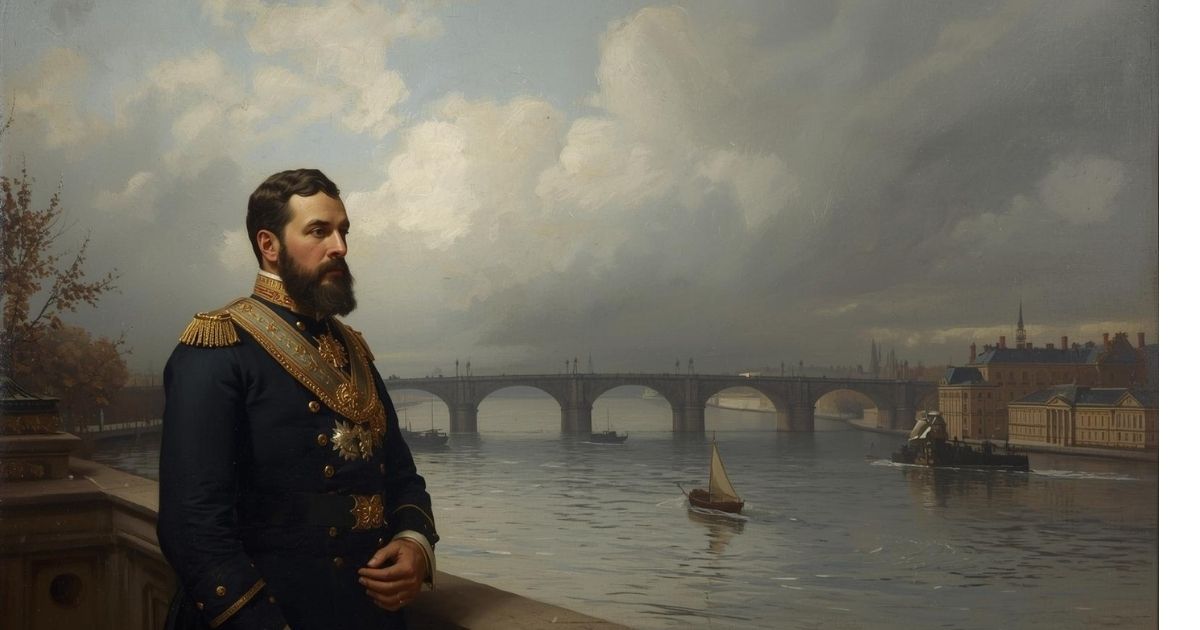
An excerpt from the original text.(complete · 3967 words)
olia took the prince to a public-house in the Litaynaya, not far off.
In one of the side rooms there sat at a table—looking like one of the
regular guests of the establishment—Ardalion Alexandrovitch, with a
bottle before him, and a newspaper on his knee. He was waiting for the
prince, and no sooner did the latter appear than he began a long
harangue about something or other; but so far gone was he that the
prince could hardly understand a word.
“I have not got a ten-rouble note,” said the prince; “but here is a
twenty-five. Change it and give me back the fifteen, or I shall be left
without a farthing myself.”
“Oh, of course, of course; and you quite understand that I—”
“Yes; and I have another request to make, general. Have you ever been
at Nastasia Philipovna’s?”
“I? I? Do you mean me? Often, my friend, often! I only pretended I had
not in order to avoid a painful subject. You saw today, you were a
witness, that I did all that a kind, an indulgent father could do. Now
a father of altogether another type shall step into the scene. You
shall see; the old soldier shall lay bare this intrigue, or a shameless
woman will force her way into a respectable and noble family.”
“Yes, quite so. I wished to ask you whether you could show me the way
to Nastasia Philipovna’s tonight. I must go; I have business with her;
I was not invited but I was introduced. Anyhow I am ready to trespass
the laws of propriety if only I can get in somehow or other.”
“My dear young friend, you have hit on my very idea. It was not for
this rubbish I asked you to come over here” (he pocketed the money,
however, at this point), “it was to invite your alliance in the
campaign against Nastasia Philipovna tonight. How well it sounds,
‘General Ivolgin and Prince Muishkin.’ That’ll fetch her, I think, eh?
Capital! We’ll go at nine; there’s time yet.”
“Where does she live?”
“Oh, a long way off, near the Great Theatre, just in the square
there—It won’t be a large party.”
The general sat on and on. He had ordered a fresh bottle when the
prince arrived; this took him an hour to drink, and then he had
another, and another, during the consumption of which he told pretty
nearly the whole story of his life. The prince was in despair. He felt
that though he had but applied to this miserable old drunkard because
he saw no other way of getting to Nastasia Philipovna’s, yet he had
been very wrong to put the slightest confidence in such a man.
At last he rose and declared that he would wait no longer. The general
rose too, drank the last drops that he could squeeze out of the bottle,
and staggered into the street.
Muishkin began to despair. He could not imagine how he had been so
foolish as to trust this man. He only wanted one thing, and that was to
get to Nastasia Philipovna’s, even at the cost of a certain amount of
impropriety. But now the scandal threatened to be more than he had
bargained for. By this time Ardalion Alexandrovitch was quite
intoxicated, and he kept his companion listening while he discoursed
eloquently and pathetically on subjects of all kinds, interspersed with
torrents of recrimination against the members of his family. He
insisted that all his troubles were caused by their bad conduct, and
time alone would put an end to them.
At last they reached the Litaynaya. The thaw increased steadily, a
warm, unhealthy wind blew through the streets, vehicles splashed
through the mud, and the iron shoes of horses and mules rang on the
paving stones. Crowds of melancholy people plodded wearily along the
footpaths, with here and there a drunken man among them.
“Do you see those brightly-lighted windows?” said the general. “Many of
my old comrades-in-arms live about here, and I, who served longer, and
suffered more than any of them, am walking on foot to the house of a
woman of rather questionable reputation! A man, look you, who has
thirteen bullets on his breast!... You don’t believe it? Well, I can
assure you it was entirely on my account that Pirogoff telegraphed to
Paris, and left Sebastopol at the greatest risk during the siege.
Nelaton, the Tuileries surgeon, demanded a safe conduct, in the name of
science, into the besieged city in order to attend my wounds. The
government knows all about it. ‘That’s the Ivolgin with thirteen
bullets in him!’ That’s how they speak of me.... Do you see that house,
prince? One of my old friends lives on the first floor, with his large
family. In this and five other houses, three overlooking Nevsky, two in
the Morskaya, are all that remain of my personal friends. Nina
Alexandrovna gave them up long ago, but I keep in touch with them
still... I may say I find refreshment in this little coterie, in thus
meeting my old acquaintances and subordinates, who worship me still, in
spite of all. General Sokolovitch (by the way, I have not called on him
lately, or seen Anna Fedorovna)... You know, my dear prince, when a
person does not receive company himself, he gives up going to other
people’s houses involuntarily. And yet... well... you look as if you
didn’t believe me.... Well now, why should I not present the son of my
old friend and companion to this delightful family—General Ivolgin and
Prince Muishkin? You will see a lovely girl—what am I saying—a lovely
girl? No, indeed, two, three! Ornaments of this city and of society:
beauty, education, culture—the woman question—poetry—everything! Added
to which is the fact that each one will have a dot of at least eighty
thousand roubles. No bad thing, eh?... In a word I absolutely must
introduce you to them: it is a duty, an obligation. General Ivolgin and
Prince Muishkin. Tableau!”
“At once? Now? You must have forgotten...” began the prince.
“No, I have forgotten nothing. Come! This is the house—up this
magnificent staircase. I am surprised not to see the porter, but ....
it is a holiday... and the man has gone off... Drunken fool! Why have
they not got rid of him? Sokolovitch owes all the happiness he has had
in the service and in his private life to me, and me alone, but... here
we are.”
The prince followed quietly, making no further objection for fear of
irritating the old man. At the same time he fervently hoped that
General Sokolovitch and his family would fade away like a mirage in the
desert, so that the visitors could escape, by merely returning
downstairs. But to his horror he saw that General Ivolgin was quite
familiar with the house, and really seemed to have friends there. At
every step he named some topographical or biographical detail that left
nothing to be desired on the score of accuracy. When they arrived at
last, on the first floor, and the general turned to ring the bell to
the right, the prince decided to run away, but a curious incident
stopped him momentarily.
“You have made a mistake, general,” said he. “The name on the door is
Koulakoff, and you were going to see General Sokolovitch.”
“Koulakoff... Koulakoff means nothing. This is Sokolovitch’s flat, and
I am ringing at his door.... What do I care for Koulakoff?... Here
comes someone to open.”
In fact, the door opened directly, and the footman informed the
visitors that the family were all away.
“What a pity! What a pity! It’s just my luck!” repeated Ardalion
Alexandrovitch over and over again, in regretful tones. “When your
master and mistress return, my man, tell them that General Ivolgin and
Prince Muishkin desired to present themselves, and that they were
extremely sorry, excessively grieved...”
Just then another person belonging to the household was seen at the
back of the hall. It was a woman of some forty years, dressed in sombre
colours, probably a housekeeper or a governess. Hearing the names she
came forward with a look of suspicion on her face.
“Marie Alexandrovna is not at home,” said she, staring hard at the
general. “She has gone to her mother’s, with Alexandra Michailovna.”
“Alexandra Michailovna out, too! How disappointing! Would you believe
it, I am always so unfortunate! May I most respectfully ask you to
present my compliments to Alexandra Michailovna, and remind her... tell
her, that with my whole heart I wish for her what she wished for
herself on Thursday evening, while she was listening to Chopin’s
Ballade. She will remember. I wish it with all sincerity. General
Ivolgin and Prince Muishkin!”
The woman’s face changed; she lost her suspicious expression.
“I will not fail to deliver your message,” she replied, and bowed them
out.
As they went downstairs the general regretted repeatedly that he had
failed to introduce the prince to his friends.
“You know I am a bit of a poet,” said he. “Have you noticed it? The
poetic soul, you know.” Then he added suddenly—“But after all... after
all I believe we made a mistake this time! I remember that the
Sokolovitch’s live in another house, and what is more, they are just
now in Moscow. Yes, I certainly was at fault. However, it is of no
consequence.”
“Just tell me,” said the prince in reply, “may I count still on your
assistance? Or shall I go on alone to see Nastasia Philipovna?”
“Count on my assistance? Go alone? How can you ask me that question,
when it is a matter on which the fate of my family so largely depends?
You don’t know Ivolgin, my friend. To trust Ivolgin is to trust a rock;
that’s how the first squadron I commanded spoke of me. ‘Depend upon
Ivolgin,’ said they all, ‘he is as steady as a rock.’ But, excuse me, I
must just call at a house on our way, a house where I have found
consolation and help in all my trials for years.”
“You are going home?”
“No... I wish... to visit Madame Terentieff, the widow of Captain
Terentieff, my old subordinate and friend. She helps me to keep up my
courage, and to bear the trials of my domestic life, and as I have an
extra burden on my mind today...”
“It seems to me,” interrupted the prince, “that I was foolish to
trouble you just now. However, at present you... Good-bye!”
“Indeed, you must not go away like that, young man, you must not!”
cried the general. “My friend here is a widow, the mother of a family;
her words come straight from her heart, and find an echo in mine. A
visit to her is merely an affair of a few minutes; I am quite at home
in her house. I will have a wash, and dress, and then we can drive to
the Grand Theatre. Make up your mind to spend the evening with me....
We are just there—that’s the house... Why, Colia! you here! Well, is
Marfa Borisovna at home or have you only just come?”
“Oh no! I have been here a long while,” replied Colia, who was at the
front door when the general met him. “I am keeping Hippolyte company.
He is worse, and has been in bed all day. I came down to buy some
cards. Marfa Borisovna expects you. But what a state you are in,
father!” added the boy, noticing his father’s unsteady gait. “Well, let
us go in.”
On meeting Colia the prince determined to accompany the general, though
he made up his mind to stay as short a time as possible. He wanted
Colia, but firmly resolved to leave the general behind. He could not
forgive himself for being so simple as to imagine that Ivolgin would be
of any use. The three climbed up the long staircase until they reached
the fourth floor where Madame Terentieff lived.
“You intend to introduce the prince?” asked Colia, as they went up.
“Yes, my boy. I wish to present him: General Ivolgin and Prince
Muishkin! But what’s the matter?... what?... How is Marfa Borisovna?”
“You know, father, you would have done much better not to come at all!
She is ready to eat you up! You have not shown yourself since the day
before yesterday and she is expecting the money. Why did you promise
her any? You are always the same! Well, now you will have to get out of
it as best you can.”
They stopped before a somewhat low doorway on the fourth floor.
Ardalion Alexandrovitch, evidently much out of countenance, pushed
Muishkin in front.
“I will wait here,” he stammered. “I should like to surprise her. ....”
Colia entered first, and as the door stood open, the mistress of the
house peeped out. The surprise of the general’s imagination fell very
flat, for she at once began to address him in terms of reproach.
Marfa Borisovna was about forty years of age. She wore a
dressing-jacket, her feet were in slippers, her face painted, and her
hair was in dozens of small plaits. No sooner did she catch sight of
Ardalion Alexandrovitch than she screamed:
“There he is, that wicked, mean wretch! I knew it was he! My heart
misgave me!”
The old man tried to put a good face on the affair.
“Come, let us go in—it’s all right,” he whispered in the prince’s ear.
But it was more serious than he wished to think. As soon as the
visitors had crossed the low dark hall, and entered the narrow
reception-room, furnished with half a dozen cane chairs, and two small
card-tables, Madame Terentieff, in the shrill tones habitual to her,
continued her stream of invectives.
“Are you not ashamed? Are you not ashamed? You barbarian! You tyrant!
You have robbed me of all I possessed—you have sucked my bones to the
marrow. How long shall I be your victim? Shameless, dishonourable man!”
“Marfa Borisovna! Marfa Borisovna! Here is... the Prince Muishkin!
General Ivolgin and Prince Muishkin,” stammered the disconcerted old
man.
“Would you believe,” said the mistress of the house, suddenly
addressing the prince, “would you believe that that man has not even
spared my orphan children? He has stolen everything I possessed, sold
everything, pawned everything; he has left me nothing—nothing! What am
I to do with your IOU’s, you cunning, unscrupulous rogue? Answer,
devourer! answer, heart of stone! How shall I feed my orphans? with
what shall I nourish them? And now he has come, he is drunk! He can
scarcely stand. How, oh how, have I offended the Almighty, that He
should bring this curse upon me! Answer, you worthless villain,
answer!”
But this was too much for the general.
“Here are twenty-five roubles, Marfa Borisovna... it is all that I can
give... and I owe even these to the prince’s generosity—my noble
friend. I have been cruelly deceived. Such is... life... Now... Excuse
me, I am very weak,” he continued, standing in the centre of the room,
and bowing to all sides. “I am faint; excuse me! Lenotchka... a
cushion... my dear!”
Lenotchka, a little girl of eight, ran to fetch the cushion at once,
and placed it on the rickety old sofa. The general meant to have said
much more, but as soon as he had stretched himself out, he turned his
face to the wall, and slept the sleep of the just.
With a grave and ceremonious air, Marfa Borisovna motioned the prince
to a chair at one of the card-tables. She seated herself opposite,
leaned her right cheek on her hand, and sat in silence, her eyes fixed
on Muishkin, now and again sighing deeply. The three children, two
little girls and a boy, Lenotchka being the eldest, came and leant on
the table and also stared steadily at him. Presently Colia appeared
from the adjoining room.
“I am very glad indeed to have met you here, Colia,” said the prince.
“Can you do something for me? I must see Nastasia Philipovna, and I
asked Ardalion Alexandrovitch just now to take me to her house, but he
has gone to sleep, as you see. Will you show me the way, for I do not
know the street? I have the address, though; it is close to the Grand
Theatre.”
“Nastasia Philipovna? She does not live there, and to tell you the
truth my father has never been to her house! It is strange that you
should have depended on him! She lives near Wladimir Street, at the
Five Corners, and it is quite close by. Will you go directly? It is
just half-past nine. I will show you the way with pleasure.”
Colia and the prince went off together. Alas! the latter had no money
to pay for a cab, so they were obliged to walk.
“I should have liked to have taken you to see Hippolyte,” said Colia.
“He is the eldest son of the lady you met just now, and was in the next
room. He is ill, and has been in bed all day. But he is rather strange,
and extremely sensitive, and I thought he might be upset considering
the circumstances in which you came... Somehow it touches me less, as
it concerns my father, while it is his mother. That, of course, makes
a great difference. What is a terrible disgrace to a woman, does not
disgrace a man, at least not in the same way. Perhaps public opinion is
wrong in condemning one sex, and excusing the other. Hippolyte is an
extremely clever boy, but so prejudiced. He is really a slave to his
opinions.”
“Do you say he is consumptive?”
“Yes. It really would be happier for him to die young. If I were in his
place I should certainly long for death. He is unhappy about his
brother and sisters, the children you saw. If it were possible, if we
only had a little money, we should leave our respective families, and
live together in a little apartment of our own. It is our dream. But,
do you know, when I was talking over your affair with him, he was
angry, and said that anyone who did not call out a man who had given
him a blow was a coward. He is very irritable to-day, and I left off
arguing the matter with him. So Nastasia Philipovna has invited you to
go and see her?”
“To tell the truth, she has not.”
“Then how do you come to be going there?” cried Colia, so much
astonished that he stopped short in the middle of the pavement. “And...
and are you going to her ‘At Home’ in that costume?”
“I don’t know, really, whether I shall be allowed in at all. If she
will receive me, so much the better. If not, the matter is ended. As to
my clothes—what can I do?”
“Are you going there for some particular reason, or only as a way of
getting into her society, and that of her friends?”
“No, I have really an object in going... That is, I am going on
business it is difficult to explain, but...”
“Well, whether you go on business or not is your affair, I do not want
to know. The only important thing, in my eyes, is that you should not
be going there simply for the pleasure of spending your evening in such
company—cocottes, generals, usurers! If that were the case I should
despise and laugh at you. There are terribly few honest people here,
and hardly any whom one can respect, although people put on airs—Varia
especially! Have you noticed, prince, how many adventurers there are
nowadays? Especially here, in our dear Russia. How it has happened I
never can understand. There used to be a certain amount of solidity in
all things, but now what happens? Everything is exposed to the public
gaze, veils are thrown back, every wound is probed by careless fingers.
We are for ever present at an orgy of scandalous revelations. Parents
blush when they remember their old-fashioned morality. At Moscow lately
a father was heard urging his son to stop at nothing—at nothing, mind
you!—to get money! The press seized upon the story, of course, and now
it is public property. Look at my father, the general! See what he is,
and yet, I assure you, he is an honest man! Only... he drinks too much,
and his morals are not all we could desire. Yes, that’s true! I pity
him, to tell the truth, but I dare not say so, because everybody would
laugh at me—but I do pity him! And who are the really clever men, after
all? Money-grubbers, every one of them, from the first to the last.
Hippolyte finds excuses for money-lending, and says it is a necessity.
He talks about the economic movement, and the ebb and flow of capital;
the devil knows what he means. It makes me angry to hear him talk so,
but he is soured by his troubles. Just imagine—the general keeps his
mother—but she lends him money! She lends it for a week or ten days at
very high interest! Isn’t it disgusting? And then, you would hardly
believe it, but my mother—Nina Alexandrovna—helps Hippolyte in all
sorts of ways, sends him money and clothes. She even goes as far as
helping the children, through Hippolyte, because their mother cares
nothing about them, and Varia does the same.”
“Well, just now you said there were no honest nor good people about,
that there were only money-grubbers—and here they are quite close at
hand, these honest and good people, your mother and Varia! I think
there is a good deal of moral strength in helping people in such
circumstances.”
“Varia does it from pride, and likes showing off, and giving herself
airs. As to my mother, I really do admire her—yes, and honour her.
Hippolyte, hardened as he is, feels it. He laughed at first, and
thought it vulgar of her—but now, he is sometimes quite touched and
overcome by her kindness. H’m! You call that being strong and good? I
will remember that! Gania knows nothing about it. He would say that it
was encouraging vice.”
“Ah, Gania knows nothing about it? It seems there are many things that
Gania does not know,” exclaimed the prince, as he considered Colia’s
last words.
“Do you know, I like you very much indeed, prince? I shall never forget
about this afternoon.”
“I like you too, Colia.”
“Listen to me! You are going to live here, are you not?” said Colia. “I
mean to get something to do directly, and earn money. Then shall we
three live together? You, and I, and Hippolyte? We will hire a flat,
and let the general come and visit us. What do you say?”
“It would be very pleasant,” returned the prince. “But we must see. I
am really rather worried just now. What! are we there already? Is that
the house? What a long flight of steps! And there’s a porter! Well,
Colia I don’t know what will come of it all.”
The prince seemed quite distracted for the moment.
“You must tell me all about it tomorrow! Don’t be afraid. I wish you
success; we agree so entirely that I can do so, although I do not
understand why you are here. Good-bye!” cried Colia excitedly. “Now I
will rush back and tell Hippolyte all about our plans and proposals!
But as to your getting in—don’t be in the least afraid. You will see
her. She is so original about everything. It’s the first floor. The
porter will show you.”
Master this chapter. Complete your experience
Purchase the complete book to access all chapters and support classic literature
As an Amazon Associate, we earn a small commission from qualifying purchases at no additional cost to you.
Available in paperback, hardcover, and e-book formats
Let's Analyse the Pattern
When people compensate for current incompetence by inflating past achievements or fictional connections to maintain the illusion of authority.
Why This Matters
Connect literature to life
This chapter teaches how to recognize when people compensate for current incompetence by invoking past achievements or fake connections.
Practice This Today
This week, notice when someone leads with credentials instead of demonstrating current ability - then ask yourself what they're actually accomplishing right now.
Now let's explore the literary elements.
Key Quotes & Analysis
"I have not got a ten-rouble note, but here is a twenty-five. Change it and give me back the fifteen, or I shall be left without a farthing myself."
Context: The prince casually offers money to the general while asking for change
Shows Myshkin's naive generosity and poor judgment about money. He trusts a drunk stranger with a large sum while admitting it's all he has.
In Today's Words:
Here's all the cash I have - can you break this hundred? Otherwise I'll be broke.
"Now a father of altogether another type shall step into the scene. You shall see; the old soldier shall lay bare this intrigue."
Context: The general promises to help expose what he sees as Nastasia's plot
Reveals his grandiose delusions and tendency to see conspiracies everywhere. He casts himself as a heroic figure while being completely unreliable.
In Today's Words:
Now you'll see what a real man can do - I'm going to expose this whole scheme.
"You saw today, you were a witness, that I did all that a kind, an indulgent father could do."
Context: The general justifies his past behavior to the prince
Shows his complete disconnect from reality and inability to take responsibility. He rewrites history to cast himself as the victim or hero.
In Today's Words:
You saw how patient I was with my family - I've been nothing but understanding.
Thematic Threads
Deception
In This Chapter
General Ivolgin weaves elaborate lies about military connections and social status while being unable to perform basic tasks
Development
Builds on earlier themes of social masks, showing how deception becomes a lifestyle rather than occasional necessity
In Your Life:
You might recognize this in family members who constantly reference past successes while avoiding present responsibilities
Class
In This Chapter
The general clings to aristocratic pretensions while living in poverty and debt, exposing the gap between claimed and actual status
Development
Deepens the exploration of social mobility by showing how people can fall from grace while refusing to acknowledge their new reality
In Your Life:
You see this when people maintain expensive appearances they can't afford or refuse jobs they consider 'beneath' their former status
Trust
In This Chapter
Prince Myshkin's naive trust in the general nearly sabotages his important mission, while Colia proves genuinely trustworthy
Development
Contrasts with earlier chapters by showing the real consequences of misplaced trust versus the rewards of recognizing genuine character
In Your Life:
You experience this when choosing who to rely on for important tasks—learning to distinguish between confident talkers and reliable actors
Family Dysfunction
In This Chapter
Colia reveals how his father's drinking and lying affects the entire family, yet he still tries to help both his father and the prince
Development
Introduced here as a new lens for understanding how individual failings ripple through family systems
In Your Life:
You might see this in your own family dynamics where one person's addiction or dishonesty forces others to become caretakers or truth-tellers
Reality vs Illusion
In This Chapter
The general lives in a fantasy world of past glory while Colia faces harsh truths about their actual circumstances
Development
Expands on earlier themes of social pretense by showing how some people completely disconnect from objective reality
In Your Life:
You encounter this when dealing with people who refuse to acknowledge obvious problems in their relationships, finances, or health
You now have the context. Time to form your own thoughts.
Discussion Questions
- 1
What specific mistakes does Prince Myshkin make when trying to get help from General Ivolgin, and how do these mistakes compound throughout the chapter?
analysis • surface - 2
Why does General Ivolgin tell elaborate stories about his military past and social connections when he can't even navigate basic tasks like giving directions or paying his debts?
analysis • medium - 3
Where have you seen people lean heavily on past achievements or name-dropping when they're struggling with present responsibilities? What usually happens in those situations?
application • medium - 4
How can you tell the difference between someone who has genuine authority and someone who's borrowing authority from their past or from other people's accomplishments?
application • deep - 5
What does Colia's honest response to his father's behavior teach us about breaking cycles of dysfunction in families or workplaces?
reflection • deep
Critical Thinking Exercise
Spot the Borrowed Authority
Think of someone in your life who frequently references past achievements, name-drops connections, or tells stories about their glory days when facing current challenges. Write down three specific examples of how they do this, then identify what current competence or responsibility they might be avoiding. Finally, consider how you can navigate interactions with this person more effectively.
Consider:
- •Look for patterns where past accomplishments are mentioned during present failures
- •Notice when someone deflects current problems by talking about who they know or what they used to do
- •Consider whether you sometimes use borrowed authority yourself when feeling insecure or incompetent
Journaling Prompt
Write about a time when you caught yourself relying on past achievements or other people's status instead of building current competence. What was driving that behavior, and how could you handle similar situations differently in the future?
Coming Up Next...
Chapter 13: The Dangerous Game Begins
Finally arriving at Nastasia Philipovna's house, the prince faces his most crucial test yet. Will his unconventional approach to this sophisticated and dangerous woman succeed where others have failed?