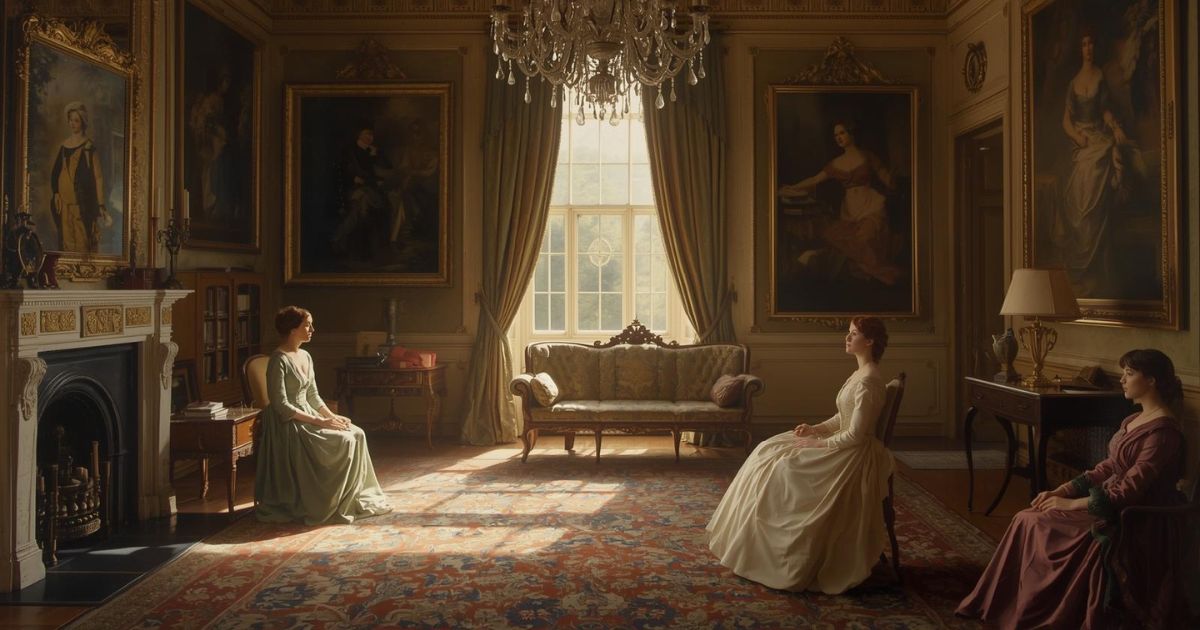
An excerpt from the original text.(complete · 1282 words)
arton Park was about half a mile from the cottage. The ladies had
passed near it in their way along the valley, but it was screened from
their view at home by the projection of a hill. The house was large and
handsome; and the Middletons lived in a style of equal hospitality and
elegance. The former was for Sir John’s gratification, the latter for
that of his lady. They were scarcely ever without some friends staying
with them in the house, and they kept more company of every kind than
any other family in the neighbourhood. It was necessary to the
happiness of both; for however dissimilar in temper and outward
behaviour, they strongly resembled each other in that total want of
talent and taste which confined their employments, unconnected with
such as society produced, within a very narrow compass. Sir John was a
sportsman, Lady Middleton a mother. He hunted and shot, and she
humoured her children; and these were their only resources. Lady
Middleton had the advantage of being able to spoil her children all the
year round, while Sir John’s independent employments were in existence
only half the time. Continual engagements at home and abroad, however,
supplied all the deficiencies of nature and education; supported the
good spirits of Sir John, and gave exercise to the good breeding of his
wife.
Lady Middleton piqued herself upon the elegance of her table, and of
all her domestic arrangements; and from this kind of vanity was her
greatest enjoyment in any of their parties. But Sir John’s satisfaction
in society was much more real; he delighted in collecting about him
more young people than his house would hold, and the noisier they were
the better was he pleased. He was a blessing to all the juvenile part
of the neighbourhood, for in summer he was for ever forming parties to
eat cold ham and chicken out of doors, and in winter his private balls
were numerous enough for any young lady who was not suffering under the
unsatiable appetite of fifteen.
The arrival of a new family in the country was always a matter of joy
to him, and in every point of view he was charmed with the inhabitants
he had now procured for his cottage at Barton. The Miss Dashwoods were
young, pretty, and unaffected. It was enough to secure his good
opinion; for to be unaffected was all that a pretty girl could want to
make her mind as captivating as her person. The friendliness of his
disposition made him happy in accommodating those, whose situation
might be considered, in comparison with the past, as unfortunate. In
showing kindness to his cousins therefore he had the real satisfaction
of a good heart; and in settling a family of females only in his
cottage, he had all the satisfaction of a sportsman; for a sportsman,
though he esteems only those of his sex who are sportsmen likewise, is
not often desirous of encouraging their taste by admitting them to a
residence within his own manor.
Mrs. Dashwood and her daughters were met at the door of the house by
Sir John, who welcomed them to Barton Park with unaffected sincerity;
and as he attended them to the drawing room repeated to the young
ladies the concern which the same subject had drawn from him the day
before, at being unable to get any smart young men to meet them. They
would see, he said, only one gentleman there besides himself; a
particular friend who was staying at the park, but who was neither very
young nor very gay. He hoped they would all excuse the smallness of the
party, and could assure them it should never happen so again. He had
been to several families that morning in hopes of procuring some
addition to their number, but it was moonlight and every body was full
of engagements. Luckily Lady Middleton’s mother had arrived at Barton
within the last hour, and as she was a very cheerful agreeable woman,
he hoped the young ladies would not find it so very dull as they might
imagine. The young ladies, as well as their mother, were perfectly
satisfied with having two entire strangers of the party, and wished for
no more.
Mrs. Jennings, Lady Middleton’s mother, was a good-humoured, merry,
fat, elderly woman, who talked a great deal, seemed very happy, and
rather vulgar. She was full of jokes and laughter, and before dinner
was over had said many witty things on the subject of lovers and
husbands; hoped they had not left their hearts behind them in Sussex,
and pretended to see them blush whether they did or not. Marianne was
vexed at it for her sister’s sake, and turned her eyes towards Elinor
to see how she bore these attacks, with an earnestness which gave
Elinor far more pain than could arise from such common-place raillery
as Mrs. Jennings’s.
Colonel Brandon, the friend of Sir John, seemed no more adapted by
resemblance of manner to be his friend, than Lady Middleton was to be
his wife, or Mrs. Jennings to be Lady Middleton’s mother. He was silent
and grave. His appearance however was not unpleasing, in spite of his
being in the opinion of Marianne and Margaret an absolute old bachelor,
for he was on the wrong side of five and thirty; but though his face
was not handsome, his countenance was sensible, and his address was
particularly gentlemanlike.
There was nothing in any of the party which could recommend them as
companions to the Dashwoods; but the cold insipidity of Lady Middleton
was so particularly repulsive, that in comparison of it the gravity of
Colonel Brandon, and even the boisterous mirth of Sir John and his
mother-in-law was interesting. Lady Middleton seemed to be roused to
enjoyment only by the entrance of her four noisy children after dinner,
who pulled her about, tore her clothes, and put an end to every kind of
discourse except what related to themselves.
In the evening, as Marianne was discovered to be musical, she was
invited to play. The instrument was unlocked, every body prepared to be
charmed, and Marianne, who sang very well, at their request went
through the chief of the songs which Lady Middleton had brought into
the family on her marriage, and which perhaps had lain ever since in
the same position on the pianoforte, for her ladyship had celebrated
that event by giving up music, although by her mother’s account, she
had played extremely well, and by her own was very fond of it.
Marianne’s performance was highly applauded. Sir John was loud in his
admiration at the end of every song, and as loud in his conversation
with the others while every song lasted. Lady Middleton frequently
called him to order, wondered how any one’s attention could be diverted
from music for a moment, and asked Marianne to sing a particular song
which Marianne had just finished. Colonel Brandon alone, of all the
party, heard her without being in raptures. He paid her only the
compliment of attention; and she felt a respect for him on the
occasion, which the others had reasonably forfeited by their shameless
want of taste. His pleasure in music, though it amounted not to that
ecstatic delight which alone could sympathize with her own, was
estimable when contrasted against the horrible insensibility of the
others; and she was reasonable enough to allow that a man of five and
thirty might well have outlived all acuteness of feeling and every
exquisite power of enjoyment. She was perfectly disposed to make every
allowance for the colonel’s advanced state of life which humanity
required.
Master this chapter. Complete your experience
Purchase the complete book to access all chapters and support classic literature
As an Amazon Associate, we earn a small commission from qualifying purchases at no additional cost to you.
Available in paperback, hardcover, and e-book formats
Let's Analyse the Pattern
When external circumstances strip away familiar markers of identity, people must choose between mourning what's lost or building from what remains.
Why This Matters
Connect literature to life
This chapter teaches how to recognize that people process major life changes through different but equally valid coping mechanisms.
Practice This Today
This week, notice when someone handles stress differently than you do—resist judging their method and look for the underlying need they're trying to meet.
Now let's explore the literary elements.
Key Quotes & Analysis
"They were not ill-received; for Sir John was entirely on the side of the Miss Dashwoods."
Context: Describing how Sir John welcomes the family to their new community
Shows that genuine acceptance exists in their new life, contrasting with the conditional acceptance they faced elsewhere. Sir John chooses to support them regardless of their reduced circumstances.
In Today's Words:
He had their backs from day one.
"The whole country about them abounded in beautiful walks."
Context: Describing the landscape around Barton Cottage that Marianne explores
The natural beauty provides both literal and metaphorical space for healing. The abundance of beautiful walks suggests abundance of opportunity for emotional recovery and new experiences.
In Today's Words:
There were amazing hiking trails everywhere.
"As a house, Barton Cottage, though small, was comfortable and compact."
Context: Describing their new home as they settle in
Emphasizes that smaller doesn't mean worse - just different. The words 'comfortable and compact' suggest coziness and manageability rather than loss, reframing their reduced circumstances positively.
In Today's Words:
The place was small but it worked perfectly for them.
Thematic Threads
Adaptation
In This Chapter
Each Dashwood woman develops different coping strategies for their reduced circumstances—Elinor through practical management, Marianne through emotional release
Development
Building from earlier displacement themes, now showing how adaptation actually works in practice
In Your Life:
You might recognize this when family members handle the same crisis completely differently, causing tension instead of mutual support.
Community
In This Chapter
Sir John's persistent hospitality represents how genuine community support appears during transitions, sometimes overwhelming but ultimately healing
Development
Introduced here as counterpoint to earlier isolation and loss
In Your Life:
This appears when neighbors, coworkers, or acquaintances step up during your crisis in ways that surprise you.
Class Mobility
In This Chapter
The cottage represents downward mobility handled with dignity—smaller space, less status, but still a home they can shape
Development
Continuing from Norland loss, now showing practical reality of reduced circumstances
In Your Life:
You see this when financial setbacks force lifestyle changes that initially feel like failure but create unexpected opportunities.
Emotional Processing
In This Chapter
Marianne's solitary walks show how some people need physical movement and solitude to work through major life changes
Development
Developing her established pattern of intense emotional response, now channeled into healthy outlets
In Your Life:
This might be your tendency to need alone time after big changes, even when others want to help or socialize.
Social Expectations
In This Chapter
The tension between accepting Sir John's hospitality and maintaining privacy shows the delicate balance of social obligations during vulnerable times
Development
Building on earlier themes of proper behavior, now complicated by genuine need and gratitude
In Your Life:
You experience this when people offer help during tough times, but accepting feels like admitting failure or losing independence.
You now have the context. Time to form your own thoughts.
Discussion Questions
- 1
How does each Dashwood woman handle the adjustment to their new life at Barton Cottage differently?
analysis • surface - 2
Why does Sir John's overwhelming hospitality feel both helpful and intrusive to the family?
analysis • medium - 3
Where do you see these different rebuilding styles playing out in your own community or workplace?
application • medium - 4
If you were advising someone going through a major life transition, how would you help them identify their natural rebuilding style?
application • deep - 5
What does this chapter reveal about the relationship between external circumstances and internal identity?
reflection • deep
Critical Thinking Exercise
Map Your Rebuilding Style
Think of a time when you faced a major life change - job loss, move, breakup, health crisis, or family shift. Write down how you handled the first month. Did you jump into action like Elinor, seek solitude like Marianne, or find balance like their mother? Now identify someone in your life going through change right now and consider how their style differs from yours.
Consider:
- •Different rebuilding styles aren't better or worse - they're just different paths
- •Your style might change depending on the type of crisis you're facing
- •Recognizing others' styles helps you offer the right kind of support
Journaling Prompt
Write about a time when someone offered you help during a difficult transition. What made their support effective or ineffective? How can you be a better 'Sir John' to someone in your life right now?
Coming Up Next...
Chapter 8: Edward's Secret
Sir John's relentless social invitations are about to pay off in ways the Dashwood women don't expect. New faces will soon enter their quiet world, bringing both opportunity and complication to their peaceful cottage life.