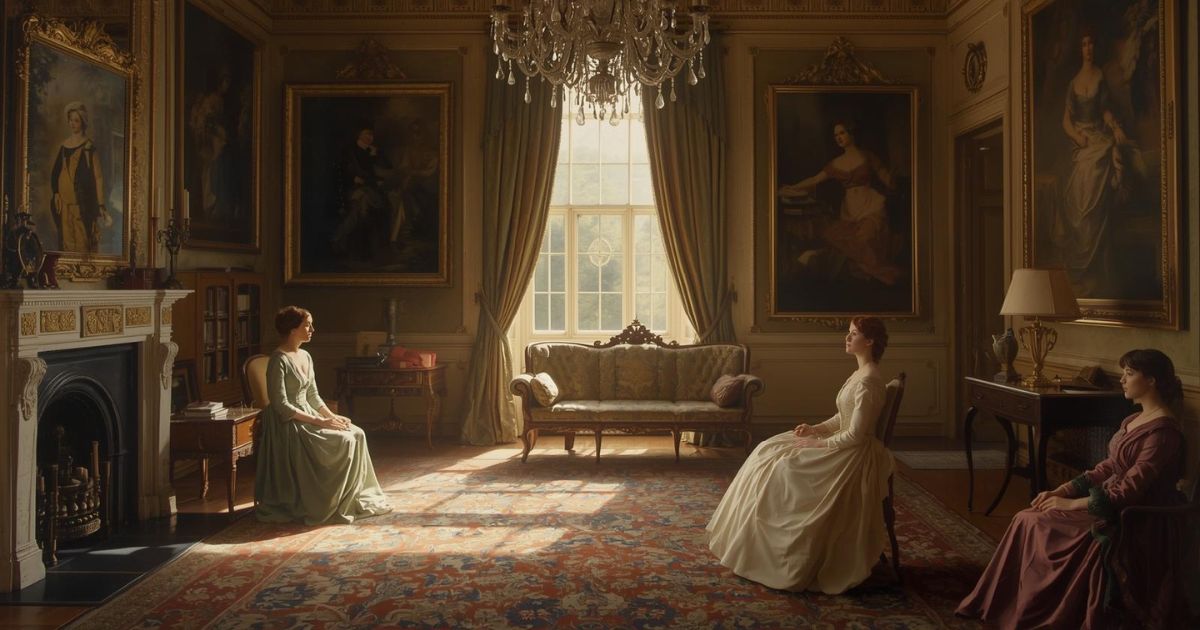
An excerpt from the original text.(complete · 1248 words)
rs. Jennings was a widow with an ample jointure. She had only two
daughters, both of whom she had lived to see respectably married, and
she had now therefore nothing to do but to marry all the rest of the
world. In the promotion of this object she was zealously active, as far
as her ability reached; and missed no opportunity of projecting
weddings among all the young people of her acquaintance. She was
remarkably quick in the discovery of attachments, and had enjoyed the
advantage of raising the blushes and the vanity of many a young lady by
insinuations of her power over such a young man; and this kind of
discernment enabled her soon after her arrival at Barton decisively to
pronounce that Colonel Brandon was very much in love with Marianne
Dashwood. She rather suspected it to be so, on the very first evening
of their being together, from his listening so attentively while she
sang to them; and when the visit was returned by the Middletons’ dining
at the cottage, the fact was ascertained by his listening to her again.
It must be so. She was perfectly convinced of it. It would be an
excellent match, for he was rich, and she was handsome. Mrs.
Jennings had been anxious to see Colonel Brandon well married, ever
since her connection with Sir John first brought him to her knowledge;
and she was always anxious to get a good husband for every pretty girl.
The immediate advantage to herself was by no means inconsiderable, for
it supplied her with endless jokes against them both. At the park she
laughed at the colonel, and in the cottage at Marianne. To the former
her raillery was probably, as far as it regarded only himself,
perfectly indifferent; but to the latter it was at first
incomprehensible; and when its object was understood, she hardly knew
whether most to laugh at its absurdity, or censure its impertinence,
for she considered it as an unfeeling reflection on the colonel’s
advanced years, and on his forlorn condition as an old bachelor.
Mrs. Dashwood, who could not think a man five years younger than
herself, so exceedingly ancient as he appeared to the youthful fancy of
her daughter, ventured to clear Mrs. Jennings from the probability of
wishing to throw ridicule on his age.
“But at least, Mama, you cannot deny the absurdity of the accusation,
though you may not think it intentionally ill-natured. Colonel Brandon
is certainly younger than Mrs. Jennings, but he is old enough to be
my father; and if he were ever animated enough to be in love, must
have long outlived every sensation of the kind. It is too ridiculous!
When is a man to be safe from such wit, if age and infirmity will not
protect him?”
“Infirmity!” said Elinor, “do you call Colonel Brandon infirm? I can
easily suppose that his age may appear much greater to you than to my
mother; but you can hardly deceive yourself as to his having the use of
his limbs!”
“Did not you hear him complain of the rheumatism? and is not that the
commonest infirmity of declining life?”
“My dearest child,” said her mother, laughing, “at this rate you must
be in continual terror of my decay; and it must seem to you a miracle
that my life has been extended to the advanced age of forty.”
“Mama, you are not doing me justice. I know very well that Colonel
Brandon is not old enough to make his friends yet apprehensive of
losing him in the course of nature. He may live twenty years longer.
But thirty-five has nothing to do with matrimony.”
“Perhaps,” said Elinor, “thirty-five and seventeen had better not have
any thing to do with matrimony together. But if there should by any
chance happen to be a woman who is single at seven and twenty, I should
not think Colonel Brandon’s being thirty-five any objection to his
marrying her.”
“A woman of seven and twenty,” said Marianne, after pausing a moment,
“can never hope to feel or inspire affection again, and if her home be
uncomfortable, or her fortune small, I can suppose that she might bring
herself to submit to the offices of a nurse, for the sake of the
provision and security of a wife. In his marrying such a woman
therefore there would be nothing unsuitable. It would be a compact of
convenience, and the world would be satisfied. In my eyes it would be
no marriage at all, but that would be nothing. To me it would seem only
a commercial exchange, in which each wished to be benefited at the
expense of the other.”
“It would be impossible, I know,” replied Elinor, “to convince you that
a woman of seven and twenty could feel for a man of thirty-five
anything near enough to love, to make him a desirable companion to her.
But I must object to your dooming Colonel Brandon and his wife to the
constant confinement of a sick chamber, merely because he chanced to
complain yesterday (a very cold damp day) of a slight rheumatic feel in
one of his shoulders.”
“But he talked of flannel waistcoats,” said Marianne; “and with me a
flannel waistcoat is invariably connected with aches, cramps,
rheumatisms, and every species of ailment that can afflict the old and
the feeble.”
“Had he been only in a violent fever, you would not have despised him
half so much. Confess, Marianne, is not there something interesting to
you in the flushed cheek, hollow eye, and quick pulse of a fever?”
Soon after this, upon Elinor’s leaving the room, “Mama,” said Marianne,
“I have an alarm on the subject of illness which I cannot conceal from
you. I am sure Edward Ferrars is not well. We have now been here almost
a fortnight, and yet he does not come. Nothing but real indisposition
could occasion this extraordinary delay. What else can detain him at
Norland?”
“Had you any idea of his coming so soon?” said Mrs. Dashwood. “I had
none. On the contrary, if I have felt any anxiety at all on the
subject, it has been in recollecting that he sometimes showed a want of
pleasure and readiness in accepting my invitation, when I talked of his
coming to Barton. Does Elinor expect him already?”
“I have never mentioned it to her, but of course she must.”
“I rather think you are mistaken, for when I was talking to her
yesterday of getting a new grate for the spare bedchamber, she observed
that there was no immediate hurry for it, as it was not likely that the
room would be wanted for some time.”
“How strange this is! what can be the meaning of it! But the whole of
their behaviour to each other has been unaccountable! How cold, how
composed were their last adieus! How languid their conversation the
last evening of their being together! In Edward’s farewell there was no
distinction between Elinor and me: it was the good wishes of an
affectionate brother to both. Twice did I leave them purposely together
in the course of the last morning, and each time did he most
unaccountably follow me out of the room. And Elinor, in quitting
Norland and Edward, cried not as I did. Even now her self-command is
invariable. When is she dejected or melancholy? When does she try to
avoid society, or appear restless and dissatisfied in it?”
Master this chapter. Complete your experience
Purchase the complete book to access all chapters and support classic literature
As an Amazon Associate, we earn a small commission from qualifying purchases at no additional cost to you.
Available in paperback, hardcover, and e-book formats
Let's Analyse the Pattern
When circumstances force change, we choose between adapting to find genuine value or judging others to protect our ego.
Why This Matters
Connect literature to life
This chapter teaches how to distinguish between genuine human warmth and polished but empty social performance.
Practice This Today
This week, notice when you dismiss someone for lacking polish—then look deeper to see if they offer something real that polished people might not.
Now let's explore the literary elements.
Key Quotes & Analysis
"Sir John was a blessing to all the juvenile part of the neighbourhood, for in summer he was for ever forming parties to eat cold ham and chicken out of doors, and in winter his private balls were numerous enough for any young lady who was not suffering under the unsatiable appetite of fifteen."
Context: Describing Sir John's generous hospitality and social activities
This shows Sir John's genuine desire to bring joy to others, especially young people. Austen's gentle humor about fifteen-year-olds having 'unsatiable appetites' for parties reveals her understanding of human nature.
In Today's Words:
Sir John was always throwing parties and get-togethers - the kind of guy who's constantly organizing barbecues and game nights because he loves seeing people have fun.
"Lady Middleton had the advantage of being able to spoil her children all the year round, while Sir John's sports were only in season."
Context: Comparing the couple's different ways of entertaining themselves
Austen's dry wit points out how Lady Middleton focuses entirely on her children while Sir John has broader interests. This reveals different approaches to finding purpose and entertainment.
In Today's Words:
Lady Middleton could obsess over her kids 24/7, while Sir John's hobbies were seasonal - showing how some people make their whole identity about their children.
"Mrs. Jennings was a widow with an ample jointure. She had only two daughters, both of whom she had lived to see respectably married, and she had now therefore nothing to do but to marry all the rest of the world."
Context: Introducing Mrs. Jennings and her passion for matchmaking
This perfectly captures how Mrs. Jennings, having successfully married off her own daughters, now sees matchmaking as her life's mission. It's both amusing and touching - she wants others to find the happiness her daughters found.
In Today's Words:
Mrs. Jennings had money and her kids were settled, so now she made it her business to play cupid for everyone else - like the mom who's always trying to set up her single friends.
Thematic Threads
Class
In This Chapter
The Dashwoods must navigate a less refined social circle than they're accustomed to at Norland
Development
Evolved from losing their estate to learning how to function in a different social stratum
In Your Life:
You might face this when changing jobs, neighborhoods, or social circles where the 'culture' feels beneath your previous experience
Identity
In This Chapter
Marianne clings to her refined sensibilities as a way to maintain her sense of self-worth in reduced circumstances
Development
Building on earlier themes of how the sisters define themselves after losing their status
In Your Life:
You might see this when you use past achievements or standards to judge new situations rather than adapting to present reality
Social Expectations
In This Chapter
The tension between Sir John's genuine hospitality and Marianne's expectations of sophisticated social interaction
Development
Introduced here as the sisters encounter their new social world
In Your Life:
You might experience this when people don't behave according to your expectations but offer something valuable in their own way
Personal Growth
In This Chapter
Elinor demonstrates wisdom by appreciating authentic kindness even when it lacks polish
Development
Continuing Elinor's pattern of practical wisdom from earlier chapters
In Your Life:
You might need this skill when learning to value substance over style in relationships and opportunities
Human Relationships
In This Chapter
The contrast between Mrs. Jennings' warm but gossipy nature and Marianne's cold dismissal of her
Development
Introduced here as we meet the extended social circle
In Your Life:
You might face this when deciding whether to engage with people who seem different from your usual social group
You now have the context. Time to form your own thoughts.
Discussion Questions
- 1
How do Elinor and Marianne each respond to their new neighbors Sir John and Mrs. Jennings, and what does this reveal about their different approaches to change?
analysis • surface - 2
Why does Marianne dismiss Sir John and Mrs. Jennings as vulgar, while Elinor appreciates their genuine kindness? What's really driving each sister's reaction?
analysis • medium - 3
Think about a time when you or someone you know had to adjust to a new workplace, neighborhood, or social group. Did you see more 'Elinor' or 'Marianne' responses?
application • medium - 4
When you're forced into unfamiliar circumstances, how can you tell if you're genuinely maintaining standards or just protecting your ego through judgment?
application • deep - 5
What does this chapter suggest about the relationship between our expectations and our ability to find genuine connection with others?
reflection • deep
Critical Thinking Exercise
Practice the Adaptation Choice
Think of a current situation where you're dealing with people or circumstances that don't match your ideal standards. Write down three judgments you've made about this situation, then challenge yourself to rewrite each judgment as an adaptation opportunity. What genuine value or learning might you be missing because you're focused on what's 'wrong'?
Consider:
- •Notice when your criticism is really about protecting your sense of superiority rather than maintaining legitimate standards
- •Look for authentic warmth or competence that might exist beneath surface differences
- •Consider whether your 'high standards' are actually preventing you from finding unexpected solutions or friendships
Journaling Prompt
Write about a time when you initially judged a person or situation harshly, but later discovered genuine value you had missed. What helped you shift from judgment to appreciation?
Coming Up Next...
Chapter 9: Willoughby's Rescue
The Dashwood sisters' social circle expands as they meet more of the local families, including some unexpected personalities who will challenge their assumptions about country life. Marianne's strong opinions about their new neighbors are about to be put to the test.