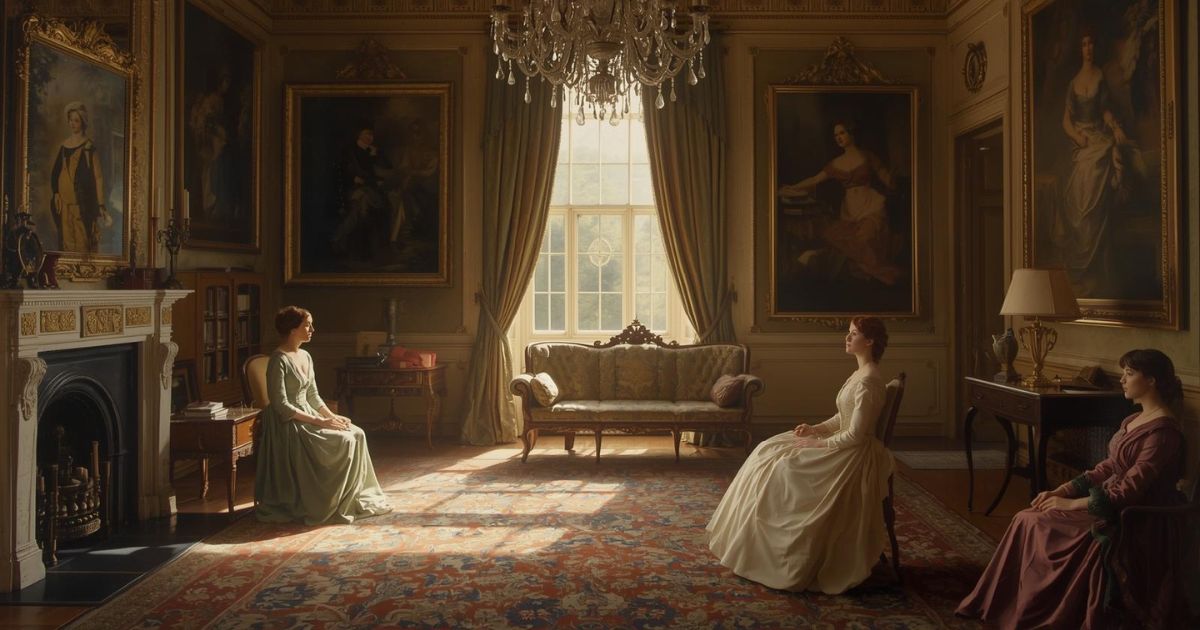
An excerpt from the original text.(complete · 1009 words)
o sooner was her answer dispatched, than Mrs. Dashwood indulged
herself in the pleasure of announcing to her son-in-law and his wife
that she was provided with a house, and should incommode them no longer
than till every thing were ready for her inhabiting it. They heard her
with surprise. Mrs. John Dashwood said nothing; but her husband civilly
hoped that she would not be settled far from Norland. She had great
satisfaction in replying that she was going into Devonshire.—Edward
turned hastily towards her, on hearing this, and, in a voice of
surprise and concern, which required no explanation to her, repeated,
“Devonshire! Are you, indeed, going there? So far from hence! And to
what part of it?” She explained the situation. It was within four miles
northward of Exeter.
“It is but a cottage,” she continued, “but I hope to see many of my
friends in it. A room or two can easily be added; and if my friends
find no difficulty in travelling so far to see me, I am sure I will
find none in accommodating them.”
She concluded with a very kind invitation to Mr. and Mrs. John Dashwood
to visit her at Barton; and to Edward she gave one with still greater
affection. Though her late conversation with her daughter-in-law had
made her resolve on remaining at Norland no longer than was
unavoidable, it had not produced the smallest effect on her in that
point to which it principally tended. To separate Edward and Elinor was
as far from being her object as ever; and she wished to show Mrs. John
Dashwood, by this pointed invitation to her brother, how totally she
disregarded her disapprobation of the match.
Mr. John Dashwood told his mother again and again how exceedingly sorry
he was that she had taken a house at such a distance from Norland as to
prevent his being of any service to her in removing her furniture. He
really felt conscientiously vexed on the occasion; for the very
exertion to which he had limited the performance of his promise to his
father was by this arrangement rendered impracticable.—The furniture
was all sent around by water. It chiefly consisted of household linen,
plate, china, and books, with a handsome pianoforte of Marianne’s. Mrs.
John Dashwood saw the packages depart with a sigh: she could not help
feeling it hard that as Mrs. Dashwood’s income would be so trifling in
comparison with their own, she should have any handsome article of
furniture.
Mrs. Dashwood took the house for a twelvemonth; it was ready furnished,
and she might have immediate possession. No difficulty arose on either
side in the agreement; and she waited only for the disposal of her
effects at Norland, and to determine her future household, before she
set off for the west; and this, as she was exceedingly rapid in the
performance of everything that interested her, was soon done.—The
horses which were left her by her husband had been sold soon after his
death, and an opportunity now offering of disposing of her carriage,
she agreed to sell that likewise at the earnest advice of her eldest
daughter. For the comfort of her children, had she consulted only her
own wishes, she would have kept it; but the discretion of Elinor
prevailed. Her wisdom too limited the number of their servants to
three; two maids and a man, with whom they were speedily provided from
amongst those who had formed their establishment at Norland.
The man and one of the maids were sent off immediately into Devonshire,
to prepare the house for their mistress’s arrival; for as Lady
Middleton was entirely unknown to Mrs. Dashwood, she preferred going
directly to the cottage to being a visitor at Barton Park; and she
relied so undoubtingly on Sir John’s description of the house, as to
feel no curiosity to examine it herself till she entered it as her own.
Her eagerness to be gone from Norland was preserved from diminution by
the evident satisfaction of her daughter-in-law in the prospect of her
removal; a satisfaction which was but feebly attempted to be concealed
under a cold invitation to her to defer her departure. Now was the time
when her son-in-law’s promise to his father might with particular
propriety be fulfilled. Since he had neglected to do it on first coming
to the estate, their quitting his house might be looked on as the most
suitable period for its accomplishment. But Mrs. Dashwood began shortly
to give over every hope of the kind, and to be convinced, from the
general drift of his discourse, that his assistance extended no farther
than their maintenance for six months at Norland. He so frequently
talked of the increasing expenses of housekeeping, and of the perpetual
demands upon his purse, which a man of any consequence in the world was
beyond calculation exposed to, that he seemed rather to stand in need
of more money himself than to have any design of giving money away.
In a very few weeks from the day which brought Sir John Middleton’s
first letter to Norland, every thing was so far settled in their future
abode as to enable Mrs. Dashwood and her daughters to begin their
journey.
Many were the tears shed by them in their last adieus to a place so
much beloved. “Dear, dear Norland!” said Marianne, as she wandered
alone before the house, on the last evening of their being there; “when
shall I cease to regret you!—when learn to feel a home elsewhere!—Oh!
happy house, could you know what I suffer in now viewing you from this
spot, from whence perhaps I may view you no more!—And you, ye
well-known trees!—but you will continue the same.—No leaf will decay
because we are removed, nor any branch become motionless although we
can observe you no longer!—No; you will continue the same; unconscious
of the pleasure or the regret you occasion, and insensible of any
change in those who walk under your shade!—But who will remain to enjoy
you?”
Master this chapter. Complete your experience
Purchase the complete book to access all chapters and support classic literature
As an Amazon Associate, we earn a small commission from qualifying purchases at no additional cost to you.
Available in paperback, hardcover, and e-book formats
Let's Analyse the Pattern
When circumstances change, we can either adapt our approach to work with new realities or resist by focusing energy on what we've lost.
Why This Matters
Connect literature to life
This chapter teaches you to identify whether someone is channeling their mental energy toward adaptation or resistance during difficult transitions.
Practice This Today
This week, notice when you or others face unwanted change—watch where the energy goes and ask 'Is this helping me build something new or just mourning what's gone?'
Now let's explore the literary elements.
Key Quotes & Analysis
"Elinor had not needed this to be assured of the injustice to which her sister was often led by her eagerness of mind and her too great importance placed by her on the delicacies of a strong sensibility."
Context: When Elinor observes how Marianne's intense emotions lead her to unfair judgments
This shows the core tension - Marianne's emotional intensity, which she sees as virtue, actually makes her harsh and unreasonable. Elinor sees the problem but loves her sister anyway.
In Today's Words:
Elinor knew that Marianne's drama queen tendencies made her judge everything too harshly.
"The whole country about them abounded in beautiful walks. The high downs which invited them from almost every window of the cottage to seek the exquisite enjoyment of air on their summits, were a happy alternative when the dirt of the valleys beneath shut up their superior beauties."
Context: Describing the landscape around their new home
Even the description of nature reflects the theme - there are 'superior beauties' above and 'dirt' below, mirroring the family's fall from higher to lower social position.
In Today's Words:
The hills around their cottage offered great hiking when the muddy valleys weren't worth walking through.
"Sir John was a sportsman, Lady Middleton a mother. He hunted and shot, and she humoured her children; and these were their only resources."
Context: Introducing the Middletons and their simple lifestyle
Austen's dry humor shows how limited these people are - they have money and status but no intellectual depth. This will matter as the Dashwoods navigate their social world.
In Today's Words:
He lived for hunting season, she lived for her kids - that was literally all they had going on.
Thematic Threads
Class
In This Chapter
The Dashwoods must learn to live as genteel poor rather than comfortable gentry, navigating reduced circumstances while maintaining dignity
Development
Evolved from Chapter 1's legal disinheritance to Chapter 4's departure—now showing daily reality of downward mobility
In Your Life:
You might face this when job loss forces lifestyle changes or aging parents need financial help
Identity
In This Chapter
Elinor maintains her core self while adapting behaviors; Marianne's identity feels threatened by any compromise with reduced circumstances
Development
Building on earlier chapters—now showing how different personalities handle identity challenges
In Your Life:
You see this when major life changes make you question who you are versus who you need to become
Social Expectations
In This Chapter
Sir John's aggressive hospitality represents social obligations they cannot refuse despite preferring privacy
Development
Introduced here—the complex dance of accepting help while maintaining independence
In Your Life:
You experience this when you need help from people whose style or values don't match yours
Personal Growth
In This Chapter
Elinor grows stronger through practical problem-solving while Marianne remains stuck in emotional responses
Development
Developing the core contrast—different approaches to handling adversity
In Your Life:
You face this choice every time life gets harder: grow through adaptation or stay stuck in resistance
Human Relationships
In This Chapter
The necessity of accepting Sir John's friendship despite personality mismatches shows how circumstances shape our social choices
Development
Introduced here—relationships of necessity versus relationships of choice
In Your Life:
You navigate this when you need people in your network who aren't naturally your type
You now have the context. Time to form your own thoughts.
Discussion Questions
- 1
How do Elinor and Marianne each handle their move to the cottage, and what does this reveal about their personalities?
analysis • surface - 2
Why does Sir John Middleton's pushy friendliness actually benefit the Dashwood women, even if they find it overwhelming?
analysis • medium - 3
Think about a time when your circumstances changed dramatically. Did you respond more like Elinor (adapting) or Marianne (resisting)? What were the results?
application • medium - 4
When you're forced to depend on people you didn't choose (like the Dashwoods with Sir John), what strategies help you maintain your dignity while accepting help?
application • deep - 5
What does this chapter suggest about the relationship between emotional intensity and practical problem-solving? Can you have both, or do they compete?
reflection • deep
Critical Thinking Exercise
Map Your Energy Allocation
Think of a current challenge in your life. Draw two columns: 'What I Can Control' and 'What I Cannot Control.' List everything about your situation in the appropriate column. Then honestly assess: where are you currently spending most of your mental and emotional energy? Create an action plan that shifts 80% of your energy to the 'Can Control' column.
Consider:
- •Be brutally honest about what you actually can and cannot control
- •Notice how much energy you're wasting on the 'cannot control' items
- •Identify one small, concrete action you can take in the 'can control' column today
Journaling Prompt
Write about a time when you successfully adapted to unwanted change. What mindset shift made the difference? How can you apply that same approach to your current situation?
Coming Up Next...
Chapter 6: Mrs. Jennings
Sir John's dinner invitation leads to the first real social test for the Dashwood sisters in their new life. They're about to discover that Barton society has its own rules - and its own fascinating characters who will change everything.