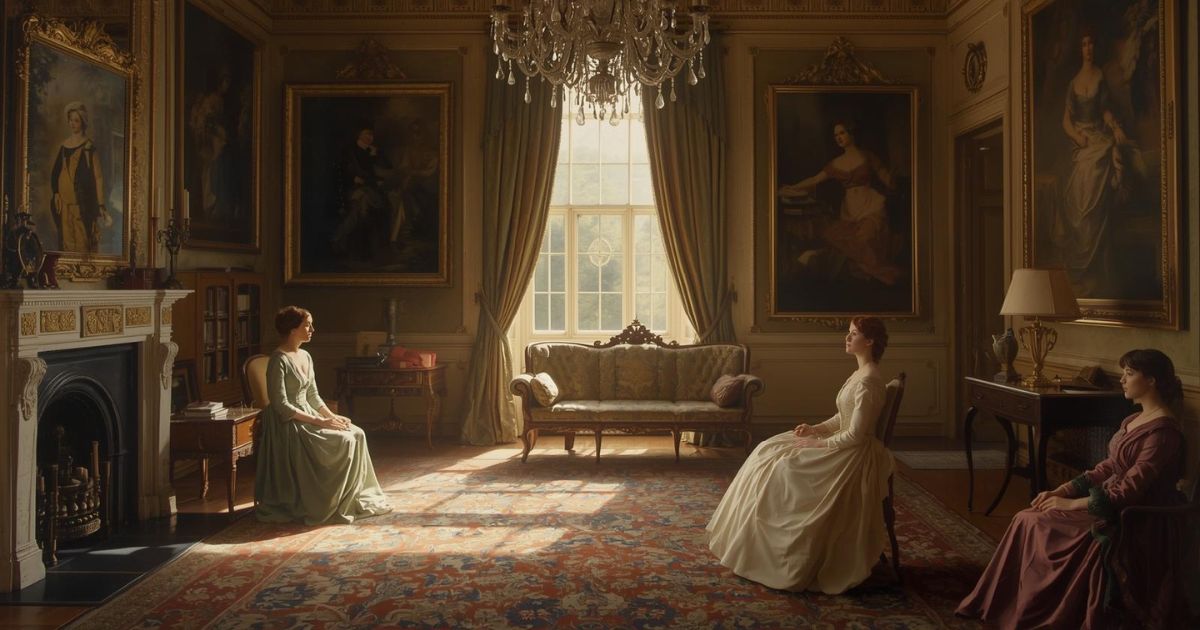
An excerpt from the original text.(complete · 1939 words)
“hat a pity it is, Elinor,” said Marianne, “that Edward should have no
taste for drawing.”
“No taste for drawing!” replied Elinor, “why should you think so? He
does not draw himself, indeed, but he has great pleasure in seeing the
performances of other people, and I assure you he is by no means
deficient in natural taste, though he has not had opportunities of
improving it. Had he ever been in the way of learning, I think he would
have drawn very well. He distrusts his own judgment in such matters so
much, that he is always unwilling to give his opinion on any picture;
but he has an innate propriety and simplicity of taste, which in
general direct him perfectly right.”
Marianne was afraid of offending, and said no more on the subject; but
the kind of approbation which Elinor described as excited in him by the
drawings of other people, was very far from that rapturous delight,
which, in her opinion, could alone be called taste. Yet, though smiling
within herself at the mistake, she honoured her sister for that blind
partiality to Edward which produced it.
“I hope, Marianne,” continued Elinor, “you do not consider him as
deficient in general taste. Indeed, I think I may say that you cannot,
for your behaviour to him is perfectly cordial, and if that were your
opinion, I am sure you could never be civil to him.”
Marianne hardly knew what to say. She would not wound the feelings of
her sister on any account, and yet to say what she did not believe was
impossible. At length she replied:
“Do not be offended, Elinor, if my praise of him is not in every thing
equal to your sense of his merits. I have not had so many opportunities
of estimating the minuter propensities of his mind, his inclinations
and tastes, as you have; but I have the highest opinion in the world of
his goodness and sense. I think him every thing that is worthy and
amiable.”
“I am sure,” replied Elinor, with a smile, “that his dearest friends
could not be dissatisfied with such commendation as that. I do not
perceive how you could express yourself more warmly.”
Marianne was rejoiced to find her sister so easily pleased.
“Of his sense and his goodness,” continued Elinor, “no one can, I
think, be in doubt, who has seen him often enough to engage him in
unreserved conversation. The excellence of his understanding and his
principles can be concealed only by that shyness which too often keeps
him silent. You know enough of him to do justice to his solid worth.
But of his minuter propensities, as you call them you have from
peculiar circumstances been kept more ignorant than myself. He and I
have been at times thrown a good deal together, while you have been
wholly engrossed on the most affectionate principle by my mother. I
have seen a great deal of him, have studied his sentiments and heard
his opinion on subjects of literature and taste; and, upon the whole, I
venture to pronounce that his mind is well-informed, enjoyment of books
exceedingly great, his imagination lively, his observation just and
correct, and his taste delicate and pure. His abilities in every
respect improve as much upon acquaintance as his manners and person. At
first sight, his address is certainly not striking; and his person can
hardly be called handsome, till the expression of his eyes, which are
uncommonly good, and the general sweetness of his countenance, is
perceived. At present, I know him so well, that I think him really
handsome; or at least, almost so. What say you, Marianne?”
“I shall very soon think him handsome, Elinor, if I do not now. When
you tell me to love him as a brother, I shall no more see imperfection
in his face, than I now do in his heart.”
Elinor started at this declaration, and was sorry for the warmth she
had been betrayed into, in speaking of him. She felt that Edward stood
very high in her opinion. She believed the regard to be mutual; but she
required greater certainty of it to make Marianne’s conviction of their
attachment agreeable to her. She knew that what Marianne and her mother
conjectured one moment, they believed the next—that with them, to wish
was to hope, and to hope was to expect. She tried to explain the real
state of the case to her sister.
“I do not attempt to deny,” said she, “that I think very highly of
him—that I greatly esteem, that I like him.”
Marianne here burst forth with indignation—
“Esteem him! Like him! Cold-hearted Elinor! Oh! worse than
cold-hearted! Ashamed of being otherwise. Use those words again, and I
will leave the room this moment.”
Elinor could not help laughing. “Excuse me,” said she; “and be assured
that I meant no offence to you, by speaking, in so quiet a way, of my
own feelings. Believe them to be stronger than I have declared; believe
them, in short, to be such as his merit, and the suspicion—the hope of
his affection for me may warrant, without imprudence or folly. But
farther than this you must not believe. I am by no means assured of
his regard for me. There are moments when the extent of it seems
doubtful; and till his sentiments are fully known, you cannot wonder at
my wishing to avoid any encouragement of my own partiality, by
believing or calling it more than it is. In my heart I feel
little—scarcely any doubt of his preference. But there are other points
to be considered besides his inclination. He is very far from being
independent. What his mother really is we cannot know; but, from
Fanny’s occasional mention of her conduct and opinions, we have never
been disposed to think her amiable; and I am very much mistaken if
Edward is not himself aware that there would be many difficulties in
his way, if he were to wish to marry a woman who had not either a great
fortune or high rank.”
Marianne was astonished to find how much the imagination of her mother
and herself had outstripped the truth.
“And you really are not engaged to him!” said she. “Yet it certainly
soon will happen. But two advantages will proceed from this delay. I
shall not lose you so soon, and Edward will have greater opportunity of
improving that natural taste for your favourite pursuit which must be
so indispensably necessary to your future felicity. Oh! if he should be
so far stimulated by your genius as to learn to draw himself, how
delightful it would be!”
Elinor had given her real opinion to her sister. She could not consider
her partiality for Edward in so prosperous a state as Marianne had
believed it. There was, at times, a want of spirits about him which, if
it did not denote indifference, spoke of something almost as
unpromising. A doubt of her regard, supposing him to feel it, need not
give him more than inquietude. It would not be likely to produce that
dejection of mind which frequently attended him. A more reasonable
cause might be found in the dependent situation which forbade the
indulgence of his affection. She knew that his mother neither behaved
to him so as to make his home comfortable at present, nor to give him
any assurance that he might form a home for himself, without strictly
attending to her views for his aggrandizement. With such a knowledge as
this, it was impossible for Elinor to feel easy on the subject. She was
far from depending on that result of his preference of her, which her
mother and sister still considered as certain. Nay, the longer they
were together the more doubtful seemed the nature of his regard; and
sometimes, for a few painful minutes, she believed it to be no more
than friendship.
But, whatever might really be its limits, it was enough, when perceived
by his sister, to make her uneasy, and at the same time, (which was
still more common,) to make her uncivil. She took the first opportunity
of affronting her mother-in-law on the occasion, talking to her so
expressively of her brother’s great expectations, of Mrs. Ferrars’s
resolution that both her sons should marry well, and of the danger
attending any young woman who attempted to draw him in; that Mrs.
Dashwood could neither pretend to be unconscious, nor endeavor to be
calm. She gave her an answer which marked her contempt, and instantly
left the room, resolving that, whatever might be the inconvenience or
expense of so sudden a removal, her beloved Elinor should not be
exposed another week to such insinuations.
In this state of her spirits, a letter was delivered to her from the
post, which contained a proposal particularly well timed. It was the
offer of a small house, on very easy terms, belonging to a relation of
her own, a gentleman of consequence and property in Devonshire. The
letter was from this gentleman himself, and written in the true spirit
of friendly accommodation. He understood that she was in need of a
dwelling; and though the house he now offered her was merely a cottage,
he assured her that everything should be done to it which she might
think necessary, if the situation pleased her. He earnestly pressed
her, after giving the particulars of the house and garden, to come with
her daughters to Barton Park, the place of his own residence, from
whence she might judge, herself, whether Barton Cottage, for the houses
were in the same parish, could, by any alteration, be made comfortable
to her. He seemed really anxious to accommodate them and the whole of
his letter was written in so friendly a style as could not fail of
giving pleasure to his cousin; more especially at a moment when she was
suffering under the cold and unfeeling behaviour of her nearer
connections. She needed no time for deliberation or inquiry. Her
resolution was formed as she read. The situation of Barton, in a county
so far distant from Sussex as Devonshire, which, but a few hours
before, would have been a sufficient objection to outweigh every
possible advantage belonging to the place, was now its first
recommendation. To quit the neighbourhood of Norland was no longer an
evil; it was an object of desire; it was a blessing, in comparison of
the misery of continuing her daughter-in-law’s guest; and to remove for
ever from that beloved place would be less painful than to inhabit or
visit it while such a woman was its mistress. She instantly wrote Sir
John Middleton her acknowledgment of his kindness, and her acceptance
of his proposal; and then hastened to show both letters to her
daughters, that she might be secure of their approbation before her
answer were sent.
Elinor had always thought it would be more prudent for them to settle
at some distance from Norland, than immediately amongst their present
acquaintance. On that head, therefore, it was not for her to oppose
her mother’s intention of removing into Devonshire. The house, too, as
described by Sir John, was on so simple a scale, and the rent so
uncommonly moderate, as to leave her no right of objection on either
point; and, therefore, though it was not a plan which brought any charm
to her fancy, though it was a removal from the vicinity of Norland
beyond her wishes, she made no attempt to dissuade her mother from
sending a letter of acquiescence.
Master this chapter. Complete your experience
Purchase the complete book to access all chapters and support classic literature
As an Amazon Associate, we earn a small commission from qualifying purchases at no additional cost to you.
Available in paperback, hardcover, and e-book formats
Let's Analyse the Pattern
External obligations and expectations create emotional distance even in genuine relationships, making authentic connection nearly impossible.
Why This Matters
Connect literature to life
This chapter teaches how to distinguish between someone who's not interested and someone who's interested but constrained by external pressures.
Practice This Today
This week, notice when someone seems distant—ask yourself if they're dealing with work stress, family pressure, or financial worry before assuming it's about you.
Now let's explore the literary elements.
Key Quotes & Analysis
"I think him everything that is worthy and amiable."
Context: Elinor describes her feelings about Edward to her mother
This restrained praise reveals Elinor's deep but carefully controlled feelings for Edward. She uses formal, measured language even when discussing someone she loves, showing her characteristic emotional reserve and proper behavior.
In Today's Words:
He's a really good guy and I care about him a lot.
"I have no knowledge in the picturesque, and I shall offend you by my ignorance and want of taste if we come to particulars."
Context: Edward discusses his appreciation of natural scenery with the Dashwood women
Edward's humble admission shows his refreshing honesty and lack of pretension. Unlike fashionable society figures who use elaborate language about art and nature, Edward admits his limitations while still genuinely appreciating beauty.
In Today's Words:
I'm not good with fancy art talk, but I know what I like when I see it.
"My mother will be sorry. She could never see any defect in Edward. To her, he was only the object of her solicitude and care."
Context: Describing Mrs. Dashwood's protective feelings toward Edward
This reveals how Mrs. Dashwood has essentially adopted Edward as a son figure, seeing past his troubles to his essential goodness. Her maternal instincts extend beyond her own daughters to include this worthy young man who clearly needs support.
In Today's Words:
She basically thinks of him as another son and worries about him like he's family.
Thematic Threads
Class Pressure
In This Chapter
Edward's anxiety about his career and mother's expectations creates distance from Elinor despite genuine feelings
Development
Deepens from earlier hints about social position affecting romantic choices
In Your Life:
When job insecurity or family expectations make you hold back from relationships that could bring happiness
Authentic Connection
In This Chapter
Edward and Elinor's relationship builds through shared values and genuine compatibility rather than dramatic gestures
Development
Contrasts with Marianne and Willoughby's passionate but surface-level attraction
In Your Life:
Recognizing that real compatibility often feels quieter and steadier than movie-style romance
Hidden Obstacles
In This Chapter
Edward's restrained behavior suggests barriers he cannot or will not discuss openly
Development
Introduced here as mysterious constraint on genuine feeling
In Your Life:
When someone you care about becomes distant for reasons they won't explain
Practical vs. Romantic
In This Chapter
Edward represents the tension between following your heart and meeting practical obligations
Development
Builds on earlier themes about love existing within social and economic realities
In Your Life:
Choosing between a relationship that feels right and one that makes financial or social sense
Emotional Reserve
In This Chapter
Edward's natural reserve or forced restraint creates uncertainty about his true feelings
Development
Contrasts with Willoughby's open expressiveness, showing different styles of emotional communication
In Your Life:
Learning to read genuine care in people who don't express feelings dramatically or obviously
You now have the context. Time to form your own thoughts.
Discussion Questions
- 1
What specific behaviors show that Edward is struggling with something beyond his relationship with Elinor?
analysis • surface - 2
Why does Edward's distraction create distance even though his feelings for Elinor seem genuine?
analysis • medium - 3
Where have you seen someone become emotionally unavailable because they're stressed about meeting other people's expectations?
application • medium - 4
If you were Elinor's friend, how would you advise her to handle Edward's mixed signals?
application • deep - 5
What does Edward's situation reveal about how external pressures can sabotage our most important relationships?
reflection • deep
Critical Thinking Exercise
Map Your Pressure Points
Think about a relationship in your life where external pressures are creating distance or tension. Draw a simple map showing the person in the center, then draw arrows pointing at them representing different pressures (family expectations, work stress, money worries, etc.). For each pressure, write one sentence about how it affects their ability to connect with you or others.
Consider:
- •Some pressures are real constraints, others are imagined obligations
- •Pressure often makes people withdraw rather than communicate their struggles
- •Understanding someone's pressure points helps you respond with compassion rather than taking distance personally
Journaling Prompt
Write about a time when you had to choose between meeting someone else's expectations and following your own heart. What did you learn about managing external pressure while staying true to your relationships?
Coming Up Next...
Chapter 5: Sir John's Welcome
Edward's visit takes an unexpected turn when a curious discovery about his jewelry raises questions about his past. Meanwhile, the mystery surrounding his obvious distress begins to unravel in ways that will test Elinor's composure.