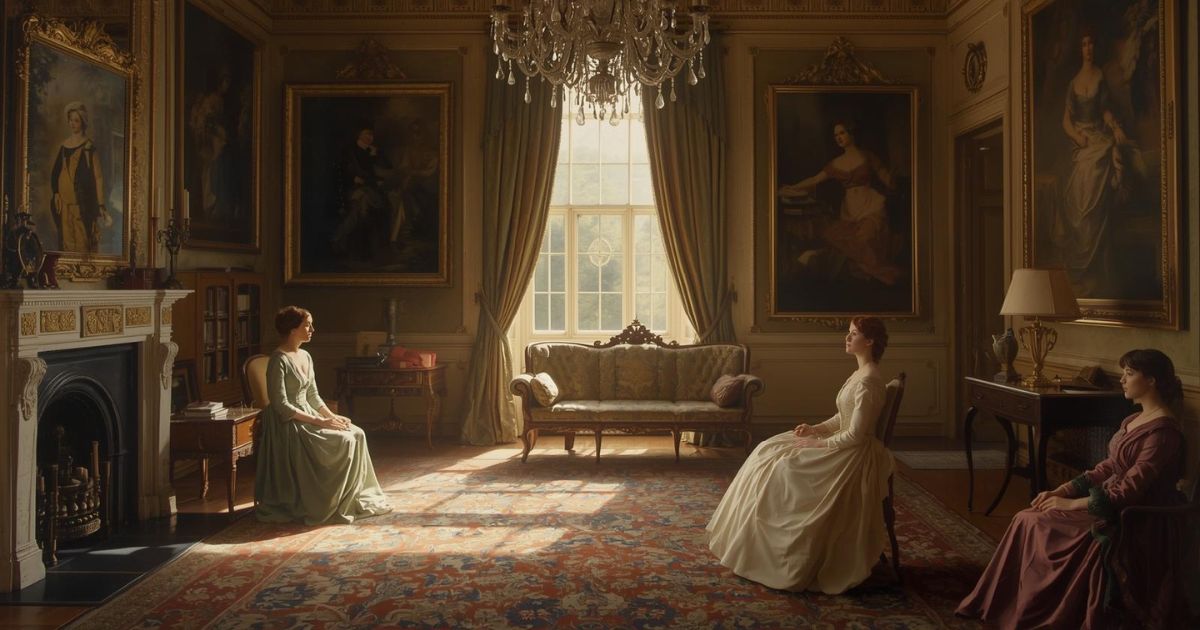
An excerpt from the original text.(complete · 3797 words)
efore the housemaid had lit their fire the next day, or the sun gained
any power over a cold, gloomy morning in January, Marianne, only half
dressed, was kneeling against one of the window-seats for the sake of
all the little light she could command from it, and writing as fast as
a continual flow of tears would permit her. In this situation, Elinor,
roused from sleep by her agitation and sobs, first perceived her; and
after observing her for a few moments with silent anxiety, said, in a
tone of the most considerate gentleness,
“Marianne, may I ask—?”
“No, Elinor,” she replied, “ask nothing; you will soon know all.”
The sort of desperate calmness with which this was said, lasted no
longer than while she spoke, and was immediately followed by a return
of the same excessive affliction. It was some minutes before she could
go on with her letter, and the frequent bursts of grief which still
obliged her, at intervals, to withhold her pen, were proofs enough of
her feeling how more than probable it was that she was writing for the
last time to Willoughby.
Elinor paid her every quiet and unobtrusive attention in her power; and
she would have tried to sooth and tranquilize her still more, had not
Marianne entreated her, with all the eagerness of the most nervous
irritability, not to speak to her for the world. In such circumstances,
it was better for both that they should not be long together; and the
restless state of Marianne’s mind not only prevented her from remaining
in the room a moment after she was dressed, but requiring at once
solitude and continual change of place, made her wander about the house
till breakfast time, avoiding the sight of every body.
At breakfast she neither ate, nor attempted to eat any thing; and
Elinor’s attention was then all employed, not in urging her, not in
pitying her, nor in appearing to regard her, but in endeavouring to
engage Mrs. Jennings’s notice entirely to herself.
As this was a favourite meal with Mrs. Jennings, it lasted a
considerable time, and they were just setting themselves, after it,
round the common working table, when a letter was delivered to
Marianne, which she eagerly caught from the servant, and, turning of a
death-like paleness, instantly ran out of the room. Elinor, who saw as
plainly by this, as if she had seen the direction, that it must come
from Willoughby, felt immediately such a sickness at heart as made her
hardly able to hold up her head, and sat in such a general tremour as
made her fear it impossible to escape Mrs. Jennings’s notice. That good
lady, however, saw only that Marianne had received a letter from
Willoughby, which appeared to her a very good joke, and which she
treated accordingly, by hoping, with a laugh, that she would find it to
her liking. Of Elinor’s distress, she was too busily employed in
measuring lengths of worsted for her rug, to see any thing at all; and
calmly continuing her talk, as soon as Marianne disappeared, she said,
“Upon my word, I never saw a young woman so desperately in love in my
life! My girls were nothing to her, and yet they used to be foolish
enough; but as for Miss Marianne, she is quite an altered creature. I
hope, from the bottom of my heart, he won’t keep her waiting much
longer, for it is quite grievous to see her look so ill and forlorn.
Pray, when are they to be married?”
Elinor, though never less disposed to speak than at that moment,
obliged herself to answer such an attack as this, and, therefore,
trying to smile, replied, “And have you really, Ma’am, talked yourself
into a persuasion of my sister’s being engaged to Mr. Willoughby? I
thought it had been only a joke, but so serious a question seems to
imply more; and I must beg, therefore, that you will not deceive
yourself any longer. I do assure you that nothing would surprise me
more than to hear of their being going to be married.”
“For shame, for shame, Miss Dashwood! how can you talk so? Don’t we all
know that it must be a match, that they were over head and ears in love
with each other from the first moment they met? Did not I see them
together in Devonshire every day, and all day long; and did not I know
that your sister came to town with me on purpose to buy wedding
clothes? Come, come, this won’t do. Because you are so sly about it
yourself, you think nobody else has any senses; but it is no such
thing, I can tell you, for it has been known all over town this ever so
long. I tell every body of it and so does Charlotte.”
“Indeed, Ma’am,” said Elinor, very seriously, “you are mistaken.
Indeed, you are doing a very unkind thing in spreading the report, and
you will find that you have though you will not believe me now.”
Mrs. Jennings laughed again, but Elinor had not spirits to say more,
and eager at all events to know what Willoughby had written, hurried
away to their room, where, on opening the door, she saw Marianne
stretched on the bed, almost choked by grief, one letter in her hand,
and two or three others lying by her. Elinor drew near, but without
saying a word; and seating herself on the bed, took her hand, kissed
her affectionately several times, and then gave way to a burst of
tears, which at first was scarcely less violent than Marianne’s. The
latter, though unable to speak, seemed to feel all the tenderness of
this behaviour, and after some time thus spent in joint affliction, she
put all the letters into Elinor’s hands; and then covering her face
with her handkerchief, almost screamed with agony. Elinor, who knew
that such grief, shocking as it was to witness it, must have its
course, watched by her till this excess of suffering had somewhat spent
itself, and then turning eagerly to Willoughby’s letter, read as
follows:
“Bond Street, January.
MY DEAR MADAM,
“I have just had the honour of receiving your letter, for which I
beg to return my sincere acknowledgments. I am much concerned to
find there was anything in my behaviour last night that did not
meet your approbation; and though I am quite at a loss to discover
in what point I could be so unfortunate as to offend you, I entreat
your forgiveness of what I can assure you to have been perfectly
unintentional. I shall never reflect on my former acquaintance with
your family in Devonshire without the most grateful pleasure, and
flatter myself it will not be broken by any mistake or
misapprehension of my actions. My esteem for your whole family is
very sincere; but if I have been so unfortunate as to give rise to
a belief of more than I felt, or meant to express, I shall reproach
myself for not having been more guarded in my professions of that
esteem. That I should ever have meant more you will allow to be
impossible, when you understand that my affections have been long
engaged elsewhere, and it will not be many weeks, I believe, before
this engagement is fulfilled. It is with great regret that I obey
your commands in returning the letters with which I have been
honoured from you, and the lock of hair, which you so obligingly
bestowed on me.
“I am, dear Madam,
“Your most obedient
“humble servant,
“JOHN WILLOUGHBY.”
With what indignation such a letter as this must be read by Miss
Dashwood, may be imagined. Though aware, before she began it, that it
must bring a confession of his inconstancy, and confirm their
separation for ever, she was not aware that such language could be
suffered to announce it; nor could she have supposed Willoughby capable
of departing so far from the appearance of every honourable and
delicate feeling—so far from the common decorum of a gentleman, as to
send a letter so impudently cruel: a letter which, instead of bringing
with his desire of a release any professions of regret, acknowledged no
breach of faith, denied all peculiar affection whatever—a letter of
which every line was an insult, and which proclaimed its writer to be
deep in hardened villainy.
She paused over it for some time with indignant astonishment; then read
it again and again; but every perusal only served to increase her
abhorrence of the man, and so bitter were her feelings against him,
that she dared not trust herself to speak, lest she might wound
Marianne still deeper by treating their disengagement, not as a loss to
her of any possible good but as an escape from the worst and most
irremediable of all evils, a connection, for life, with an unprincipled
man, as a deliverance the most real, a blessing the most important.
In her earnest meditations on the contents of the letter, on the
depravity of that mind which could dictate it, and probably, on the
very different mind of a very different person, who had no other
connection whatever with the affair than what her heart gave him with
every thing that passed, Elinor forgot the immediate distress of her
sister, forgot that she had three letters on her lap yet unread, and so
entirely forgot how long she had been in the room, that when on hearing
a carriage drive up to the door, she went to the window to see who
could be coming so unreasonably early, she was all astonishment to
perceive Mrs. Jennings’s chariot, which she knew had not been ordered
till one. Determined not to quit Marianne, though hopeless of
contributing, at present, to her ease, she hurried away to excuse
herself from attending Mrs. Jennings, on account of her sister being
indisposed. Mrs. Jennings, with a thoroughly good-humoured concern for
its cause, admitted the excuse most readily, and Elinor, after seeing
her safe off, returned to Marianne, whom she found attempting to rise
from the bed, and whom she reached just in time to prevent her from
falling on the floor, faint and giddy from a long want of proper rest
and food; for it was many days since she had any appetite, and many
nights since she had really slept; and now, when her mind was no longer
supported by the fever of suspense, the consequence of all this was
felt in an aching head, a weakened stomach, and a general nervous
faintness. A glass of wine, which Elinor procured for her directly,
made her more comfortable, and she was at last able to express some
sense of her kindness, by saying,
“Poor Elinor! how unhappy I make you!”
“I only wish,” replied her sister, “there were any thing I could do,
which might be of comfort to you.”
This, as every thing else would have been, was too much for Marianne,
who could only exclaim, in the anguish of her heart, “Oh! Elinor, I am
miserable, indeed,” before her voice was entirely lost in sobs.
Elinor could no longer witness this torrent of unresisted grief in
silence.
“Exert yourself, dear Marianne,” she cried, “if you would not kill
yourself and all who love you. Think of your mother; think of her
misery while you suffer: for her sake you must exert yourself.”
“I cannot, I cannot,” cried Marianne; “leave me, leave me, if I
distress you; leave me, hate me, forget me! but do not torture me so.
Oh! how easy for those, who have no sorrow of their own to talk of
exertion! Happy, happy Elinor, you cannot have an idea of what I
suffer.”
“Do you call me happy, Marianne? Ah! if you knew!—And can you believe
me to be so, while I see you so wretched!”
“Forgive me, forgive me,” throwing her arms round her sister’s neck; “I
know you feel for me; I know what a heart you have; but yet you are—you
must be happy; Edward loves you—what, oh what, can do away such
happiness as that?”
“Many, many circumstances,” said Elinor, solemnly.
“No, no, no,” cried Marianne wildly, “he loves you, and only you. You
can have no grief.”
“I can have no pleasure while I see you in this state.”
“And you will never see me otherwise. Mine is a misery which nothing
can do away.”
“You must not talk so, Marianne. Have you no comforts? no friends? Is
your loss such as leaves no opening for consolation? Much as you suffer
now, think of what you would have suffered if the discovery of his
character had been delayed to a later period—if your engagement had
been carried on for months and months, as it might have been, before he
chose to put an end to it. Every additional day of unhappy confidence,
on your side, would have made the blow more dreadful.”
“Engagement!” cried Marianne, “there has been no engagement.”
“No engagement!”
“No, he is not so unworthy as you believe him. He has broken no faith
with me.”
“But he told you that he loved you.”
“Yes—no—never absolutely. It was every day implied, but never
professedly declared. Sometimes I thought it had been, but it never
was.”
“Yet you wrote to him?”
“Yes: could that be wrong after all that had passed? But I cannot
talk.”
Elinor said no more, and turning again to the three letters which now
raised a much stronger curiosity than before, directly ran over the
contents of all. The first, which was what her sister had sent him on
their arrival in town, was to this effect.
Berkeley Street, January.
“How surprised you will be, Willoughby, on receiving this; and I think
you will feel something more than surprise, when you know that I am in
town. An opportunity of coming hither, though with Mrs. Jennings, was a
temptation we could not resist. I wish you may receive this in time to
come here to-night, but I will not depend on it. At any rate I shall
expect you to-morrow. For the present, adieu.
“M.D.”
Her second note, which had been written on the morning after the dance
at the Middletons’, was in these words:—
“I cannot express my disappointment in having missed you the day before
yesterday, nor my astonishment at not having received any answer to a
note which I sent you above a week ago. I have been expecting to hear
from you, and still more to see you, every hour of the day. Pray call
again as soon as possible, and explain the reason of my having expected
this in vain. You had better come earlier another time, because we are
generally out by one. We were last night at Lady Middleton’s, where
there was a dance. I have been told that you were asked to be of the
party. But could it be so? You must be very much altered indeed since
we parted, if that could be the case, and you not there. But I will not
suppose this possible, and I hope very soon to receive your personal
assurance of its being otherwise.
“M.D.”
The contents of her last note to him were these:—
“What am I to imagine, Willoughby, by your behaviour last night? Again
I demand an explanation of it. I was prepared to meet you with the
pleasure which our separation naturally produced, with the familiarity
which our intimacy at Barton appeared to me to justify. I was repulsed
indeed! I have passed a wretched night in endeavouring to excuse a
conduct which can scarcely be called less than insulting; but though I
have not yet been able to form any reasonable apology for your
behaviour, I am perfectly ready to hear your justification of it. You
have perhaps been misinformed, or purposely deceived, in something
concerning me, which may have lowered me in your opinion. Tell me what
it is, explain the grounds on which you acted, and I shall be
satisfied, in being able to satisfy you. It would grieve me indeed to
be obliged to think ill of you; but if I am to do it, if I am to learn
that you are not what we have hitherto believed you, that your regard
for us all was insincere, that your behaviour to me was intended only
to deceive, let it be told as soon as possible. My feelings are at
present in a state of dreadful indecision; I wish to acquit you, but
certainty on either side will be ease to what I now suffer. If your
sentiments are no longer what they were, you will return my notes, and
the lock of my hair which is in your possession.
“M.D.”
That such letters, so full of affection and confidence, could have been
so answered, Elinor, for Willoughby’s sake, would have been unwilling
to believe. But her condemnation of him did not blind her to the
impropriety of their having been written at all; and she was silently
grieving over the imprudence which had hazarded such unsolicited proofs
of tenderness, not warranted by anything preceding, and most severely
condemned by the event, when Marianne, perceiving that she had finished
the letters, observed to her that they contained nothing but what any
one would have written in the same situation.
“I felt myself,” she added, “to be as solemnly engaged to him, as if
the strictest legal covenant had bound us to each other.”
“I can believe it,” said Elinor; “but unfortunately he did not feel the
same.”
“He did feel the same, Elinor—for weeks and weeks he felt it. I know
he did. Whatever may have changed him now, (and nothing but the
blackest art employed against me can have done it), I was once as dear
to him as my own soul could wish. This lock of hair, which now he can
so readily give up, was begged of me with the most earnest
supplication. Had you seen his look, his manner, had you heard his
voice at that moment! Have you forgot the last evening of our being
together at Barton? The morning that we parted too! When he told me
that it might be many weeks before we met again—his distress—can I ever
forget his distress?”
For a moment or two she could say no more; but when this emotion had
passed away, she added, in a firmer tone,
“Elinor, I have been cruelly used; but not by Willoughby.”
“Dearest Marianne, who but himself? By whom can he have been
instigated?”
“By all the world, rather than by his own heart. I could rather believe
every creature of my acquaintance leagued together to ruin me in his
opinion, than believe his nature capable of such cruelty. This woman of
whom he writes—whoever she be—or any one, in short, but your own dear
self, mama, and Edward, may have been so barbarous to bely me. Beyond
you three, is there a creature in the world whom I would not rather
suspect of evil than Willoughby, whose heart I know so well?”
Elinor would not contend, and only replied, “Whoever may have been so
detestably your enemy, let them be cheated of their malignant triumph,
my dear sister, by seeing how nobly the consciousness of your own
innocence and good intentions supports your spirits. It is a reasonable
and laudable pride which resists such malevolence.”
“No, no,” cried Marianne, “misery such as mine has no pride. I care not
who knows that I am wretched. The triumph of seeing me so may be open
to all the world. Elinor, Elinor, they who suffer little may be proud
and independent as they like—may resist insult, or return
mortification—but I cannot. I must feel—I must be wretched—and they are
welcome to enjoy the consciousness of it that can.”
“But for my mother’s sake and mine—”
“I would do more than for my own. But to appear happy when I am so
miserable—Oh! who can require it?”
Again they were both silent. Elinor was employed in walking
thoughtfully from the fire to the window, from the window to the fire,
without knowing that she received warmth from one, or discerning
objects through the other; and Marianne, seated at the foot of the bed,
with her head leaning against one of its posts, again took up
Willoughby’s letter, and, after shuddering over every sentence,
exclaimed,—
“It is too much! Oh, Willoughby, Willoughby, could this be yours!
Cruel, cruel—nothing can acquit you. Elinor, nothing can. Whatever he
might have heard against me—ought he not to have suspended his belief?
ought he not to have told me of it, to have given me the power of
clearing myself? ‘The lock of hair, (repeating it from the letter,)
which you so obligingly bestowed on me’—That is unpardonable.
Willoughby, where was your heart when you wrote those words? Oh,
barbarously insolent!—Elinor, can he be justified?”
“No, Marianne, in no possible way.”
“And yet this woman—who knows what her art may have been?—how long it
may have been premeditated, and how deeply contrived by her!—Who is
she?—Who can she be?—Whom did I ever hear him talk of as young and
attractive among his female acquaintance?—Oh! no one, no one—he talked
to me only of myself.”
Another pause ensued; Marianne was greatly agitated, and it ended thus.
“Elinor, I must go home. I must go and comfort mama. Can not we be gone
to-morrow?”
“To-morrow, Marianne!”
“Yes, why should I stay here? I came only for Willoughby’s sake—and now
who cares for me? Who regards me?”
“It would be impossible to go to-morrow. We owe Mrs. Jennings much more
than civility; and civility of the commonest kind must prevent such a
hasty removal as that.”
“Well then, another day or two, perhaps; but I cannot stay here long, I
cannot stay to endure the questions and remarks of all these people.
The Middletons and Palmers—how am I to bear their pity? The pity of
such a woman as Lady Middleton! Oh, what would he say to that!”
Elinor advised her to lie down again, and for a moment she did so; but
no attitude could give her ease; and in restless pain of mind and body
she moved from one posture to another, till growing more and more
hysterical, her sister could with difficulty keep her on the bed at
all, and for some time was fearful of being constrained to call for
assistance. Some lavender drops, however, which she was at length
persuaded to take, were of use; and from that time till Mrs. Jennings
returned, she continued on the bed quiet and motionless.
Master this chapter. Complete your experience
Purchase the complete book to access all chapters and support classic literature
As an Amazon Associate, we earn a small commission from qualifying purchases at no additional cost to you.
Available in paperback, hardcover, and e-book formats
Let's Analyse the Pattern
When someone's secret obligations from their past prevent them from being fully present or honest in current relationships, creating confusion and false hope for others.
Why This Matters
Connect literature to life
This chapter teaches how to recognize when someone's behavior suggests hidden constraints that they cannot or will not explain.
Practice This Today
Next time someone gives you mixed signals - showing interest but pulling away - ask yourself what obligations they might be carrying that they haven't mentioned.
Now let's explore the literary elements.
Key Quotes & Analysis
"Four years they have been engaged, and she never suspected it."
Context: When Mrs. Jennings reveals the shocking duration of Edward and Lucy's secret engagement
This quote emphasizes how completely Elinor was deceived and how long Edward maintained this deception. The length of time makes the betrayal feel deeper and more calculated.
In Today's Words:
He's been lying to her for four whole years and she had no clue.
"She was stronger alone."
Context: Describing how Elinor processes her emotions privately rather than seeking comfort from others
Shows Elinor's pattern of emotional self-reliance and her belief that sharing pain would burden others. It reveals both her strength and her tendency toward isolation.
In Today's Words:
She handled things better when she didn't have to put on a brave face for other people.
"The youthful infatuation of nineteen would naturally blind him to everything but her beauty."
Context: Explaining how Edward became engaged to Lucy when he was young and inexperienced
This provides context for Edward's poor decision-making, suggesting he was too young to understand the consequences of his commitment to Lucy.
In Today's Words:
He was nineteen and thinking with his hormones instead of his brain.
Thematic Threads
Deception
In This Chapter
Edward has maintained a four-year deception, letting Elinor develop feelings while bound to another woman
Development
Escalated from earlier hints about Edward's mysterious behavior to full revelation of systematic dishonesty
In Your Life:
You might be unknowingly involved with someone who's hiding major commitments that affect your relationship.
Social Expectations
In This Chapter
Edward feels trapped by his engagement because breaking it would destroy Lucy socially and his own reputation
Development
Deepened from earlier exploration of marriage as social contract to showing how these expectations can become prisons
In Your Life:
You might stay in situations that no longer serve you because of what others expect or what breaking free might cost socially.
Emotional Isolation
In This Chapter
Elinor processes this devastating news alone, maintaining composure while privately heartbroken
Development
Continued theme of Elinor bearing emotional burdens silently while others express feelings freely
In Your Life:
You might be the person everyone relies on to stay strong, leaving you with no one to turn to when you're struggling.
Class Manipulation
In This Chapter
Lucy is pleased her secret engagement is now known among 'the right people,' using it for social advancement
Development
Extended from earlier themes about social climbing to show how personal relationships become tools for status
In Your Life:
You might encounter people who view relationships primarily as opportunities for advancement rather than genuine connection.
Information Power
In This Chapter
The revelation comes through Mrs. Jennings' gossip network, showing how information travels and transforms understanding
Development
Built on earlier patterns of how gossip and partial information shape social dynamics
In Your Life:
You might discover that crucial information about your life situation is circulating among others before you have it yourself.
You now have the context. Time to form your own thoughts.
Discussion Questions
- 1
What secret does Elinor discover about Edward, and how long has this situation been going on?
analysis • surface - 2
Why couldn't Edward tell Elinor the truth about his engagement to Lucy? What was he risking by keeping it secret?
analysis • medium - 3
Where have you seen the 'Hidden Commitment Trap' in modern life - someone who seems available but has secret obligations holding them back?
application • medium - 4
If you were Elinor's friend, what advice would you give her about how to handle this revelation and protect herself going forward?
application • deep - 5
What does Edward's situation teach us about how past decisions can trap us, and how those traps affect everyone around us?
reflection • deep
Critical Thinking Exercise
Map Your Hidden Commitment Radar
Think of three people in your life whose behavior sometimes confuses you - they seem interested but pull away, make promises but don't follow through, or act distant without explanation. For each person, write down what hidden commitments might be influencing their behavior. Consider family obligations, work constraints, past relationships, financial pressures, or social expectations they haven't shared with you.
Consider:
- •Focus on understanding their constraints, not judging their choices
- •Consider what questions you could ask to get clearer information
- •Think about how recognizing these patterns changes your expectations
Journaling Prompt
Write about a time when you had hidden commitments that prevented you from being fully honest with someone. How did it feel to be in that position, and what did you learn about handling such situations?
Coming Up Next...
Chapter 30: Miss Grey
The news of Edward's engagement spreads through their social circle like wildfire, and Elinor must face the sympathetic looks and awkward conversations that follow. Meanwhile, someone unexpected arrives with information that could change everything.