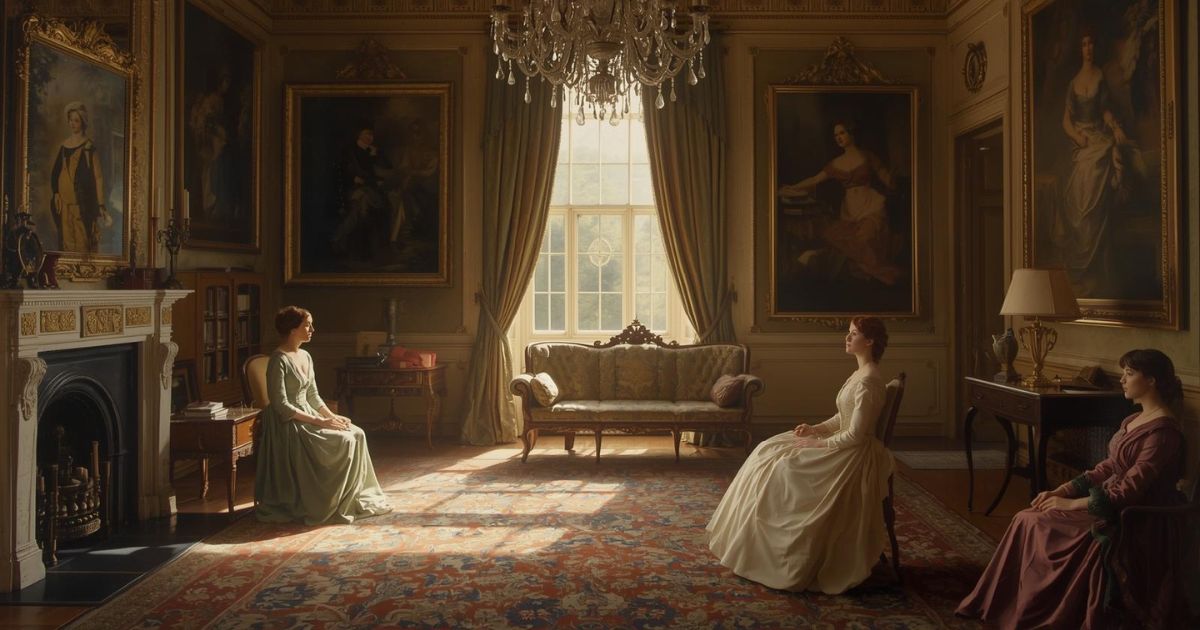
An excerpt from the original text.(complete · 3053 words)
rs. Jennings came immediately to their room on her return, and without
waiting to have her request of admittance answered, opened the door and
walked in with a look of real concern.
“How do you do my dear?”—said she in a voice of great compassion to
Marianne, who turned away her face without attempting to answer.
“How is she, Miss Dashwood? Poor thing! she looks very bad. No wonder.
Ay, it is but too true. He is to be married very soon—a
good-for-nothing fellow! I have no patience with him. Mrs. Taylor told
me of it half an hour ago, and she was told it by a particular friend
of Miss Grey herself, else I am sure I should not have believed it; and
I was almost ready to sink as it was. Well, said I, all I can say is,
that if this be true, he has used a young lady of my acquaintance
abominably ill, and I wish with all my soul his wife may plague his
heart out. And so I shall always say, my dear, you may depend on it. I
have no notion of men’s going on in this way; and if ever I meet him
again, I will give him such a dressing as he has not had this many a
day. But there is one comfort, my dear Miss Marianne; he is not the
only young man in the world worth having; and with your pretty face you
will never want admirers. Well, poor thing! I won’t disturb her any
longer, for she had better have her cry out at once and have done with.
The Parrys and Sandersons luckily are coming tonight you know, and that
will amuse her.”
She then went away, walking on tiptoe out of the room, as if she
supposed her young friend’s affliction could be increased by noise.
Marianne, to the surprise of her sister, determined on dining with
them. Elinor even advised her against it. But “no, she would go down;
she could bear it very well, and the bustle about her would be less.”
Elinor, pleased to have her governed for a moment by such a motive,
though believing it hardly possible that she could sit out the dinner,
said no more; and adjusting her dress for her as well as she could,
while Marianne still remained on the bed, was ready to assist her into
the dining room as soon as they were summoned to it.
When there, though looking most wretchedly, she ate more and was calmer
than her sister had expected. Had she tried to speak, or had she been
conscious of half Mrs. Jennings’s well-meant but ill-judged attentions
to her, this calmness could not have been maintained; but not a
syllable escaped her lips; and the abstraction of her thoughts
preserved her in ignorance of every thing that was passing before her.
Elinor, who did justice to Mrs. Jennings’s kindness, though its
effusions were often distressing, and sometimes almost ridiculous, made
her those acknowledgments, and returned her those civilities, which her
sister could not make or return for herself. Their good friend saw that
Marianne was unhappy, and felt that every thing was due to her which
might make her at all less so. She treated her therefore, with all the
indulgent fondness of a parent towards a favourite child on the last
day of its holidays. Marianne was to have the best place by the fire,
was to be tempted to eat by every delicacy in the house, and to be
amused by the relation of all the news of the day. Had not Elinor, in
the sad countenance of her sister, seen a check to all mirth, she could
have been entertained by Mrs. Jennings’s endeavours to cure a
disappointment in love, by a variety of sweetmeats and olives, and a
good fire. As soon, however, as the consciousness of all this was
forced by continual repetition on Marianne, she could stay no longer.
With a hasty exclamation of Misery, and a sign to her sister not to
follow her, she directly got up and hurried out of the room.
“Poor soul!” cried Mrs. Jennings, as soon as she was gone, “how it
grieves me to see her! And I declare if she is not gone away without
finishing her wine! And the dried cherries too! Lord! nothing seems to
do her any good. I am sure if I knew of any thing she would like, I
would send all over the town for it. Well, it is the oddest thing to
me, that a man should use such a pretty girl so ill! But when there is
plenty of money on one side, and next to none on the other, Lord bless
you! they care no more about such things!—”
“The lady then—Miss Grey I think you called her—is very rich?”
“Fifty thousand pounds, my dear. Did you ever see her? a smart, stylish
girl they say, but not handsome. I remember her aunt very well, Biddy
Henshawe; she married a very wealthy man. But the family are all rich
together. Fifty thousand pounds! and by all accounts, it won’t come
before it’s wanted; for they say he is all to pieces. No wonder!
dashing about with his curricle and hunters! Well, it don’t signify
talking; but when a young man, be who he will, comes and makes love to
a pretty girl, and promises marriage, he has no business to fly off
from his word only because he grows poor, and a richer girl is ready to
have him. Why don’t he, in such a case, sell his horses, let his house,
turn off his servants, and make a thorough reform at once? I warrant
you, Miss Marianne would have been ready to wait till matters came
round. But that won’t do now-a-days; nothing in the way of pleasure can
ever be given up by the young men of this age.”
“Do you know what kind of a girl Miss Grey is? Is she said to be
amiable?”
“I never heard any harm of her; indeed I hardly ever heard her
mentioned; except that Mrs. Taylor did say this morning, that one day
Miss Walker hinted to her, that she believed Mr. and Mrs. Ellison would
not be sorry to have Miss Grey married, for she and Mrs. Ellison could
never agree.”
“And who are the Ellisons?”
“Her guardians, my dear. But now she is of age and may choose for
herself; and a pretty choice she has made!—What now,” after pausing a
moment—“your poor sister is gone to her own room, I suppose, to moan by
herself. Is there nothing one can get to comfort her? Poor dear, it
seems quite cruel to let her be alone. Well, by-and-by we shall have a
few friends, and that will amuse her a little. What shall we play at?
She hates whist I know; but is there no round game she cares for?”
“Dear ma’am, this kindness is quite unnecessary. Marianne, I dare say,
will not leave her room again this evening. I shall persuade her if I
can to go early to bed, for I am sure she wants rest.”
“Aye, I believe that will be best for her. Let her name her own supper,
and go to bed. Lord! no wonder she has been looking so bad and so cast
down this last week or two, for this matter I suppose has been hanging
over her head as long as that. And so the letter that came today
finished it! Poor soul! I am sure if I had had a notion of it, I would
not have joked her about it for all my money. But then you know, how
should I guess such a thing? I made sure of its being nothing but a
common love letter, and you know young people like to be laughed at
about them. Lord! how concerned Sir John and my daughters will be when
they hear it! If I had my senses about me I might have called in
Conduit Street in my way home, and told them of it. But I shall see
them tomorrow.”
“It would be unnecessary I am sure, for you to caution Mrs. Palmer and
Sir John against ever naming Mr. Willoughby, or making the slightest
allusion to what has passed, before my sister. Their own good-nature
must point out to them the real cruelty of appearing to know any thing
about it when she is present; and the less that may ever be said to
myself on the subject, the more my feelings will be spared, as you my
dear madam will easily believe.”
“Oh! Lord! yes, that I do indeed. It must be terrible for you to hear
it talked of; and as for your sister, I am sure I would not mention a
word about it to her for the world. You saw I did not all dinner time.
No more would Sir John, nor my daughters, for they are all very
thoughtful and considerate; especially if I give them a hint, as I
certainly will. For my part, I think the less that is said about such
things, the better, the sooner ’tis blown over and forgot. And what
good does talking ever do you know?”
“In this affair it can only do harm; more so perhaps than in many cases
of a similar kind, for it has been attended by circumstances which, for
the sake of every one concerned in it, make it unfit to become the
public conversation. I must do this justice to Mr. Willoughby—he has
broken no positive engagement with my sister.”
“Law, my dear! Don’t pretend to defend him. No positive engagement
indeed! after taking her all over Allenham House, and fixing on the
very rooms they were to live in hereafter!”
Elinor, for her sister’s sake, could not press the subject farther, and
she hoped it was not required of her for Willoughby’s; since, though
Marianne might lose much, he could gain very little by the enforcement
of the real truth. After a short silence on both sides, Mrs. Jennings,
with all her natural hilarity, burst forth again.
“Well, my dear, ’tis a true saying about an ill-wind, for it will be
all the better for Colonel Brandon. He will have her at last; aye, that
he will. Mind me, now, if they an’t married by Mid-summer. Lord! how
he’ll chuckle over this news! I hope he will come tonight. It will be
all to one a better match for your sister. Two thousand a year without
debt or drawback—except the little love-child, indeed; aye, I had
forgot her; but she may be ’prenticed out at a small cost, and then
what does it signify? Delaford is a nice place, I can tell you; exactly
what I call a nice old fashioned place, full of comforts and
conveniences; quite shut in with great garden walls that are covered
with the best fruit-trees in the country; and such a mulberry tree in
one corner! Lord! how Charlotte and I did stuff the only time we were
there! Then, there is a dove-cote, some delightful stew-ponds, and a
very pretty canal; and every thing, in short, that one could wish for;
and, moreover, it is close to the church, and only a quarter of a mile
from the turnpike-road, so ’tis never dull, for if you only go and sit
up in an old yew arbour behind the house, you may see all the carriages
that pass along. Oh! ’tis a nice place! A butcher hard by in the
village, and the parsonage-house within a stone’s throw. To my fancy, a
thousand times prettier than Barton Park, where they are forced to send
three miles for their meat, and have not a neighbour nearer than your
mother. Well, I shall spirit up the Colonel as soon as I can. One
shoulder of mutton, you know, drives another down. If we can but put
Willoughby out of her head!”
“Ay, if we can do that, Ma’am,” said Elinor, “we shall do very well
with or without Colonel Brandon.” And then rising, she went away to
join Marianne, whom she found, as she expected, in her own room,
leaning, in silent misery, over the small remains of a fire, which,
till Elinor’s entrance, had been her only light.
“You had better leave me,” was all the notice that her sister received
from her.
“I will leave you,” said Elinor, “if you will go to bed.” But this,
from the momentary perverseness of impatient suffering, she at first
refused to do. Her sister’s earnest, though gentle persuasion, however,
soon softened her to compliance, and Elinor saw her lay her aching head
on the pillow, and as she hoped, in a way to get some quiet rest before
she left her.
In the drawing-room, whither she then repaired, she was soon joined by
Mrs. Jennings, with a wine-glass, full of something, in her hand.
“My dear,” said she, entering, “I have just recollected that I have
some of the finest old Constantia wine in the house that ever was
tasted, so I have brought a glass of it for your sister. My poor
husband! how fond he was of it! Whenever he had a touch of his old
colicky gout, he said it did him more good than any thing else in the
world. Do take it to your sister.”
“Dear Ma’am,” replied Elinor, smiling at the difference of the
complaints for which it was recommended, “how good you are! But I have
just left Marianne in bed, and, I hope, almost asleep; and as I think
nothing will be of so much service to her as rest, if you will give me
leave, I will drink the wine myself.”
Mrs. Jennings, though regretting that she had not been five minutes
earlier, was satisfied with the compromise; and Elinor, as she
swallowed the chief of it, reflected, that though its effects on a
colicky gout were, at present, of little importance to her, its healing
powers, on a disappointed heart might be as reasonably tried on herself
as on her sister.
Colonel Brandon came in while the party were at tea, and by his manner
of looking round the room for Marianne, Elinor immediately fancied that
he neither expected nor wished to see her there, and, in short, that he
was already aware of what occasioned her absence. Mrs. Jennings was not
struck by the same thought; for soon after his entrance, she walked
across the room to the tea-table where Elinor presided, and whispered,
“The Colonel looks as grave as ever you see. He knows nothing of it; do
tell him, my dear.”
He shortly afterwards drew a chair close to hers, and, with a look
which perfectly assured her of his good information, inquired after her
sister.
“Marianne is not well,” said she. “She has been indisposed all day, and
we have persuaded her to go to bed.”
“Perhaps, then,” he hesitatingly replied, “what I heard this morning
may be—there may be more truth in it than I could believe possible at
first.”
“What did you hear?”
“That a gentleman, whom I had reason to think—in short, that a man,
whom I knew to be engaged—but how shall I tell you? If you know it
already, as surely you must, I may be spared.”
“You mean,” answered Elinor, with forced calmness, “Mr. Willoughby’s
marriage with Miss Grey. Yes, we do know it all. This seems to have
been a day of general elucidation, for this very morning first unfolded
it to us. Mr. Willoughby is unfathomable! Where did you hear it?”
“In a stationer’s shop in Pall Mall, where I had business. Two ladies
were waiting for their carriage, and one of them was giving the other
an account of the intended match, in a voice so little attempting
concealment, that it was impossible for me not to hear all. The name of
Willoughby, John Willoughby, frequently repeated, first caught my
attention; and what followed was a positive assertion that every thing
was now finally settled respecting his marriage with Miss Grey—it was
no longer to be a secret—it would take place even within a few weeks,
with many particulars of preparations and other matters. One thing,
especially, I remember, because it served to identify the man still
more:—as soon as the ceremony was over, they were to go to Combe Magna,
his seat in Somersetshire. My astonishment!—but it would be impossible
to describe what I felt. The communicative lady I learnt, on inquiry,
for I stayed in the shop till they were gone, was a Mrs. Ellison, and
that, as I have been since informed, is the name of Miss Grey’s
guardian.”
“It is. But have you likewise heard that Miss Grey has fifty thousand
pounds? In that, if in any thing, we may find an explanation.”
“It may be so; but Willoughby is capable—at least I think”—he stopped a
moment; then added in a voice which seemed to distrust itself, “And
your sister—how did she—”
“Her sufferings have been very severe. I have only to hope that they
may be proportionately short. It has been, it is a most cruel
affliction. Till yesterday, I believe, she never doubted his regard;
and even now, perhaps—but I am almost convinced that he never was
really attached to her. He has been very deceitful! and, in some
points, there seems a hardness of heart about him.”
“Ah!” said Colonel Brandon, “there is, indeed! But your sister does
not—I think you said so—she does not consider quite as you do?”
“You know her disposition, and may believe how eagerly she would still
justify him if she could.”
He made no answer; and soon afterwards, by the removal of the
tea-things, and the arrangement of the card parties, the subject was
necessarily dropped. Mrs. Jennings, who had watched them with pleasure
while they were talking, and who expected to see the effect of Miss
Dashwood’s communication, in such an instantaneous gaiety on Colonel
Brandon’s side, as might have become a man in the bloom of youth, of
hope and happiness, saw him, with amazement, remain the whole evening
more serious and thoughtful than usual.
Master this chapter. Complete your experience
Purchase the complete book to access all chapters and support classic literature
As an Amazon Associate, we earn a small commission from qualifying purchases at no additional cost to you.
Available in paperback, hardcover, and e-book formats
Let's Analyse the Pattern
Using the timing and delivery of information as a weapon to eliminate perceived threats or gain advantage.
Why This Matters
Connect literature to life
This chapter teaches how to recognize when people weaponize information to eliminate perceived threats or gain advantage over others.
Practice This Today
This week, notice when someone shares 'important' information with you—ask yourself what they gain from your knowing it and whether their timing serves their interests.
Now let's explore the literary elements.
Key Quotes & Analysis
"We have been engaged these four years."
Context: Lucy drops this bombshell while watching Elinor's face for a reaction
This simple statement destroys all of Elinor's hopes and reframes everything she thought she knew about Edward. The casual delivery makes it more cruel, as Lucy pretends this is just normal conversation while delivering devastating news.
In Today's Words:
We've been together this whole time, in case you were wondering.
"I thought it my duty to undeceive you as soon as possible."
Context: Lucy pretending her revelation is motivated by kindness rather than jealousy
This shows Lucy's manipulative nature - she frames her cruel revelation as a favor to Elinor. It's psychological warfare disguised as helpfulness, making Elinor unable to respond with anger without seeming unreasonable.
In Today's Words:
I'm just looking out for you by crushing your dreams.
"Elinor for a few moments remained silent."
Context: Elinor's immediate response to learning about Edward's engagement
This silence speaks volumes about Elinor's shock and the effort it takes her to process this information while maintaining composure. It shows both her emotional control and the magnitude of what she's just learned.
In Today's Words:
She needed a minute to process what just hit her.
Thematic Threads
Hidden Information
In This Chapter
Edward's four-year secret engagement completely reframes every interaction Elinor has had with him
Development
Escalated from Edward's mysterious behavior to full revelation of his binding commitment
In Your Life:
You might discover that a coworker's strange behavior stems from information you weren't privy to, changing everything you thought you understood about the situation.
Female Competition
In This Chapter
Lucy deliberately targets Elinor with this revelation because she recognizes her as romantic competition
Development
Introduced here as direct confrontation between women over the same man
In Your Life:
You might encounter someone who sees you as competition and tries to undermine you through seemingly innocent 'sharing' of information.
Emotional Composure
In This Chapter
Elinor maintains perfect dignity despite being devastated, refusing to give Lucy the satisfaction of seeing her break
Development
Built from Elinor's consistent pattern of self-control under pressure
In Your Life:
You might need to keep your composure when someone delivers painful news specifically to watch you suffer.
Class Manipulation
In This Chapter
Lucy uses her lower social position to appear vulnerable while actually wielding power through information
Development
Evolved from earlier subtle class tensions to direct manipulation of social dynamics
In Your Life:
You might encounter someone who uses their perceived disadvantage to manipulate situations while actually holding significant power.
Binding Commitments
In This Chapter
Edward's engagement represents a promise that traps him regardless of his current feelings
Development
Introduced here as the explanation for Edward's conflicted behavior
In Your Life:
You might find yourself or others trapped by past commitments that no longer align with current desires or circumstances.
You now have the context. Time to form your own thoughts.
Discussion Questions
- 1
Why does Lucy choose this specific moment to tell Elinor about her secret engagement to Edward?
analysis • surface - 2
What does Lucy accomplish by watching Elinor's face while delivering this devastating news?
analysis • medium - 3
Where have you seen someone use 'helpful information' to eliminate competition or gain advantage over others?
application • medium - 4
How would you respond if someone delivered shocking news while clearly enjoying your reaction?
application • deep - 5
What does this scene reveal about how insecurity drives people to hurt others preemptively?
reflection • deep
Critical Thinking Exercise
Decode the Information Attack
Think of a time when someone shared 'important' information with you that felt strangely timed or delivered with unusual intensity. Write down what they told you, when they chose to tell you, and what they might have gained from your knowing. Then analyze their true motivations beyond the surface explanation they gave.
Consider:
- •Consider what the person gained by you knowing this information
- •Notice if they watched your reaction carefully or seemed to enjoy delivering the news
- •Think about whether the timing gave them some advantage or eliminated a threat to them
Journaling Prompt
Write about a time when you had to maintain composure while receiving devastating news. How did you protect yourself emotionally while processing the information? What did that experience teach you about managing shock and disappointment?
Coming Up Next...
Chapter 31: The Palmers
Elinor must somehow continue her conversation with Lucy while processing this devastating news, and Lucy isn't finished sharing details about her secret relationship with Edward. The full extent of this hidden engagement is about to unfold.