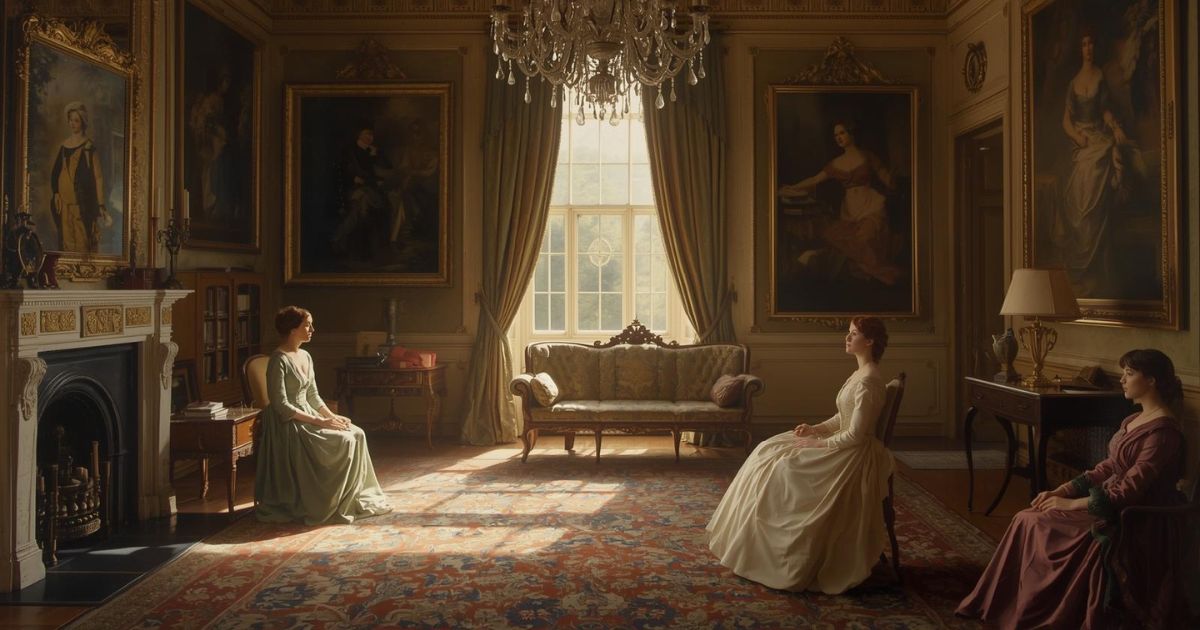
An excerpt from the original text.(complete · 3764 words)
rom a night of more sleep than she had expected, Marianne awoke the
next morning to the same consciousness of misery in which she had
closed her eyes.
Elinor encouraged her as much as possible to talk of what she felt; and
before breakfast was ready, they had gone through the subject again and
again; and with the same steady conviction and affectionate counsel on
Elinor’s side, the same impetuous feelings and varying opinions on
Marianne’s, as before. Sometimes she could believe Willoughby to be as
unfortunate and as innocent as herself, and at others, lost every
consolation in the impossibility of acquitting him. At one moment she
was absolutely indifferent to the observation of all the world, at
another she would seclude herself from it for ever, and at a third
could resist it with energy. In one thing, however, she was uniform,
when it came to the point, in avoiding, where it was possible, the
presence of Mrs. Jennings, and in a determined silence when obliged to
endure it. Her heart was hardened against the belief of Mrs. Jennings’s
entering into her sorrows with any compassion.
“No, no, no, it cannot be,” she cried; “she cannot feel. Her kindness
is not sympathy; her good-nature is not tenderness. All that she wants
is gossip, and she only likes me now because I supply it.”
Elinor had not needed this to be assured of the injustice to which her
sister was often led in her opinion of others, by the irritable
refinement of her own mind, and the too great importance placed by her
on the delicacies of a strong sensibility, and the graces of a polished
manner. Like half the rest of the world, if more than half there be
that are clever and good, Marianne, with excellent abilities and an
excellent disposition, was neither reasonable nor candid. She expected
from other people the same opinions and feelings as her own, and she
judged of their motives by the immediate effect of their actions on
herself. Thus a circumstance occurred, while the sisters were together
in their own room after breakfast, which sunk the heart of Mrs.
Jennings still lower in her estimation; because, through her own
weakness, it chanced to prove a source of fresh pain to herself, though
Mrs. Jennings was governed in it by an impulse of the utmost goodwill.
With a letter in her outstretched hand, and countenance gaily smiling,
from the persuasion of bringing comfort, she entered their room,
saying,
“Now, my dear, I bring you something that I am sure will do you good.”
Marianne heard enough. In one moment her imagination placed before her
a letter from Willoughby, full of tenderness and contrition,
explanatory of all that had passed, satisfactory, convincing; and
instantly followed by Willoughby himself, rushing eagerly into the room
to inforce, at her feet, by the eloquence of his eyes, the assurances
of his letter. The work of one moment was destroyed by the next. The
hand writing of her mother, never till then unwelcome, was before her;
and, in the acuteness of the disappointment which followed such an
ecstasy of more than hope, she felt as if, till that instant, she had
never suffered.
The cruelty of Mrs. Jennings no language, within her reach in her
moments of happiest eloquence, could have expressed; and now she could
reproach her only by the tears which streamed from her eyes with
passionate violence—a reproach, however, so entirely lost on its
object, that after many expressions of pity, she withdrew, still
referring her to the letter of comfort. But the letter, when she was
calm enough to read it, brought little comfort. Willoughby filled every
page. Her mother, still confident of their engagement, and relying as
warmly as ever on his constancy, had only been roused by Elinor’s
application, to intreat from Marianne greater openness towards them
both; and this, with such tenderness towards her, such affection for
Willoughby, and such a conviction of their future happiness in each
other, that she wept with agony through the whole of it.
All her impatience to be at home again now returned; her mother was
dearer to her than ever; dearer through the very excess of her mistaken
confidence in Willoughby, and she was wildly urgent to be gone. Elinor,
unable herself to determine whether it were better for Marianne to be
in London or at Barton, offered no counsel of her own except of
patience till their mother’s wishes could be known; and at length she
obtained her sister’s consent to wait for that knowledge.
Mrs. Jennings left them earlier than usual; for she could not be easy
till the Middletons and Palmers were able to grieve as much as herself;
and positively refusing Elinor’s offered attendance, went out alone for
the rest of the morning. Elinor, with a very heavy heart, aware of the
pain she was going to communicate, and perceiving, by Marianne’s
letter, how ill she had succeeded in laying any foundation for it, then
sat down to write her mother an account of what had passed, and entreat
her directions for the future; while Marianne, who came into the
drawing-room on Mrs. Jennings’s going away, remained fixed at the table
where Elinor wrote, watching the advancement of her pen, grieving over
her for the hardship of such a task, and grieving still more fondly
over its effect on her mother.
In this manner they had continued about a quarter of an hour, when
Marianne, whose nerves could not then bear any sudden noise, was
startled by a rap at the door.
“Who can this be?” cried Elinor. “So early too! I thought we had been
safe.”
Marianne moved to the window.
“It is Colonel Brandon!” said she, with vexation. “We are never safe
from him.”
“He will not come in, as Mrs. Jennings is from home.”
“I will not trust to that,” retreating to her own room. “A man who
has nothing to do with his own time has no conscience in his intrusion
on that of others.”
The event proved her conjecture right, though it was founded on
injustice and error; for Colonel Brandon did come in; and Elinor, who
was convinced that solicitude for Marianne brought him thither, and who
saw that solicitude in his disturbed and melancholy look, and in his
anxious though brief inquiry after her, could not forgive her sister
for esteeming him so lightly.
“I met Mrs. Jennings in Bond Street,” said he, after the first
salutation, “and she encouraged me to come on; and I was the more
easily encouraged, because I thought it probable that I might find you
alone, which I was very desirous of doing. My object—my wish—my sole
wish in desiring it—I hope, I believe it is—is to be a means of giving
comfort;—no, I must not say comfort—not present comfort—but conviction,
lasting conviction to your sister’s mind. My regard for her, for
yourself, for your mother—will you allow me to prove it, by relating
some circumstances which nothing but a very sincere regard—nothing
but an earnest desire of being useful—I think I am justified—though
where so many hours have been spent in convincing myself that I am
right, is there not some reason to fear I may be wrong?” He stopped.
“I understand you,” said Elinor. “You have something to tell me of Mr.
Willoughby, that will open his character farther. Your telling it will
be the greatest act of friendship that can be shown Marianne. My
gratitude will be insured immediately by any information tending to
that end, and hers must be gained by it in time. Pray, pray let me
hear it.”
“You shall; and, to be brief, when I quitted Barton last October,—but
this will give you no idea—I must go farther back. You will find me a
very awkward narrator, Miss Dashwood; I hardly know where to begin. A
short account of myself, I believe, will be necessary, and it shall
be a short one. On such a subject,” sighing heavily, “can I have little
temptation to be diffuse.”
He stopt a moment for recollection, and then, with another sigh, went
on.
“You have probably entirely forgotten a conversation—(it is not to be
supposed that it could make any impression on you)—a conversation
between us one evening at Barton Park—it was the evening of a dance—in
which I alluded to a lady I had once known, as resembling, in some
measure, your sister Marianne.”
“Indeed,” answered Elinor, “I have not forgotten it.” He looked
pleased by this remembrance, and added,
“If I am not deceived by the uncertainty, the partiality of tender
recollection, there is a very strong resemblance between them, as well
in mind as person. The same warmth of heart, the same eagerness of
fancy and spirits. This lady was one of my nearest relations, an orphan
from her infancy, and under the guardianship of my father. Our ages
were nearly the same, and from our earliest years we were playfellows
and friends. I cannot remember the time when I did not love Eliza; and
my affection for her, as we grew up, was such, as perhaps, judging from
my present forlorn and cheerless gravity, you might think me incapable
of having ever felt. Hers, for me, was, I believe, fervent as the
attachment of your sister to Mr. Willoughby and it was, though from a
different cause, no less unfortunate. At seventeen she was lost to me
for ever. She was married—married against her inclination to my
brother. Her fortune was large, and our family estate much encumbered.
And this, I fear, is all that can be said for the conduct of one, who
was at once her uncle and guardian. My brother did not deserve her; he
did not even love her. I had hoped that her regard for me would support
her under any difficulty, and for some time it did; but at last the
misery of her situation, for she experienced great unkindness, overcame
all her resolution, and though she had promised me that nothing—but how
blindly I relate! I have never told you how this was brought on. We
were within a few hours of eloping together for Scotland. The
treachery, or the folly, of my cousin’s maid betrayed us. I was
banished to the house of a relation far distant, and she was allowed no
liberty, no society, no amusement, till my father’s point was gained. I
had depended on her fortitude too far, and the blow was a severe
one—but had her marriage been happy, so young as I then was, a few
months must have reconciled me to it, or at least I should not have now
to lament it. This however was not the case. My brother had no regard
for her; his pleasures were not what they ought to have been, and from
the first he treated her unkindly. The consequence of this, upon a mind
so young, so lively, so inexperienced as Mrs. Brandon’s, was but too
natural. She resigned herself at first to all the misery of her
situation; and happy had it been if she had not lived to overcome those
regrets which the remembrance of me occasioned. But can we wonder that,
with such a husband to provoke inconstancy, and without a friend to
advise or restrain her (for my father lived only a few months after
their marriage, and I was with my regiment in the East Indies) she
should fall? Had I remained in England, perhaps—but I meant to promote
the happiness of both by removing from her for years, and for that
purpose had procured my exchange. The shock which her marriage had
given me,” he continued, in a voice of great agitation, “was of
trifling weight—was nothing to what I felt when I heard, about two
years afterwards, of her divorce. It was that which threw this
gloom,—even now the recollection of what I suffered—”
He could say no more, and rising hastily walked for a few minutes about
the room. Elinor, affected by his relation, and still more by his
distress, could not speak. He saw her concern, and coming to her, took
her hand, pressed it, and kissed it with grateful respect. A few
minutes more of silent exertion enabled him to proceed with composure.
“It was nearly three years after this unhappy period before I returned
to England. My first care, when I did arrive, was of course to seek
for her; but the search was as fruitless as it was melancholy. I could
not trace her beyond her first seducer, and there was every reason to
fear that she had removed from him only to sink deeper in a life of
sin. Her legal allowance was not adequate to her fortune, nor
sufficient for her comfortable maintenance, and I learnt from my
brother that the power of receiving it had been made over some months
before to another person. He imagined, and calmly could he imagine it,
that her extravagance, and consequent distress, had obliged her to
dispose of it for some immediate relief. At last, however, and after I
had been six months in England, I did find her. Regard for a former
servant of my own, who had since fallen into misfortune, carried me to
visit him in a spunging-house, where he was confined for debt; and
there, in the same house, under a similar confinement, was my
unfortunate sister. So altered—so faded—worn down by acute suffering of
every kind! hardly could I believe the melancholy and sickly figure
before me, to be the remains of the lovely, blooming, healthful girl,
on whom I had once doted. What I endured in so beholding her—but I have
no right to wound your feelings by attempting to describe it—I have
pained you too much already. That she was, to all appearance, in the
last stage of a consumption, was—yes, in such a situation it was my
greatest comfort. Life could do nothing for her, beyond giving time for
a better preparation for death; and that was given. I saw her placed in
comfortable lodgings, and under proper attendants; I visited her every
day during the rest of her short life: I was with her in her last
moments.”
Again he stopped to recover himself; and Elinor spoke her feelings in
an exclamation of tender concern, at the fate of his unfortunate
friend.
“Your sister, I hope, cannot be offended,” said he, “by the resemblance
I have fancied between her and my poor disgraced relation. Their fates,
their fortunes, cannot be the same; and had the natural sweet
disposition of the one been guarded by a firmer mind, or a happier
marriage, she might have been all that you will live to see the other
be. But to what does all this lead? I seem to have been distressing you
for nothing. Ah! Miss Dashwood—a subject such as this—untouched for
fourteen years—it is dangerous to handle it at all! I will be more
collected—more concise. She left to my care her only child, a little
girl, the offspring of her first guilty connection, who was then about
three years old. She loved the child, and had always kept it with her.
It was a valued, a precious trust to me; and gladly would I have
discharged it in the strictest sense, by watching over her education
myself, had the nature of our situations allowed it; but I had no
family, no home; and my little Eliza was therefore placed at school. I
saw her there whenever I could, and after the death of my brother,
(which happened about five years ago, and which left to me the
possession of the family property,) she visited me at Delaford. I
called her a distant relation; but I am well aware that I have in
general been suspected of a much nearer connection with her. It is now
three years ago (she had just reached her fourteenth year,) that I
removed her from school, to place her under the care of a very
respectable woman, residing in Dorsetshire, who had the charge of four
or five other girls of about the same time of life; and for two years I
had every reason to be pleased with her situation. But last February,
almost a twelvemonth back, she suddenly disappeared. I had allowed her,
(imprudently, as it has since turned out,) at her earnest desire, to go
to Bath with one of her young friends, who was attending her father
there for his health. I knew him to be a very good sort of man, and I
thought well of his daughter—better than she deserved, for, with a most
obstinate and ill-judged secrecy, she would tell nothing, would give no
clue, though she certainly knew all. He, her father, a well-meaning,
but not a quick-sighted man, could really, I believe, give no
information; for he had been generally confined to the house, while the
girls were ranging over the town and making what acquaintance they
chose; and he tried to convince me, as thoroughly as he was convinced
himself, of his daughter’s being entirely unconcerned in the business.
In short, I could learn nothing but that she was gone; all the rest,
for eight long months, was left to conjecture. What I thought, what I
feared, may be imagined; and what I suffered too.”
“Good heavens!” cried Elinor, “could it be—could Willoughby!”—
“The first news that reached me of her,” he continued, “came in a
letter from herself, last October. It was forwarded to me from
Delaford, and I received it on the very morning of our intended party
to Whitwell; and this was the reason of my leaving Barton so suddenly,
which I am sure must at the time have appeared strange to every body,
and which I believe gave offence to some. Little did Mr. Willoughby
imagine, I suppose, when his looks censured me for incivility in
breaking up the party, that I was called away to the relief of one whom
he had made poor and miserable; but had he known it, what would it
have availed? Would he have been less gay or less happy in the smiles
of your sister? No, he had already done that, which no man who can
feel for another would do. He had left the girl whose youth and
innocence he had seduced, in a situation of the utmost distress, with
no creditable home, no help, no friends, ignorant of his address! He
had left her, promising to return; he neither returned, nor wrote, nor
relieved her.”
“This is beyond every thing!” exclaimed Elinor.
“His character is now before you; expensive, dissipated, and worse than
both. Knowing all this, as I have now known it many weeks, guess what I
must have felt on seeing your sister as fond of him as ever, and on
being assured that she was to marry him: guess what I must have felt
for all your sakes. When I came to you last week and found you alone, I
came determined to know the truth; though irresolute what to do when it
was known. My behaviour must have seemed strange to you then; but now
you will comprehend it. To suffer you all to be so deceived; to see
your sister—but what could I do? I had no hope of interfering with
success; and sometimes I thought your sister’s influence might yet
reclaim him. But now, after such dishonorable usage, who can tell what
were his designs on her. Whatever they may have been, however, she may
now, and hereafter doubtless will turn with gratitude towards her own
condition, when she compares it with that of my poor Eliza, when she
considers the wretched and hopeless situation of this poor girl, and
pictures her to herself, with an affection for him so strong, still as
strong as her own, and with a mind tormented by self-reproach, which
must attend her through life. Surely this comparison must have its use
with her. She will feel her own sufferings to be nothing. They proceed
from no misconduct, and can bring no disgrace. On the contrary, every
friend must be made still more her friend by them. Concern for her
unhappiness, and respect for her fortitude under it, must strengthen
every attachment. Use your own discretion, however, in communicating to
her what I have told you. You must know best what will be its effect;
but had I not seriously, and from my heart believed it might be of
service, might lessen her regrets, I would not have suffered myself to
trouble you with this account of my family afflictions, with a recital
which may seem to have been intended to raise myself at the expense of
others.”
Elinor’s thanks followed this speech with grateful earnestness;
attended too with the assurance of her expecting material advantage to
Marianne, from the communication of what had passed.
“I have been more pained,” said she, “by her endeavors to acquit him
than by all the rest; for it irritates her mind more than the most
perfect conviction of his unworthiness can do. Now, though at first she
will suffer much, I am sure she will soon become easier. Have you,” she
continued, after a short silence, “ever seen Mr. Willoughby since you
left him at Barton?”
“Yes,” he replied gravely, “once I have. One meeting was unavoidable.”
Elinor, startled by his manner, looked at him anxiously, saying,
“What? have you met him to—”
“I could meet him no other way. Eliza had confessed to me, though most
reluctantly, the name of her lover; and when he returned to town, which
was within a fortnight after myself, we met by appointment, he to
defend, I to punish his conduct. We returned unwounded, and the
meeting, therefore, never got abroad.”
Elinor sighed over the fancied necessity of this; but to a man and a
soldier she presumed not to censure it.
“Such,” said Colonel Brandon, after a pause, “has been the unhappy
resemblance between the fate of mother and daughter! and so imperfectly
have I discharged my trust!”
“Is she still in town?”
“No; as soon as she recovered from her lying-in, for I found her near
her delivery, I removed her and her child into the country, and there
she remains.”
Recollecting, soon afterwards, that he was probably dividing Elinor
from her sister, he put an end to his visit, receiving from her again
the same grateful acknowledgments, and leaving her full of compassion
and esteem for him.
Master this chapter. Complete your experience
Purchase the complete book to access all chapters and support classic literature
As an Amazon Associate, we earn a small commission from qualifying purchases at no additional cost to you.
Available in paperback, hardcover, and e-book formats
Let's Analyse the Pattern
The Honor Trap - When Doing Right Goes Wrong
When rigid adherence to moral rules creates more harm than breaking them would.
Why This Matters
Connect literature to life
This chapter teaches how to recognize when rigid adherence to promises or principles creates more harm than breaking them would.
Practice This Today
This week, notice when someone uses 'I gave my word' or 'it's the right thing to do' to avoid making a hard but necessary choice - ask yourself what outcome their 'honor' actually creates.
Now let's explore the literary elements.
Key Quotes & Analysis
"I was simple enough to think, that because my faith was plighted to another, there could be no danger in my being with you."
Context: Edward explains why he allowed himself to get close to Elinor despite being engaged to Lucy
This reveals Edward's self-deception and naivety. He thought he could control his feelings, but emotions don't follow logic. It shows how he underestimated the power of genuine connection.
In Today's Words:
I was stupid enough to think that since I was already committed to someone else, it would be safe to spend time with you.
"The person to whom the engagement is known, is not likely, I think, to be influenced by these feelings."
Context: Elinor delicately suggests that Lucy might not truly love Edward and could be persuaded to release him
This shows Elinor's diplomatic way of pointing out that Lucy might be more interested in Edward's status than his happiness. Even in pain, Elinor is trying to find solutions rather than just wallowing.
In Today's Words:
The person you're engaged to probably doesn't care about your feelings as much as you think.
"It is a most unfortunate affair, and will probably be a source of lasting unhappiness to both."
Context: Elinor's assessment of Edward's situation with Lucy
Elinor sees clearly that honoring this engagement will make both Edward and Lucy miserable. She recognizes that sometimes doing the 'right' thing creates more harm than good.
In Today's Words:
This is a terrible situation that's going to make everyone involved miserable for years.
Thematic Threads
Social Expectations
In This Chapter
Edward feels trapped by society's definition of honor and promise-keeping, even when it causes widespread suffering
Development
Evolved from earlier chapters showing how social rules constrain the Dashwood women's choices
In Your Life:
You might feel pressured to stay in situations that harm you because others expect you to 'stick it out' or 'honor your commitments'
Personal Growth
In This Chapter
Edward recognizes he was 'young and foolish' when he got engaged but feels unable to act on this wisdom
Development
Builds on Marianne's journey of learning from her mistakes with Willoughby
In Your Life:
You might struggle to change course even when you know you've outgrown old decisions or relationships
Identity
In This Chapter
Edward's identity is so tied to being 'honorable' that he can't imagine breaking his word without losing himself
Development
Continues the theme of characters defining themselves through social roles rather than authentic desires
In Your Life:
You might stay stuck in patterns because changing would challenge how you see yourself or how others see you
Human Relationships
In This Chapter
Elinor prioritizes Edward's wellbeing over her own pain, showing love through problem-solving rather than possession
Development
Contrasts with earlier examples of selfish love from characters like Willoughby and Lucy
In Your Life:
You might recognize the difference between love that seeks to possess and love that seeks the other person's genuine happiness
You now have the context. Time to form your own thoughts.
Discussion Questions
- 1
What does Edward reveal about his engagement to Lucy, and how does he feel about being trapped in it?
analysis • surface - 2
Why does Edward feel he must honor an engagement that makes him miserable, and what does this reveal about how social rules can conflict with personal happiness?
analysis • medium - 3
Where do you see people today staying trapped in situations because they think breaking a commitment would be 'wrong,' even when everyone would be better off if they left?
application • medium - 4
How does Elinor's response to Edward's confession show a different way to handle someone else's moral dilemma, and what would you do in her position?
application • deep - 5
What does this chapter suggest about when keeping your word becomes harmful, and how do we know when it's more moral to break a promise than keep it?
reflection • deep
Critical Thinking Exercise
Break Down the Honor Trap
Think of a situation where you or someone you know stayed committed to something that was making everyone miserable because it felt like the 'right' thing to do. Write down what the original promise was, what changed since then, who gets hurt by keeping it, and who would benefit if it were broken. Then identify what fear or belief keeps the person trapped.
Consider:
- •Consider whether the person who made the promise had full information when they made it
- •Think about whether the other person would actually want them to stay trapped
- •Look for whether 'honor' is being used to avoid a difficult conversation or decision
Journaling Prompt
Write about a time when you stayed in a situation longer than you should have because you thought leaving would make you a 'bad person.' What were you really afraid of, and what would you tell your past self now?
Coming Up Next...
Chapter 32: Willoughby's Letter
Mrs. Jennings returns with shocking news that will turn Edward's impossible situation completely upside down. Sometimes the solution to an unsolvable problem comes from the most unexpected source.