An excerpt from the original text.(complete · 1439 words)
othing occurred during the next three or four days, to make Elinor
regret what she had done, in applying to her mother; for Willoughby
neither came nor wrote. They were engaged about the end of that time to
attend Lady Middleton to a party, from which Mrs. Jennings was kept
away by the indisposition of her youngest daughter; and for this party,
Marianne, wholly dispirited, careless of her appearance, and seeming
equally indifferent whether she went or staid, prepared, without one
look of hope or one expression of pleasure. She sat by the drawing-room
fire after tea, till the moment of Lady Middleton’s arrival, without
once stirring from her seat, or altering her attitude, lost in her own
thoughts, and insensible of her sister’s presence; and when at last
they were told that Lady Middleton waited for them at the door, she
started as if she had forgotten that any one was expected.
They arrived in due time at the place of destination, and as soon as
the string of carriages before them would allow, alighted, ascended the
stairs, heard their names announced from one landing-place to another
in an audible voice, and entered a room splendidly lit up, quite full
of company, and insufferably hot. When they had paid their tribute of
politeness by curtsying to the lady of the house, they were permitted
to mingle in the crowd, and take their share of the heat and
inconvenience, to which their arrival must necessarily add. After some
time spent in saying little or doing less, Lady Middleton sat down to
Cassino, and as Marianne was not in spirits for moving about, she and
Elinor luckily succeeding to chairs, placed themselves at no great
distance from the table.
They had not remained in this manner long, before Elinor perceived
Willoughby, standing within a few yards of them, in earnest
conversation with a very fashionable looking young woman. She soon
caught his eye, and he immediately bowed, but without attempting to
speak to her, or to approach Marianne, though he could not but see her;
and then continued his discourse with the same lady. Elinor turned
involuntarily to Marianne, to see whether it could be unobserved by
her. At that moment she first perceived him, and her whole countenance
glowing with sudden delight, she would have moved towards him
instantly, had not her sister caught hold of her.
“Good heavens!” she exclaimed, “he is there—he is there—Oh! why does he
not look at me? why cannot I speak to him?”
“Pray, pray be composed,” cried Elinor, “and do not betray what you
feel to every body present. Perhaps he has not observed you yet.”
This however was more than she could believe herself; and to be
composed at such a moment was not only beyond the reach of Marianne, it
was beyond her wish. She sat in an agony of impatience which affected
every feature.
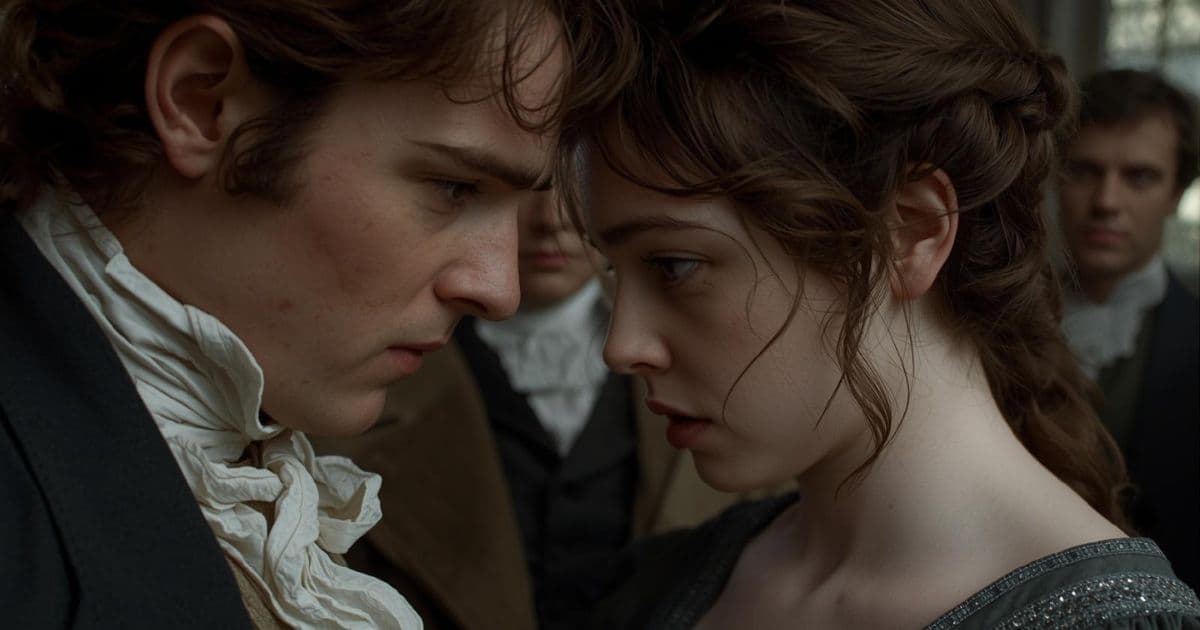
At last he turned round again, and regarded them both; she started up,
and pronouncing his name in a tone of affection, held out her hand to
him. He approached, and addressing himself rather to Elinor than
Marianne, as if wishing to avoid her eye, and determined not to observe
her attitude, inquired in a hurried manner after Mrs. Dashwood, and
asked how long they had been in town. Elinor was robbed of all presence
of mind by such an address, and was unable to say a word. But the
feelings of her sister were instantly expressed. Her face was crimsoned
over, and she exclaimed, in a voice of the greatest emotion, “Good God!
Willoughby, what is the meaning of this? Have you not received my
letters? Will you not shake hands with me?”
He could not then avoid it, but her touch seemed painful to him, and he
held her hand only for a moment. During all this time he was evidently
struggling for composure. Elinor watched his countenance and saw its
expression becoming more tranquil. After a moment’s pause, he spoke
with calmness.
“I did myself the honour of calling in Berkeley Street last Tuesday,
and very much regretted that I was not fortunate enough to find
yourselves and Mrs. Jennings at home. My card was not lost, I hope.”
“But have you not received my notes?” cried Marianne in the wildest
anxiety. “Here is some mistake I am sure—some dreadful mistake. What
can be the meaning of it? Tell me, Willoughby; for heaven’s sake tell
me, what is the matter?”
He made no reply; his complexion changed and all his embarrassment
returned; but as if, on catching the eye of the young lady with whom he
had been previously talking, he felt the necessity of instant exertion,
he recovered himself again, and after saying, “Yes, I had the pleasure
of receiving the information of your arrival in town, which you were so
good as to send me,” turned hastily away with a slight bow and joined
his friend.
Marianne, now looking dreadfully white, and unable to stand, sunk into
her chair, and Elinor, expecting every moment to see her faint, tried
to screen her from the observation of others, while reviving her with
lavender water.
“Go to him, Elinor,” she cried, as soon as she could speak, “and force
him to come to me. Tell him I must see him again—must speak to him
instantly.—I cannot rest—I shall not have a moment’s peace till this is
explained—some dreadful misapprehension or other. Oh, go to him this
moment.”
“How can that be done? No, my dearest Marianne, you must wait. This is
not the place for explanations. Wait only till tomorrow.”
With difficulty however could she prevent her from following him
herself; and to persuade her to check her agitation, to wait, at least,
with the appearance of composure, till she might speak to him with more
privacy and more effect, was impossible; for Marianne continued
incessantly to give way in a low voice to the misery of her feelings,
by exclamations of wretchedness. In a short time Elinor saw Willoughby
quit the room by the door towards the staircase, and telling Marianne
that he was gone, urged the impossibility of speaking to him again that
evening, as a fresh argument for her to be calm. She instantly begged
her sister would entreat Lady Middleton to take them home, as she was
too miserable to stay a minute longer.
Lady Middleton, though in the middle of a rubber, on being informed
that Marianne was unwell, was too polite to object for a moment to her
wish of going away, and making over her cards to a friend, they
departed as soon as the carriage could be found. Scarcely a word was
spoken during their return to Berkeley Street. Marianne was in a silent
agony, too much oppressed even for tears; but as Mrs. Jennings was
luckily not come home, they could go directly to their own room, where
hartshorn restored her a little to herself. She was soon undressed and
in bed, and as she seemed desirous of being alone, her sister then left
her, and while she waited the return of Mrs. Jennings, had leisure
enough for thinking over the past.
That some kind of engagement had subsisted between Willoughby and
Marianne she could not doubt, and that Willoughby was weary of it,
seemed equally clear; for however Marianne might still feed her own
wishes, she could not attribute such behaviour to mistake or
misapprehension of any kind. Nothing but a thorough change of sentiment
could account for it. Her indignation would have been still stronger
than it was, had she not witnessed that embarrassment which seemed to
speak a consciousness of his own misconduct, and prevented her from
believing him so unprincipled as to have been sporting with the
affections of her sister from the first, without any design that would
bear investigation. Absence might have weakened his regard, and
convenience might have determined him to overcome it, but that such a
regard had formerly existed she could not bring herself to doubt.
As for Marianne, on the pangs which so unhappy a meeting must already
have given her, and on those still more severe which might await her in
its probable consequence, she could not reflect without the deepest
concern. Her own situation gained in the comparison; for while she
could esteem Edward as much as ever, however they might be divided in
future, her mind might be always supported. But every circumstance that
could embitter such an evil seemed uniting to heighten the misery of
Marianne in a final separation from Willoughby—in an immediate and
irreconcilable rupture with him.
Master this chapter. Complete your experience
Purchase the complete book to access all chapters and support classic literature
As an Amazon Associate, we earn a small commission from qualifying purchases at no additional cost to you.
Available in paperback, hardcover, and e-book formats
Let's Analyse the Pattern
Using personal revelation as emotional leverage to manipulate others into compliance or complicity.
Why This Matters
Connect literature to life
This chapter teaches how to spot when someone uses personal revelation as emotional leverage rather than genuine connection.
Practice This Today
This week, notice when someone shares something personal then immediately asks for something—pause and ask yourself if you're being trusted or positioned.
Now let's explore the literary elements.
Key Quotes & Analysis
"I certainly did not seek your confidence, but you do me no more than justice in imagining that I may be depended on."
Context: Elinor's response when Lucy asks her to keep the engagement secret
This shows Elinor's dignity and integrity. She didn't ask for this painful information, but she won't betray Lucy's trust even though it hurts her. It demonstrates her moral character even when dealing with someone who's being cruel to her.
In Today's Words:
I didn't ask you to tell me this, but you can trust me to keep your secret.
"We have been engaged these four years, and it was our mutual wish to keep it secret from all our friends."
Context: Lucy revealing the length and secrecy of her engagement to Edward
This reveals how long Lucy has been planning her financial security through Edward, and how she's kept him tied to her since she was barely more than a child. The emphasis on secrecy suggests shame or calculation rather than romantic love.
In Today's Words:
We've been together for four years and decided to keep it between us.
"I have no wish to influence you to determine either way. It ought to be entirely under your own direction."
Context: Elinor's response when Lucy asks whether she should break her engagement
Even though Elinor would benefit if Lucy ended the engagement, she refuses to manipulate the situation. This shows her fundamental honesty and respect for others' autonomy, even when it costs her personally.
In Today's Words:
This is your decision to make, not mine. I'm not going to try to influence you either way.
Thematic Threads
Manipulation
In This Chapter
Lucy uses fake intimacy and strategic vulnerability to control Elinor and secure her position with Edward
Development
Introduced here as Lucy reveals her true calculating nature
In Your Life:
You might see this when someone shares personal information then immediately asks for favors or special treatment.
Class
In This Chapter
Lucy's desperation to marry Edward stems from her precarious social and financial position
Development
Continues the theme of how class anxiety drives behavior and choices
In Your Life:
You might recognize this in your own financial fears driving relationship or career decisions.
Emotional Intelligence
In This Chapter
Elinor demonstrates remarkable self-control and wisdom in handling Lucy's manipulation
Development
Builds on Elinor's consistent pattern of emotional maturity throughout the story
In Your Life:
You might need this same composure when dealing with manipulative people in your workplace or family.
Deception
In This Chapter
Lucy's entire persona is a carefully constructed lie designed to achieve her goals
Development
Revealed here as Lucy drops her sweet facade and shows her true calculating nature
In Your Life:
You might encounter this when someone's public personality doesn't match their private actions or motivations.
Women's Limited Options
In This Chapter
Lucy's behavior is partially explained by the few paths available to women for financial security
Development
Continues exploring how social constraints shape women's choices and desperation
In Your Life:
You might relate to feeling trapped by limited options and understanding how desperation can lead to questionable choices.
You now have the context. Time to form your own thoughts.
Discussion Questions
- 1
What strategy does Lucy use when she asks Elinor for advice about breaking her engagement to Edward?
analysis • surface - 2
Why does Lucy share her secret engagement with Elinor, knowing that Elinor has feelings for Edward?
analysis • medium - 3
Where have you seen someone share personal information and then immediately ask for a favor or special treatment?
application • medium - 4
How can you tell the difference between someone genuinely seeking advice and someone trying to manipulate you through fake vulnerability?
application • deep - 5
What does Lucy's behavior reveal about how people use emotional manipulation when they feel powerless in other areas of life?
reflection • deep
Critical Thinking Exercise
Decode the Manipulation Script
Think of a recent conversation where someone shared something personal, then asked for something from you. Write out the conversation step-by-step, then identify the manipulation pattern. What did they reveal? What did they ask for? How did they make you feel obligated to say yes?
Consider:
- •Notice if the personal revelation made you feel 'special' or 'trusted'
- •Check if the request came immediately after the vulnerable sharing
- •Ask yourself if saying no would have made you feel guilty or mean
Journaling Prompt
Write about a time when you shared something personal with someone. What was your real motivation - genuine connection or getting something you needed? How can you recognize your own patterns of using vulnerability to influence others?
Coming Up Next...
Chapter 29: Edward's Visit
Elinor must now carry the heavy burden of Lucy's secret while watching Edward remain oblivious to the web of deception surrounding him. Meanwhile, Marianne's own romantic situation takes an unexpected turn that will test everything she believes about love.