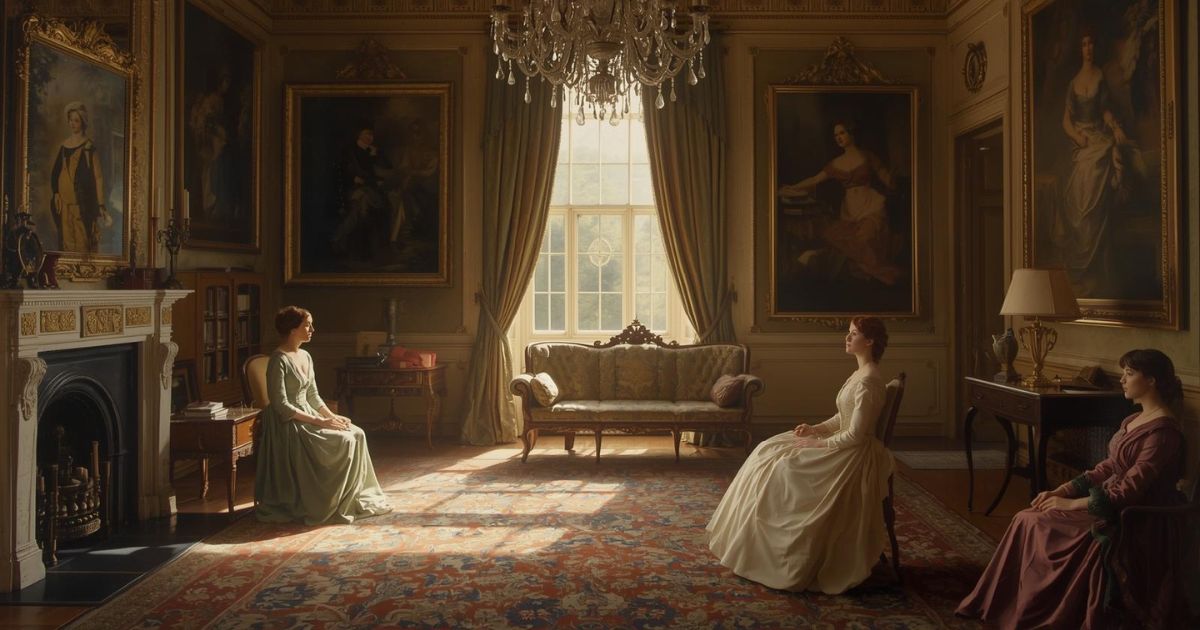
An excerpt from the original text.(complete · 2474 words)
“f this open weather holds much longer,” said Mrs. Jennings, when they
met at breakfast the following morning, “Sir John will not like leaving
Barton next week; ’tis a sad thing for sportsmen to lose a day’s
pleasure. Poor souls! I always pity them when they do; they seem to
take it so much to heart.”
“That is true,” cried Marianne, in a cheerful voice, and walking to the
window as she spoke, to examine the day. “I had not thought of that.
This weather will keep many sportsmen in the country.”
It was a lucky recollection, all her good spirits were restored by it.
“It is charming weather for them indeed,” she continued, as she sat
down to the breakfast table with a happy countenance. “How much they
must enjoy it! But” (with a little return of anxiety) “it cannot be
expected to last long. At this time of the year, and after such a
series of rain, we shall certainly have very little more of it. Frosts
will soon set in, and in all probability with severity. In another day
or two perhaps; this extreme mildness can hardly last longer—nay,
perhaps it may freeze tonight!”
“At any rate,” said Elinor, wishing to prevent Mrs. Jennings from
seeing her sister’s thoughts as clearly as she did, “I dare say we
shall have Sir John and Lady Middleton in town by the end of next
week.”
“Ay, my dear, I’ll warrant you we do. Mary always has her own way.”
“And now,” silently conjectured Elinor, “she will write to Combe by
this day’s post.”
But if she did, the letter was written and sent away with a privacy
which eluded all her watchfulness to ascertain the fact. Whatever the
truth of it might be, and far as Elinor was from feeling thorough
contentment about it, yet while she saw Marianne in spirits, she could
not be very uncomfortable herself. And Marianne was in spirits; happy
in the mildness of the weather, and still happier in her expectation of
a frost.
The morning was chiefly spent in leaving cards at the houses of Mrs.
Jennings’s acquaintance to inform them of her being in town; and
Marianne was all the time busy in observing the direction of the wind,
watching the variations of the sky and imagining an alteration in the
air.
“Don’t you find it colder than it was in the morning, Elinor? There
seems to me a very decided difference. I can hardly keep my hands warm
even in my muff. It was not so yesterday, I think. The clouds seem
parting too, the sun will be out in a moment, and we shall have a clear
afternoon.”
Elinor was alternately diverted and pained; but Marianne persevered,
and saw every night in the brightness of the fire, and every morning in
the appearance of the atmosphere, the certain symptoms of approaching
frost.
The Miss Dashwoods had no greater reason to be dissatisfied with Mrs.
Jennings’s style of living, and set of acquaintance, than with her
behaviour to themselves, which was invariably kind. Every thing in her
household arrangements was conducted on the most liberal plan, and
excepting a few old city friends, whom, to Lady Middleton’s regret, she
had never dropped, she visited no one to whom an introduction could at
all discompose the feelings of her young companions. Pleased to find
herself more comfortably situated in that particular than she had
expected, Elinor was very willing to compound for the want of much real
enjoyment from any of their evening parties, which, whether at home or
abroad, formed only for cards, could have little to amuse her.
Colonel Brandon, who had a general invitation to the house, was with
them almost every day; he came to look at Marianne and talk to Elinor,
who often derived more satisfaction from conversing with him than from
any other daily occurrence, but who saw at the same time with much
concern his continued regard for her sister. She feared it was a
strengthening regard. It grieved her to see the earnestness with which
he often watched Marianne, and his spirits were certainly worse than
when at Barton.
About a week after their arrival, it became certain that Willoughby was
also arrived. His card was on the table when they came in from the
morning’s drive.
“Good God!” cried Marianne, “he has been here while we were out.”
Elinor, rejoiced to be assured of his being in London, now ventured to
say, “Depend upon it, he will call again tomorrow.” But Marianne seemed
hardly to hear her, and on Mrs. Jennings’s entrance, escaped with the
precious card.
This event, while it raised the spirits of Elinor, restored to those of
her sister all, and more than all, their former agitation. From this
moment her mind was never quiet; the expectation of seeing him every
hour of the day, made her unfit for any thing. She insisted on being
left behind, the next morning, when the others went out.
Elinor’s thoughts were full of what might be passing in Berkeley Street
during their absence; but a moment’s glance at her sister when they
returned was enough to inform her, that Willoughby had paid no second
visit there. A note was just then brought in, and laid on the table.
“For me!” cried Marianne, stepping hastily forward.
“No, ma’am, for my mistress.”
But Marianne, not convinced, took it instantly up.
“It is indeed for Mrs. Jennings; how provoking!”
“You are expecting a letter, then?” said Elinor, unable to be longer
silent.
“Yes, a little—not much.”
After a short pause. “You have no confidence in me, Marianne.”
“Nay, Elinor, this reproach from you—you who have confidence in no
one!”
“Me!” returned Elinor in some confusion; “indeed, Marianne, I have
nothing to tell.”
“Nor I,” answered Marianne with energy, “our situations then are alike.
We have neither of us any thing to tell; you, because you do not
communicate, and I, because I conceal nothing.”
Elinor, distressed by this charge of reserve in herself, which she was
not at liberty to do away, knew not how, under such circumstances, to
press for greater openness in Marianne.
Mrs. Jennings soon appeared, and the note being given her, she read it
aloud. It was from Lady Middleton, announcing their arrival in Conduit
Street the night before, and requesting the company of her mother and
cousins the following evening. Business on Sir John’s part, and a
violent cold on her own, prevented their calling in Berkeley Street.
The invitation was accepted; but when the hour of appointment drew
near, necessary as it was in common civility to Mrs. Jennings, that
they should both attend her on such a visit, Elinor had some difficulty
in persuading her sister to go, for still she had seen nothing of
Willoughby; and therefore was not more indisposed for amusement abroad,
than unwilling to run the risk of his calling again in her absence.
Elinor found, when the evening was over, that disposition is not
materially altered by a change of abode, for although scarcely settled
in town, Sir John had contrived to collect around him, nearly twenty
young people, and to amuse them with a ball. This was an affair,
however, of which Lady Middleton did not approve. In the country, an
unpremeditated dance was very allowable; but in London, where the
reputation of elegance was more important and less easily attained, it
was risking too much for the gratification of a few girls, to have it
known that Lady Middleton had given a small dance of eight or nine
couple, with two violins, and a mere side-board collation.
Mr. and Mrs. Palmer were of the party; from the former, whom they had
not seen before since their arrival in town, as he was careful to avoid
the appearance of any attention to his mother-in-law, and therefore
never came near her, they received no mark of recognition on their
entrance. He looked at them slightly, without seeming to know who they
were, and merely nodded to Mrs. Jennings from the other side of the
room. Marianne gave one glance round the apartment as she entered: it
was enough—he was not there—and she sat down, equally ill-disposed to
receive or communicate pleasure. After they had been assembled about an
hour, Mr. Palmer sauntered towards the Miss Dashwoods to express his
surprise on seeing them in town, though Colonel Brandon had been first
informed of their arrival at his house, and he had himself said
something very droll on hearing that they were to come.
“I thought you were both in Devonshire,” said he.
“Did you?” replied Elinor.
“When do you go back again?”
“I do not know.” And thus ended their discourse.
Never had Marianne been so unwilling to dance in her life, as she was
that evening, and never so much fatigued by the exercise. She
complained of it as they returned to Berkeley Street.
“Aye, aye,” said Mrs. Jennings, “we know the reason of all that very
well; if a certain person who shall be nameless, had been there, you
would not have been a bit tired: and to say the truth it was not very
pretty of him not to give you the meeting when he was invited.”
“Invited!” cried Marianne.
“So my daughter Middleton told me, for it seems Sir John met him
somewhere in the street this morning.” Marianne said no more, but
looked exceedingly hurt. Impatient in this situation to be doing
something that might lead to her sister’s relief, Elinor resolved to
write the next morning to her mother, and hoped by awakening her fears
for the health of Marianne, to procure those inquiries which had been
so long delayed; and she was still more eagerly bent on this measure by
perceiving after breakfast on the morrow, that Marianne was again
writing to Willoughby, for she could not suppose it to be to any other
person.
About the middle of the day, Mrs. Jennings went out by herself on
business, and Elinor began her letter directly, while Marianne, too
restless for employment, too anxious for conversation, walked from one
window to the other, or sat down by the fire in melancholy meditation.
Elinor was very earnest in her application to her mother, relating all
that had passed, her suspicions of Willoughby’s inconstancy, urging her
by every plea of duty and affection to demand from Marianne an account
of her real situation with respect to him.
Her letter was scarcely finished, when a rap foretold a visitor, and
Colonel Brandon was announced. Marianne, who had seen him from the
window, and who hated company of any kind, left the room before he
entered it. He looked more than usually grave, and though expressing
satisfaction at finding Miss Dashwood alone, as if he had somewhat in
particular to tell her, sat for some time without saying a word.
Elinor, persuaded that he had some communication to make in which her
sister was concerned, impatiently expected its opening. It was not the
first time of her feeling the same kind of conviction; for, more than
once before, beginning with the observation of “your sister looks
unwell to-day,” or “your sister seems out of spirits,” he had appeared
on the point, either of disclosing, or of inquiring, something
particular about her. After a pause of several minutes, their silence
was broken, by his asking her in a voice of some agitation, when he was
to congratulate her on the acquisition of a brother? Elinor was not
prepared for such a question, and having no answer ready, was obliged
to adopt the simple and common expedient, of asking what he meant? He
tried to smile as he replied, “your sister’s engagement to Mr.
Willoughby is very generally known.”
“It cannot be generally known,” returned Elinor, “for her own family do
not know it.”
He looked surprised and said, “I beg your pardon, I am afraid my
inquiry has been impertinent; but I had not supposed any secrecy
intended, as they openly correspond, and their marriage is universally
talked of.”
“How can that be? By whom can you have heard it mentioned?”
“By many—by some of whom you know nothing, by others with whom you are
most intimate, Mrs. Jennings, Mrs. Palmer, and the Middletons. But
still I might not have believed it, for where the mind is perhaps
rather unwilling to be convinced, it will always find something to
support its doubts, if I had not, when the servant let me in today,
accidentally seen a letter in his hand, directed to Mr. Willoughby in
your sister’s writing. I came to inquire, but I was convinced before I
could ask the question. Is every thing finally settled? Is it
impossible to—? But I have no right, and I could have no chance of
succeeding. Excuse me, Miss Dashwood. I believe I have been wrong in
saying so much, but I hardly know what to do, and on your prudence I
have the strongest dependence. Tell me that it is all absolutely
resolved on, that any attempt, that in short concealment, if
concealment be possible, is all that remains.”
These words, which conveyed to Elinor a direct avowal of his love for
her sister, affected her very much. She was not immediately able to say
anything, and even when her spirits were recovered, she debated for a
short time, on the answer it would be most proper to give. The real
state of things between Willoughby and her sister was so little known
to herself, that in endeavouring to explain it, she might be as liable
to say too much as too little. Yet as she was convinced that Marianne’s
affection for Willoughby, could leave no hope of Colonel Brandon’s
success, whatever the event of that affection might be, and at the same
time wished to shield her conduct from censure, she thought it most
prudent and kind, after some consideration, to say more than she really
knew or believed. She acknowledged, therefore, that though she had
never been informed by themselves of the terms on which they stood with
each other, of their mutual affection she had no doubt, and of their
correspondence she was not astonished to hear.
He listened to her with silent attention, and on her ceasing to speak,
rose directly from his seat, and after saying in a voice of emotion,
“to your sister I wish all imaginable happiness; to Willoughby that he
may endeavour to deserve her,”—took leave, and went away.
Elinor derived no comfortable feelings from this conversation, to
lessen the uneasiness of her mind on other points; she was left, on the
contrary, with a melancholy impression of Colonel Brandon’s
unhappiness, and was prevented even from wishing it removed, by her
anxiety for the very event that must confirm it.
Master this chapter. Complete your experience
Purchase the complete book to access all chapters and support classic literature
As an Amazon Associate, we earn a small commission from qualifying purchases at no additional cost to you.
Available in paperback, hardcover, and e-book formats
Let's Analyse the Pattern
We often need to lose everything before we can see our destructive patterns clearly and value what we've been taking for granted.
Why This Matters
Connect literature to life
This chapter teaches how to recognize the difference between dramatic, inconsistent attention and steady, dependable care.
Practice This Today
This week, notice who shows up during your ordinary, unglamorous moments versus who only appears when things are exciting or convenient for them.
Now let's explore the literary elements.
Key Quotes & Analysis
"I saw that my own feelings had prepared my sufferings, and that my want of fortitude under them had almost led me to the grave."
Context: Marianne is reflecting on how her emotional choices nearly killed her
This shows Marianne taking full responsibility for her actions and their consequences. She's not blaming Willoughby anymore but recognizing her own role in her suffering.
In Today's Words:
I realize now that I created my own drama and let it almost destroy me.
"Had I died, it would have been self-destruction."
Context: She's acknowledging that her illness was partly self-inflicted through emotional excess
This is a powerful moment of accountability where Marianne recognizes that her romantic martyrdom was actually a form of slow suicide that would have devastated her family.
In Today's Words:
If I had died, it would have been my own fault for not taking care of myself.
"I compare it with what it ought to have been; I compare my conduct with yours, and I see everything most reproachaful to myself."
Context: She's contrasting her selfish behavior with Elinor's selfless care
Marianne is finally seeing Elinor's strength and sacrifice clearly, understanding what real love and maturity look like through her sister's example.
In Today's Words:
When I look at how you handled everything versus how I acted, I'm embarrassed by my behavior.
Thematic Threads
Personal Growth
In This Chapter
Marianne's illness forces brutal self-examination and recognition of her selfish behavior
Development
Major breakthrough - she finally takes responsibility instead of blaming circumstances
In Your Life:
You might need a wake-up call to see how your drama affects the people who love you.
Human Relationships
In This Chapter
Marianne begins to value Colonel Brandon's steady devotion over Willoughby's false passion
Development
Shift from romantic fantasy to appreciating genuine care and consistency
In Your Life:
You might be overlooking someone reliable while chasing someone who doesn't truly care.
Identity
In This Chapter
Marianne's sense of self transforms from dramatic victim to someone taking responsibility
Development
Complete identity shift - from self-indulgent to self-aware
In Your Life:
You might define yourself by your struggles instead of your capacity for growth.
Social Expectations
In This Chapter
Marianne realizes her behavior violated basic social contracts of care and consideration
Development
New understanding that social expectations aren't constraints but mutual care agreements
In Your Life:
You might justify selfish behavior by calling it 'being true to yourself' when it's actually hurting others.
You now have the context. Time to form your own thoughts.
Discussion Questions
- 1
What specific realizations does Marianne have about her behavior during her recovery?
analysis • surface - 2
Why did it take a near-death experience for Marianne to see how her actions affected others?
analysis • medium - 3
Where do you see people today choosing drama and intensity over steady, reliable relationships?
application • medium - 4
How can someone recognize when they're taking good people for granted while chasing unavailable ones?
application • deep - 5
What does Marianne's transformation reveal about the difference between being in love and being obsessed?
reflection • deep
Critical Thinking Exercise
The Gratitude Inventory Challenge
Make two lists: people in your life who are exciting but unreliable, and people who are steady but maybe underappreciated. For each person on the steady list, write one specific way they've shown up for you recently. Then identify one person you might be taking for granted while focusing energy on someone who doesn't reciprocate.
Consider:
- •Look for patterns in who gets your attention versus who deserves it
- •Consider whether you're confusing drama with passion in relationships
- •Notice if you dismiss reliability as 'boring' when it might actually be valuable
Journaling Prompt
Write about a time when you had to hit rock bottom or face a crisis before you could see a situation clearly. What were you blind to before, and what helped you finally recognize the truth?
Coming Up Next...
Chapter 28: Homeward
As Marianne continues her recovery, she'll need to face the people she's hurt and make some difficult decisions about her future. Meanwhile, secrets about Willoughby's true character are about to surface.