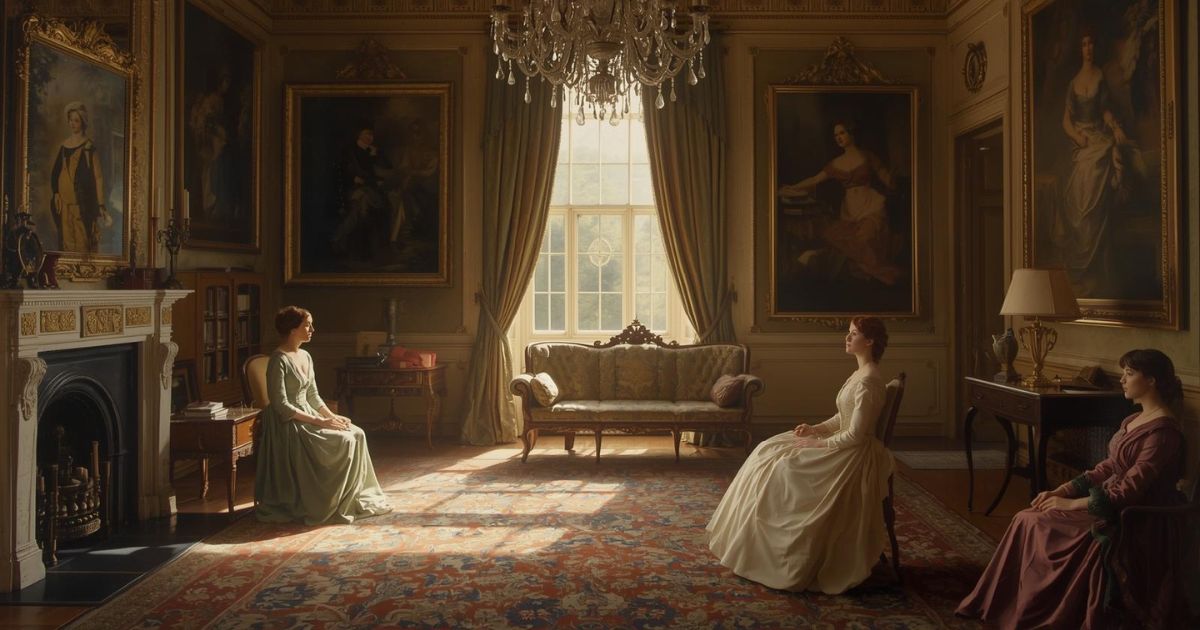
An excerpt from the original text.(complete · 1430 words)
ittle had Mrs. Dashwood or her daughters imagined when they first came
into Devonshire, that so many engagements would arise to occupy their
time as shortly presented themselves, or that they should have such
frequent invitations and such constant visitors as to leave them little
leisure for serious employment. Yet such was the case. When Marianne
was recovered, the schemes of amusement at home and abroad, which Sir
John had been previously forming, were put into execution. The private
balls at the park then began; and parties on the water were made and
accomplished as often as a showery October would allow. In every
meeting of the kind Willoughby was included; and the ease and
familiarity which naturally attended these parties were exactly
calculated to give increasing intimacy to his acquaintance with the
Dashwoods, to afford him opportunity of witnessing the excellencies of
Marianne, of marking his animated admiration of her, and of receiving,
in her behaviour to himself, the most pointed assurance of her
affection.
Elinor could not be surprised at their attachment. She only wished that
it were less openly shown; and once or twice did venture to suggest the
propriety of some self-command to Marianne. But Marianne abhorred all
concealment where no real disgrace could attend unreserve; and to aim
at the restraint of sentiments which were not in themselves illaudable,
appeared to her not merely an unnecessary effort, but a disgraceful
subjection of reason to common-place and mistaken notions. Willoughby
thought the same; and their behaviour at all times, was an illustration
of their opinions.
When he was present she had no eyes for any one else. Every thing he
did, was right. Every thing he said, was clever. If their evenings at
the park were concluded with cards, he cheated himself and all the rest
of the party to get her a good hand. If dancing formed the amusement of
the night, they were partners for half the time; and when obliged to
separate for a couple of dances, were careful to stand together and
scarcely spoke a word to any body else. Such conduct made them of
course most exceedingly laughed at; but ridicule could not shame, and
seemed hardly to provoke them.
Mrs. Dashwood entered into all their feelings with a warmth which left
her no inclination for checking this excessive display of them. To her
it was but the natural consequence of a strong affection in a young and
ardent mind.
This was the season of happiness to Marianne. Her heart was devoted to
Willoughby, and the fond attachment to Norland, which she brought with
her from Sussex, was more likely to be softened than she had thought it
possible before, by the charms which his society bestowed on her
present home.
Elinor’s happiness was not so great. Her heart was not so much at ease,
nor her satisfaction in their amusements so pure. They afforded her no
companion that could make amends for what she had left behind, nor that
could teach her to think of Norland with less regret than ever. Neither
Lady Middleton nor Mrs. Jennings could supply to her the conversation
she missed; although the latter was an everlasting talker, and from the
first had regarded her with a kindness which ensured her a large share
of her discourse. She had already repeated her own history to Elinor
three or four times; and had Elinor’s memory been equal to her means of
improvement, she might have known very early in their acquaintance all
the particulars of Mr. Jennings’s last illness, and what he said to his
wife a few minutes before he died. Lady Middleton was more agreeable
than her mother only in being more silent. Elinor needed little
observation to perceive that her reserve was a mere calmness of manner
with which sense had nothing to do. Towards her husband and mother she
was the same as to them; and intimacy was therefore neither to be
looked for nor desired. She had nothing to say one day that she had not
said the day before. Her insipidity was invariable, for even her
spirits were always the same; and though she did not oppose the parties
arranged by her husband, provided every thing were conducted in style
and her two eldest children attended her, she never appeared to receive
more enjoyment from them than she might have experienced in sitting at
home;—and so little did her presence add to the pleasure of the others,
by any share in their conversation, that they were sometimes only
reminded of her being amongst them by her solicitude about her
troublesome boys.
In Colonel Brandon alone, of all her new acquaintance, did Elinor find
a person who could in any degree claim the respect of abilities, excite
the interest of friendship, or give pleasure as a companion. Willoughby
was out of the question. Her admiration and regard, even her sisterly
regard, was all his own; but he was a lover; his attentions were wholly
Marianne’s, and a far less agreeable man might have been more generally
pleasing. Colonel Brandon, unfortunately for himself, had no such
encouragement to think only of Marianne, and in conversing with Elinor
he found the greatest consolation for the indifference of her sister.
Elinor’s compassion for him increased, as she had reason to suspect
that the misery of disappointed love had already been known to him.
This suspicion was given by some words which accidentally dropped from
him one evening at the park, when they were sitting down together by
mutual consent, while the others were dancing. His eyes were fixed on
Marianne, and, after a silence of some minutes, he said, with a faint
smile, “Your sister, I understand, does not approve of second
attachments.”
“No,” replied Elinor, “her opinions are all romantic.”
“Or rather, as I believe, she considers them impossible to exist.”
“I believe she does. But how she contrives it without reflecting on the
character of her own father, who had himself two wives, I know not. A
few years however will settle her opinions on the reasonable basis of
common sense and observation; and then they may be more easy to define
and to justify than they now are, by any body but herself.”
“This will probably be the case,” he replied; “and yet there is
something so amiable in the prejudices of a young mind, that one is
sorry to see them give way to the reception of more general opinions.”
“I cannot agree with you there,” said Elinor. “There are inconveniences
attending such feelings as Marianne’s, which all the charms of
enthusiasm and ignorance of the world cannot atone for. Her systems
have all the unfortunate tendency of setting propriety at nought; and a
better acquaintance with the world is what I look forward to as her
greatest possible advantage.”
After a short pause he resumed the conversation by saying,—
“Does your sister make no distinction in her objections against a
second attachment? or is it equally criminal in every body? Are those
who have been disappointed in their first choice, whether from the
inconstancy of its object, or the perverseness of circumstances, to be
equally indifferent during the rest of their lives?”
“Upon my word, I am not acquainted with the minutiae of her principles.
I only know that I never yet heard her admit any instance of a second
attachment’s being pardonable.”
“This,” said he, “cannot hold; but a change, a total change of
sentiments—No, no, do not desire it; for when the romantic refinements
of a young mind are obliged to give way, how frequently are they
succeeded by such opinions as are but too common, and too dangerous! I
speak from experience. I once knew a lady who in temper and mind
greatly resembled your sister, who thought and judged like her, but who
from an enforced change—from a series of unfortunate circumstances—”
Here he stopt suddenly; appeared to think that he had said too much,
and by his countenance gave rise to conjectures, which might not
otherwise have entered Elinor’s head. The lady would probably have
passed without suspicion, had he not convinced Miss Dashwood that what
concerned her ought not to escape his lips. As it was, it required but
a slight effort of fancy to connect his emotion with the tender
recollection of past regard. Elinor attempted no more. But Marianne, in
her place, would not have done so little. The whole story would have
been speedily formed under her active imagination; and every thing
established in the most melancholy order of disastrous love.
Master this chapter. Complete your experience
Purchase the complete book to access all chapters and support classic literature
As an Amazon Associate, we earn a small commission from qualifying purchases at no additional cost to you.
Available in paperback, hardcover, and e-book formats
Let's Analyse the Pattern
When we concentrate all our emotional security, identity, and future hopes in one person or outcome, we become catastrophically vulnerable to loss.
Why This Matters
Connect literature to life
This chapter teaches how to spot when someone has concentrated all their emotional security and identity in one person or outcome, making them catastrophically vulnerable to loss.
Practice This Today
This week, notice when friends or family members start dropping other activities, relationships, or goals to focus entirely on one person or opportunity—that's your early warning signal.
Now let's explore the literary elements.
Key Quotes & Analysis
"My Dear Madam, I have just had the honour of receiving your letter, for which I beg to return my sincere acknowledgments."
Context: The opening of his devastating breakup letter to Marianne
The formal, business-like tone is deliberately cruel after their intimate relationship. He's treating her like a stranger to make the rejection as cold as possible.
In Today's Words:
He's basically saying 'Thanks for your message' like she's some random person, not someone he claimed to love.
"I am sorry to find that I have been unfortunate enough to give rise to a belief of more than I felt, or meant to express."
Context: Willoughby denying he ever had serious feelings for Marianne
This is gaslighting at its finest - making Marianne doubt her own experience of their relationship. He's rewriting history to make himself look innocent.
In Today's Words:
'You misunderstood everything. I never said I loved you. That's on you for reading too much into it.'
"She was without any power, because she was without any desire of command over herself."
Context: Describing Marianne's complete emotional breakdown
This shows the danger of Marianne's approach to life - when you live entirely by emotion, you have no tools to cope when emotions overwhelm you.
In Today's Words:
She had no self-control because she never wanted self-control - and now she's paying the price.
Thematic Threads
Emotional Resilience
In This Chapter
Marianne's complete breakdown versus Elinor's steady strength shows two different approaches to crisis
Development
Building on earlier contrasts between the sisters' temperaments
In Your Life:
You might recognize this in how differently people in your family or workplace handle setbacks and stress
Romantic Idealism
In This Chapter
Marianne's fairy-tale view of love crashes against Willoughby's cold reality
Development
Her romantic dreams from earlier chapters now become her nightmare
In Your Life:
You might see this when someone you know gets blindsided by a partner's true character after idealizing them
Social Masks
In This Chapter
Willoughby's formal letter reveals how easily people can switch from intimate to stranger
Development
Earlier hints about his character now fully revealed
In Your Life:
You might recognize this in how some people can be warm one day and completely cold the next when it suits them
Support Systems
In This Chapter
Elinor's quiet, practical care shows what real support looks like during crisis
Development
Her protective nature toward Marianne continues to deepen
In Your Life:
You might see this in who actually shows up with practical help when someone in your life is falling apart
Class and Money
In This Chapter
Willoughby's engagement to wealth over love reveals the economic realities behind romantic choices
Development
Underlying theme of financial security driving major life decisions
In Your Life:
You might recognize this when someone chooses financial security over genuine connection, or when money pressures force difficult relationship decisions
You now have the context. Time to form your own thoughts.
Discussion Questions
- 1
What specific details in Willoughby's letter reveal his true character, and how does his tone differ from how he used to speak to Marianne?
analysis • surface - 2
Why does Marianne's complete breakdown happen so quickly, while Elinor manages to stay functional despite her own heartbreak with Edward?
analysis • medium - 3
Where do you see this 'total investment' pattern in modern relationships - romantic, work, or family situations where someone puts all their emotional eggs in one basket?
application • medium - 4
If you were Elinor watching your sister or friend completely fall apart, what specific actions would you take to help them through the crisis?
application • deep - 5
What does this chapter reveal about the difference between loving someone deeply and making them your entire world?
reflection • deep
Critical Thinking Exercise
Build Your Emotional Portfolio
Create a visual map of your current emotional investments. Draw yourself in the center, then draw lines to different sources of meaning, identity, and security in your life - relationships, work, hobbies, goals, values. Make the lines thicker for bigger investments. Look at your map: are you diversified like a smart investor, or do you have one giant line that could break?
Consider:
- •Notice if one area dominates everything else - that's your vulnerability point
- •Identify which connections you could strengthen to create better balance
- •Consider what would happen if your biggest investment disappeared tomorrow
Journaling Prompt
Write about a time when you put too much of yourself into one person, job, or dream. What did you learn about building backup systems for your heart?
Coming Up Next...
Chapter 12: Colonel Brandon's Story
As Marianne remains lost in her grief, Mrs. Jennings arrives with shocking gossip that will shed new light on Willoughby's sudden engagement. The truth behind his cruel abandonment may be even more complex than anyone imagined.