An excerpt from the original text.(complete · 2741 words)
VI.
[Illustration]
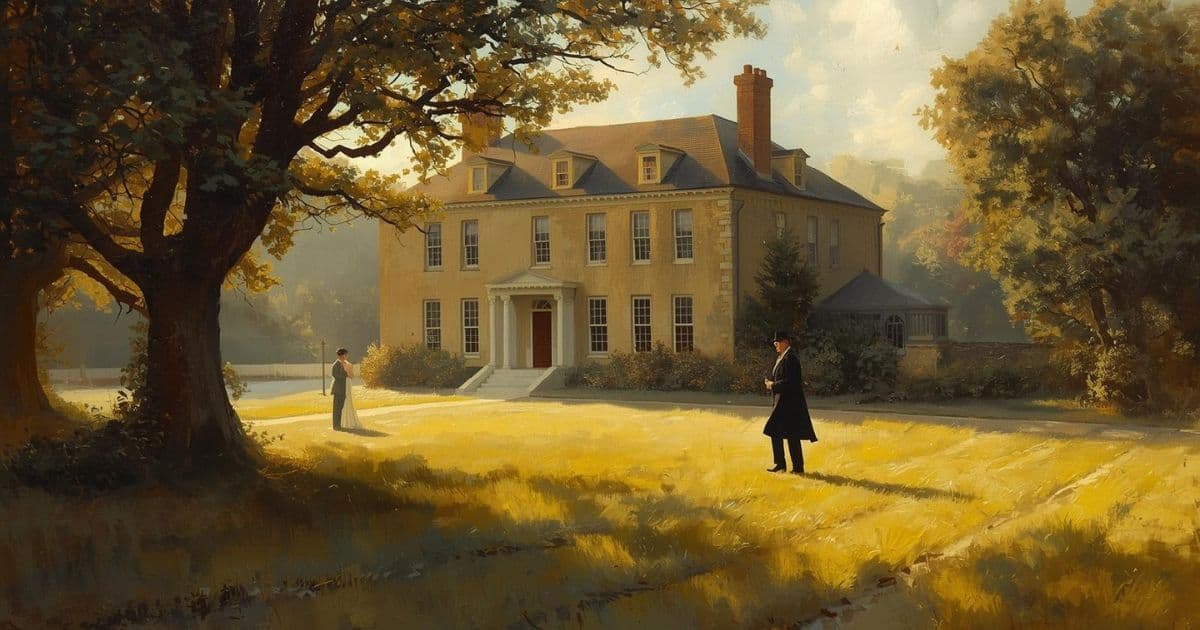
One morning, about a week after Bingley’s engagement with Jane had been
formed, as he and the females of the family were sitting together in the
dining-room, their attention was suddenly drawn to the window by the
sound of a carriage; and they perceived a chaise and four driving up the
lawn. It was too early in the morning for visitors; and besides, the
equipage did not answer to that of any of their neighbours. The horses
were post; and neither the carriage, nor the livery of the servant who
preceded it, were familiar to them. As it was certain, however, that
somebody was coming, Bingley instantly prevailed on Miss Bennet to avoid
the confinement of such an intrusion, and walk away with him into the
shrubbery. They both set off; and the conjectures of the remaining three
continued, though with little satisfaction, till the door was thrown
open, and their visitor entered. It was Lady Catherine de Bourgh.
They were of course all intending to be surprised: but their
astonishment was beyond their expectation; and on the part of Mrs.
Bennet and Kitty, though she was perfectly unknown to them, even
inferior to what Elizabeth felt.
She entered the room with an air more than usually ungracious, made no
other reply to Elizabeth’s salutation than a slight inclination of the
head, and sat down without saying a word. Elizabeth had mentioned her
name to her mother on her Ladyship’s entrance, though no request of
introduction had been made.
Mrs. Bennet, all amazement, though flattered by having a guest of such
high importance, received her with the utmost politeness. After sitting
for a moment in silence, she said, very stiffly, to Elizabeth,--
“I hope you are well, Miss Bennet. That lady, I suppose, is your
mother?”
Elizabeth replied very concisely that she was.
“And that, I suppose, is one of your sisters?”
“Yes, madam,” said Mrs. Bennet, delighted to speak to a Lady Catherine.
“She is my youngest girl but one. My youngest of all is lately married,
and my eldest is somewhere about the ground, walking with a young man,
who, I believe, will soon become a part of the family.”
“You have a very small park here,” returned Lady Catherine, after a
short silence.
“It is nothing in comparison of Rosings, my Lady, I dare say; but, I
assure you, it is much larger than Sir William Lucas’s.”
“This must be a most inconvenient sitting-room for the evening in
summer: the windows are full west.”
Mrs. Bennet assured her that they never sat there after dinner; and then
added,--
“May I take the liberty of asking your Ladyship whether you left Mr. and
Mrs. Collins well?”
“Yes, very well. I saw them the night before last.”
Elizabeth now expected that she would produce a letter for her from
Charlotte, as it seemed the only probable motive for her calling. But no
letter appeared, and she was completely puzzled.
Mrs. Bennet, with great civility, begged her Ladyship to take some
refreshment: but Lady Catherine very resolutely, and not very politely,
declined eating anything; and then, rising up, said to Elizabeth,--
“Miss Bennet, there seemed to be a prettyish kind of a little wilderness
on one side of your lawn. I should be glad to take a turn in it, if you
will favour me with your company.”
“Go, my dear,” cried her mother, “and show her Ladyship about the
different walks. I think she will be pleased with the hermitage.”
Elizabeth obeyed; and, running into her own room for her parasol,
attended her noble guest downstairs. As they passed through the hall,
Lady Catherine opened the doors into the dining-parlour and
drawing-room, and pronouncing them, after a short survey, to be
decent-looking rooms, walked on.
Her carriage remained at the door, and Elizabeth saw that her
waiting-woman was in it. They proceeded in silence along the gravel walk
that led to the copse; Elizabeth was determined to make no effort for
conversation with a woman who was now more than usually insolent and
disagreeable.
[Illustration:
“After a short survey”
[Copyright 1894 by George Allen.]]
“How could I ever think her like her nephew?” said she, as she looked in
her face.
As soon as they entered the copse, Lady Catherine began in the following
manner:--
“You can be at no loss, Miss Bennet, to understand the reason of my
journey hither. Your own heart, your own conscience, must tell you why I
come.”
Elizabeth looked with unaffected astonishment.
“Indeed, you are mistaken, madam; I have not been at all able to account
for the honour of seeing you here.”
“Miss Bennet,” replied her Ladyship, in an angry tone, “you ought to
know that I am not to be trifled with. But however insincere you may
choose to be, you shall not find me so. My character has ever been
celebrated for its sincerity and frankness; and in a cause of such
moment as this, I shall certainly not depart from it. A report of a most
alarming nature reached me two days ago. I was told, that not only your
sister was on the point of being most advantageously married, but that
you--that Miss Elizabeth Bennet would, in all likelihood, be soon
afterwards united to my nephew--my own nephew, Mr. Darcy. Though I
know it must be a scandalous falsehood, though I would not injure him
so much as to suppose the truth of it possible, I instantly resolved on
setting off for this place, that I might make my sentiments known to
you.”
“If you believed it impossible to be true,” said Elizabeth, colouring
with astonishment and disdain, “I wonder you took the trouble of coming
so far. What could your Ladyship propose by it?”
“At once to insist upon having such a report universally contradicted.”
“Your coming to Longbourn, to see me and my family,” said Elizabeth
coolly, “will be rather a confirmation of it--if, indeed, such a report
is in existence.”
“If! do you then pretend to be ignorant of it? Has it not been
industriously circulated by yourselves? Do you not know that such a
report is spread abroad?”
“I never heard that it was.”
“And can you likewise declare, that there is no foundation for it?”
“I do not pretend to possess equal frankness with your Ladyship. You
may ask questions which I shall not choose to answer.”
“This is not to be borne. Miss Bennet, I insist on being satisfied. Has
he, has my nephew, made you an offer of marriage?”
“Your Ladyship has declared it to be impossible.”
“It ought to be so; it must be so, while he retains the use of his
reason. But your arts and allurements may, in a moment of infatuation,
have made him forget what he owes to himself and to all his family. You
may have drawn him in.”
“If I have, I shall be the last person to confess it.”
“Miss Bennet, do you know who I am? I have not been accustomed to such
language as this. I am almost the nearest relation he has in the world,
and am entitled to know all his dearest concerns.”
“But you are not entitled to know mine; nor will such behaviour as
this ever induce me to be explicit.”
“Let me be rightly understood. This match, to which you have the
presumption to aspire, can never take place. No, never. Mr. Darcy is
engaged to my daughter. Now, what have you to say?”
“Only this,--that if he is so, you can have no reason to suppose he will
make an offer to me.”
Lady Catherine hesitated for a moment, and then replied,--
“The engagement between them is of a peculiar kind. From their infancy,
they have been intended for each other. It was the favourite wish of
his mother, as well as of hers. While in their cradles we planned the
union; and now, at the moment when the wishes of both sisters would be
accomplished, is their marriage to be prevented by a young woman of
inferior birth, of no importance in the world, and wholly unallied to
the family? Do you pay no regard to the wishes of his friends--to his
tacit engagement with Miss de Bourgh? Are you lost to every feeling of
propriety and delicacy? Have you not heard me say, that from his
earliest hours he was destined for his cousin?”
“Yes; and I had heard it before. But what is that to me? If there is no
other objection to my marrying your nephew, I shall certainly not be
kept from it by knowing that his mother and aunt wished him to marry
Miss de Bourgh. You both did as much as you could in planning the
marriage. Its completion depended on others. If Mr. Darcy is neither by
honour nor inclination confined to his cousin, why is not he to make
another choice? And if I am that choice, why may not I accept him?”
“Because honour, decorum, prudence--nay, interest--forbid it. Yes, Miss
Bennet, interest; for do not expect to be noticed by his family or
friends, if you wilfully act against the inclinations of all. You will
be censured, slighted, and despised, by everyone connected with him.
Your alliance will be a disgrace; your name will never even be mentioned
by any of us.”
“These are heavy misfortunes,” replied Elizabeth. “But the wife of Mr.
Darcy must have such extraordinary sources of happiness necessarily
attached to her situation, that she could, upon the whole, have no cause
to repine.”
“Obstinate, headstrong girl! I am ashamed of you! Is this your gratitude
for my attentions to you last spring? Is nothing due to me on that
score? Let us sit down. You are to understand, Miss Bennet, that I came
here with the determined resolution of carrying my purpose; nor will I
be dissuaded from it. I have not been used to submit to any person’s
whims. I have not been in the habit of brooking disappointment.”
“That will make your Ladyship’s situation at present more pitiable;
but it will have no effect on me.”
“I will not be interrupted! Hear me in silence. My daughter and my
nephew are formed for each other. They are descended, on the maternal
side, from the same noble line; and, on the father’s, from respectable,
honourable, and ancient, though untitled, families. Their fortune on
both sides is splendid. They are destined for each other by the voice of
every member of their respective houses; and what is to divide
them?--the upstart pretensions of a young woman without family,
connections, or fortune! Is this to be endured? But it must not, shall
not be! If you were sensible of your own good, you would not wish to
quit the sphere in which you have been brought up.”
“In marrying your nephew, I should not consider myself as quitting that
sphere. He is a gentleman; I am a gentleman’s daughter; so far we are
equal.”
“True. You are a gentleman’s daughter. But what was your mother? Who
are your uncles and aunts? Do not imagine me ignorant of their
condition.”
“Whatever my connections may be,” said Elizabeth, “if your nephew does
not object to them, they can be nothing to you.”
“Tell me, once for all, are you engaged to him?”
Though Elizabeth would not, for the mere purpose of obliging Lady
Catherine, have answered this question, she could not but say, after a
moment’s deliberation,--
“I am not.”
Lady Catherine seemed pleased.
“And will you promise me never to enter into such an engagement?”
“I will make no promise of the kind.”
“Miss Bennet, I am shocked and astonished. I expected to find a more
reasonable young woman. But do not deceive yourself into a belief that I
will ever recede. I shall not go away till you have given me the
assurance I require.”
“And I certainly never shall give it. I am not to be intimidated into
anything so wholly unreasonable. Your Ladyship wants Mr. Darcy to marry
your daughter; but would my giving you the wished-for promise make
their marriage at all more probable? Supposing him to be attached to
me, would my refusing to accept his hand make him wish to bestow it on
his cousin? Allow me to say, Lady Catherine, that the arguments with
which you have supported this extraordinary application have been as
frivolous as the application was ill-judged. You have widely mistaken my
character, if you think I can be worked on by such persuasions as these.
How far your nephew might approve of your interference in his affairs,
I cannot tell; but you have certainly no right to concern yourself in
mine. I must beg, therefore, to be importuned no further on the
subject.”
“Not so hasty, if you please. I have by no means done. To all the
objections I have already urged I have still another to add. I am no
stranger to the particulars of your youngest sister’s infamous
elopement. I know it all; that the young man’s marrying her was a
patched-up business, at the expense of your father and uncle. And is
such a girl to be my nephew’s sister? Is her husband, who is the son
of his late father’s steward, to be his brother? Heaven and earth!--of
what are you thinking? Are the shades of Pemberley to be thus polluted?”
“You can now have nothing further to say,” she resentfully answered.
“You have insulted me, in every possible method. I must beg to return to
the house.”
And she rose as she spoke. Lady Catherine rose also, and they turned
back. Her Ladyship was highly incensed.
“You have no regard, then, for the honour and credit of my nephew!
Unfeeling, selfish girl! Do you not consider that a connection with you
must disgrace him in the eyes of everybody?”
“Lady Catherine, I have nothing further to say. You know my sentiments.”
“You are then resolved to have him?”
“I have said no such thing. I am only resolved to act in that manner,
which will, in my own opinion, constitute my happiness, without
reference to you, or to any person so wholly unconnected with me.”
“It is well. You refuse, then, to oblige me. You refuse to obey the
claims of duty, honour, and gratitude. You are determined to ruin him in
the opinion of all his friends, and make him the contempt of the world.”
“Neither duty, nor honour, nor gratitude,” replied Elizabeth, “has any
possible claim on me, in the present instance. No principle of either
would be violated by my marriage with Mr. Darcy. And with regard to the
resentment of his family, or the indignation of the world, if the former
were excited by his marrying me, it would not give me one moment’s
concern--and the world in general would have too much sense to join in
the scorn.”
“And this is your real opinion! This is your final resolve! Very well. I
shall now know how to act. Do not imagine, Miss Bennet, that your
ambition will ever be gratified. I came to try you. I hoped to find you
reasonable; but depend upon it I will carry my point.”
In this manner Lady Catherine talked on till they were at the door of
the carriage, when, turning hastily round, she added,--
“I take no leave of you, Miss Bennet. I send no compliments to your
mother. You deserve no such attention. I am most seriously displeased.”
Elizabeth made no answer; and without attempting to persuade her
Ladyship to return into the house, walked quietly into it herself. She
heard the carriage drive away as she proceeded upstairs. Her mother
impatiently met her at the door of her dressing-room, to ask why Lady
Catherine would not come in again and rest herself.
“She did not choose it,” said her daughter; “she would go.”
“She is a very fine-looking woman! and her calling here was prodigiously
civil! for she only came, I suppose, to tell us the Collinses were well.
She is on her road somewhere, I dare say; and so, passing through
Meryton, thought she might as well call on you. I suppose she had
nothing particular to say to you, Lizzy?”
Elizabeth was forced to give in to a little falsehood here; for to
acknowledge the substance of their conversation was impossible.
[Illustration:
“But now it comes out”
]
Master this chapter. Complete your experience
Purchase the complete book to access all chapters and support classic literature
As an Amazon Associate, we earn a small commission from qualifying purchases at no additional cost to you.
Available in paperback, hardcover, and e-book formats
Let's Analyse the Pattern
Why This Matters
Connect literature to life
This chapter teaches how to recognize when someone's aggressive demands actually signal their loss of control, not their strength.
Now let's explore the literary elements.
Key Quotes & Analysis
"I am not to be intimidated into anything so wholly unreasonable."
Context: Elizabeth's response to Lady Catherine's demands that she promise never to marry Darcy.
This line captures Elizabeth's transformation into someone who won't be bullied, even by the most powerful people in society. It shows she's learned to value her own judgment over social pressure.
"Do you know who I am? I have not been accustomed to such language as this."
Context: Lady Catherine's shock when Elizabeth refuses to submit to her authority.
Reveals how rarely anyone has dared to stand up to Lady Catherine. Her outrage shows how the aristocracy expected automatic deference from their social inferiors.
"You have no right to concern yourself in my affairs."
Context: Elizabeth firmly establishing boundaries when Lady Catherine tries to control her life.
A revolutionary statement for the time period. Elizabeth is asserting that even powerful aristocrats don't get to dictate the personal choices of people they consider beneath them.
Thematic Threads
Class
In This Chapter
Lady Catherine expects her aristocratic status to automatically grant her control over Elizabeth's romantic choices
Development
Evolved from earlier subtle class tensions to direct confrontation between aristocratic entitlement and middle-class dignity
In Your Life:
When someone tries to use their wealth, status, or connections to pressure you into a decision, how do you maintain your sense of self-worth and autonomy?
Power
In This Chapter
True power is revealed through Elizabeth's calm refusal to be intimidated versus Lady Catherine's desperate threats
Development
Builds on earlier themes of earned versus inherited authority, now showing how quiet strength defeats bluster
In Your Life:
Have you ever discovered that staying calm and standing your ground was more powerful than arguing back when someone tried to bully or intimidate you?
Pride
In This Chapter
Lady Catherine's pride in her social position blinds her to how her behavior actually undermines her influence
Development
Contrasts with Elizabeth's earlier pride issues—Elizabeth has learned humility while Lady Catherine remains trapped by arrogance
In Your Life:
Can you think of a time when your own pride or assumptions about your importance actually worked against you in a conflict or relationship?
Personal Growth
In This Chapter
Elizabeth demonstrates remarkable composure and wisdom in handling an intimidating confrontation
Development
Shows the culmination of Elizabeth's journey from impulsive judgment to mature self-possession
In Your Life:
How do you handle confrontational situations now compared to when you were younger—what has helped you develop more composure under pressure?
Marriage
In This Chapter
The chapter reveals that marriage choices belong to individuals, not to family patriarchs or social expectations
Development
Reinforces the novel's progressive stance that love and compatibility matter more than social arrangement
In Your Life:
When family members or friends have strong opinions about your romantic relationships, how do you balance respecting their input with making your own choices?
You now have the context. Time to form your own thoughts.
Discussion Questions
- 1
What specific tactics does Lady Catherine use to try to force Elizabeth to promise she won't marry Darcy, and how does Elizabeth respond to each one?
- 2
Why does Lady Catherine's visit actually backfire and strengthen Elizabeth's position rather than weaken it?
- 3
Where do you see people today using threats and demands when they feel their authority or influence slipping away?
- 4
How would you handle someone who shows up demanding you make promises about your personal choices, especially if they have more social power than you?
- 5
What does this confrontation reveal about the difference between real strength and the appearance of power?
Critical Thinking Exercise
Map the Desperation Signals
Think of a time when someone escalated to threats or demands with you - a boss, family member, or authority figure. Write down their exact words and tactics, then analyze what they were really afraid of losing. What did their escalation reveal about their actual power versus their perceived power?
Consider:
- •Notice the gap between what they claimed their authority was based on versus what they actually had control over
- •Consider whether their threats were realistic or empty bluffs designed to intimidate
- •Reflect on how staying calm and not engaging with their emotional escalation might have changed the dynamic
Coming Up Next...
Chapter 57
Lady Catherine's failed intimidation attempt has unexpected consequences that reach far beyond the Bennet household. Meanwhile, Elizabeth must grapple with what this confrontation reveals about her own feelings and the possibilities that lie ahead.