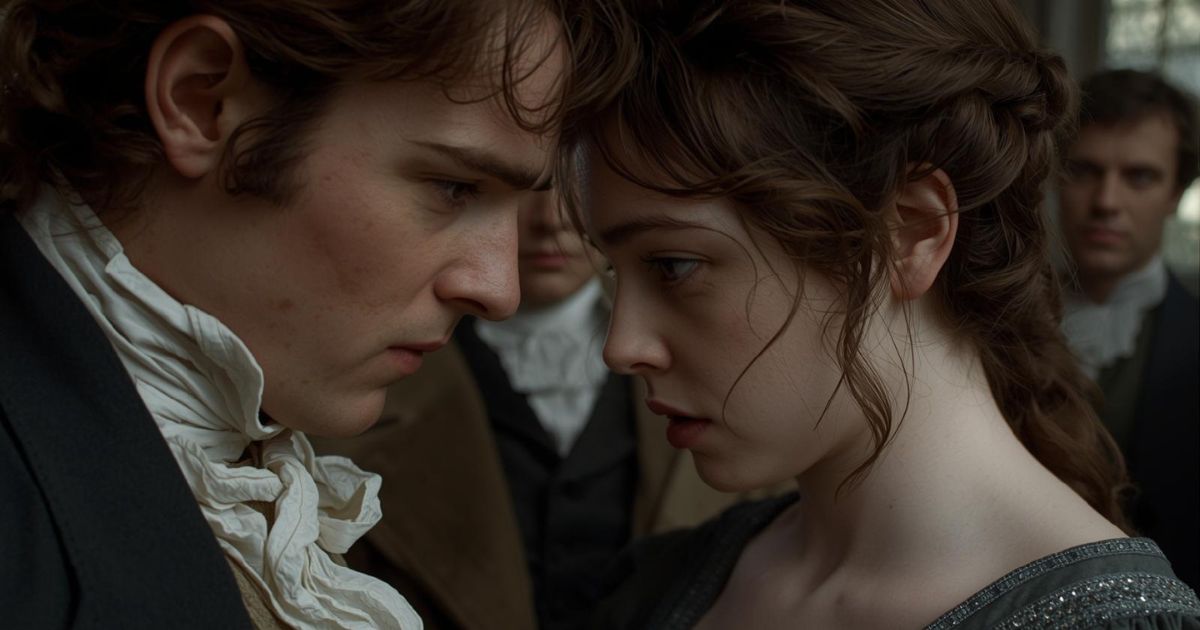
An excerpt from the original text.(complete · 1663 words)
VII.
[Illustration]
The discomposure of spirits which this extraordinary visit threw
Elizabeth into could not be easily overcome; nor could she for many
hours learn to think of it less than incessantly. Lady Catherine, it
appeared, had actually taken the trouble of this journey from Rosings
for the sole purpose of breaking off her supposed engagement with Mr.
Darcy. It was a rational scheme, to be sure! but from what the report of
their engagement could originate, Elizabeth was at a loss to imagine;
till she recollected that his being the intimate friend of Bingley,
and her being the sister of Jane, was enough, at a time when the
expectation of one wedding made everybody eager for another, to supply
the idea. She had not herself forgotten to feel that the marriage of her
sister must bring them more frequently together. And her neighbours at
Lucas Lodge, therefore, (for through their communication with the
Collinses, the report, she concluded, had reached Lady Catherine,) had
only set that down as almost certain and immediate which she had
looked forward to as possible at some future time.
In revolving Lady Catherine’s expressions, however, she could not help
feeling some uneasiness as to the possible consequence of her persisting
in this interference. From what she had said of her resolution to
prevent the marriage, it occurred to Elizabeth that she must meditate an
application to her nephew; and how he might take a similar
representation of the evils attached to a connection with her she dared
not pronounce. She knew not the exact degree of his affection for his
aunt, or his dependence on her judgment, but it was natural to suppose
that he thought much higher of her Ladyship than she could do; and it
was certain, that in enumerating the miseries of a marriage with one
whose immediate connections were so unequal to his own, his aunt would
address him on his weakest side. With his notions of dignity, he would
probably feel that the arguments, which to Elizabeth had appeared weak
and ridiculous, contained much good sense and solid reasoning.
If he had been wavering before, as to what he should do, which had often
seemed likely, the advice and entreaty of so near a relation might
settle every doubt, and determine him at once to be as happy as dignity
unblemished could make him. In that case he would return no more. Lady
Catherine might see him in her way through town; and his engagement to
Bingley of coming again to Netherfield must give way.
“If, therefore, an excuse for not keeping his promise should come to his
friend within a few days,” she added, “I shall know how to understand
it. I shall then give over every expectation, every wish of his
constancy. If he is satisfied with only regretting me, when he might
have obtained my affections and hand, I shall soon cease to regret him
at all.”
The surprise of the rest of the family, on hearing who their visitor had
been, was very great: but they obligingly satisfied it with the same
kind of supposition which had appeased Mrs. Bennet’s curiosity; and
Elizabeth was spared from much teasing on the subject.
The next morning, as she was going down stairs, she was met by her
father, who came out of his library with a letter in his hand.
“Lizzy,” said he, “I was going to look for you: come into my room.”
She followed him thither; and her curiosity to know what he had to tell
her was heightened by the supposition of its being in some manner
connected with the letter he held. It suddenly struck her that it might
be from Lady Catherine, and she anticipated with dismay all the
consequent explanations.
She followed her father to the fireplace, and they both sat down. He
then said,--
“I have received a letter this morning that has astonished me
exceedingly. As it principally concerns yourself, you ought to know its
contents. I did not know before that I had two daughters on the brink
of matrimony. Let me congratulate you on a very important conquest.”
The colour now rushed into Elizabeth’s cheeks in the instantaneous
conviction of its being a letter from the nephew, instead of the aunt;
and she was undetermined whether most to be pleased that he explained
himself at all, or offended that his letter was not rather addressed to
herself, when her father continued,--
“You look conscious. Young ladies have great penetration in such matters
as these; but I think I may defy even your sagacity to discover the
name of your admirer. This letter is from Mr. Collins.”
“From Mr. Collins! and what can he have to say?”
“Something very much to the purpose, of course. He begins with
congratulations on the approaching nuptials of my eldest daughter, of
which, it seems, he has been told by some of the good-natured, gossiping
Lucases. I shall not sport with your impatience by reading what he says
on that point. What relates to yourself is as follows:--‘Having thus
offered you the sincere congratulations of Mrs. Collins and myself on
this happy event, let me now add a short hint on the subject of another,
of which we have been advertised by the same authority. Your daughter
Elizabeth, it is presumed, will not long bear the name of Bennet, after
her eldest sister has resigned it; and the chosen partner of her fate
may be reasonably looked up to as one of the most illustrious personages
in this land.’ Can you possibly guess, Lizzy, who is meant by this?
‘This young gentleman is blessed, in a peculiar way, with everything the
heart of mortal can most desire,--splendid property, noble kindred, and
extensive patronage. Yet, in spite of all these temptations, let me warn
my cousin Elizabeth, and yourself, of what evils you may incur by a
precipitate closure with this gentleman’s proposals, which, of course,
you will be inclined to take immediate advantage of.’ Have you any idea,
Lizzy, who this gentleman is? But now it comes out. ‘My motive for
cautioning you is as follows:--We have reason to imagine that his aunt,
Lady Catherine de Bourgh, does not look on the match with a friendly
eye.’ Mr. Darcy, you see, is the man! Now, Lizzy, I think I have
surprised you. Could he, or the Lucases, have pitched on any man, within
the circle of our acquaintance, whose name would have given the lie more
effectually to what they related? Mr. Darcy, who never looks at any
woman but to see a blemish, and who probably never looked at you in
his life! It is admirable!”
Elizabeth tried to join in her father’s pleasantry, but could only force
one most reluctant smile. Never had his wit been directed in a manner so
little agreeable to her.
“Are you not diverted?”
“Oh, yes. Pray read on.”
“‘After mentioning the likelihood of this marriage to her Ladyship last
night, she immediately, with her usual condescension, expressed what she
felt on the occasion; when it became apparent, that, on the score of
some family objections on the part of my cousin, she would never give
her consent to what she termed so disgraceful a match. I thought it my
duty to give the speediest intelligence of this to my cousin, that she
and her noble admirer may be aware of what they are about, and not run
hastily into a marriage which has not been properly sanctioned.’ Mr.
Collins, moreover, adds, ‘I am truly rejoiced that my cousin Lydia’s sad
business has been so well hushed up, and am only concerned that their
living together before the marriage took place should be so generally
known. I must not, however, neglect the duties of my station, or refrain
from declaring my amazement, at hearing that you received the young
couple into your house as soon as they were married. It was an
encouragement of vice; and had I been the rector of Longbourn, I should
very strenuously have opposed it. You ought certainly to forgive them as
a Christian, but never to admit them in your sight, or allow their
names to be mentioned in your hearing.’ That is his notion of
Christian forgiveness! The rest of his letter is only about his dear
Charlotte’s situation, and his expectation of a young olive-branch. But,
Lizzy, you look as if you did not enjoy it. You are not going to be
missish, I hope, and pretend to be affronted at an idle report. For
what do we live, but to make sport for our neighbours, and laugh at them
in our turn?”
“Oh,” cried Elizabeth, “I am exceedingly diverted. But it is so
strange!”
“Yes, that is what makes it amusing. Had they fixed on any other man
it would have been nothing; but his perfect indifference and your
pointed dislike make it so delightfully absurd! Much as I abominate
writing, I would not give up Mr. Collins’s correspondence for any
consideration. Nay, when I read a letter of his, I cannot help giving
him the preference even over Wickham, much as I value the impudence and
hypocrisy of my son-in-law. And pray, Lizzy, what said Lady Catherine
about this report? Did she call to refuse her consent?”
To this question his daughter replied only with a laugh; and as it had
been asked without the least suspicion, she was not distressed by his
repeating it. Elizabeth had never been more at a loss to make her
feelings appear what they were not. It was necessary to laugh when she
would rather have cried. Her father had most cruelly mortified her by
what he said of Mr. Darcy’s indifference; and she could do nothing but
wonder at such a want of penetration, or fear that, perhaps, instead of
his seeing too little, she might have fancied too much.
[Illustration:
“The efforts of his aunt”
[Copyright 1894 by George Allen.]]
Master this chapter. Complete your experience
Purchase the complete book to access all chapters and support classic literature
As an Amazon Associate, we earn a small commission from qualifying purchases at no additional cost to you.
Available in paperback, hardcover, and e-book formats
Let's Analyse the Pattern
Why This Matters
Connect literature to life
This chapter teaches how to identify whose opinions actually matter by examining their knowledge of your authentic self and their investment in your genuine wellbeing.
Now let's explore the literary elements.
Key Quotes & Analysis
"I know your disposition, Lizzy. I know that you could be neither happy nor respectable, unless you truly esteemed your husband."
Context: He explains why he was initially concerned about her engagement to Darcy.
This shows how well Mr. Bennet understands his daughter's character. He knows Elizabeth needs genuine respect and admiration in marriage, not just security or social advancement.
"Indeed he has no improper pride. He is perfectly amiable."
Context: She defends Darcy's character to her father.
This complete reversal from her earlier opinions shows Elizabeth's growth. She can now see Darcy's true nature and articulate why she loves him without embarrassment.
"If any young men come for Mary or Kitty, send them away directly, for I am quite at leisure."
Context: His humorous response after giving Elizabeth his blessing.
This joke shows Mr. Bennet's relief and happiness. He's moved from worry to joy, and his humor indicates he's completely comfortable with Elizabeth's choice.
Thematic Threads
Validation
In This Chapter
Elizabeth seeks her father's blessing not from duty but because his opinion matters—he knows her character and needs
Development
Evolved from seeking approval from society to valuing judgment from those who truly know her
In Your Life:
When making important life decisions, whose opinion do you truly value and why—and how has that changed as you've grown older?
Personal Growth
In This Chapter
Elizabeth can now articulate her feelings for Darcy without defensiveness, showing emotional maturity
Development
Culmination of her journey from reactive judgments to thoughtful self-awareness
In Your Life:
Can you think of a time when you were able to discuss a difficult topic or admit feelings without getting defensive, and what helped you reach that level of emotional maturity?
Marriage
In This Chapter
Mr. Bennet's relief that Elizabeth chose love with respect over convenience reveals what makes marriages work
Development
Contrasts sharply with the Bennet marriage and other convenience-based unions shown throughout
In Your Life:
What qualities do you believe are essential for a successful long-term relationship, and how do they differ from what might seem practical or convenient?
Class
In This Chapter
Mr. Bennet's concerns aren't about Darcy's wealth but about Elizabeth's authentic happiness
Development
Shows how true worth transcends social position—a theme that's been building since Elizabeth first misjudged Darcy
In Your Life:
When evaluating potential partners or friends, do you focus more on their status and achievements or on whether they genuinely care about your happiness?
Pride
In This Chapter
Elizabeth's ability to admit she was wrong about Darcy shows healthy pride—confidence without defensiveness
Development
Transformed from stubborn pride that refused to see truth to mature pride that can acknowledge growth
In Your Life:
Can you recall a recent situation where you admitted you were wrong about someone or something—what made you confident enough to acknowledge that growth?
You now have the context. Time to form your own thoughts.
Discussion Questions
- 1
What concerns does Mr. Bennet express when Elizabeth tells him about her engagement to Darcy, and how does she address them?
- 2
Why does Mr. Bennet's opinion matter so much to Elizabeth, especially compared to her mother's reaction?
- 3
Think about a time when someone who knew you well questioned a decision you were making. How did their perspective help or challenge you?
- 4
When facing a major life choice, how do you decide whose opinion to seek and whose to ignore? What makes someone qualified to give you advice?
- 5
What does this scene reveal about the difference between seeking approval and seeking wisdom from people who truly know us?
Critical Thinking Exercise
Map Your Validation Network
Think of a significant decision you're currently considering or recently made. List three people whose opinion would matter to you about this choice. For each person, write down why their perspective carries weight with you - what do they know about you that makes their input valuable? Then identify one person whose approval you might want but whose opinion shouldn't actually influence this decision, and explain why.
Consider:
- •Consider whether each person knows your values and patterns, or just your public image
- •Think about whether they have your authentic best interests at heart, not just what looks good
- •Reflect on whether their life experience gives them insight into your specific situation
Coming Up Next...
Chapter 58
When Darcy unexpectedly returns to Longbourn with Bingley, Elizabeth will finally get the chance she's been desperately hoping for - but will she have the courage to take it?