An excerpt from the original text.(complete · 2327 words)
V.
[Illustration]
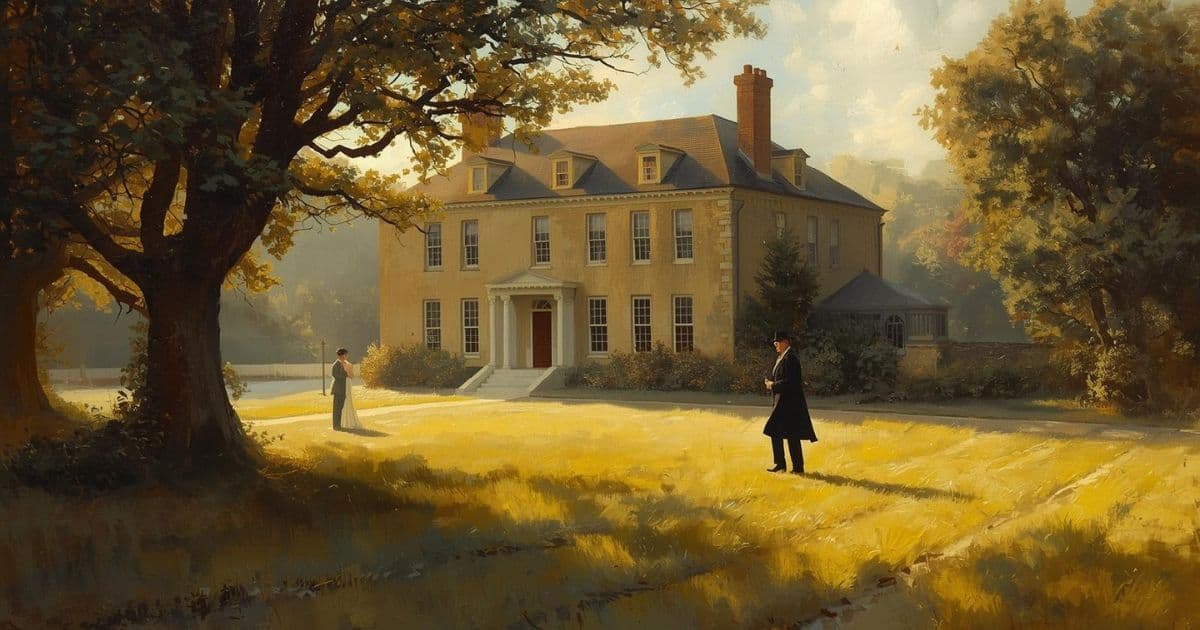
A few days after this visit, Mr. Bingley called again, and alone. His
friend had left him that morning for London, but was to return home in
ten days’ time. He sat with them above an hour, and was in remarkably
good spirits. Mrs. Bennet invited him to dine with them; but, with many
expressions of concern, he confessed himself engaged elsewhere.
“Next time you call,” said she, “I hope we shall be more lucky.”
He should be particularly happy at any time, etc., etc.; and if she
would give him leave, would take an early opportunity of waiting on
them.
“Can you come to-morrow?”
Yes, he had no engagement at all for to-morrow; and her invitation was
accepted with alacrity.
He came, and in such very good time, that the ladies were none of them
dressed. In ran Mrs. Bennet to her daughters’ room, in her
dressing-gown, and with her hair half finished, crying out,--
“My dear Jane, make haste and hurry down. He is come--Mr. Bingley is
come. He is, indeed. Make haste, make haste. Here, Sarah, come to Miss
Bennet this moment, and help her on with her gown. Never mind Miss
Lizzy’s hair.”
“We will be down as soon as we can,” said Jane; “but I dare say Kitty is
forwarder than either of us, for she went upstairs half an hour ago.”
“Oh! hang Kitty! what has she to do with it? Come, be quick, be quick!
where is your sash, my dear?”
But when her mother was gone, Jane would not be prevailed on to go down
without one of her sisters.
The same anxiety to get them by themselves was visible again in the
evening. After tea, Mr. Bennet retired to the library, as was his
custom, and Mary went upstairs to her instrument. Two obstacles of the
five being thus removed, Mrs. Bennet sat looking and winking at
Elizabeth and Catherine for a considerable time, without making any
impression on them. Elizabeth would not observe her; and when at last
Kitty did, she very innocently said, “What is the matter, mamma? What do
you keep winking at me for? What am I to do?”
“Nothing, child, nothing. I did not wink at you.” She then sat still
five minutes longer; but unable to waste such a precious occasion, she
suddenly got up, and saying to Kitty,--
“Come here, my love, I want to speak to you,” took her out of the room.
Jane instantly gave a look at Elizabeth which spoke her distress at such
premeditation, and her entreaty that she would not give in to it. In a
few minutes, Mrs. Bennet half opened the door and called out,--
“Lizzy, my dear, I want to speak with you.”
Elizabeth was forced to go.
“We may as well leave them by themselves, you know,” said her mother as
soon as she was in the hall. “Kitty and I are going upstairs to sit in
my dressing-room.”
Elizabeth made no attempt to reason with her mother, but remained
quietly in the hall till she and Kitty were out of sight, then returned
into the drawing-room.
Mrs. Bennet’s schemes for this day were ineffectual. Bingley was
everything that was charming, except the professed lover of her
daughter. His ease and cheerfulness rendered him a most agreeable
addition to their evening party; and he bore with the ill-judged
officiousness of the mother, and heard all her silly remarks with a
forbearance and command of countenance particularly grateful to the
daughter.
He scarcely needed an invitation to stay supper; and before he went away
an engagement was formed, chiefly through his own and Mrs. Bennet’s
means, for his coming next morning to shoot with her husband.
After this day, Jane said no more of her indifference. Not a word passed
between the sisters concerning Bingley; but Elizabeth went to bed in the
happy belief that all must speedily be concluded, unless Mr. Darcy
returned within the stated time. Seriously, however, she felt tolerably
persuaded that all this must have taken place with that gentleman’s
concurrence.
Bingley was punctual to his appointment; and he and Mr. Bennet spent the
morning together, as had been agreed on. The latter was much more
agreeable than his companion expected. There was nothing of presumption
or folly in Bingley that could provoke his ridicule, or disgust him into
silence; and he was more communicative, and less eccentric, than the
other had ever seen him. Bingley of course returned with him to dinner;
and in the evening Mrs. Bennet’s invention was again at work to get
everybody away from him and her daughter. Elizabeth, who had a letter to
write, went into the breakfast-room for that purpose soon after tea; for
as the others were all going to sit down to cards, she could not be
wanted to counteract her mother’s schemes.
But on her returning to the drawing-room, when her letter was finished,
she saw, to her infinite surprise, there was reason to fear that her
mother had been too ingenious for her. On opening the door, she
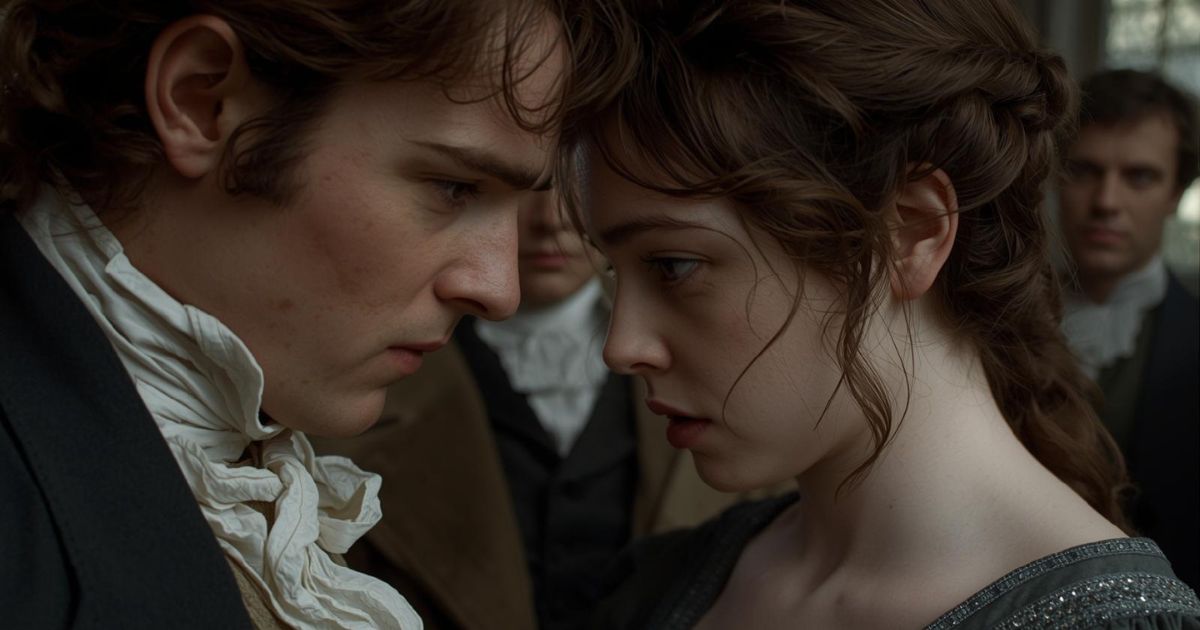
perceived her sister and Bingley standing together over the hearth, as
if engaged in earnest conversation; and had this led to no suspicion,
the faces of both, as they hastily turned round and moved away from each
other, would have told it all. Their situation was awkward enough; but
hers she thought was still worse. Not a syllable was uttered by
either; and Elizabeth was on the point of going away again, when
Bingley, who as well as the other had sat down, suddenly rose, and,
whispering a few words to her sister, ran out of the room.
Jane could have no reserves from Elizabeth, where confidence would give
pleasure; and, instantly embracing her, acknowledged, with the liveliest
emotion, that she was the happiest creature in the world.
“’Tis too much!” she added, “by far too much. I do not deserve it. Oh,
why is not everybody as happy?”
Elizabeth’s congratulations were given with a sincerity, a warmth, a
delight, which words could but poorly express. Every sentence of
kindness was a fresh source of happiness to Jane. But she would not
allow herself to stay with her sister, or say half that remained to be
said, for the present.
“I must go instantly to my mother,” she cried. “I would not on any
account trifle with her affectionate solicitude, or allow her to hear it
from anyone but myself. He is gone to my father already. Oh, Lizzy, to
know that what I have to relate will give such pleasure to all my dear
family! how shall I bear so much happiness?”
She then hastened away to her mother, who had purposely broken up the
card-party, and was sitting upstairs with Kitty.
Elizabeth, who was left by herself, now smiled at the rapidity and ease
with which an affair was finally settled, that had given them so many
previous months of suspense and vexation.
“And this,” said she, “is the end of all his friend’s anxious
circumspection! of all his sister’s falsehood and contrivance! the
happiest, wisest, and most reasonable end!”
In a few minutes she was joined by Bingley, whose conference with her
father had been short and to the purpose.
“Where is your sister?” said he hastily, as he opened the door.
“With my mother upstairs. She will be down in a moment, I dare say.”
He then shut the door, and, coming up to her, claimed the good wishes
and affection of a sister. Elizabeth honestly and heartily expressed her
delight in the prospect of their relationship. They shook hands with
great cordiality; and then, till her sister came down, she had to listen
to all he had to say of his own happiness, and of Jane’s perfections;
and in spite of his being a lover, Elizabeth really believed all his
expectations of felicity to be rationally founded, because they had for
basis the excellent understanding and super-excellent disposition of
Jane, and a general similarity of feeling and taste between her and
himself.
It was an evening of no common delight to them all; the satisfaction of
Miss Bennet’s mind gave such a glow of sweet animation to her face, as
made her look handsomer than ever. Kitty simpered and smiled, and hoped
her turn was coming soon. Mrs. Bennet could not give her consent, or
speak her approbation in terms warm enough to satisfy her feelings,
though she talked to Bingley of nothing else, for half an hour; and when
Mr. Bennet joined them at supper, his voice and manner plainly showed
how really happy he was.
Not a word, however, passed his lips in allusion to it, till their
visitor took his leave for the night; but as soon as he was gone, he
turned to his daughter and said,--
“Jane, I congratulate you. You will be a very happy woman.”
Jane went to him instantly, kissed him, and thanked him for his
goodness.
“You are a good girl,” he replied, “and I have great pleasure in
thinking you will be so happily settled. I have not a doubt of your
doing very well together. Your tempers are by no means unlike. You are
each of you so complying, that nothing will ever be resolved on; so
easy, that every servant will cheat you; and so generous, that you will
always exceed your income.”
“I hope not so. Imprudence or thoughtlessness in money matters would be
unpardonable in me.”
“Exceed their income! My dear Mr. Bennet,” cried his wife, “what are you
talking of? Why, he has four or five thousand a year, and very likely
more.” Then addressing her daughter, “Oh, my dear, dear Jane, I am so
happy! I am sure I shan’t get a wink of sleep all night. I knew how it
would be. I always said it must be so, at last. I was sure you could not
be so beautiful for nothing! I remember, as soon as ever I saw him, when
he first came into Hertfordshire last year, I thought how likely it was
that you should come together. Oh, he is the handsomest young man that
ever was seen!”
Wickham, Lydia, were all forgotten. Jane was beyond competition her
favourite child. At that moment she cared for no other. Her younger
sisters soon began to make interest with her for objects of happiness
which she might in future be able to dispense.
Mary petitioned for the use of the library at Netherfield; and Kitty
begged very hard for a few balls there every winter.
Bingley, from this time, was of course a daily visitor at Longbourn;
coming frequently before breakfast, and always remaining till after
supper; unless when some barbarous neighbour, who could not be enough
detested, had given him an invitation to dinner, which he thought
himself obliged to accept.
Elizabeth had now but little time for conversation with her sister; for
while he was present Jane had no attention to bestow on anyone else: but
she found herself considerably useful to both of them, in those hours of
separation that must sometimes occur. In the absence of Jane, he always
attached himself to Elizabeth for the pleasure of talking of her; and
when Bingley was gone, Jane constantly sought the same means of relief.
“He has made me so happy,” said she, one evening, “by telling me that he
was totally ignorant of my being in town last spring! I had not believed
it possible.”
“I suspected as much,” replied Elizabeth. “But how did he account for
it?”
“It must have been his sisters’ doing. They were certainly no friends to
his acquaintance with me, which I cannot wonder at, since he might have
chosen so much more advantageously in many respects. But when they see,
as I trust they will, that their brother is happy with me, they will
learn to be contented, and we shall be on good terms again: though we
can never be what we once were to each other.”
“That is the most unforgiving speech,” said Elizabeth, “that I ever
heard you utter. Good girl! It would vex me, indeed, to see you again
the dupe of Miss Bingley’s pretended regard.”
“Would you believe it, Lizzy, that when he went to town last November he
really loved me, and nothing but a persuasion of my being indifferent
would have prevented his coming down again?”
“He made a little mistake, to be sure; but it is to the credit of his
modesty.”
This naturally introduced a panegyric from Jane on his diffidence, and
the little value he put on his own good qualities.
Elizabeth was pleased to find that he had not betrayed the interference
of his friend; for, though Jane had the most generous and forgiving
heart in the world, she knew it was a circumstance which must prejudice
her against him.
“I am certainly the most fortunate creature that ever existed!” cried
Jane. “Oh, Lizzy, why am I thus singled from my family, and blessed
above them all? If I could but see you as happy! If there were but such
another man for you!”
“If you were to give me forty such men I never could be so happy as you.
Till I have your disposition, your goodness, I never can have your
happiness. No, no, let me shift for myself; and, perhaps, if I have very
good luck, I may meet with another Mr. Collins in time.”
The situation of affairs in the Longbourn family could not be long a
secret. Mrs. Bennet was privileged to whisper it to Mrs. Philips, and
she ventured, without any permission, to do the same by all her
neighbours in Meryton.
The Bennets were speedily pronounced to be the luckiest family in the
world; though only a few weeks before, when Lydia had first run away,
they had been generally proved to be marked out for misfortune.
[Illustration]
Master this chapter. Complete your experience
Purchase the complete book to access all chapters and support classic literature
As an Amazon Associate, we earn a small commission from qualifying purchases at no additional cost to you.
Available in paperback, hardcover, and e-book formats
Let's Analyse the Pattern
Why This Matters
Connect literature to life
This chapter teaches how to recognize when someone uses intimidation to mask a weak position, and how desperation often masquerades as authority.
Now let's explore the literary elements.
Key Quotes & Analysis
"I am not to be intimidated into anything so wholly unreasonable."
Context: Elizabeth's response to Lady Catherine's demands that she promise not to marry Darcy.
This shows Elizabeth's complete transformation from someone who once felt small around powerful people. She's learned that unreasonable demands don't deserve reasonable responses, no matter who makes them.
"Do you know who I am? I have not been accustomed to such language as this."
Context: Lady Catherine's shocked reaction when Elizabeth refuses to back down.
Reveals how Lady Catherine has lived in a bubble where her title protected her from any challenge. She genuinely can't understand why Elizabeth won't automatically defer to her rank.
"You have no regard, then, for the honour and credit of my nephew!"
Context: Lady Catherine trying to shame Elizabeth by suggesting the match would disgrace Darcy.
Shows Lady Catherine's weapon of choice - making people feel unworthy. But Elizabeth has learned that her worth isn't determined by other people's approval, even from the wealthy and titled.
Thematic Threads
Class Privilege
In This Chapter
Lady Catherine weaponizes her title and wealth as her primary arguments, expecting social rank alone to win the battle
Development
Evolution from earlier subtle class tensions to direct confrontation where privilege meets its match
In Your Life:
When have you seen someone use their wealth, status, or connections to try to get their way instead of making a valid argument?
Personal Growth
In This Chapter
Elizabeth stands firm against intimidation, showing how far she's traveled from her earlier insecurities about social position
Development
Culmination of Elizabeth's journey from self-doubt to self-assurance, now tested under extreme pressure
In Your Life:
Think of a time when you had to stand up for yourself despite feeling intimidated - what gave you the strength to hold your ground?
Power Dynamics
In This Chapter
The scene reveals how real power works—Lady Catherine's loud demands expose weakness while Elizabeth's quiet refusal demonstrates strength
Development
Shift from traditional authority based on birth to earned authority based on character and principle
In Your Life:
Have you ever noticed how the loudest, most demanding person in a conflict is often the one who actually has the least real power?
Fear
In This Chapter
Lady Catherine's fury masks her terror that the social order she depends on is changing, making her increasingly desperate
Development
Introduced here as the driving force behind seemingly irrational behavior
In Your Life:
What social changes or generational shifts make you feel most anxious about losing control or relevance?
Boundaries
In This Chapter
Elizabeth's refusal to make promises she doesn't want to make shows the power of clear, calm boundary-setting
Development
Natural progression from Elizabeth learning to value herself to actively protecting that value
In Your Life:
When was the last time you said no to someone's demands without feeling obligated to justify or explain your decision?
You now have the context. Time to form your own thoughts.
Discussion Questions
- 1
What specific tactics does Lady Catherine use to try to intimidate Elizabeth, and how does Elizabeth respond to each one?
- 2
Why does Lady Catherine's visit actually help Elizabeth and Darcy's relationship instead of destroying it?
- 3
Think of a time when someone used their position or status to try to pressure you. What similarities do you see to Lady Catherine's approach?
- 4
If you were in Elizabeth's position, what would be the hardest part about standing your ground, and what strategies would help you stay calm?
- 5
What does Lady Catherine's desperation reveal about how power really works, and when people who seem powerful are actually most vulnerable?
Critical Thinking Exercise
Decode the Intimidation Playbook
Think of a situation where someone tried to pressure you using their authority, status, or what they've done for you rather than logical arguments. Write down their exact tactics, then identify what they were really afraid of losing. Finally, script three calm responses you could have used that would have exposed the weakness in their position.
Consider:
- •Notice when someone escalates volume or demands instead of improving their reasoning
- •Pay attention to what fears might be driving their aggressive behavior
- •Consider how staying calm and asking for specifics can reveal the holes in their argument
Coming Up Next...
Chapter 56
Just when it seems everything is settling into domestic happiness, an unexpected and unwelcome visitor is about to arrive with demands that will test Elizabeth's newfound maturity.