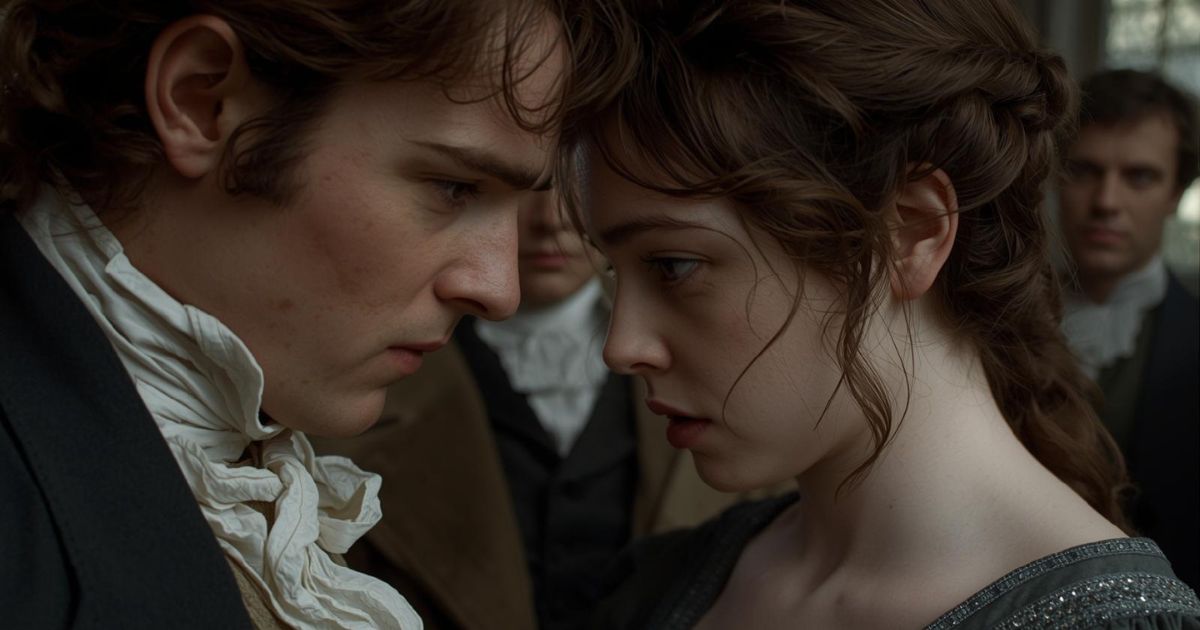
An excerpt from the original text.(complete · 1612 words)
IV.
[Illustration]
As soon as they were gone, Elizabeth walked out to recover her spirits;
or, in other words, to dwell without interruption on those subjects
which must deaden them more. Mr. Darcy’s behaviour astonished and vexed
her.
“Why, if he came only to be silent, grave, and indifferent,” said she,
“did he come at all?”
She could settle it in no way that gave her pleasure.
“He could be still amiable, still pleasing to my uncle and aunt, when he
was in town; and why not to me? If he fears me, why come hither? If he
no longer cares for me, why silent? Teasing, teasing man! I will think
no more about him.”
Her resolution was for a short time involuntarily kept by the approach
of her sister, who joined her with a cheerful look which showed her
better satisfied with their visitors than Elizabeth.
“Now,” said she, “that this first meeting is over, I feel perfectly
easy. I know my own strength, and I shall never be embarrassed again by
his coming. I am glad he dines here on Tuesday. It will then be publicly
seen, that on both sides we meet only as common and indifferent
acquaintance.”
“Yes, very indifferent, indeed,” said Elizabeth, laughingly. “Oh, Jane!
take care.”
“My dear Lizzy, you cannot think me so weak as to be in danger now.”
“I think you are in very great danger of making him as much in love with
you as ever.”
They did not see the gentlemen again till Tuesday; and Mrs. Bennet, in
the meanwhile, was giving way to all the happy schemes which the
good-humour and common politeness of Bingley, in half an hour’s visit,
had revived.
On Tuesday there was a large party assembled at Longbourn; and the two
who were most anxiously expected, to the credit of their punctuality as
sportsmen, were in very good time. When they repaired to the
dining-room, Elizabeth eagerly watched to see whether Bingley would take
the place which, in all their former parties, had belonged to him, by
her sister. Her prudent mother, occupied by the same ideas, forbore to
invite him to sit by herself. On entering the room, he seemed to
hesitate; but Jane happened to look round, and happened to smile: it was
decided. He placed himself by her.
Elizabeth, with a triumphant sensation, looked towards his friend. He
bore it with noble indifference; and she would have imagined that
Bingley had received his sanction to be happy, had she not seen his eyes
likewise turned towards Mr. Darcy, with an expression of half-laughing
alarm.
His behaviour to her sister was such during dinnertime as showed an
admiration of her, which, though more guarded than formerly, persuaded
Elizabeth, that, if left wholly to himself, Jane’s happiness, and his
own, would be speedily secured. Though she dared not depend upon the
consequence, she yet received pleasure from observing his behaviour. It
gave her all the animation that her spirits could boast; for she was in
no cheerful humour. Mr. Darcy was almost as far from her as the table
could divide them. He was on one side of her mother. She knew how little
such a situation would give pleasure to either, or make either appear to
advantage. She was not near enough to hear any of their discourse; but
she could see how seldom they spoke to each other, and how formal and
cold was their manner whenever they did. Her mother’s ungraciousness
made the sense of what they owed him more painful to Elizabeth’s mind;
and she would, at times, have given anything to be privileged to tell
him, that his kindness was neither unknown nor unfelt by the whole of
the family.
She was in hopes that the evening would afford some opportunity of
bringing them together; that the whole of the visit would not pass away
without enabling them to enter into something more of conversation,
than the mere ceremonious salutation attending his entrance. Anxious and
uneasy, the period which passed in the drawing-room before the gentlemen
came, was wearisome and dull to a degree that almost made her uncivil.
She looked forward to their entrance as the point on which all her
chance of pleasure for the evening must depend.
“If he does not come to me, then,” said she, “I shall give him up for
ever.”
The gentlemen came; and she thought he looked as if he would have
answered her hopes; but, alas! the ladies had crowded round the table,
where Miss Bennet was making tea, and Elizabeth pouring out the coffee,
in so close a confederacy, that there was not a single vacancy near her
which would admit of a chair. And on the gentlemen’s approaching, one of
the girls moved closer to her than ever, and said, in a whisper,--
“The men shan’t come and part us, I am determined. We want none of them;
do we?”
Darcy had walked away to another part of the room. She followed him with
her eyes, envied everyone to whom he spoke, had scarcely patience enough
to help anybody to coffee, and then was enraged against herself for
being so silly!
“A man who has once been refused! How could I ever be foolish enough to
expect a renewal of his love? Is there one among the sex who would not
protest against such a weakness as a second proposal to the same woman?
There is no indignity so abhorrent to their feelings.”
She was a little revived, however, by his bringing back his coffee-cup
himself; and she seized the opportunity of saying,--
“Is your sister at Pemberley still?”
“Yes; she will remain there till Christmas.”
“And quite alone? Have all her friends left her?”
“Mrs. Annesley is with her. The others have been gone on to Scarborough
these three weeks.”
She could think of nothing more to say; but if he wished to converse
with her, he might have better success. He stood by her, however, for
some minutes, in silence; and, at last, on the young lady’s whispering
to Elizabeth again, he walked away.
When the tea things were removed, and the card tables placed, the ladies
all rose; and Elizabeth was then hoping to be soon joined by him, when
all her views were overthrown, by seeing him fall a victim to her
mother’s rapacity for whist players, and in a few moments after seated
with the rest of the party. She now lost every expectation of pleasure.
They were confined for the evening at different tables; and she had
nothing to hope, but that his eyes were so often turned towards her side
of the room, as to make him play as unsuccessfully as herself.
Mrs. Bennet had designed to keep the two Netherfield gentlemen to
supper; but their carriage was, unluckily, ordered before any of the
others, and she had no opportunity of detaining them.
“Well, girls,” said she, as soon as they were left to themselves, “what
say you to the day? I think everything has passed off uncommonly well, I
assure you. The dinner was as well dressed as any I ever saw. The
venison was roasted to a turn--and everybody said, they never saw so fat
a haunch. The soup was fifty times better than what we had at the
Lucases’ last week; and even Mr. Darcy acknowledged that the partridges
were remarkably well done; and I suppose he has two or three French
cooks at least. And, my dear Jane, I never saw you look in greater
beauty. Mrs. Long said so too, for I asked her whether you did not. And
what do you think she said besides? ‘Ah! Mrs. Bennet, we shall have her
at Netherfield at last!’ She did, indeed. I do think Mrs. Long is as
good a creature as ever lived--and her nieces are very pretty behaved
girls, and not at all handsome: I like them prodigiously.”
[Illustration:
“M^{rs}. Long and her nieces.”
]
Mrs. Bennet, in short, was in very great spirits: she had seen enough of
Bingley’s behaviour to Jane to be convinced that she would get him at
last; and her expectations of advantage to her family, when in a happy
humour, were so far beyond reason, that she was quite disappointed at
not seeing him there again the next day, to make his proposals.
“It has been a very agreeable day,” said Miss Bennet to Elizabeth. “The
party seemed so well selected, so suitable one with the other. I hope we
may often meet again.”
Elizabeth smiled.
“Lizzy, you must not do so. You must not suspect me. It mortifies me. I
assure you that I have now learnt to enjoy his conversation as an
agreeable and sensible young man without having a wish beyond it. I am
perfectly satisfied, from what his manners now are, that he never had
any design of engaging my affection. It is only that he is blessed with
greater sweetness of address, and a stronger desire of generally
pleasing, than any other man.”
“You are very cruel,” said her sister, “you will not let me smile, and
are provoking me to it every moment.”
“How hard it is in some cases to be believed! And how impossible in
others! But why should you wish to persuade me that I feel more than I
acknowledge?”
“That is a question which I hardly know how to answer. We all love to
instruct, though we can teach only what is not worth knowing. Forgive
me; and if you persist in indifference, do not make me your
confidante.”
[Illustration:
“Lizzy, my dear, I want to speak to you.”
]
Master this chapter. Complete your experience
Purchase the complete book to access all chapters and support classic literature
As an Amazon Associate, we earn a small commission from qualifying purchases at no additional cost to you.
Available in paperback, hardcover, and e-book formats
Let's Analyse the Pattern
Why This Matters
Connect literature to life
This chapter teaches how to recognize when a parent's concern comes from love rather than control, and how admitting past mistakes can actually strengthen family trust.
Now let's explore the literary elements.
Key Quotes & Analysis
"I know your disposition, Lizzy. I know that you could be neither happy nor respectable, unless you truly esteemed your husband."
Context: When Elizabeth tells him about her engagement to Darcy
This shows Mr. Bennet truly understands his daughter's character. He knows she's not the type to marry for money or status - she needs genuine love and respect. His concern is for her emotional well-being, not social climbing.
"Indeed he has no improper pride. He is perfectly amiable. You do not know what he really is."
Context: Defending Darcy to her father who remembers her previous dislike
Elizabeth completely reverses her earlier judgment of Darcy's character. She now sees his apparent pride was actually reserve, and she's willing to admit she was totally wrong about him. This shows remarkable personal growth and humility.
"If any young men come for Mary or Kitty, send them in, for I am quite at leisure."
Context: After giving his blessing to Elizabeth's engagement
Classic Mr. Bennet humor, but also shows he's genuinely happy about Elizabeth's choice. He's so pleased with how this turned out that he's joking about his other daughters' future suitors. The lightness shows his relief and approval.
Thematic Threads
Personal Growth
In This Chapter
Elizabeth openly admits her complete misjudgment of Darcy to her father
Development
Culmination of Elizabeth's journey from stubborn first impressions to mature self-reflection
In Your Life:
When was the last time you admitted you were completely wrong about someone, and how did that moment of honesty change your relationship with them?
Family Relationships
In This Chapter
Mr. Bennet shows genuine care for Elizabeth's happiness and respects her judgment
Development
Healing moment that repairs the distance created by family chaos in earlier chapters
In Your Life:
Think about a time when family chaos or conflict created distance between you and someone you care about - what would it take to have that genuine, healing conversation?
Social Class
In This Chapter
Darcy properly asks Mr. Bennet for permission despite their class differences
Development
Evolution from class-based prejudice to mutual respect across social boundaries
In Your Life:
Have you ever found yourself making assumptions about someone based on their background, job, or social status before really getting to know them?
Marriage
In This Chapter
Mr. Bennet ensures Elizabeth loves Darcy for himself, not his wealth or status
Development
Contrast to earlier marriages based on convenience or desperation
In Your Life:
When you think about your ideal relationship, are you drawn to someone for who they truly are, or do external factors like their career success or social standing influence your feelings more than you'd like to admit?
Prejudice
In This Chapter
Elizabeth laughs about how wrong her first impressions were
Development
Final dissolution of the prejudice that drove the entire story's conflict
In Your Life:
Can you think of a time when your first impression of someone was so wrong that you can now laugh about it - what made you realize you had misjudged them?
You now have the context. Time to form your own thoughts.
Discussion Questions
- 1
What specific concerns does Mr. Bennet express about Elizabeth's engagement to Darcy, and how does she address them?
- 2
Why does Mr. Bennet say he respects Elizabeth's judgment more than her sisters', and what does this reveal about how he sees her character?
- 3
Think about a time when you completely changed your mind about someone - what parallels do you see with Elizabeth's experience with Darcy?
- 4
If you were in Elizabeth's position, how would you handle telling family about a relationship they might not initially understand or approve of?
- 5
What does this conversation teach us about the difference between being stubborn and being discerning when it comes to judging people?
Critical Thinking Exercise
Practice the 'I Was Wrong' Conversation
Think of someone you initially misjudged - either positively or negatively. Write out how you would tell a trusted friend or family member about changing your opinion, using Elizabeth's approach as a model. Focus on being specific about what you got wrong and what changed your mind, without making excuses for your initial judgment.
Consider:
- •Notice how admitting error can actually strengthen your credibility rather than weaken it
- •Consider why people trust those who can acknowledge mistakes more than those who seem never to be wrong
- •Think about how your willingness to change your mind about one person might affect how others view your judgment overall
Coming Up Next...
Chapter 55
Bingley's next visit might bring the resolution Jane's been waiting for, but will Elizabeth get any clarity about where she stands with Darcy?