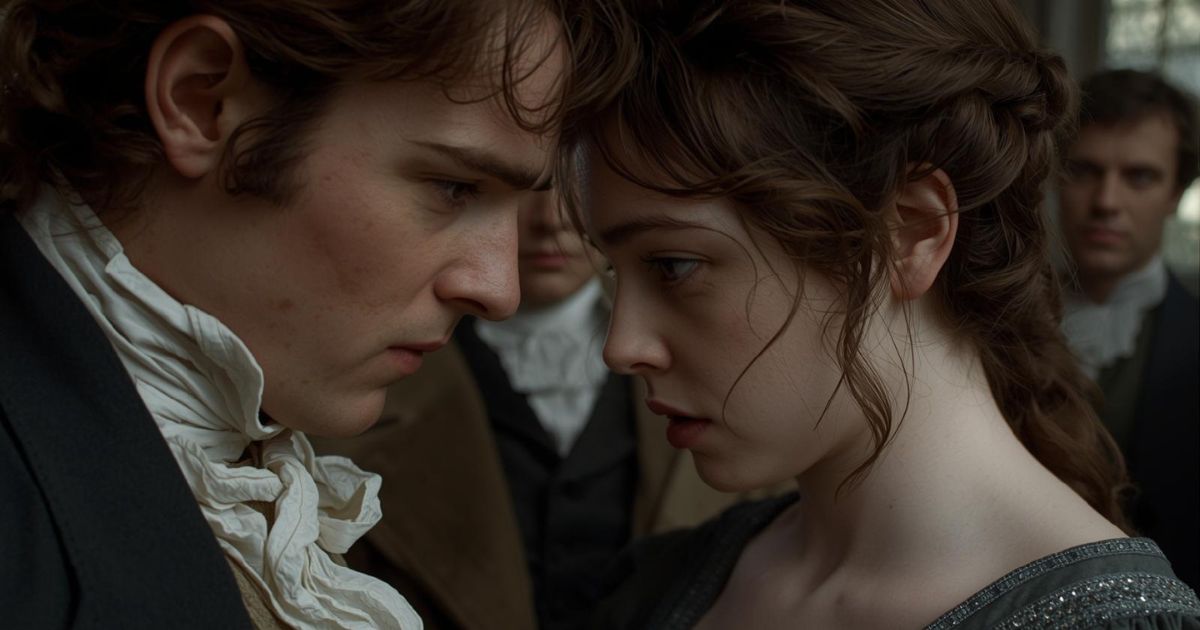
An excerpt from the original text.(complete · 2942 words)
III.
[Illustration]
Mr. Wickham was so perfectly satisfied with this conversation, that he
never again distressed himself, or provoked his dear sister Elizabeth,
by introducing the subject of it; and she was pleased to find that she
had said enough to keep him quiet.
The day of his and Lydia’s departure soon came; and Mrs. Bennet was
forced to submit to a separation, which, as her husband by no means
entered into her scheme of their all going to Newcastle, was likely to
continue at least a twelvemonth.
“Oh, my dear Lydia,” she cried, “when shall we meet again?”
“Oh, Lord! I don’t know. Not these two or three years, perhaps.”
“Write to me very often, my dear.”
“As often as I can. But you know married women have never much time for
writing. My sisters may write to me. They will have nothing else to
do.”
Mr. Wickham’s adieus were much more affectionate than his wife’s. He
smiled, looked handsome, and said many pretty things.
“He is as fine a fellow,” said Mr. Bennet, as soon as they were out of
the house, “as ever I saw. He simpers, and smirks, and makes love to us
all. I am prodigiously proud of him. I defy even Sir William Lucas
himself to produce a more valuable son-in-law.”
The loss of her daughter made Mrs. Bennet very dull for several days.
“I often think,” said she, “that there is nothing so bad as parting with
one’s friends. One seems so forlorn without them.”
“This is the consequence, you see, madam, of marrying a daughter,” said
Elizabeth. “It must make you better satisfied that your other four are
single.”
“It is no such thing. Lydia does not leave me because she is married;
but only because her husband’s regiment happens to be so far off. If
that had been nearer, she would not have gone so soon.”
But the spiritless condition which this event threw her into was shortly
relieved, and her mind opened again to the agitation of hope, by an
article of news which then began to be in circulation. The housekeeper
at Netherfield had received orders to prepare for the arrival of her
master, who was coming down in a day or two, to shoot there for several
weeks. Mrs. Bennet was quite in the fidgets. She looked at Jane, and
smiled, and shook her head, by turns.
“Well, well, and so Mr. Bingley is coming down, sister,” (for Mrs.
Philips first brought her the news). “Well, so much the better. Not that
I care about it, though. He is nothing to us, you know, and I am sure I
never want to see him again. But, however, he is very welcome to come to
Netherfield, if he likes it. And who knows what may happen? But that
is nothing to us. You know, sister, we agreed long ago never to mention
a word about it. And so, it is quite certain he is coming?”
“You may depend on it,” replied the other, “for Mrs. Nichols was in
Meryton last night: I saw her passing by, and went out myself on purpose
to know the truth of it; and she told me that it was certainly true. He
comes down on Thursday, at the latest, very likely on Wednesday. She was
going to the butcher’s, she told me, on purpose to order in some meat on
Wednesday, and she has got three couple of ducks just fit to be killed.”
Miss Bennet had not been able to hear of his coming without changing
colour. It was many months since she had mentioned his name to
Elizabeth; but now, as soon as they were alone together, she said,--
“I saw you look at me to-day, Lizzy, when my aunt told us of the present
report; and I know I appeared distressed; but don’t imagine it was from
any silly cause. I was only confused for the moment, because I felt that
I should be looked at. I do assure you that the news does not affect
me either with pleasure or pain. I am glad of one thing, that he comes
alone; because we shall see the less of him. Not that I am afraid of
myself, but I dread other people’s remarks.”
Elizabeth did not know what to make of it. Had she not seen him in
Derbyshire, she might have supposed him capable of coming there with no
other view than what was acknowledged; but she still thought him partial
to Jane, and she wavered as to the greater probability of his coming
there with his friend’s permission, or being bold enough to come
without it.
“Yet it is hard,” she sometimes thought, “that this poor man cannot come
to a house, which he has legally hired, without raising all this
speculation! I will leave him to himself.”
In spite of what her sister declared, and really believed to be her
feelings, in the expectation of his arrival, Elizabeth could easily
perceive that her spirits were affected by it. They were more disturbed,
more unequal, than she had often seen them.
The subject which had been so warmly canvassed between their parents,
about a twelvemonth ago, was now brought forward again.
“As soon as ever Mr. Bingley comes, my dear,” said Mrs. Bennet, “you
will wait on him, of course.”
“No, no. You forced me into visiting him last year, and promised, if I
went to see him, he should marry one of my daughters. But it ended in
nothing, and I will not be sent on a fool’s errand again.”
His wife represented to him how absolutely necessary such an attention
would be from all the neighbouring gentlemen, on his returning to
Netherfield.
“’Tis an etiquette I despise,” said he. “If he wants our society, let
him seek it. He knows where we live. I will not spend my hours in
running after my neighbours every time they go away and come back
again.”
“Well, all I know is, that it will be abominably rude if you do not wait
on him. But, however, that shan’t prevent my asking him to dine here, I
am determined. We must have Mrs. Long and the Gouldings soon. That will
make thirteen with ourselves, so there will be just room at table for
him.”
Consoled by this resolution, she was the better able to bear her
husband’s incivility; though it was very mortifying to know that her
neighbours might all see Mr. Bingley, in consequence of it, before
they did. As the day of his arrival drew near,--
“I begin to be sorry that he comes at all,” said Jane to her sister. “It
would be nothing; I could see him with perfect indifference; but I can
hardly bear to hear it thus perpetually talked of. My mother means well;
but she does not know, no one can know, how much I suffer from what she
says. Happy shall I be when his stay at Netherfield is over!”
“I wish I could say anything to comfort you,” replied Elizabeth; “but it
is wholly out of my power. You must feel it; and the usual satisfaction
of preaching patience to a sufferer is denied me, because you have
always so much.”
Mr. Bingley arrived. Mrs. Bennet, through the assistance of servants,
contrived to have the earliest tidings of it, that the period of anxiety
and fretfulness on her side be as long as it could. She counted the days
that must intervene before their invitation could be sent--hopeless of
seeing him before. But on the third morning after his arrival in
Hertfordshire, she saw him from her dressing-room window enter the
paddock, and ride towards the house.
Her daughters were eagerly called to partake of her joy. Jane resolutely
kept her place at the table; but Elizabeth, to satisfy her mother, went
to the window--she looked--she saw Mr. Darcy with him, and sat down
again by her sister.
“There is a gentleman with him, mamma,” said Kitty; “who can it be?”
“Some acquaintance or other, my dear, I suppose; I am sure I do not
know.”
“La!” replied Kitty, “it looks just like that man that used to be with
him before. Mr. what’s his name--that tall, proud man.”
“Good gracious! Mr. Darcy!--and so it does, I vow. Well, any friend of
Mr. Bingley’s will always be welcome here, to be sure; but else I must
say that I hate the very sight of him.”
Jane looked at Elizabeth with surprise and concern. She knew but little
of their meeting in Derbyshire, and therefore felt for the awkwardness
which must attend her sister, in seeing him almost for the first time
after receiving his explanatory letter. Both sisters were uncomfortable
enough. Each felt for the other, and of course for themselves; and their
mother talked on of her dislike of Mr. Darcy, and her resolution to be
civil to him only as Mr. Bingley’s friend, without being heard by either
of them. But Elizabeth had sources of uneasiness which could not yet be
suspected by Jane, to whom she had never yet had courage to show Mrs.
Gardiner’s letter, or to relate her own change of sentiment towards
him. To Jane, he could be only a man whose proposals she had refused,
and whose merits she had undervalued; but to her own more extensive
information, he was the person to whom the whole family were indebted
for the first of benefits, and whom she regarded herself with an
interest, if not quite so tender, at least as reasonable and just, as
what Jane felt for Bingley. Her astonishment at his coming--at his
coming to Netherfield, to Longbourn, and voluntarily seeking her again,
was almost equal to what she had known on first witnessing his altered
behaviour in Derbyshire.
The colour which had been driven from her face returned for half a
minute with an additional glow, and a smile of delight added lustre to
her eyes, as she thought for that space of time that his affection and
wishes must still be unshaken; but she would not be secure.
“Let me first see how he behaves,” said she; “it will then be early
enough for expectation.”
She sat intently at work, striving to be composed, and without daring to
lift up her eyes, till anxious curiosity carried them to the face of her
sister as the servant was approaching the door. Jane looked a little
paler than usual, but more sedate than Elizabeth had expected. On the
gentlemen’s appearing, her colour increased; yet she received them with
tolerable ease, and with a propriety of behaviour equally free from any
symptom of resentment, or any unnecessary complaisance.
Elizabeth said as little to either as civility would allow, and sat down
again to her work, with an eagerness which it did not often command. She
had ventured only one glance at Darcy. He looked serious as usual; and,
she thought, more as he had been used to look in Hertfordshire, than as
she had seen him at Pemberley. But, perhaps, he could not in her
mother’s presence be what he was before her uncle and aunt. It was a
painful, but not an improbable, conjecture.
Bingley she had likewise seen for an instant, and in that short period
saw him looking both pleased and embarrassed. He was received by Mrs.
Bennet with a degree of civility which made her two daughters ashamed,
especially when contrasted with the cold and ceremonious politeness of
her courtesy and address of his friend.
Elizabeth particularly, who knew that her mother owed to the latter the
preservation of her favourite daughter from irremediable infamy, was
hurt and distressed to a most painful degree by a distinction so ill
applied.
Darcy, after inquiring of her how Mr. and Mrs. Gardiner did--a question
which she could not answer without confusion--said scarcely anything. He
was not seated by her: perhaps that was the reason of his silence; but
it had not been so in Derbyshire. There he had talked to her friends
when he could not to herself. But now several minutes elapsed, without
bringing the sound of his voice; and when occasionally, unable to resist
the impulse of curiosity, she raised her eyes to his face, she as often
found him looking at Jane as at herself, and frequently on no object but
the ground. More thoughtfulness and less anxiety to please, than when
they last met, were plainly expressed. She was disappointed, and angry
with herself for being so.
“Could I expect it to be otherwise?” said she. “Yet why did he come?”
She was in no humour for conversation with anyone but himself; and to
him she had hardly courage to speak.
She inquired after his sister, but could do no more.
“It is a long time, Mr. Bingley, since you went away,” said Mrs. Bennet.
He readily agreed to it.
“I began to be afraid you would never come back again. People did say,
you meant to quit the place entirely at Michaelmas; but, however, I hope
it is not true. A great many changes have happened in the neighbourhood
since you went away. Miss Lucas is married and settled: and one of my
own daughters. I suppose you have heard of it; indeed, you must have
seen it in the papers. It was in the ‘Times’ and the ‘Courier,’ I know;
though it was not put in as it ought to be. It was only said, ‘Lately,
George Wickham, Esq., to Miss Lydia Bennet,’ without there being a
syllable said of her father, or the place where she lived, or anything.
It was my brother Gardiner’s drawing up, too, and I wonder how he came
to make such an awkward business of it. Did you see it?”
Bingley replied that he did, and made his congratulations. Elizabeth
dared not lift up her eyes. How Mr. Darcy looked, therefore, she could
not tell.
“It is a delightful thing, to be sure, to have a daughter well married,”
continued her mother; “but at the same time, Mr. Bingley, it is very
hard to have her taken away from me. They are gone down to Newcastle, a
place quite northward it seems, and there they are to stay, I do not
know how long. His regiment is there; for I suppose you have heard of
his leaving the ----shire, and of his being gone into the Regulars.
Thank heaven! he has some friends, though, perhaps, not so many as he
deserves.”
Elizabeth, who knew this to be levelled at Mr. Darcy, was in such misery
of shame that she could hardly keep her seat. It drew from her, however,
the exertion of speaking, which nothing else had so effectually done
before; and she asked Bingley whether he meant to make any stay in the
country at present. A few weeks, he believed.
“When you have killed all your own birds, Mr. Bingley,” said her mother,
“I beg you will come here and shoot as many as you please on Mr.
Bennet’s manor. I am sure he will be vastly happy to oblige you, and
will save all the best of the coveys for you.”
Elizabeth’s misery increased at such unnecessary, such officious
attention! Were the same fair prospect to arise at present, as had
flattered them a year ago, everything, she was persuaded, would be
hastening to the same vexatious conclusion. At that instant she felt,
that years of happiness could not make Jane or herself amends for
moments of such painful confusion.
“The first wish of my heart,” said she to herself, “is never more to be
in company with either of them. Their society can afford no pleasure
that will atone for such wretchedness as this! Let me never see either
one or the other again!”
Yet the misery, for which years of happiness were to offer no
compensation, received soon afterwards material relief, from observing
how much the beauty of her sister rekindled the admiration of her former
lover. When first he came in, he had spoken to her but little, but every
five minutes seemed to be giving her more of his attention. He found her
as handsome as she had been last year; as good-natured, and as
unaffected, though not quite so chatty. Jane was anxious that no
difference should be perceived in her at all, and was really persuaded
that she talked as much as ever; but her mind was so busily engaged,
that she did not always know when she was silent.
When the gentlemen rose to go away, Mrs. Bennet was mindful of her
intended civility, and they were invited and engaged to dine at
Longbourn in a few days’ time.
“You are quite a visit in my debt, Mr. Bingley,” she added; “for when
you went to town last winter, you promised to take a family dinner with
us as soon as you returned. I have not forgot, you see; and I assure you
I was very much disappointed that you did not come back and keep your
engagement.”
Bingley looked a little silly at this reflection, and said something of
his concern at having been prevented by business. They then went away.
Mrs. Bennet had been strongly inclined to ask them to stay and dine
there that day; but, though she always kept a very good table, she did
not think anything less than two courses could be good enough for a man
on whom she had such anxious designs, or satisfy the appetite and pride
of one who had ten thousand a year.
[Illustration:
“Jane happened to look round”
]
Master this chapter. Complete your experience
Purchase the complete book to access all chapters and support classic literature
As an Amazon Associate, we earn a small commission from qualifying purchases at no additional cost to you.
Available in paperback, hardcover, and e-book formats
Let's Analyse the Pattern
Why This Matters
Connect literature to life
This chapter teaches how someone's private space and long-term relationships reveal character more accurately than public performances or single interactions.
Now let's explore the literary elements.
Key Quotes & Analysis
"I have never had a cross word from him in my life, and I have known him ever since he was four years old."
Context: The housekeeper describing Darcy's character to Elizabeth during the house tour.
This quote reveals Darcy's true nature - he's consistently kind even to servants, which was rare among wealthy men of the time. It directly contradicts Elizabeth's impression of him as proud and cruel.
"She felt that to be mistress of Pemberley might be something!"
Context: Elizabeth's thoughts while touring the magnificent estate.
This shows Elizabeth imagining herself as Darcy's wife, but it's not just about the wealth - she's beginning to understand the responsibility and character required to manage such a place well.
"As a brother, a landlord, a master, she considered how many people's happiness were in his guardianship!"
Context: Elizabeth reflecting on Darcy's responsibilities and character.
Elizabeth realizes that Darcy's apparent pride actually stems from genuine care and responsibility for many people's welfare. His serious demeanor makes sense when you understand the weight he carries.
Thematic Threads
Prejudice
In This Chapter
Elizabeth's preconceptions about Darcy crumble when she sees evidence of his true character through his home and housekeeper's testimony
Development
Major breakthrough - her prejudice begins dissolving when confronted with contradictory evidence
In Your Life:
When have you discovered that someone you disliked was actually nothing like what you first assumed - and what made you finally see past your initial judgment?
Class
In This Chapter
Darcy's wealth is revealed as responsibility rather than privilege - he uses his position to care for tenants and employees
Development
Evolving from class as barrier to class as stewardship and genuine noblesse oblige
In Your Life:
How do you use whatever privileges or advantages you have in life - do you see them as perks to enjoy or responsibilities to help others?
Truth
In This Chapter
Physical spaces and servant testimony reveal authentic character more than social performances
Development
Continuing theme that truth emerges through observation and multiple perspectives
In Your Life:
When has someone's actions or living space revealed their true character in a way that completely contradicted how they presented themselves in public?
Personal Growth
In This Chapter
Elizabeth confronts how wrong her first impressions were and begins genuine self-examination
Development
Accelerating - she's now actively questioning her own judgment rather than just defending it
In Your Life:
Can you think of a time when you had to admit you were completely wrong about someone or something important - how did that feel and what did you do with that realization?
Pride
In This Chapter
Elizabeth realizes Darcy's pride stems from genuine responsibility and care, not arrogance
Development
Reframing from negative trait to positive quality misunderstood
In Your Life:
Have you ever misjudged someone's confidence or high standards as arrogance, only to later realize it came from a place of genuine care and responsibility?
You now have the context. Time to form your own thoughts.
Discussion Questions
- 1
What does Elizabeth discover about Darcy during her visit to Pemberley that contradicts her previous impressions of him?
- 2
Why does the housekeeper's testimony carry more weight than the opinions Elizabeth heard at social gatherings?
- 3
When have you discovered that your first impression of someone was completely wrong after seeing them in their own environment or hearing from people who know them well?
- 4
Before making important decisions about someone's character - hiring them, dating them, or trusting them with responsibility - what sources would you consult beyond your own limited interactions?
- 5
What does this chapter reveal about the difference between how people perform in public versus who they are in their daily lives?
Critical Thinking Exercise
Map Your Character References
Think of someone you need to evaluate - a potential roommate, romantic partner, business partner, or employee. Create two lists: 'Performance Contexts' (where you've seen them in formal or social situations) and 'Reality Contexts' (who could tell you about their daily character - long-term friends, service workers they interact with, former roommates, people they've helped). Identify which list is longer and what gaps you need to fill before making your judgment.
Consider:
- •People who depend on this person financially have strong motivation to tell the truth about their character
- •How someone treats people with less power reveals more than how they treat equals or superiors
- •Look for patterns across multiple relationships and contexts, not just isolated incidents
Coming Up Next...
Chapter 54
The aftermath of this uncomfortable visit will leave both Elizabeth and Darcy questioning everything. Will Bingley's return lead to happiness for Jane, or just reopen old wounds?