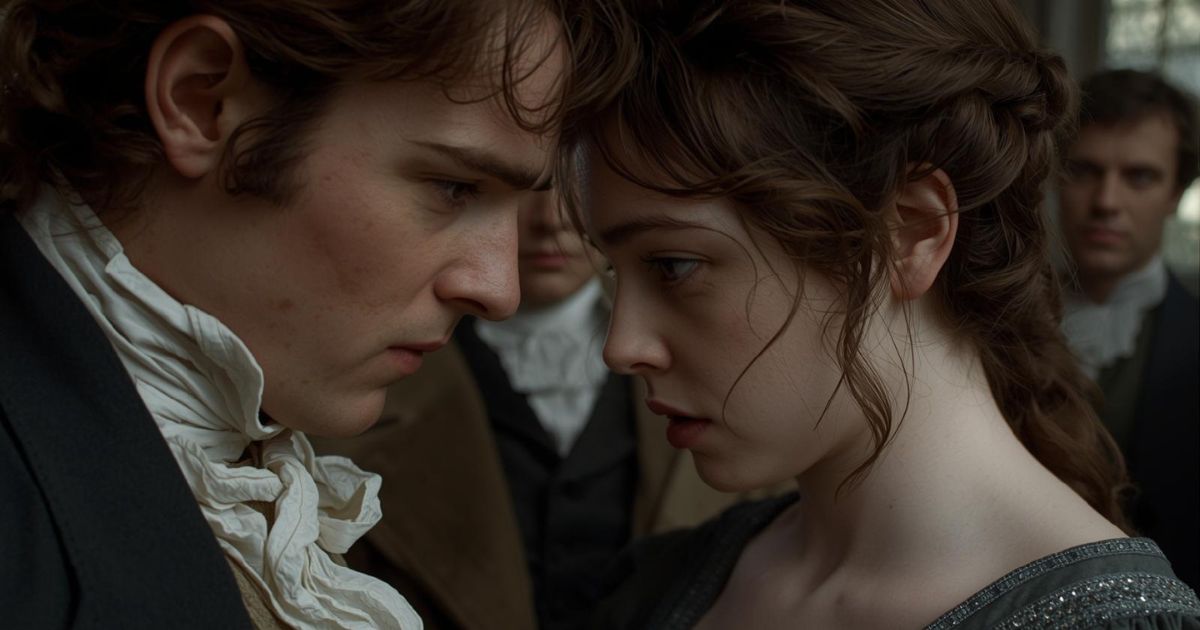
An excerpt from the original text.(complete · 1731 words)
V.
[Illustration]
Convinced as Elizabeth now was that Miss Bingley’s dislike of her had
originated in jealousy, she could not help feeling how very unwelcome
her appearance at Pemberley must be to her, and was curious to know
with how much civility on that lady’s side the acquaintance would now
be renewed.
On reaching the house, they were shown through the hall into the saloon,
whose northern aspect rendered it delightful for summer. Its windows,
opening to the ground, admitted a most refreshing view of the high woody
hills behind the house, and of the beautiful oaks and Spanish chestnuts
which were scattered over the intermediate lawn.
In this room they were received by Miss Darcy, who was sitting there
with Mrs. Hurst and Miss Bingley, and the lady with whom she lived in
London. Georgiana’s reception of them was very civil, but attended with
all that embarrassment which, though proceeding from shyness and the
fear of doing wrong, would easily give to those who felt themselves
inferior the belief of her being proud and reserved. Mrs. Gardiner and
her niece, however, did her justice, and pitied her.
By Mrs. Hurst and Miss Bingley they were noticed only by a courtesy; and
on their being seated, a pause, awkward as such pauses must always be,
succeeded for a few moments. It was first broken by Mrs. Annesley, a
genteel, agreeable-looking woman, whose endeavour to introduce some kind
of discourse proved her to be more truly well-bred than either of the
others; and between her and Mrs. Gardiner, with occasional help from
Elizabeth, the conversation was carried on. Miss Darcy looked as if she
wished for courage enough to join in it; and sometimes did venture a
short sentence, when there was least danger of its being heard.
Elizabeth soon saw that she was herself closely watched by Miss Bingley,
and that she could not speak a word, especially to Miss Darcy, without
calling her attention. This observation would not have prevented her
from trying to talk to the latter, had they not been seated at an
inconvenient distance; but she was not sorry to be spared the necessity
of saying much: her own thoughts were employing her. She expected every
moment that some of the gentlemen would enter the room: she wished, she
feared, that the master of the house might be amongst them; and whether
she wished or feared it most, she could scarcely determine. After
sitting in this manner a quarter of an hour, without hearing Miss
Bingley’s voice, Elizabeth was roused by receiving from her a cold
inquiry after the health of her family. She answered with equal
indifference and brevity, and the other said no more.
The next variation which their visit afforded was produced by the
entrance of servants with cold meat, cake, and a variety of all the
finest fruits in season; but this did not take place till after many a
significant look and smile from Mrs. Annesley to Miss Darcy had been
given, to remind her of her post. There was now employment for the whole
party; for though they could not all talk, they could all eat; and the
beautiful pyramids of grapes, nectarines, and peaches, soon collected
them round the table.
While thus engaged, Elizabeth had a fair opportunity of deciding whether
she most feared or wished for the appearance of Mr. Darcy, by the
feelings which prevailed on his entering the room; and then, though but
a moment before she had believed her wishes to predominate, she began to
regret that he came.
He had been some time with Mr. Gardiner, who, with two or three other
gentlemen from the house, was engaged by the river; and had left him
only on learning that the ladies of the family intended a visit to
Georgiana that morning. No sooner did he appear, than Elizabeth wisely
resolved to be perfectly easy and unembarrassed;--a resolution the more
necessary to be made, but perhaps not the more easily kept, because she
saw that the suspicions of the whole party were awakened against them,
and that there was scarcely an eye which did not watch his behaviour
when he first came into the room. In no countenance was attentive
curiosity so strongly marked as in Miss Bingley’s, in spite of the
smiles which overspread her face whenever she spoke to one of its
objects; for jealousy had not yet made her desperate, and her attentions
to Mr. Darcy were by no means over. Miss Darcy, on her brother’s
entrance, exerted herself much more to talk; and Elizabeth saw that he
was anxious for his sister and herself to get acquainted, and forwarded,
as much as possible, every attempt at conversation on either side. Miss
Bingley saw all this likewise; and, in the imprudence of anger, took the
first opportunity of saying, with sneering civility,--
“Pray, Miss Eliza, are not the ----shire militia removed from Meryton?
They must be a great loss to your family.”
In Darcy’s presence she dared not mention Wickham’s name: but Elizabeth
instantly comprehended that he was uppermost in her thoughts; and the
various recollections connected with him gave her a moment’s distress;
but, exerting herself vigorously to repel the ill-natured attack, she
presently answered the question in a tolerably disengaged tone. While
she spoke, an involuntary glance showed her Darcy with a heightened
complexion, earnestly looking at her, and his sister overcome with
confusion, and unable to lift up her eyes. Had Miss Bingley known what
pain she was then giving her beloved friend, she undoubtedly would have
refrained from the hint; but she had merely intended to discompose
Elizabeth, by bringing forward the idea of a man to whom she believed
her partial, to make her betray a sensibility which might injure her in
Darcy’s opinion, and, perhaps, to remind the latter of all the follies
and absurdities by which some part of her family were connected with
that corps. Not a syllable had ever reached her of Miss Darcy’s
meditated elopement. To no creature had it been revealed, where secrecy
was possible, except to Elizabeth; and from all Bingley’s connections
her brother was particularly anxious to conceal it, from that very wish
which Elizabeth had long ago attributed to him, of their becoming
hereafter her own. He had certainly formed such a plan; and without
meaning that it should affect his endeavour to separate him from Miss
Bennet, it is probable that it might add something to his lively concern
for the welfare of his friend.
Elizabeth’s collected behaviour, however, soon quieted his emotion; and
as Miss Bingley, vexed and disappointed, dared not approach nearer to
Wickham, Georgiana also recovered in time, though not enough to be able
to speak any more. Her brother, whose eye she feared to meet, scarcely
recollected her interest in the affair; and the very circumstance which
had been designed to turn his thoughts from Elizabeth, seemed to have
fixed them on her more and more cheerfully.
Their visit did not continue long after the question and answer above
mentioned; and while Mr. Darcy was attending them to their carriage,
Miss Bingley was venting her feelings in criticisms on Elizabeth’s
person, behaviour, and dress. But Georgiana would not join her. Her
brother’s recommendation was enough to insure her favour: his judgment
could not err; and he had spoken in such terms of Elizabeth, as to leave
Georgiana without the power of finding her otherwise than lovely and
amiable. When Darcy returned to the saloon, Miss Bingley could not help
repeating to him some part of what she had been saying to his sister.
“How very ill Eliza Bennet looks this morning, Mr. Darcy,” she cried: “I
never in my life saw anyone so much altered as she is since the winter.
She is grown so brown and coarse! Louisa and I were agreeing that we
should not have known her again.”
However little Mr. Darcy might have liked such an address, he contented
himself with coolly replying, that he perceived no other alteration than
her being rather tanned,--no miraculous consequence of travelling in the
summer.
“For my own part,” she rejoined, “I must confess that I never could see
any beauty in her. Her face is too thin; her complexion has no
brilliancy; and her features are not at all handsome. Her nose wants
character; there is nothing marked in its lines. Her teeth are
tolerable, but not out of the common way; and as for her eyes, which
have sometimes been called so fine, I never could perceive anything
extraordinary in them. They have a sharp, shrewish look, which I do not
like at all; and in her air altogether, there is a self-sufficiency
without fashion, which is intolerable.”
Persuaded as Miss Bingley was that Darcy admired Elizabeth, this was not
the best method of recommending herself; but angry people are not always
wise; and in seeing him at last look somewhat nettled, she had all the
success she expected. He was resolutely silent, however; and, from a
determination of making him speak, she continued,--
“I remember, when we first knew her in Hertfordshire, how amazed we all
were to find that she was a reputed beauty; and I particularly recollect
your saying one night, after they had been dining at Netherfield, ‘She
a beauty! I should as soon call her mother a wit.’ But afterwards she
seemed to improve on you, and I believe you thought her rather pretty at
one time.”
“Yes,” replied Darcy, who could contain himself no longer, “but that
was only when I first knew her; for it is many months since I have
considered her as one of the handsomest women of my acquaintance.”
He then went away, and Miss Bingley was left to all the satisfaction of
having forced him to say what gave no one any pain but herself.
Mrs. Gardiner and Elizabeth talked of all that had occurred during their
visit, as they returned, except what had particularly interested them
both. The looks and behaviour of everybody they had seen were discussed,
except of the person who had mostly engaged their attention. They talked
of his sister, his friends, his house, his fruit, of everything but
himself; yet Elizabeth was longing to know what Mrs. Gardiner thought of
him, and Mrs. Gardiner would have been highly gratified by her niece’s
beginning the subject.
[Illustration]
Master this chapter. Complete your experience
Purchase the complete book to access all chapters and support classic literature
As an Amazon Associate, we earn a small commission from qualifying purchases at no additional cost to you.
Available in paperback, hardcover, and e-book formats
Let's Analyse the Pattern
Why This Matters
Connect literature to life
This chapter teaches how to assess someone's true nature by observing their home environment and listening to people who interact with them regularly in low-stakes situations.
Now let's explore the literary elements.
Key Quotes & Analysis
"I have never had a cross word from him in my life, and I have known him ever since he was four years old."
Context: The housekeeper describes Darcy's character to Elizabeth during the house tour
This quote destroys Elizabeth's image of Darcy as proud and difficult. A servant who has known him since childhood and never received harsh treatment reveals his true nature. It forces Elizabeth to question everything she believed about him.
"As a brother, a landlord, a master, she considered how many people's happiness were in his guardianship!"
Context: Elizabeth reflects on Darcy's responsibilities and character after hearing Mrs. Reynolds' praise
This shows Elizabeth finally understanding the weight of Darcy's position and how well he handles it. She's realizing that being wealthy means having responsibility for others' welfare, and Darcy takes that seriously.
"She had never seen a place for which nature had done more, or where natural beauty had been so little counteracted by an awkward taste."
Context: Elizabeth's first impression of Pemberley estate
The estate reflects Darcy's character - naturally beautiful without flashy showing off. Elizabeth is seeing that true class doesn't need to prove itself. This contrasts with her earlier assumptions about his arrogance.
Thematic Threads
Prejudice
In This Chapter
Elizabeth's prejudices against Darcy completely crumble when she sees him through others' eyes and in his own environment
Development
Evolved from initial formation based on Wickham's lies to complete reversal through direct evidence
In Your Life:
When have you discovered that your strong negative opinion about someone was completely wrong, and what made you finally see them differently?
Social Class
In This Chapter
Pemberley represents responsible wealth—Darcy cares for his estate, employees, and community rather than just displaying status
Development
Developing from earlier focus on class barriers to showing how class can be used responsibly
In Your Life:
How do you use your privileges or advantages to benefit others rather than just showcase your status?
Personal Growth
In This Chapter
Elizabeth must confront how wrong her judgments were and acknowledge her own capacity for error
Development
Continuing her journey from confident prejudice toward humility and self-awareness
In Your Life:
Can you think of a time when you had to admit you were completely wrong about something important and face your own fallibility?
Pride
In This Chapter
Darcy's apparent pride was actually reserve and social awkwardness—his real character shows appropriate confidence without arrogance
Development
Revealing that perceived pride was misunderstood social discomfort and genuine dignity
In Your Life:
Have you ever misjudged someone's shyness or social awkwardness as arrogance or unfriendliness?
Marriage
In This Chapter
Elizabeth begins to imagine what marriage to Darcy would actually be like, based on his true character rather than her assumptions
Development
Shifting from rejection of his proposal to considering him as a genuine partner
In Your Life:
How has getting to know someone's true character changed your view of whether you could build a life together?
You now have the context. Time to form your own thoughts.
Discussion Questions
- 1
What specific things did Mrs. Reynolds tell Elizabeth about Darcy that contradicted her previous opinion of him?
- 2
Why do you think Darcy behaved so differently at Pemberley compared to how he acted at social gatherings and balls?
- 3
Think of someone you initially disliked or misjudged. What context or information later changed your opinion of them?
- 4
When meeting someone new, what are three different 'environments' or situations you could observe them in to get a fuller picture of their character?
- 5
What does this chapter suggest about the difference between someone's public persona and their private character?
Critical Thinking Exercise
The Three-Source Character Check
Think of someone you have a strong opinion about—positive or negative. Write down what you know about them from three different sources: your direct interactions, what others say about them, and how they behave in their 'home environment' (workplace, neighborhood, family setting). Compare these three perspectives and identify any contradictions or gaps in your understanding.
Consider:
- •Consider whether your direct interactions happened when they were stressed, performing a role, or outside their comfort zone
- •Evaluate whether the people describing them have their own biases or limited exposure to the person
- •Pay attention to how they treat people who have no power to help or hurt them—this often reveals true character
Coming Up Next...
Chapter 46
Elizabeth's happiness at Pemberley is about to be shattered. Two letters are waiting that will bring devastating news about Lydia, turning Elizabeth's world upside down and threatening everything that's just begun with Darcy.