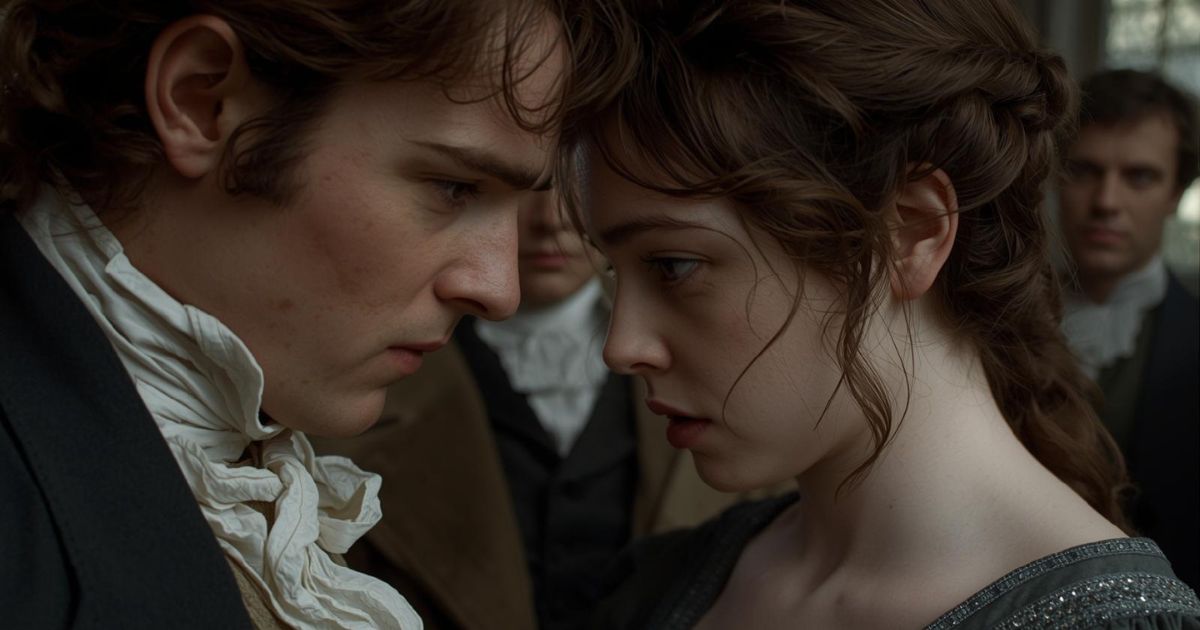
An excerpt from the original text.(complete · 3029 words)
VI.
[Illustration]
Elizabeth had been a good deal disappointed in not finding a letter from
Jane on their first arrival at Lambton; and this disappointment had been
renewed on each of the mornings that had now been spent there; but on
the third her repining was over, and her sister justified, by the
receipt of two letters from her at once, on one of which was marked that
it had been mis-sent elsewhere. Elizabeth was not surprised at it, as
Jane had written the direction remarkably ill.
They had just been preparing to walk as the letters came in; and her
uncle and aunt, leaving her to enjoy them in quiet, set off by
themselves. The one mis-sent must be first attended to; it had been
written five days ago. The beginning contained an account of all their
little parties and engagements, with such news as the country afforded;
but the latter half, which was dated a day later, and written in evident
agitation, gave more important intelligence. It was to this effect:--
“Since writing the above, dearest Lizzy, something has occurred of a
most unexpected and serious nature; but I am afraid of alarming you--be
assured that we are all well. What I have to say relates to poor Lydia.
An express came at twelve last night, just as we were all gone to bed,
from Colonel Forster, to inform us that she was gone off to Scotland
with one of his officers; to own the truth, with Wickham! Imagine our
surprise. To Kitty, however, it does not seem so wholly unexpected. I am
very, very sorry. So imprudent a match on both sides! But I am willing
to hope the best, and that his character has been misunderstood.
Thoughtless and indiscreet I can easily believe him, but this step (and
let us rejoice over it) marks nothing bad at heart. His choice is
disinterested at least, for he must know my father can give her nothing.
Our poor mother is sadly grieved. My father bears it better. How
thankful am I, that we never let them know what has been said against
him; we must forget it ourselves. They were off Saturday night about
twelve, as is conjectured, but were not missed till yesterday morning at
eight. The express was sent off directly. My dear Lizzy, they must have
passed within ten miles of us. Colonel Forster gives us reason to expect
him here soon. Lydia left a few lines for his wife, informing her of
their intention. I must conclude, for I cannot be long from my poor
mother. I am afraid you will not be able to make it out, but I hardly
know what I have written.”
Without allowing herself time for consideration, and scarcely knowing
what she felt, Elizabeth, on finishing this letter, instantly seized the
other, and opening it with the utmost impatience, read as follows: it
had been written a day later than the conclusion of the first.
“By this time, my dearest sister, you have received my hurried letter; I
wish this may be more intelligible, but though not confined for time, my
head is so bewildered that I cannot answer for being coherent. Dearest
Lizzy, I hardly know what I would write, but I have bad news for you,
and it cannot be delayed. Imprudent as a marriage between Mr. Wickham
and our poor Lydia would be, we are now anxious to be assured it has
taken place, for there is but too much reason to fear they are not gone
to Scotland. Colonel Forster came yesterday, having left Brighton the
day before, not many hours after the express. Though Lydia’s short
letter to Mrs. F. gave them to understand that they were going to Gretna
Green, something was dropped by Denny expressing his belief that W.
never intended to go there, or to marry Lydia at all, which was repeated
to Colonel F., who, instantly taking the alarm, set off from B.,
intending to trace their route. He did trace them easily to Clapham, but
no farther; for on entering that place, they removed into a
hackney-coach, and dismissed the chaise that brought them from Epsom.
All that is known after this is, that they were seen to continue the
London road. I know not what to think. After making every possible
inquiry on that side of London, Colonel F. came on into Hertfordshire,
anxiously renewing them at all the turnpikes, and at the inns in Barnet
and Hatfield, but without any success,--no such people had been seen to
pass through. With the kindest concern he came on to Longbourn, and
broke his apprehensions to us in a manner most creditable to his heart.
I am sincerely grieved for him and Mrs. F.; but no one can throw any
blame on them. Our distress, my dear Lizzy, is very great. My father and
mother believe the worst, but I cannot think so ill of him. Many
circumstances might make it more eligible for them to be married
privately in town than to pursue their first plan; and even if he
could form such a design against a young woman of Lydia’s connections,
which is not likely, can I suppose her so lost to everything?
Impossible! I grieve to find, however, that Colonel F. is not disposed
to depend upon their marriage: he shook his head when I expressed my
hopes, and said he feared W. was not a man to be trusted. My poor mother
is really ill, and keeps her room. Could she exert herself, it would be
better, but this is not to be expected; and as to my father, I never in
my life saw him so affected. Poor Kitty has anger for having concealed
their attachment; but as it was a matter of confidence, one cannot
wonder. I am truly glad, dearest Lizzy, that you have been spared
something of these distressing scenes; but now, as the first shock is
over, shall I own that I long for your return? I am not so selfish,
however, as to press for it, if inconvenient. Adieu! I take up my pen
again to do, what I have just told you I would not; but circumstances
are such, that I cannot help earnestly begging you all to come here as
soon as possible. I know my dear uncle and aunt so well, that I am not
afraid of requesting it, though I have still something more to ask of
the former. My father is going to London with Colonel Forster instantly,
to try to discover her. What he means to do, I am sure I know not; but
his excessive distress will not allow him to pursue any measure in the
best and safest way, and Colonel Forster is obliged to be at Brighton
again to-morrow evening. In such an exigence my uncle’s advice and
assistance would be everything in the world; he will immediately
comprehend what I must feel, and I rely upon his goodness.”
“Oh! where, where is my uncle?” cried Elizabeth, darting from her seat
as she finished the letter, in eagerness to follow him, without losing a
moment of the time so precious; but as she reached the door, it was
opened by a servant, and Mr. Darcy appeared. Her pale face and
impetuous manner made him start, and before he could recover himself
enough to speak, she, in whose mind every idea was superseded by Lydia’s
situation, hastily exclaimed, “I beg your pardon, but I must leave you.
I must find Mr. Gardiner this moment on business that cannot be delayed;
I have not an instant to lose.”
“Good God! what is the matter?” cried he, with more feeling than
politeness; then recollecting himself, “I will not detain you a minute;
but let me, or let the servant, go after Mr. and Mrs. Gardiner. You are
not well enough; you cannot go yourself.”
Elizabeth hesitated; but her knees trembled under her, and she felt how
little would be gained by her attempting to pursue them. Calling back
the servant, therefore, she commissioned him, though in so breathless an
accent as made her almost unintelligible, to fetch his master and
mistress home instantly.
On his quitting the room, she sat down, unable to support herself, and
looking so miserably ill, that it was impossible for Darcy to leave her,
or to refrain from saying, in a tone of gentleness and commiseration,
“Let me call your maid. Is there nothing you could take to give you
present relief? A glass of wine; shall I get you one? You are very ill.”
“No, I thank you,” she replied, endeavouring to recover herself. “There
is nothing the matter with me. I am quite well, I am only distressed by
some dreadful news which I have just received from Longbourn.”
She burst into tears as she alluded to it, and for a few minutes could
not speak another word. Darcy, in wretched suspense, could only say
something indistinctly of his
[Illustration:
“I have not an instant to lose”
]
concern, and observe her in compassionate silence. At length she spoke
again. “I have just had a letter from Jane, with such dreadful news. It
cannot be concealed from anyone. My youngest sister has left all her
friends--has eloped; has thrown herself into the power of--of Mr.
Wickham. They are gone off together from Brighton. You know him too
well to doubt the rest. She has no money, no connections, nothing that
can tempt him to--she is lost for ever.”
Darcy was fixed in astonishment.
“When I consider,” she added, in a yet more agitated voice, “that I
might have prevented it! I who knew what he was. Had I but explained
some part of it only--some part of what I learnt, to my own family! Had
his character been known, this could not have happened. But it is all,
all too late now.”
“I am grieved, indeed,” cried Darcy: “grieved--shocked. But is it
certain, absolutely certain?”
“Oh, yes! They left Brighton together on Sunday night, and were traced
almost to London, but not beyond: they are certainly not gone to
Scotland.”
“And what has been done, what has been attempted, to recover her?”
“My father has gone to London, and Jane has written to beg my uncle’s
immediate assistance, and we shall be off, I hope, in half an hour. But
nothing can be done; I know very well that nothing can be done. How is
such a man to be worked on? How are they even to be discovered? I have
not the smallest hope. It is every way horrible!”
Darcy shook his head in silent acquiescence.
“When my eyes were opened to his real character, oh! had I known what
I ought, what I dared to do! But I knew not--I was afraid of doing too
much. Wretched, wretched mistake!”
Darcy made no answer. He seemed scarcely to hear her, and was walking up
and down the room in earnest meditation; his brow contracted, his air
gloomy. Elizabeth soon observed, and instantly understood it. Her power
was sinking; everything must sink under such a proof of family
weakness, such an assurance of the deepest disgrace. She could neither
wonder nor condemn; but the belief of his self-conquest brought nothing
consolatory to her bosom, afforded no palliation of her distress. It
was, on the contrary, exactly calculated to make her understand her own
wishes; and never had she so honestly felt that she could have loved
him, as now, when all love must be vain.
But self, though it would intrude, could not engross her. Lydia--the
humiliation, the misery she was bringing on them all--soon swallowed up
every private care; and covering her face with her handkerchief,
Elizabeth was soon lost to everything else; and, after a pause of
several minutes, was only recalled to a sense of her situation by the
voice of her companion, who, in a manner which, though it spoke
compassion, spoke likewise restraint, said,--
“I am afraid you have been long desiring my absence, nor have I anything
to plead in excuse of my stay, but real, though unavailing concern.
Would to Heaven that anything could be either said or done on my part,
that might offer consolation to such distress! But I will not torment
you with vain wishes, which may seem purposely to ask for your thanks.
This unfortunate affair will, I fear, prevent my sister’s having the
pleasure of seeing you at Pemberley to-day.”
“Oh, yes! Be so kind as to apologize for us to Miss Darcy. Say that
urgent business calls us home immediately. Conceal the unhappy truth as
long as it is possible. I know it cannot be long.”
He readily assured her of his secrecy, again expressed his sorrow for
her distress, wished it a happier conclusion than there was at present
reason to hope, and, leaving his compliments for her relations, with
only one serious parting look, went away.
As he quitted the room, Elizabeth felt how improbable it was that they
should ever see each other again on such terms of cordiality as had
marked their several meetings in Derbyshire; and as she threw a
retrospective glance over the whole of their acquaintance, so full of
contradictions and varieties, sighed at the perverseness of those
feelings which would now have promoted its continuance, and would
formerly have rejoiced in its termination.
If gratitude and esteem are good foundations of affection, Elizabeth’s
change of sentiment will be neither improbable nor faulty. But if
otherwise, if the regard springing from such sources is unreasonable or
unnatural, in comparison of what is so often described as arising on a
first interview with its object, and even before two words have been
exchanged, nothing can be said in her defence, except that she had given
somewhat of a trial to the latter method, in her partiality for Wickham,
and that its ill success might, perhaps, authorize her to seek the other
less interesting mode of attachment. Be that as it may, she saw him go
with regret; and in this early example of what Lydia’s infamy must
produce, found additional anguish as she reflected on that wretched
business. Never since reading Jane’s second letter had she entertained a
hope of Wickham’s meaning to marry her. No one but Jane, she thought,
could flatter herself with such an expectation. Surprise was the least
of all her feelings on this development. While the contents of the first
letter remained on her mind, she was all surprise, all astonishment,
that Wickham should marry a girl whom it was impossible he could marry
for money; and how Lydia could ever have attached him had appeared
incomprehensible. But now it was all too natural. For such an attachment
as this, she might have sufficient charms; and though she did not
suppose Lydia to be deliberately engaging in an elopement, without the
intention of marriage, she had no difficulty in believing that neither
her virtue nor her understanding would preserve her from falling an easy
prey.
She had never perceived, while the regiment was in Hertfordshire, that
Lydia had any partiality for him; but she was convinced that Lydia had
wanted only encouragement to attach herself to anybody. Sometimes one
officer, sometimes another, had been her favourite, as their attentions
raised them in her opinion. Her affections had been continually
fluctuating, but never without an object. The mischief of neglect and
mistaken indulgence towards such a girl--oh! how acutely did she now
feel it!
She was wild to be at home--to hear, to see, to be upon the spot to
share with Jane in the cares that must now fall wholly upon her, in a
family so deranged; a father absent, a mother incapable of exertion, and
requiring constant attendance; and though almost persuaded that nothing
could be done for Lydia, her uncle’s interference seemed of the utmost
importance, and till he entered the room the misery of her impatience
was severe. Mr. and Mrs. Gardiner had hurried back in alarm, supposing,
by the servant’s account, that their niece was taken suddenly ill; but
satisfying them instantly on that head, she eagerly communicated the
cause of their summons, reading the two letters aloud, and dwelling on
the postscript of the last with trembling energy. Though Lydia had never
been a favourite with them, Mr. and Mrs. Gardiner could not but be
deeply affected. Not Lydia only, but all were concerned in it; and after
the first exclamations of surprise and horror, Mr. Gardiner readily
promised every assistance in his power. Elizabeth, though expecting no
less, thanked him with tears of gratitude; and all three being actuated
by one spirit, everything relating to their journey was speedily
settled. They were to be off as soon as possible. “But what is to be
done about Pemberley?” cried Mrs. Gardiner. “John told us Mr. Darcy was
here when you sent for us;--was it so?”
“Yes; and I told him we should not be able to keep our engagement.
That is all settled.”
“What is all settled?” repeated the other, as she ran into her room to
prepare. “And are they upon such terms as for her to disclose the real
truth? Oh, that I knew how it was!”
But wishes were vain; or, at best, could serve only to amuse her in the
hurry and confusion of the following hour. Had Elizabeth been at leisure
to be idle, she would have remained certain that all employment was
impossible to one so wretched as herself; but she had her share of
business as well as her aunt, and amongst the rest there were notes to
be written to all their friends at Lambton, with false excuses for their
sudden departure. An hour, however, saw the whole completed; and Mr.
Gardiner, meanwhile, having settled his account at the inn, nothing
remained to be done but to go; and Elizabeth, after all the misery of
the morning, found herself, in a shorter space of time than she could
have supposed, seated in the carriage, and on the road to Longbourn.
[Illustration:
“The first pleasing earnest of their welcome”
]
Master this chapter. Complete your experience
Purchase the complete book to access all chapters and support classic literature
As an Amazon Associate, we earn a small commission from qualifying purchases at no additional cost to you.
Available in paperback, hardcover, and e-book formats
Let's Analyse the Pattern
Why This Matters
Connect literature to life
This chapter teaches how to see that individual actions create ripple effects that can destroy opportunities for entire networks of connected people.
Now let's explore the literary elements.
Key Quotes & Analysis
"I never saw anyone so shocked. He could not speak a word for full ten minutes."
Context: After Elizabeth tells Darcy about Lydia's elopement
This quote captures Elizabeth's interpretation of Darcy's silence as horror at being connected to such a scandalous family. She assumes his shock means he's reconsidering any feelings he might have for her.
"But is it possible that she will marry him?"
Context: Elizabeth desperately hoping there might still be a chance for a legitimate marriage
Shows Elizabeth grasping at any possibility that might save her family's reputation. The question reveals both her hope and her understanding of how dire the situation really is.
"When I consider that I might have prevented it! I who knew what he was."
Context: Elizabeth blaming herself for not warning people about Wickham
This reveals Elizabeth's moral growth - she takes responsibility for her role in the disaster. Her guilt shows she understands that keeping secrets can have devastating consequences for others.
Thematic Threads
Reputation
In This Chapter
Lydia's elopement destroys the entire family's social standing and marriage prospects
Development
Evolved from individual pride issues to collective family consequences
In Your Life:
When has someone else's poor choices or scandal affected your own reputation or opportunities, and how did you handle the unfairness of being judged for their actions?
Responsibility
In This Chapter
Elizabeth blames herself for not exposing Wickham when she could have prevented this
Development
Shows Elizabeth's growth—she now considers her duty to protect others
In Your Life:
Have you ever kept quiet about someone's problematic behavior and later regretted not speaking up when it could have prevented harm to others?
Class
In This Chapter
The scandal makes any connection with Darcy's social level impossible
Development
Class barriers, temporarily lowered by love, snap back into place under scandal
In Your Life:
When have you felt that social or economic differences created insurmountable barriers in a relationship or opportunity, even when personal connection seemed strong?
Growth
In This Chapter
Elizabeth handles the crisis with maturity, thinking of others before herself
Development
Demonstrates how far she's come from her earlier self-centered reactions
In Your Life:
How do you typically react when a crisis hits—do you focus on your own problems first, or have you learned to consider how it affects others around you?
Love
In This Chapter
Just as Elizabeth recognizes her feelings for Darcy, external forces threaten to destroy any possibility
Development
Love becomes more precious and fragile when threatened by circumstances beyond control
In Your Life:
Have you ever realized you had strong feelings for someone just as circumstances made a relationship seem impossible?
You now have the context. Time to form your own thoughts.
Discussion Questions
- 1
What specific news does Elizabeth receive, and why is it so devastating for the entire Bennet family?
- 2
Why does Elizabeth blame herself for what happened, and what does this reveal about how much she's changed since the beginning of the story?
- 3
Where do you see this pattern today—one person's bad choices affecting everyone connected to them, even when those people did nothing wrong?
- 4
If you were in Elizabeth's position, how would you handle telling Darcy about the scandal, and what would you do to protect your family's reputation?
- 5
What does this chapter reveal about how individual responsibility and collective consequences work in families and communities?
Critical Thinking Exercise
Map Your Network Risk
Think about your closest personal and professional circles—family, roommates, coworkers, close friends. For each person, honestly assess: if they made a serious mistake or poor choice, how would it affect your reputation, opportunities, or relationships? Then identify one concrete step you could take to either strengthen boundaries or prepare for potential fallout without abandoning people you care about.
Consider:
- •Consider both the likelihood of problems and the severity of potential impact on your life
- •Think about which relationships are worth the risk versus which ones might need clearer boundaries
- •Remember that you can care about someone while still protecting yourself from the consequences of their choices
Coming Up Next...
Chapter 47
Elizabeth must return home immediately to face the family crisis, but she's not prepared for what she'll discover about the true extent of the scandal. Meanwhile, someone unexpected might be working behind the scenes to help the Bennet family.