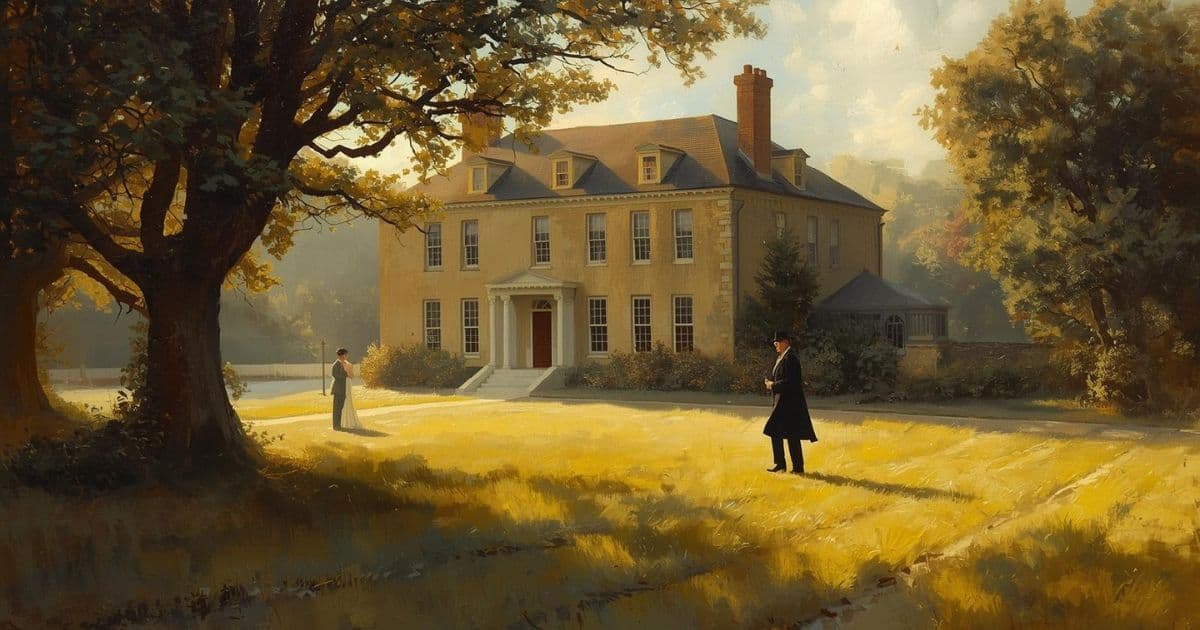
An excerpt from the original text.(complete · 2352 words)
IV.
[Illustration]
Elizabeth had settled it that Mr. Darcy would bring his sister to visit
her the very day after her reaching Pemberley; and was, consequently,
resolved not to be out of sight of the inn the whole of that morning.
But her conclusion was false; for on the very morning after their own
arrival at Lambton these visitors came. They had been walking about the
place with some of their new friends, and were just returned to the inn
to dress themselves for dining with the same family, when the sound of a
carriage drew them to a window, and they saw a gentleman and lady in a
curricle driving up the street. Elizabeth, immediately recognizing the
livery, guessed what it meant, and imparted no small degree of surprise
to her relations, by acquainting them with the honour which she
expected. Her uncle and aunt were all amazement; and the embarrassment
of her manner as she spoke, joined to the circumstance itself, and many
of the circumstances of the preceding day, opened to them a new idea on
the business. Nothing had ever suggested it before, but they now felt
that there was no other way of accounting for such attentions from such
a quarter than by supposing a partiality for their niece. While these
newly-born notions were passing in their heads, the perturbation of
Elizabeth’s feelings was every moment increasing. She was quite amazed
at her own discomposure; but, amongst other causes of disquiet, she
dreaded lest the partiality of the brother should have said too much in
her favour; and, more than commonly anxious to please, she naturally
suspected that every power of pleasing would fail her.
She retreated from the window, fearful of being seen; and as she walked
up and down the room, endeavouring to compose herself, saw such looks of
inquiring surprise in her uncle and aunt as made everything worse.
Miss Darcy and her brother appeared, and this formidable introduction
took place. With astonishment did Elizabeth see that her new
acquaintance was at least as much embarrassed as herself. Since her
being at Lambton, she had heard that Miss Darcy was exceedingly proud;
but the observation of a very few minutes convinced her that she was
only exceedingly shy. She found it difficult to obtain even a word from
her beyond a monosyllable.
Miss Darcy was tall, and on a larger scale than Elizabeth; and, though
little more than sixteen, her figure was formed, and her appearance
womanly and graceful. She was less handsome than her brother, but there
was sense and good-humour in her face, and her manners were perfectly
unassuming and gentle. Elizabeth, who had expected to find in her as
acute and unembarrassed an observer as ever Mr. Darcy had been, was much
relieved by discerning such different feelings.
They had not been long together before Darcy told her that Bingley was
also coming to wait on her; and she had barely time to express her
satisfaction, and prepare for such a visitor, when Bingley’s quick step
was heard on the stairs, and in a moment he entered the room. All
Elizabeth’s anger against him had been long done away; but had she still
felt any, it could hardly have stood its ground against the unaffected
cordiality with which he expressed himself on seeing her again. He
inquired in a friendly, though general, way, after her family, and
looked and spoke with the same good-humoured ease that he had ever done.
To Mr. and Mrs. Gardiner he was scarcely a less interesting personage
than to herself. They had long wished to see him. The whole party before
them, indeed, excited a lively attention. The suspicions which had just
arisen of Mr. Darcy and their niece, directed their observation towards
each with an earnest, though guarded, inquiry; and they soon drew from
those inquiries the full conviction that one of them at least knew what
it was to love. Of the lady’s sensations they remained a little in
doubt; but that the gentleman was overflowing with admiration was
evident enough.
Elizabeth, on her side, had much to do. She wanted to ascertain the
feelings of each of her visitors, she wanted to compose her own, and to
make herself agreeable to all; and in the latter object, where she
feared most to fail, she was most sure of success, for those to whom
she endeavoured to give pleasure were pre-possessed in her favour.
Bingley was ready, Georgiana was eager, and Darcy determined, to be
pleased.
[Illustration:
“To make herself agreeable to all”
[Copyright 1894 by George Allen.]]
In seeing Bingley, her thoughts naturally flew to her sister; and oh!
how ardently did she long to know whether any of his were directed in a
like manner. Sometimes she could fancy that he talked less than on
former occasions, and once or twice pleased herself with the notion
that, as he looked at her, he was trying to trace a resemblance. But,
though this might be imaginary, she could not be deceived as to his
behaviour to Miss Darcy, who had been set up as a rival to Jane. No
look appeared on either side that spoke particular regard. Nothing
occurred between them that could justify the hopes of his sister. On
this point she was soon satisfied; and two or three little circumstances
occurred ere they parted, which, in her anxious interpretation, denoted
a recollection of Jane, not untinctured by tenderness, and a wish of
saying more that might lead to the mention of her, had he dared. He
observed to her, at a moment when the others were talking together, and
in a tone which had something of real regret, that it “was a very long
time since he had had the pleasure of seeing her;” and, before she could
reply, he added, “It is above eight months. We have not met since the
26th of November, when we were all dancing together at Netherfield.”
Elizabeth was pleased to find his memory so exact; and he afterwards
took occasion to ask her, when unattended to by any of the rest, whether
all her sisters were at Longbourn. There was not much in the question,
nor in the preceding remark; but there was a look and a manner which
gave them meaning.
It was not often that she could turn her eyes on Mr. Darcy himself; but
whenever she did catch a glimpse she saw an expression of general
complaisance, and in all that he said, she heard an accent so far
removed from hauteur or disdain of his companions, as convinced her
that the improvement of manners which she had yesterday witnessed,
however temporary its existence might prove, had at least outlived one
day. When she saw him thus seeking the acquaintance, and courting the
good opinion of people with whom any intercourse a few months ago would
have been a disgrace; when she saw him thus civil, not only to herself,
but to the very relations whom he had openly disdained, and recollected
their last lively scene in Hunsford Parsonage, the difference, the
change was so great, and struck so forcibly on her mind, that she could
hardly restrain her astonishment from being visible. Never, even in the
company of his dear friends at Netherfield, or his dignified relations
at Rosings, had she seen him so desirous to please, so free from
self-consequence or unbending reserve, as now, when no importance could
result from the success of his endeavours, and when even the
acquaintance of those to whom his attentions were addressed, would draw
down the ridicule and censure of the ladies both of Netherfield and
Rosings.
Their visitors stayed with them above half an hour; and when they arose
to depart, Mr. Darcy called on his sister to join him in expressing
their wish of seeing Mr. and Mrs. Gardiner, and Miss Bennet, to dinner
at Pemberley, before they left the country. Miss Darcy, though with a
diffidence which marked her little in the habit of giving invitations,
readily obeyed. Mrs. Gardiner looked at her niece, desirous of knowing
how she, whom the invitation most concerned, felt disposed as to its
acceptance, but Elizabeth had turned away her head. Presuming, however,
that this studied avoidance spoke rather a momentary embarrassment than
any dislike of the proposal, and seeing in her husband, who was fond of
society, a perfect willingness to accept it, she ventured to engage for
her attendance, and the day after the next was fixed on.
Bingley expressed great pleasure in the certainty of seeing Elizabeth
again, having still a great deal to say to her, and many inquiries to
make after all their Hertfordshire friends. Elizabeth, construing all
this into a wish of hearing her speak of her sister, was pleased; and
on this account, as well as some others, found herself, when their
visitors left them, capable of considering the last half hour with some
satisfaction, though while it was passing the enjoyment of it had been
little. Eager to be alone, and fearful of inquiries or hints from her
uncle and aunt, she stayed with them only long enough to hear their
favourable opinion of Bingley, and then hurried away to dress.
But she had no reason to fear Mr. and Mrs. Gardiner’s curiosity; it was
not their wish to force her communication. It was evident that she was
much better acquainted with Mr. Darcy than they had before any idea of;
it was evident that he was very much in love with her. They saw much to
interest, but nothing to justify inquiry.
Of Mr. Darcy it was now a matter of anxiety to think well; and, as far
as their acquaintance reached, there was no fault to find. They could
not be untouched by his politeness; and had they drawn his character
from their own feelings and his servant’s report, without any reference
to any other account, the circle in Hertfordshire to which he was known
would not have recognized it for Mr. Darcy. There was now an interest,
however, in believing the housekeeper; and they soon became sensible
that the authority of a servant, who had known him since he was four
years old, and whose own manners indicated respectability, was not to be
hastily rejected. Neither had anything occurred in the intelligence of
their Lambton friends that could materially lessen its weight. They had
nothing to accuse him of but pride; pride he probably had, and if not,
it would certainly be imputed by the inhabitants of a small market town
where the family did not visit. It was acknowledged, however, that he
was a liberal man, and did much good among the poor.
With respect to Wickham, the travellers soon found that he was not held
there in much estimation; for though the chief of his concerns with the
son of his patron were imperfectly understood, it was yet a well-known
fact that, on his quitting Derbyshire, he had left many debts behind
him, which Mr. Darcy afterwards discharged.
As for Elizabeth, her thoughts were at Pemberley this evening more than
the last; and the evening, though as it passed it seemed long, was not
long enough to determine her feelings towards one in that mansion; and
she lay awake two whole hours, endeavouring to make them out. She
certainly did not hate him. No; hatred had vanished long ago, and she
had almost as long been ashamed of ever feeling a dislike against him,
that could be so called. The respect created by the conviction of his
valuable qualities, though at first unwillingly admitted, had for some
time ceased to be repugnant to her feelings; and it was now heightened
into somewhat of a friendlier nature by the testimony so highly in his
favour, and bringing forward his disposition in so amiable a light,
which yesterday had produced. But above all, above respect and esteem,
there was a motive within her of good-will which could not be
overlooked. It was gratitude;--gratitude, not merely for having once
loved her, but for loving her still well enough to forgive all the
petulance and acrimony of her manner in rejecting him, and all the
unjust accusations accompanying her rejection. He who, she had been
persuaded, would avoid her as his greatest enemy, seemed, on this
accidental meeting, most eager to preserve the acquaintance; and
without any indelicate display of regard, or any peculiarity of manner,
where their two selves only were concerned, was soliciting the good
opinion of her friends, and bent on making her known to his sister. Such
a change in a man of so much pride excited not only astonishment but
gratitude--for to love, ardent love, it must be attributed; and, as
such, its impression on her was of a sort to be encouraged, as by no
means unpleasing, though it could not be exactly defined. She respected,
she esteemed, she was grateful to him, she felt a real interest in his
welfare; and she only wanted to know how far she wished that welfare to
depend upon herself, and how far it would be for the happiness of both
that she should employ the power, which her fancy told her she still
possessed, of bringing on the renewal of his addresses.
It had been settled in the evening, between the aunt and niece, that
such a striking civility as Miss Darcy’s, in coming to them on the very
day of her arrival at Pemberley--for she had reached it only to a late
breakfast--ought to be imitated, though it could not be equalled, by
some exertion of politeness on their side; and, consequently, that it
would be highly expedient to wait on her at Pemberley the following
morning. They were, therefore, to go. Elizabeth was pleased; though when
she asked herself the reason, she had very little to say in reply.
Mr. Gardiner left them soon after breakfast. The fishing scheme had been
renewed the day before, and a positive engagement made of his meeting
some of the gentlemen at Pemberley by noon.
[Illustration:
“Engaged by the river”
]
Master this chapter. Complete your experience
Purchase the complete book to access all chapters and support classic literature
As an Amazon Associate, we earn a small commission from qualifying purchases at no additional cost to you.
Available in paperback, hardcover, and e-book formats
Let's Analyse the Pattern
Why This Matters
Connect literature to life
This chapter teaches how a person's spaces and the people around them reveal their true nature more reliably than direct interaction.
Now let's explore the literary elements.
Key Quotes & Analysis
"And of this place, thought she, I might have been mistress!"
Context: As Elizabeth first sees the grandeur of Pemberley estate
This reveals Elizabeth's dawning realization of what she gave up when she rejected Darcy. It's not about the wealth - it's about recognizing she misjudged the man who offered her everything.
"I have never known a cross word from him in my life, and I have known him ever since he was four years old."
Context: The housekeeper describing Darcy's character to Elizabeth
This completely contradicts Elizabeth's image of Darcy as proud and harsh. Coming from someone who's known him since childhood, it carries the weight of truth that forces Elizabeth to question everything she believed.
"As a brother, a landlord, a master, she considered how many people's happiness were in his guardianship!"
Context: Elizabeth reflecting on Darcy's responsibilities and character
Elizabeth realizes Darcy isn't just wealthy - he's a man who takes care of everyone depending on him. This insight shows her growing understanding of true character versus surface impressions.
Thematic Threads
Prejudice
In This Chapter
Elizabeth's prejudice dissolves when confronted with overwhelming counter-evidence from neutral sources
Development
Evolving from rigid judgment to genuine curiosity about Darcy's true nature
In Your Life:
When have you had to admit you were completely wrong about someone after getting information from multiple sources, and how did it feel to let go of your initial judgment?
Class
In This Chapter
Pemberley reveals how wealth can be wielded responsibly—Darcy as good steward rather than oppressor
Development
Complicating earlier assumptions about the wealthy being automatically corrupt or heartless
In Your Life:
Have you ever discovered that someone wealthy or privileged in your community actually uses their advantages to help others rather than just themselves?
Personal Growth
In This Chapter
Elizabeth experiences the humbling realization that she fundamentally misjudged someone's character
Development
Moving from defensive self-justification toward honest self-examination
In Your Life:
Can you think of a time when you realized you had badly misjudged someone's character - what made you finally see the truth about them?
Pride
In This Chapter
Elizabeth's intellectual pride prevented her from seeing Darcy clearly—she was too invested in being right
Development
Beginning to recognize how her own pride created the very blindness she criticized in others
In Your Life:
When has your need to be right about someone prevented you from seeing who they really are?
You now have the context. Time to form your own thoughts.
Discussion Questions
- 1
What specific details about Darcy's character does Elizabeth learn from Mrs. Reynolds and the tour of Pemberley?
- 2
Why is Elizabeth able to absorb this positive information about Darcy now when she dismissed or never sought it before?
- 3
Think of a time when you completely changed your opinion about someone after getting new information - what made you finally ready to see them differently?
- 4
How could Elizabeth have discovered Darcy's true character earlier, and what stops us from seeking out different perspectives on people we've already judged?
- 5
What does this chapter reveal about how our emotional state affects what information we can actually process and believe?
Critical Thinking Exercise
The Third-Party Reality Check
Think of someone you have strong negative feelings about - a coworker, family member, or acquaintance. Write down three people who interact with this person in completely different contexts than you do. What would each of these people likely say about this person's character? What positive qualities might they see that you're missing or dismissing?
Consider:
- •Consider how your specific relationship dynamic might create blind spots about their other qualities
- •Think about whether you're invested in being 'right' about this person in ways that block new information
- •Ask yourself what evidence you might be filtering out because it doesn't fit your current narrative about them
Coming Up Next...
Chapter 45
Elizabeth visits Pemberley again for the return call, where she'll have to navigate Miss Bingley's jealous hostility while trying to understand her own rapidly evolving feelings for Darcy.