An excerpt from the original text.(complete · 2995 words)
[llustration]
Elizabeth awoke the next morning to the same thoughts and meditations
which had at length closed her eyes. She could not yet recover from the
surprise of what had happened: it was impossible to think of anything
else; and, totally indisposed for employment, she resolved soon after
breakfast to indulge herself in air and exercise. She was proceeding
directly to her favourite walk, when the recollection of Mr. Darcy’s
sometimes coming there stopped her, and instead of entering the park,
she turned up the lane which led her farther from the turnpike road. The
park paling was still the boundary on one side, and she soon passed one
of the gates into the ground.
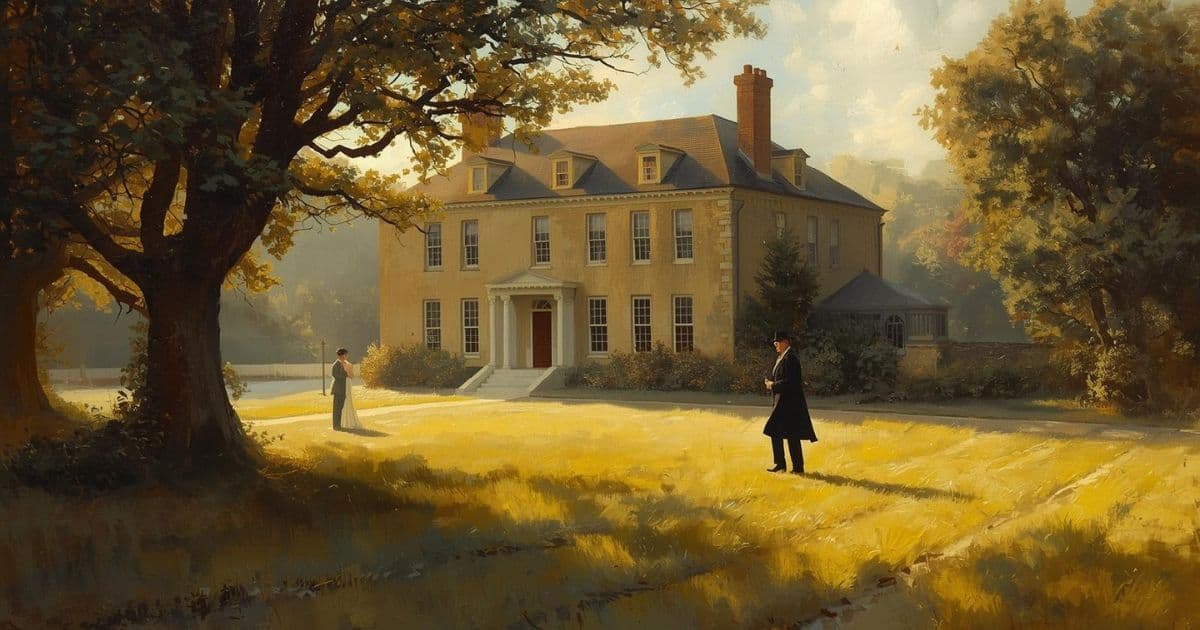
After walking two or three times along that part of the lane, she was
tempted, by the pleasantness of the morning, to stop at the gates and
look into the park. The five weeks which she had now passed in Kent had
made a great difference in the country, and every day was adding to the
verdure of the early trees. She was on the point of continuing her
walk, when she caught a glimpse of a gentleman within the sort of grove
which edged the park: he was moving that way; and fearful of its being
Mr. Darcy, she was directly retreating. But the person who advanced was
now near enough to see her, and stepping forward with eagerness,
pronounced her name. She had turned away; but on hearing herself called,
though in a voice which proved it to be Mr. Darcy, she moved again
towards the gate. He had by that time reached it also; and, holding out
a letter, which she instinctively took, said, with a look of haughty
composure, “I have been walking in the grove some time, in the hope of
meeting you. Will you do me the honour of reading that letter?” and
then, with a slight bow, turned again into the plantation, and was soon
out of sight.
With no expectation of pleasure, but with the strongest curiosity,
Elizabeth opened the letter, and to her still increasing wonder,
perceived an envelope containing two sheets of letter paper, written
quite through, in a very close hand. The envelope itself was likewise
full. Pursuing her way along the lane, she then began it. It was dated
from Rosings, at eight o’clock in the morning, and was as follows:--
“Be not alarmed, madam, on receiving this letter, by the apprehension of
its containing any repetition of those sentiments, or renewal of those
offers, which were last night so disgusting to you. I write without any
intention of paining you, or humbling myself, by dwelling on wishes,
which, for the happiness of both, cannot be too soon forgotten; and the
effort which the formation and the perusal of this letter must occasion,
should have been spared, had not my character required it to be written
and read. You must, therefore, pardon the freedom with which I demand
your attention; your feelings, I know, will bestow it unwillingly, but I
demand it of your justice.
“Two offences of a very different nature, and by no means of equal
magnitude, you last night laid to my charge. The first mentioned was,
that, regardless of the sentiments of either, I had detached Mr. Bingley
from your sister,--and the other, that I had, in defiance of various
claims, in defiance of honour and humanity, ruined the immediate
prosperity and blasted the prospects of Mr. Wickham. Wilfully and
wantonly to have thrown off the companion of my youth, the acknowledged
favourite of my father, a young man who had scarcely any other
dependence than on our patronage, and who had been brought up to expect
its exertion, would be a depravity, to which the separation of two young
persons whose affection could be the growth of only a few weeks, could
bear no comparison. But from the severity of that blame which was last
night so liberally bestowed, respecting each circumstance, I shall hope
to be in future secured, when the following account of my actions and
their motives has been read. If, in the explanation of them which is due
to myself, I am under the necessity of relating feelings which may be
offensive to yours, I can only say that I am sorry. The necessity must
be obeyed, and further apology would be absurd. I had not been long in
Hertfordshire before I saw, in common with others, that Bingley
preferred your elder sister to any other young woman in the country. But
it was not till the evening of the dance at Netherfield that I had any
apprehension of his feeling a serious attachment. I had often seen him
in love before. At that ball, while I had the honour of dancing with
you, I was first made acquainted, by Sir William Lucas’s accidental
information, that Bingley’s attentions to your sister had given rise to
a general expectation of their marriage. He spoke of it as a certain
event, of which the time alone could be undecided. From that moment I
observed my friend’s behaviour attentively; and I could then perceive
that his partiality for Miss Bennet was beyond what I had ever witnessed
in him. Your sister I also watched. Her look and manners were open,
cheerful, and engaging as ever, but without any symptom of peculiar
regard; and I remained convinced, from the evening’s scrutiny, that
though she received his attentions with pleasure, she did not invite
them by any participation of sentiment. If you have not been mistaken
here, I must have been in an error. Your superior knowledge of your
sister must make the latter probable. If it be so, if I have been misled
by such error to inflict pain on her, your resentment has not been
unreasonable. But I shall not scruple to assert, that the serenity of
your sister’s countenance and air was such as might have given the most
acute observer a conviction that, however amiable her temper, her heart
was not likely to be easily touched. That I was desirous of believing
her indifferent is certain; but I will venture to say that my
investigations and decisions are not usually influenced by my hopes or
fears. I did not believe her to be indifferent because I wished it; I
believed it on impartial conviction, as truly as I wished it in reason.
My objections to the marriage were not merely those which I last night
acknowledged to have required the utmost force of passion to put aside
in my own case; the want of connection could not be so great an evil to
my friend as to me. But there were other causes of repugnance; causes
which, though still existing, and existing to an equal degree in both
instances, I had myself endeavoured to forget, because they were not
immediately before me. These causes must be stated, though briefly. The
situation of your mother’s family, though objectionable, was nothing in
comparison of that total want of propriety so frequently, so almost
uniformly betrayed by herself, by your three younger sisters, and
occasionally even by your father:--pardon me,--it pains me to offend
you. But amidst your concern for the defects of your nearest relations,
and your displeasure at this representation of them, let it give you
consolation to consider that to have conducted yourselves so as to avoid
any share of the like censure is praise no less generally bestowed on
you and your eldest sister than it is honourable to the sense and
disposition of both. I will only say, farther, that from what passed
that evening my opinion of all parties was confirmed, and every
inducement heightened, which could have led me before to preserve my
friend from what I esteemed a most unhappy connection. He left
Netherfield for London on the day following, as you, I am certain,
remember, with the design of soon returning. The part which I acted is
now to be explained. His sisters’ uneasiness had been equally excited
with my own: our coincidence of feeling was soon discovered; and, alike
sensible that no time was to be lost in detaching their brother, we
shortly resolved on joining him directly in London. We accordingly
went--and there I readily engaged in the office of pointing out to my
friend the certain evils of such a choice. I described and enforced them
earnestly. But however this remonstrance might have staggered or delayed
his determination, I do not suppose that it would ultimately have
prevented the marriage, had it not been seconded by the assurance, which
I hesitated not in giving, of your sister’s indifference. He had before
believed her to return his affection with sincere, if not with equal,
regard. But Bingley has great natural modesty, with a stronger
dependence on my judgment than on his own. To convince him, therefore,
that he had deceived himself was no very difficult point. To persuade
him against returning into Hertfordshire, when that conviction had been
given, was scarcely the work of a moment. I cannot blame myself for
having done thus much. There is but one part of my conduct, in the whole
affair, on which I do not reflect with satisfaction; it is that I
condescended to adopt the measures of art so far as to conceal from him
your sister’s being in town. I knew it myself, as it was known to Miss
Bingley; but her brother is even yet ignorant of it. That they might
have met without ill consequence is, perhaps, probable; but his regard
did not appear to me enough extinguished for him to see her without some
danger. Perhaps this concealment, this disguise, was beneath me. It is
done, however, and it was done for the best. On this subject I have
nothing more to say, no other apology to offer. If I have wounded your
sister’s feelings, it was unknowingly done; and though the motives which
governed me may to you very naturally appear insufficient, I have not
yet learnt to condemn them.--With respect to that other, more weighty
accusation, of having injured Mr. Wickham, I can only refute it by
laying before you the whole of his connection with my family. Of what he
has particularly accused me I am ignorant; but of the truth of what I
shall relate I can summon more than one witness of undoubted veracity.
Mr. Wickham is the son of a very respectable man, who had for many years
the management of all the Pemberley estates, and whose good conduct in
the discharge of his trust naturally inclined my father to be of service
to him; and on George Wickham, who was his godson, his kindness was
therefore liberally bestowed. My father supported him at school, and
afterwards at Cambridge; most important assistance, as his own father,
always poor from the extravagance of his wife, would have been unable to
give him a gentleman’s education. My father was not only fond of this
young man’s society, whose manners were always engaging, he had also the
highest opinion of him, and hoping the church would be his profession,
intended to provide for him in it. As for myself, it is many, many years
since I first began to think of him in a very different manner. The
vicious propensities, the want of principle, which he was careful to
guard from the knowledge of his best friend, could not escape the
observation of a young man of nearly the same age with himself, and who
had opportunities of seeing him in unguarded moments, which Mr. Darcy
could not have. Here again I shall give you pain--to what degree you
only can tell. But whatever may be the sentiments which Mr. Wickham has
created, a suspicion of their nature shall not prevent me from unfolding
his real character. It adds even another motive. My excellent father
died about five years ago; and his attachment to Mr. Wickham was to the
last so steady, that in his will he particularly recommended it to me to
promote his advancement in the best manner that his profession might
allow, and if he took orders, desired that a valuable family living
might be his as soon as it became vacant. There was also a legacy of
one thousand pounds. His own father did not long survive mine; and
within half a year from these events Mr. Wickham wrote to inform me
that, having finally resolved against taking orders, he hoped I should
not think it unreasonable for him to expect some more immediate
pecuniary advantage, in lieu of the preferment, by which he could not be
benefited. He had some intention, he added, of studying the law, and I
must be aware that the interest of one thousand pounds would be a very
insufficient support therein. I rather wished than believed him to be
sincere; but, at any rate, was perfectly ready to accede to his
proposal. I knew that Mr. Wickham ought not to be a clergyman. The
business was therefore soon settled. He resigned all claim to assistance
in the church, were it possible that he could ever be in a situation to
receive it, and accepted in return three thousand pounds. All connection
between us seemed now dissolved. I thought too ill of him to invite him
to Pemberley, or admit his society in town. In town, I believe, he
chiefly lived, but his studying the law was a mere pretence; and being
now free from all restraint, his life was a life of idleness and
dissipation. For about three years I heard little of him; but on the
decease of the incumbent of the living which had been designed for him,
he applied to me again by letter for the presentation. His
circumstances, he assured me, and I had no difficulty in believing it,
were exceedingly bad. He had found the law a most unprofitable study,
and was now absolutely resolved on being ordained, if I would present
him to the living in question--of which he trusted there could be little
doubt, as he was well assured that I had no other person to provide for,
and I could not have forgotten my revered father’s intentions. You will
hardly blame me for refusing to comply with this entreaty, or for
resisting every repetition of it. His resentment was in proportion to
the distress of his circumstances--and he was doubtless as violent in
his abuse of me to others as in his reproaches to myself. After this
period, every appearance of acquaintance was dropped. How he lived, I
know not. But last summer he was again most painfully obtruded on my
notice. I must now mention a circumstance which I would wish to forget
myself, and which no obligation less than the present should induce me
to unfold to any human being. Having said thus much, I feel no doubt of
your secrecy. My sister, who is more than ten years my junior, was left
to the guardianship of my mother’s nephew, Colonel Fitzwilliam, and
myself. About a year ago, she was taken from school, and an
establishment formed for her in London; and last summer she went with
the lady who presided over it to Ramsgate; and thither also went Mr.
Wickham, undoubtedly by design; for there proved to have been a prior
acquaintance between him and Mrs. Younge, in whose character we were
most unhappily deceived; and by her connivance and aid he so far
recommended himself to Georgiana, whose affectionate heart retained a
strong impression of his kindness to her as a child, that she was
persuaded to believe herself in love and to consent to an elopement. She
was then but fifteen, which must be her excuse; and after stating her
imprudence, I am happy to add, that I owed the knowledge of it to
herself. I joined them unexpectedly a day or two before the intended
elopement; and then Georgiana, unable to support the idea of grieving
and offending a brother whom she almost looked up to as a father,
acknowledged the whole to me. You may imagine what I felt and how I
acted. Regard for my sister’s credit and feelings prevented any public
exposure; but I wrote to Mr. Wickham, who left the place immediately,
and Mrs. Younge was of course removed from her charge. Mr. Wickham’s
chief object was unquestionably my sister’s fortune, which is thirty
thousand pounds; but I cannot help supposing that the hope of revenging
himself on me was a strong inducement. His revenge would have been
complete indeed. This, madam, is a faithful narrative of every event in
which we have been concerned together; and if you do not absolutely
reject it as false, you will, I hope, acquit me henceforth of cruelty
towards Mr. Wickham. I know not in what manner, under what form of
falsehood, he has imposed on you; but his success is not perhaps to be
wondered at, ignorant as you previously were of everything concerning
either. Detection could not be in your power, and suspicion certainly
not in your inclination. You may possibly wonder why all this was not
told you last night. But I was not then master enough of myself to know
what could or ought to be revealed. For the truth of everything here
related, I can appeal more particularly to the testimony of Colonel
Fitzwilliam, who, from our near relationship and constant intimacy, and
still more as one of the executors of my father’s will, has been
unavoidably acquainted with every particular of these transactions. If
your abhorrence of me should make my assertions valueless, you
cannot be prevented by the same cause from confiding in my cousin; and
that there may be the possibility of consulting him, I shall endeavour
to find some opportunity of putting this letter in your hands in the
course of the morning. I will only add, God bless you.
“FITZWILLIAM DARCY.”
[Illustration]
Master this chapter. Complete your experience
Purchase the complete book to access all chapters and support classic literature
As an Amazon Associate, we earn a small commission from qualifying purchases at no additional cost to you.
Available in paperback, hardcover, and e-book formats
Let's Analyse the Pattern
Why This Matters
Connect literature to life
This chapter teaches how manipulators use validation and confirmation bias to gain trust while isolating their targets from people who might expose the truth.
Now let's explore the literary elements.
Key Quotes & Analysis
"How despicably have I acted! I, who have prided myself on my discernment! I, who have valued myself on my abilities!"
Context: Elizabeth's internal reaction after reading Darcy's letter
This shows Elizabeth's painful but necessary self-awareness. She realizes her pride in being a good judge of character was actually arrogance, and she's been completely wrong about both Darcy and Wickham.
"Till this moment, I never knew myself."
Context: Elizabeth's realization about her own character flaws
This moment of self-discovery is crucial to Elizabeth's growth. True maturity comes from recognizing our own blind spots and biases, not just criticizing others.
"I have no wish of denying that I did everything in my power to separate my friend from your sister, or that I rejoice in my success."
Context: Darcy's honest admission in his letter about interfering with Jane and Bingley
Darcy doesn't make excuses or apologize for protecting his friend. His honesty, even when it makes him look bad, shows his integrity and respect for Elizabeth's intelligence.
Thematic Threads
Pride
In This Chapter
Elizabeth's pride in her judgment prevents her from seeing her own biases and mistakes
Development
Evolved from initial wounded vanity to deeper self-examination and growth
In Your Life:
When was the last time your confidence in being right prevented you from seeing a mistake you were making?
Prejudice
In This Chapter
Elizabeth realizes her prejudice against Darcy was based on first impressions and wounded feelings
Development
Transforms from unconscious bias to conscious recognition and correction
In Your Life:
Have you ever realized that your negative opinion of someone was based more on how they made you feel than on who they actually are?
Deception
In This Chapter
Wickham's manipulation is revealed—he exploited Elizabeth's existing prejudices to gain her trust
Development
Shifts from charming lies accepted to uncomfortable truths acknowledged
In Your Life:
Can you think of a time when someone told you exactly what you wanted to hear, and you later realized they had ulterior motives?
Personal Growth
In This Chapter
Elizabeth courageously examines her own flaws and admits she was wrong
Development
Major turning point—from defensive self-justification to honest self-reflection
In Your Life:
What's the hardest truth about yourself that you've had to accept, and how did it change you?
Truth
In This Chapter
Darcy's letter forces Elizabeth to confront multiple uncomfortable truths about herself and others
Development
Evolution from avoiding difficult truths to embracing them for growth
In Your Life:
When has someone's honest feedback, even though it stung, ultimately helped you become a better person?
You now have the context. Time to form your own thoughts.
Discussion Questions
- 1
What specific information in Darcy's letter completely changes Elizabeth's understanding of both him and Wickham?
- 2
Why did Elizabeth believe Wickham's story so easily while dismissing everything positive she heard about Darcy?
- 3
Think about your workplace, school, or social media - where do you see people accepting information that confirms what they already believe while rejecting information that challenges them?
- 4
When you realize you've misjudged someone based on first impressions or gossip, what's your strategy for rebuilding that relationship and restoring trust?
- 5
Elizabeth discovers that being proud of her judgment actually made her judgment worse - what does this reveal about the relationship between confidence and wisdom?
Critical Thinking Exercise
Audit Your Information Sources
Think of a strong opinion you hold about a person, situation, or issue. Write down where you got that information and whether those sources confirmed what you already believed or challenged your assumptions. Then identify one source that might give you a different perspective and commit to seeking it out this week.
Consider:
- •Are your most trusted information sources telling you what you want to hear or what you need to hear?
- •When was the last time you changed your mind about something important based on new information?
- •What makes you more likely to trust someone - that they validate your existing beliefs or that they demonstrate consistent character over time?
Coming Up Next...
Chapter 36
Elizabeth's world has been turned upside down by Darcy's revelations. Now she must process these shocking truths and figure out what they mean for her future, especially as she prepares to return home to her family.