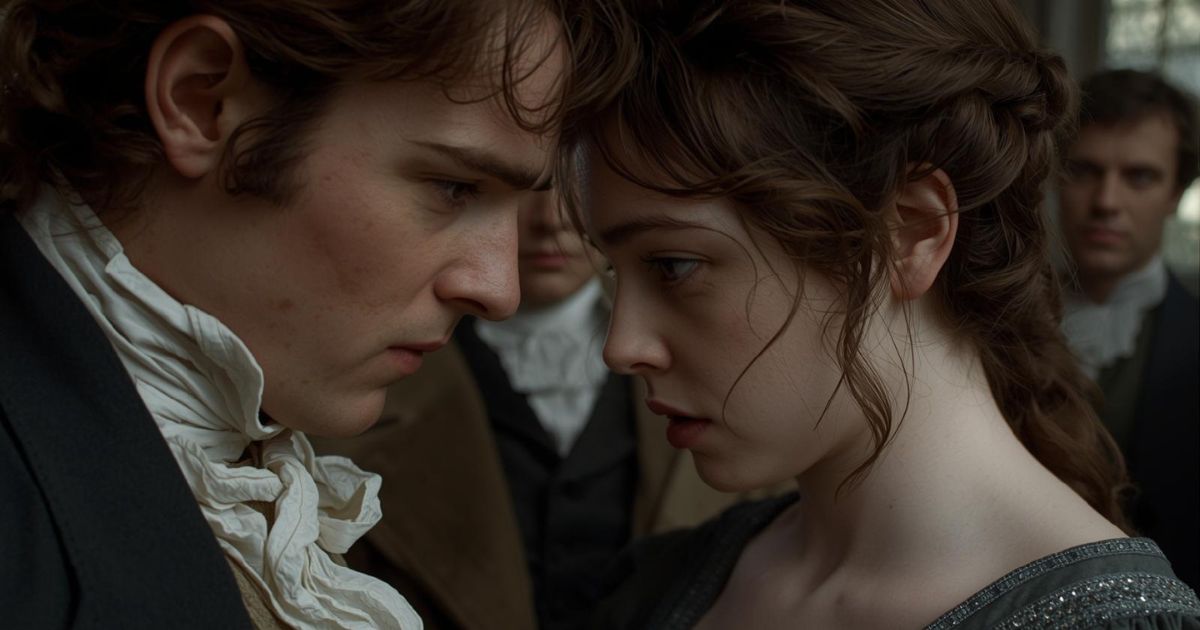
An excerpt from the original text.(complete · 2103 words)
[llustration]
When they were gone, Elizabeth, as if intending to exasperate herself as
much as possible against Mr. Darcy, chose for her employment the
examination of all the letters which Jane had written to her since her
being in Kent. They contained no actual complaint, nor was there any
revival of past occurrences, or any communication of present suffering.
But in all, and in almost every line of each, there was a want of that
cheerfulness which had been used to characterize her style, and which,
proceeding from the serenity of a mind at ease with itself, and kindly
disposed towards everyone, had been scarcely ever clouded. Elizabeth
noticed every sentence conveying the idea of uneasiness, with an
attention which it had hardly received on the first perusal. Mr. Darcy’s
shameful boast of what misery he had been able to inflict gave her a
keener sense of her sister’s sufferings. It was some consolation to
think that his visit to Rosings was to end on the day after the next,
and a still greater that in less than a fortnight she should herself be
with Jane again, and enabled to contribute to the recovery of her
spirits, by all that affection could do.
She could not think of Darcy’s leaving Kent without remembering that his
cousin was to go with him; but Colonel Fitzwilliam had made it clear
that he had no intentions at all, and, agreeable as he was, she did not
mean to be unhappy about him.
While settling this point, she was suddenly roused by the sound of the
door-bell; and her spirits were a little fluttered by the idea of its
being Colonel Fitzwilliam himself, who had once before called late in
the evening, and might now come to inquire particularly after her. But
this idea was soon banished, and her spirits were very differently
affected, when, to her utter amazement, she saw Mr. Darcy walk into the
room. In a hurried manner he immediately began an inquiry after her
health, imputing his visit to a wish of hearing that she were better.
She answered him with cold civility. He sat down for a few moments, and
then getting up walked about the room. Elizabeth was surprised, but
said not a word. After a silence of several minutes, he came towards her
in an agitated manner, and thus began:--
“In vain have I struggled. It will not do. My feelings will not be
repressed. You must allow me to tell you how ardently I admire and love
you.”
Elizabeth’s astonishment was beyond expression. She stared, coloured,
doubted, and was silent. This he considered sufficient encouragement,
and the avowal of all that he felt and had long felt for her immediately
followed. He spoke well; but there were feelings besides those of the
heart to be detailed, and he was not more eloquent on the subject of
tenderness than of pride. His sense of her inferiority, of its being a
degradation, of the family obstacles which judgment had always opposed
to inclination, were dwelt on with a warmth which seemed due to the
consequence he was wounding, but was very unlikely to recommend his
suit.
In spite of her deeply-rooted dislike, she could not be insensible to
the compliment of such a man’s affection, and though her intentions did
not vary for an instant, she was at first sorry for the pain he was to
receive; till roused to resentment by his subsequent language, she lost
all compassion in anger. She tried, however, to compose herself to
answer him with patience, when he should have done. He concluded with
representing to her the strength of that attachment which in spite of
all his endeavours he had found impossible to conquer; and with
expressing his hope that it would now be rewarded by her acceptance of
his hand. As he said this she could easily see that he had no doubt of a
favourable answer. He spoke of apprehension and anxiety, but his
countenance expressed real security. Such a circumstance could only
exasperate farther; and when he ceased the colour rose into her cheeks
and she said,--
“In such cases as this, it is, I believe, the established mode to
express a sense of obligation for the sentiments avowed, however
unequally they may be returned. It is natural that obligation should be
felt, and if I could feel gratitude, I would now thank you. But I
cannot--I have never desired your good opinion, and you have certainly
bestowed it most unwillingly. I am sorry to have occasioned pain to
anyone. It has been most unconsciously done, however, and I hope will be
of short duration. The feelings which you tell me have long prevented
the acknowledgment of your regard can have little difficulty in
overcoming it after this explanation.”
Mr. Darcy, who was leaning against the mantel-piece with his eyes fixed
on her face, seemed to catch her words with no less resentment than
surprise. His complexion became pale with anger, and the disturbance of
his mind was visible in every feature. He was struggling for the
appearance of composure, and would not open his lips till he believed
himself to have attained it. The pause was to Elizabeth’s feelings
dreadful. At length, in a voice of forced calmness, he said,--
“And this is all the reply which I am to have the honour of expecting! I
might, perhaps, wish to be informed why, with so little endeavour at
civility, I am thus rejected. But it is of small importance.”
“I might as well inquire,” replied she, “why, with so evident a design
of offending and insulting me, you chose to tell me that you liked me
against your will, against your reason, and even against your character?
Was not this some excuse for incivility, if I was uncivil? But I have
other provocations. You know I have. Had not my own feelings decided
against you, had they been indifferent, or had they even been
favourable, do you think that any consideration would tempt me to accept
the man who has been the means of ruining, perhaps for ever, the
happiness of a most beloved sister?”
As she pronounced these words, Mr. Darcy changed colour; but the emotion
was short, and he listened without attempting to interrupt her while she
continued,--
“I have every reason in the world to think ill of you. No motive can
excuse the unjust and ungenerous part you acted there. You dare not,
you cannot deny that you have been the principal, if not the only means
of dividing them from each other, of exposing one to the censure of the
world for caprice and instability, the other to its derision for
disappointed hopes, and involving them both in misery of the acutest
kind.”
She paused, and saw with no slight indignation that he was listening
with an air which proved him wholly unmoved by any feeling of remorse.
He even looked at her with a smile of affected incredulity.
“Can you deny that you have done it?” she repeated.
With assumed tranquillity he then replied, “I have no wish of denying
that I did everything in my power to separate my friend from your
sister, or that I rejoice in my success. Towards him I have been
kinder than towards myself.”
Elizabeth disdained the appearance of noticing this civil reflection,
but its meaning did not escape, nor was it likely to conciliate her.
“But it is not merely this affair,” she continued, “on which my dislike
is founded. Long before it had taken place, my opinion of you was
decided. Your character was unfolded in the recital which I received
many months ago from Mr. Wickham. On this subject, what can you have to
say? In what imaginary act of friendship can you here defend yourself?
or under what misrepresentation can you here impose upon others?”
“You take an eager interest in that gentleman’s concerns,” said Darcy,
in a less tranquil tone, and with a heightened colour.
“Who that knows what his misfortunes have been can help feeling an
interest in him?”
“His misfortunes!” repeated Darcy, contemptuously,--“yes, his
misfortunes have been great indeed.”
“And of your infliction,” cried Elizabeth, with energy; “You have
reduced him to his present state of poverty--comparative poverty. You
have withheld the advantages which you must know to have been designed
for him. You have deprived the best years of his life of that
independence which was no less his due than his desert. You have done
all this! and yet you can treat the mention of his misfortunes with
contempt and ridicule.”
“And this,” cried Darcy, as he walked with quick steps across the room,
“is your opinion of me! This is the estimation in which you hold me! I
thank you for explaining it so fully. My faults, according to this
calculation, are heavy indeed! But, perhaps,” added he, stopping in his
walk, and turning towards her, “these offences might have been
overlooked, had not your pride been hurt by my honest confession of the
scruples that had long prevented my forming any serious design. These
bitter accusations might have been suppressed, had I, with greater
policy, concealed my struggles, and flattered you into the belief of my
being impelled by unqualified, unalloyed inclination; by reason, by
reflection, by everything. But disguise of every sort is my abhorrence.
Nor am I ashamed of the feelings I related. They were natural and just.
Could you expect me to rejoice in the inferiority of your
connections?--to congratulate myself on the hope of relations whose
condition in life is so decidedly beneath my own?”
Elizabeth felt herself growing more angry every moment; yet she tried to
the utmost to speak with composure when she said,--
“You are mistaken, Mr. Darcy, if you suppose that the mode of your
declaration affected me in any other way than as it spared me the
concern which I might have felt in refusing you, had you behaved in a
more gentlemanlike manner.”
She saw him start at this; but he said nothing, and she continued,--
“You could not have made me the offer of your hand in any possible way
that would have tempted me to accept it.”
Again his astonishment was obvious; and he looked at her with an
expression of mingled incredulity and mortification. She went on,--
“From the very beginning, from the first moment, I may almost say, of my
acquaintance with you, your manners impressing me with the fullest
belief of your arrogance, your conceit, and your selfish disdain of the
feelings of others, were such as to form that groundwork of
disapprobation, on which succeeding events have built so immovable a
dislike; and I had not known you a month before I felt that you were the
last man in the world whom I could ever be prevailed on to marry.”
“You have said quite enough, madam. I perfectly comprehend your
feelings, and have now only to be ashamed of what my own have been.
Forgive me for having taken up so much of your time, and accept my best
wishes for your health and happiness.”
And with these words he hastily left the room, and Elizabeth heard him
the next moment open the front door and quit the house. The tumult of
her mind was now painfully great. She knew not how to support herself,
and, from actual weakness, sat down and cried for half an hour. Her
astonishment, as she reflected on what had passed, was increased by
every review of it. That she should receive an offer of marriage from
Mr. Darcy! that he should have been in love with her for so many months!
so much in love as to wish to marry her in spite of all the objections
which had made him prevent his friend’s marrying her sister, and which
must appear at least with equal force in his own case, was almost
incredible! it was gratifying to have inspired unconsciously so strong
an affection. But his pride, his abominable pride, his shameless avowal
of what he had done with respect to Jane, his unpardonable assurance in
acknowledging, though he could not justify it, and the unfeeling manner
which he had mentioned Mr. Wickham, his cruelty towards whom he had not
attempted to deny, soon overcame the pity which the consideration of his
attachment had for a moment excited.
She continued in very agitating reflections till the sound of Lady
Catherine’s carriage made her feel how unequal she was to encounter
Charlotte’s observation, and hurried her away to her room.
[Illustration:
“Hearing herself called”
]
Master this chapter. Complete your experience
Purchase the complete book to access all chapters and support classic literature
As an Amazon Associate, we earn a small commission from qualifying purchases at no additional cost to you.
Available in paperback, hardcover, and e-book formats
Let's Analyse the Pattern
Why This Matters
Connect literature to life
This chapter teaches how to recognize when your emotional reaction to new information signals that your original judgment might be wrong.
Now let's explore the literary elements.
Key Quotes & Analysis
"How despicably have I acted! I, who have prided myself on my discernment!"
Context: Elizabeth's internal reaction after reading Darcy's letter
This quote captures Elizabeth's painful moment of self-recognition. She realizes her pride in being a good judge of character was actually her greatest weakness, showing true humility and growth.
"Till this moment, I never knew myself."
Context: Elizabeth's realization about her own flaws and prejudices
This powerful moment of self-awareness marks Elizabeth's transformation from a confident young woman to someone capable of honest self-reflection. It's the beginning of real wisdom and maturity.
"I have been a selfish being all my life, in practice, though not in principle."
Context: Darcy's admission in his letter about his past behavior
Darcy shows remarkable self-awareness and honesty about his faults. This quote reveals his capacity for growth and his genuine desire to be better, making him more sympathetic and human.
Thematic Threads
Prejudice
In This Chapter
Elizabeth confronts how her preconceptions about both Darcy and Wickham were completely wrong
Development
Evolved from subtle bias in early chapters to full recognition of her flawed judgment
In Your Life:
When have you realized that your first impressions of someone were completely wrong, and what made you finally see past your initial assumptions?
Pride
In This Chapter
Elizabeth's wounded pride from Darcy's first proposal made her unable to see his true character
Development
Shifting from Darcy's pride being the problem to Elizabeth recognizing her own pride
In Your Life:
Think about a time when your hurt feelings or bruised ego prevented you from seeing someone's genuine intentions - how did your pride get in the way?
Truth
In This Chapter
Darcy's letter reveals multiple hidden truths that completely reframe past events
Development
Truth emerges as more complex than initial appearances suggested
In Your Life:
What's a situation where learning the full story completely changed how you understood what had happened before?
Growth
In This Chapter
Elizabeth experiences painful but necessary self-reflection and admits her mistakes
Development
First major moment of character development and self-awareness
In Your Life:
When was the last time you had to admit you were wrong about something important, and how did that moment of self-awareness change you?
Class
In This Chapter
Darcy's concerns about the Bennet family's behavior reflect real social class tensions
Development
Class barriers shown as having some legitimate basis beyond mere snobbery
In Your Life:
How do you navigate situations where someone's background or family behavior genuinely affects your relationship with them?
You now have the context. Time to form your own thoughts.
Discussion Questions
- 1
What specific information in Darcy's letter completely changes Elizabeth's understanding of both Wickham and Darcy himself?
- 2
Why was Elizabeth so ready to believe Wickham's story about Darcy, but so resistant to considering Darcy might have good reasons for his actions?
- 3
Think about your workplace, school, or community - where do you see people forming strong opinions about others based on limited information or first impressions?
- 4
When someone challenges your established opinion of them with new information, what's your strategy for staying open-minded while still protecting yourself from manipulation?
- 5
What does Elizabeth's ability to admit she was completely wrong teach us about the difference between intelligence and wisdom?
Critical Thinking Exercise
Rewrite Your First Impression
Think of someone you initially disliked or dismissed, but later realized you'd misjudged. Write two short paragraphs: first, describe your initial impression and what 'evidence' supported it. Second, describe what you discovered later that changed your view. Focus on how your brain filtered information to support your first judgment.
Consider:
- •What specific behaviors or comments did you interpret negatively that might have had different explanations?
- •How did your initial judgment cause you to miss or dismiss contradicting evidence about this person?
- •What does this reveal about how you form opinions quickly, and how you might slow down that process in the future?
Coming Up Next...
Chapter 35
After this devastating rejection, Darcy will write Elizabeth a letter that changes everything she thought she knew about him - and about herself.