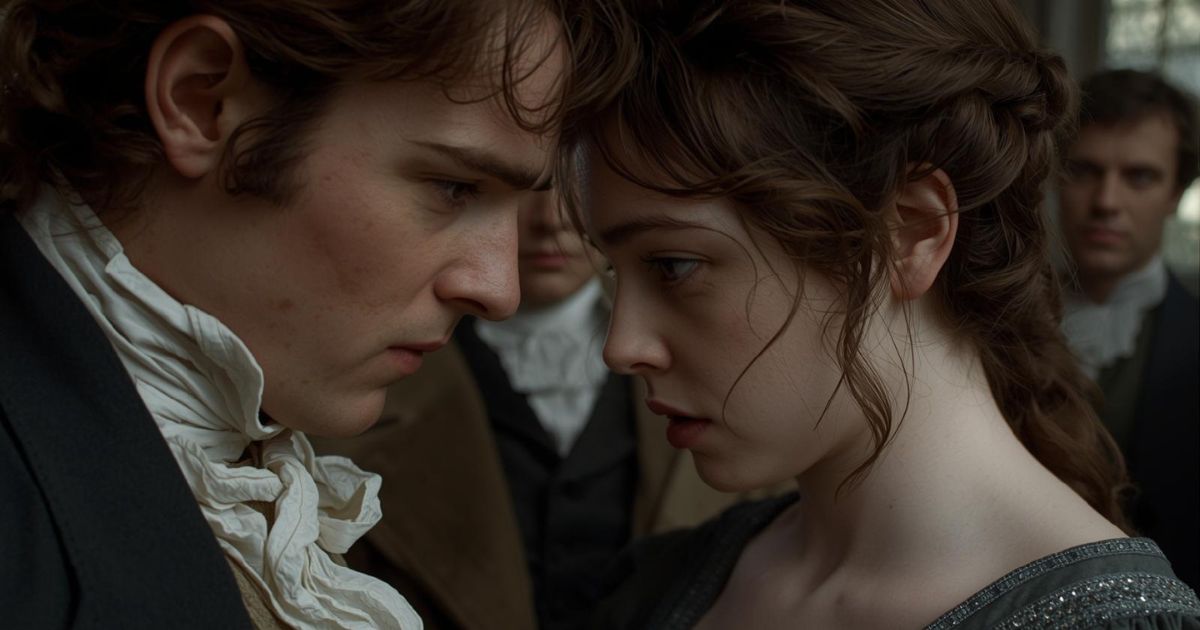
An excerpt from the original text.(complete · 2013 words)
[llustration]
Elizabeth, when Mr. Darcy gave her the letter, did not expect it to
contain a renewal of his offers, she had formed no expectation at all of
its contents. But such as they were, it may be well supposed how eagerly
she went through them, and what a contrariety of emotion they excited.
Her feelings as she read were scarcely to be defined. With amazement did
she first understand that he believed any apology to be in his power;
and steadfastly was she persuaded, that he could have no explanation to
give, which a just sense of shame would not conceal. With a strong
prejudice against everything he might say, she began his account of
what had happened at Netherfield. She read with an eagerness which
hardly left her power of comprehension; and from impatience of knowing
what the next sentence might bring, was incapable of attending to the
sense of the one before her eyes. His belief of her sister’s
insensibility she instantly resolved to be false; and his account of the
real, the worst objections to the match, made her too angry to have any
wish of doing him justice. He expressed no regret for what he had done
which satisfied her; his style was not penitent, but haughty. It was all
pride and insolence.
But when this subject was succeeded by his account of Mr. Wickham--when
she read, with somewhat clearer attention, a relation of events which,
if true, must overthrow every cherished opinion of his worth, and which
bore so alarming an affinity to his own history of himself--her feelings
were yet more acutely painful and more difficult of definition.
Astonishment, apprehension, and even horror, oppressed her. She wished
to discredit it entirely, repeatedly exclaiming, “This must be false!
This cannot be! This must be the grossest falsehood!”--and when she had
gone through the whole letter, though scarcely knowing anything of the
last page or two, put it hastily away, protesting that she would not
regard it, that she would never look in it again.
In this perturbed state of mind, with thoughts that could rest on
nothing, she walked on; but it would not do: in half a minute the letter
was unfolded again; and collecting herself as well as she could, she
again began the mortifying perusal of all that related to Wickham, and
commanded herself so far as to examine the meaning of every sentence.
The account of his connection with the Pemberley family was exactly
what he had related himself; and the kindness of the late Mr. Darcy,
though she had not before known its extent, agreed equally well with his
own words. So far each recital confirmed the other; but when she came to
the will, the difference was great. What Wickham had said of the living
was fresh in her memory; and as she recalled his very words, it was
impossible not to feel that there was gross duplicity on one side or the
other, and, for a few moments, she flattered herself that her wishes did
not err. But when she read and re-read, with the closest attention, the
particulars immediately following of Wickham’s resigning all pretensions
to the living, of his receiving in lieu so considerable a sum as three
thousand pounds, again was she forced to hesitate. She put down the
letter, weighed every circumstance with what she meant to be
impartiality--deliberated on the probability of each statement--but with
little success. On both sides it was only assertion. Again she read on.
But every line proved more clearly that the affair, which she had
believed it impossible that any contrivance could so represent as to
render Mr. Darcy’s conduct in it less than infamous, was capable of a
turn which must make him entirely blameless throughout the whole.
The extravagance and general profligacy which he scrupled not to lay to
Mr. Wickham’s charge exceedingly shocked her; the more so, as she could
bring no proof of its injustice. She had never heard of him before his
entrance into the ----shire militia, in which he had engaged at the
persuasion of the young man, who, on meeting him accidentally in town,
had there renewed a slight acquaintance. Of his former way of life,
nothing had been known in Hertfordshire but what he told
[Illustration:
“Meeting accidentally in Town”
[Copyright 1894 by George Allen.]]
himself. As to his real character, had information been in her power,
she had never felt a wish of inquiring. His countenance, voice, and
manner, had established him at once in the possession of every virtue.
She tried to recollect some instance of goodness, some distinguished
trait of integrity or benevolence, that might rescue him from the
attacks of Mr. Darcy; or at least, by the predominance of virtue, atone
for those casual errors, under which she would endeavour to class what
Mr. Darcy had described as the idleness and vice of many years’
continuance. But no such recollection befriended her. She could see him
instantly before her, in every charm of air and address, but she could
remember no more substantial good than the general approbation of the
neighbourhood, and the regard which his social powers had gained him in
the mess. After pausing on this point a considerable while, she once
more continued to read. But, alas! the story which followed, of his
designs on Miss Darcy, received some confirmation from what had passed
between Colonel Fitzwilliam and herself only the morning before; and at
last she was referred for the truth of every particular to Colonel
Fitzwilliam himself--from whom she had previously received the
information of his near concern in all his cousin’s affairs and whose
character she had no reason to question. At one time she had almost
resolved on applying to him, but the idea was checked by the awkwardness
of the application, and at length wholly banished by the conviction that
Mr. Darcy would never have hazarded such a proposal, if he had not been
well assured of his cousin’s corroboration.
She perfectly remembered everything that had passed in conversation
between Wickham and herself in their first evening at Mr. Philips’s.
Many of his expressions were still fresh in her memory. She was now
struck with the impropriety of such communications to a stranger, and
wondered it had escaped her before. She saw the indelicacy of putting
himself forward as he had done, and the inconsistency of his professions
with his conduct. She remembered that he had boasted of having no fear
of seeing Mr. Darcy--that Mr. Darcy might leave the country, but that
he should stand his ground; yet he had avoided the Netherfield ball
the very next week. She remembered, also, that till the Netherfield
family had quitted the country, he had told his story to no one but
herself; but that after their removal, it had been everywhere discussed;
that he had then no reserves, no scruples in sinking Mr. Darcy’s
character, though he had assured her that respect for the father would
always prevent his exposing the son.
How differently did everything now appear in which he was concerned! His
attentions to Miss King were now the consequence of views solely and
hatefully mercenary; and the mediocrity of her fortune proved no longer
the moderation of his wishes, but his eagerness to grasp at anything.
His behaviour to herself could now have had no tolerable motive: he had
either been deceived with regard to her fortune, or had been gratifying
his vanity by encouraging the preference which she believed she had most
incautiously shown. Every lingering struggle in his favour grew fainter
and fainter; and in further justification of Mr. Darcy, she could not
but allow that Mr. Bingley, when questioned by Jane, had long ago
asserted his blamelessness in the affair;--that, proud and repulsive as
were his manners, she had never, in the whole course of their
acquaintance--an acquaintance which had latterly brought them much
together, and given her a sort of intimacy with his ways--seen anything
that betrayed him to be unprincipled or unjust--anything that spoke him
of irreligious or immoral habits;--that among his own connections he was
esteemed and valued;--that even Wickham had allowed him merit as a
brother, and that she had often heard him speak so affectionately of his
sister as to prove him capable of some amiable feeling;--that had his
actions been what Wickham represented them, so gross a violation of
everything right could hardly have been concealed from the world; and
that friendship between a person capable of it and such an amiable man
as Mr. Bingley was incomprehensible.
She grew absolutely ashamed of herself. Of neither Darcy nor Wickham
could she think, without feeling that she had been blind, partial,
prejudiced, absurd.
“How despicably have I acted!” she cried. “I, who have prided myself on
my discernment! I, who have valued myself on my abilities! who have
often disdained the generous candour of my sister, and gratified my
vanity in useless or blameless distrust. How humiliating is this
discovery! Yet, how just a humiliation! Had I been in love, I could not
have been more wretchedly blind. But vanity, not love, has been my
folly. Pleased with the preference of one, and offended by the neglect
of the other, on the very beginning of our acquaintance, I have courted
prepossession and ignorance, and driven reason away where either were
concerned. Till this moment, I never knew myself.”
From herself to Jane, from Jane to Bingley, her thoughts were in a line
which soon brought to her recollection that Mr. Darcy’s explanation
there had appeared very insufficient; and she read it again. Widely
different was the effect of a second perusal. How could she deny that
credit to his assertions, in one instance, which she had been obliged to
give in the other? He declared himself to have been totally unsuspicious
of her sister’s attachment; and she could not help remembering what
Charlotte’s opinion had always been. Neither could she deny the justice
of his description of Jane. She felt that Jane’s feelings, though
fervent, were little displayed, and that there was a constant
complacency in her air and manner, not often united with great
sensibility.
When she came to that part of the letter in which her family were
mentioned, in tones of such mortifying, yet merited, reproach, her sense
of shame was severe. The justice of the charge struck her too forcibly
for denial; and the circumstances to which he particularly alluded, as
having passed at the Netherfield ball, and as confirming all his first
disapprobation, could not have made a stronger impression on his mind
than on hers.
The compliment to herself and her sister was not unfelt. It soothed, but
it could not console her for the contempt which had been thus
self-attracted by the rest of her family; and as she considered that
Jane’s disappointment had, in fact, been the work of her nearest
relations, and reflected how materially the credit of both must be hurt
by such impropriety of conduct, she felt depressed beyond anything she
had ever known before.
After wandering along the lane for two hours, giving way to every
variety of thought, reconsidering events, determining probabilities, and
reconciling herself, as well as she could, to a change so sudden and so
important, fatigue, and a recollection of her long absence, made her at
length return home; and she entered the house with the wish of appearing
cheerful as usual, and the resolution of repressing such reflections as
must make her unfit for conversation.
She was immediately told, that the two gentlemen from Rosings had each
called during her absence; Mr. Darcy, only for a few minutes, to take
leave, but that Colonel Fitzwilliam had been sitting with them at least
an hour, hoping for her return, and almost resolving to walk after her
till she could be found. Elizabeth could but just affect concern in
missing him; she really rejoiced at it. Colonel Fitzwilliam was no
longer an object. She could think only of her letter.
[Illustration:
“His parting obeisance”
]
Master this chapter. Complete your experience
Purchase the complete book to access all chapters and support classic literature
As an Amazon Associate, we earn a small commission from qualifying purchases at no additional cost to you.
Available in paperback, hardcover, and e-book formats
Let's Analyse the Pattern
Why This Matters
Connect literature to life
This chapter teaches how our ego creates blind spots that prevent us from seeing crucial information about people and situations until we're psychologically ready to receive it.
Now let's explore the literary elements.
Key Quotes & Analysis
"How despicably have I acted! I, who have prided myself on my discernment!"
Context: Elizabeth's painful self-realization after reading Darcy's letter
This moment of brutal honesty marks Elizabeth's transformation from self-righteousness to humility. She recognizes that her pride in her own judgment was actually a blind spot that led her astray.
"Till this moment, I never knew myself."
Context: Elizabeth's recognition of her own character flaws after learning the truth
One of the most powerful moments of self-discovery in literature. Elizabeth realizes that true self-knowledge is rare and difficult, but essential for growth and genuine relationships.
"She grew absolutely ashamed of herself. Of neither Darcy nor Wickham could she think, without feeling that she had been blind, partial, prejudiced, absurd."
Context: Describing Elizabeth's emotional state as she processes the truth
The narrator captures the complete reversal of Elizabeth's understanding. This shame is necessary for growth - she must fully acknowledge her mistakes before she can change.
Thematic Threads
Pride
In This Chapter
Elizabeth's pride in her judgment blinds her to her own mistakes and prejudices
Development
Evolving from social pride to intellectual pride—she's proud of being a good judge of character
In Your Life:
When have you been so confident in your ability to read people that you missed obvious signs you were wrong about someone?
Prejudice
In This Chapter
Elizabeth realizes her prejudice against Darcy was based on wounded vanity, not facts
Development
Shifting from class-based prejudice to personal prejudice rooted in first impressions
In Your Life:
Think of someone you disliked based on a first impression—how much of that dislike was actually about your own hurt feelings rather than their actual character?
Personal Growth
In This Chapter
Elizabeth gains painful self-awareness and humility through Darcy's letter
Development
Major breakthrough moment—first time she questions her own judgment and admits error
In Your Life:
What's the most difficult truth about yourself that you've had to accept, and how did it change the way you see your own decision-making?
Truth vs Perception
In This Chapter
The letter reveals the gap between Elizabeth's perceptions and reality about both Darcy and Wickham
Development
Building throughout—now explicitly confronting how wrong perceptions can be
In Your Life:
When has someone you thought you knew well turned out to be completely different from who you believed them to be?
Class
In This Chapter
Darcy's protection of his sister shows responsibility that comes with privilege, not just entitlement
Development
Complicating earlier simple view of class—showing both burdens and privileges of social position
In Your Life:
How do you balance using your advantages to help others versus just enjoying the privileges you have?
You now have the context. Time to form your own thoughts.
Discussion Questions
- 1
What specific information in Darcy's letter completely changed Elizabeth's understanding of him and Wickham?
- 2
Why was Elizabeth finally able to hear and accept difficult truths about herself that she couldn't see before?
- 3
Think about a time when someone tried to give you feedback but you weren't ready to hear it. What made you finally listen?
- 4
When you receive information that challenges your view of yourself or someone else, what's your strategy for staying open instead of getting defensive?
- 5
What does Elizabeth's transformation teach us about the difference between being smart and being wise?
Critical Thinking Exercise
Track Your Information Filters
Think of someone you have a strong negative opinion about - a coworker, family member, or public figure. Write down three facts about them that might contradict your view. Then honestly assess: have you been filtering out information that doesn't fit your narrative? What would change if you approached them with Elizabeth's post-letter mindset?
Consider:
- •Notice when you feel defensive - that's often when you most need to listen
- •Consider whether your dislike of someone is preventing you from seeing their valid points
- •Ask yourself what story you've been telling about this person and what evidence might challenge it
Coming Up Next...
Chapter 37
Elizabeth struggles with the weight of these revelations, trying to process how wrong she's been about everything. Her entire worldview has been shaken, and she must figure out what to do with this new knowledge about both Darcy and herself.