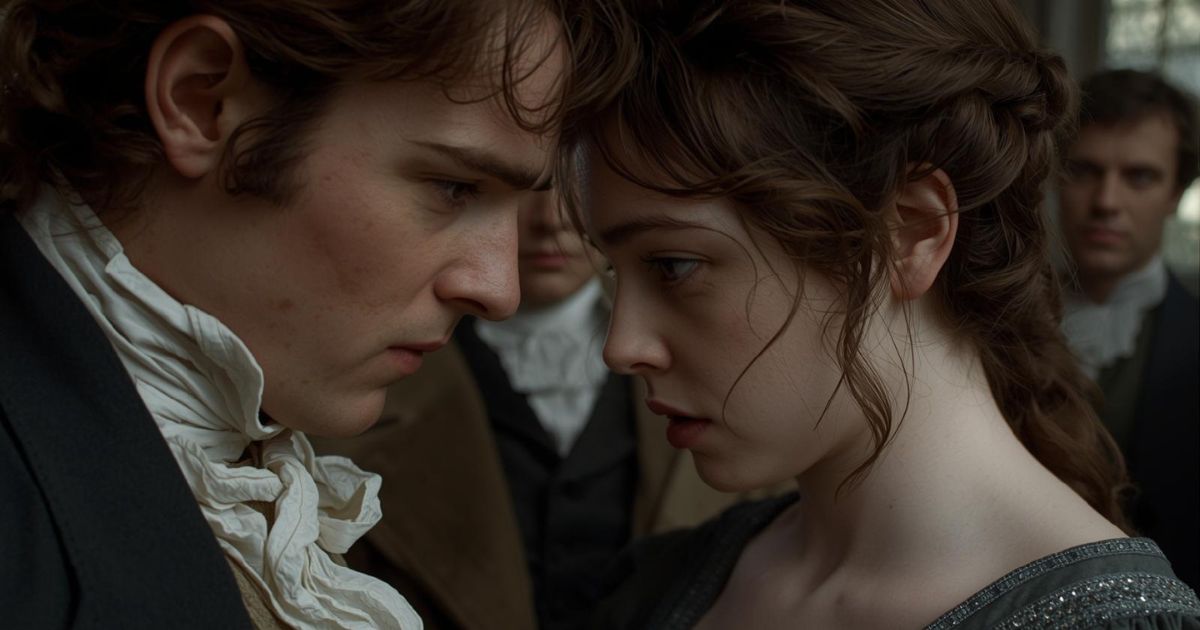
An excerpt from the original text.(complete · 2334 words)
[llustration]
Mrs. Gardiner’s caution to Elizabeth was punctually and kindly given on
the first favourable opportunity of speaking to her alone: after
honestly telling her what she thought, she thus went on:--
“You are too sensible a girl, Lizzy, to fall in love merely because you
are warned against it; and, therefore, I am not afraid of speaking
openly. Seriously, I would have you be on your guard. Do not involve
yourself, or endeavour to involve him, in an affection which the want of
fortune would make so very imprudent. I have nothing to say against
him: he is a most interesting young man; and if he had the fortune he
ought to have, I should think you could not do better. But as it is--you
must not let your fancy run away with you. You have sense, and we all
expect you to use it. Your father would depend on your resolution and
good conduct, I am sure. You must not disappoint your father.”
“My dear aunt, this is being serious indeed.”
“Yes, and I hope to engage you to be serious likewise.”
“Well, then, you need not be under any alarm. I will take care of
myself, and of Mr. Wickham too. He shall not be in love with me, if I
can prevent it.”
“Elizabeth, you are not serious now.”
“I beg your pardon. I will try again. At present I am not in love with
Mr. Wickham; no, I certainly am not. But he is, beyond all comparison,
the most agreeable man I ever saw--and if he becomes really attached to
me--I believe it will be better that he should not. I see the imprudence
of it. Oh, that abominable Mr. Darcy! My father’s opinion of me does
me the greatest honour; and I should be miserable to forfeit it. My
father, however, is partial to Mr. Wickham. In short, my dear aunt, I
should be very sorry to be the means of making any of you unhappy; but
since we see, every day, that where there is affection young people are
seldom withheld, by immediate want of fortune, from entering into
engagements with each other, how can I promise to be wiser than so many
of my fellow-creatures, if I am tempted, or how am I even to know that
it would be wiser to resist? All that I can promise you, therefore, is
not to be in a hurry. I will not be in a hurry to believe myself his
first object. When I am in company with him, I will not be wishing. In
short, I will do my best.”
“Perhaps it will be as well if you discourage his coming here so very
often. At least you should not remind your mother of inviting him.”
“As I did the other day,” said Elizabeth, with a conscious smile; “very
true, it will be wise in me to refrain from that. But do not imagine
that he is always here so often. It is on your account that he has been
so frequently invited this week. You know my mother’s ideas as to the
necessity of constant company for her friends. But really, and upon my
honour, I will try to do what I think to be wisest; and now I hope you
are satisfied.”
Her aunt assured her that she was; and Elizabeth, having thanked her for
the kindness of her hints, they parted,--a wonderful instance of advice
being given on such a point without being resented.
Mr. Collins returned into Hertfordshire soon after it had been quitted
by the Gardiners and Jane; but, as he took up his abode with the
Lucases, his arrival was no great inconvenience to Mrs. Bennet. His
marriage was now fast approaching; and she was at length so far resigned
as to think it inevitable, and even repeatedly to say, in an ill-natured
tone, that she “wished they might be happy.” Thursday was to be the
wedding-day, and on Wednesday Miss Lucas paid her farewell visit; and
when she rose to take leave, Elizabeth, ashamed of her mother’s
ungracious and reluctant good wishes, and sincerely affected herself,
accompanied her out of the room. As they went down stairs together,
Charlotte said,--
“I shall depend on hearing from you very often, Eliza.”
“That you certainly shall.”
“And I have another favour to ask. Will you come and see me?”
“We shall often meet, I hope, in Hertfordshire.”
“I am not likely to leave Kent for some time. Promise me, therefore, to
come to Hunsford.”
Elizabeth could not refuse, though she foresaw little pleasure in the
visit.
“My father and Maria are to come to me in March,” added Charlotte, “and
I hope you will consent to be of the party. Indeed, Eliza, you will be
as welcome to me as either of them.”
The wedding took place: the bride and bridegroom set off for Kent from
the church door, and everybody had as much to say or to hear on the
subject as usual. Elizabeth soon heard from her friend, and their
correspondence was as regular and frequent as it ever had been: that it
should be equally unreserved was impossible. Elizabeth could never
address her without feeling that all the comfort of intimacy was over;
and, though determined not to slacken as a correspondent, it was for the
sake of what had been rather than what was. Charlotte’s first letters
were received with a good deal of eagerness: there could not but be
curiosity to know how she would speak of her new home, how she would
like Lady Catherine, and how happy she would dare pronounce herself to
be; though, when the letters were read, Elizabeth felt that Charlotte
expressed herself on every point exactly as she might have foreseen. She
wrote cheerfully, seemed surrounded with comforts, and mentioned nothing
which she could not praise. The house, furniture, neighbourhood, and
roads, were all to her taste, and Lady Catherine’s behaviour was most
friendly and obliging. It was Mr. Collins’s picture of Hunsford and
Rosings rationally softened; and Elizabeth perceived that she must wait
for her own visit there, to know the rest.
Jane had already written a few lines to her sister, to announce their
safe arrival in London; and when she wrote again, Elizabeth hoped it
would be in her power to say something of the Bingleys.
Her impatience for this second letter was as well rewarded as impatience
generally is. Jane had been a week in town, without either seeing or
hearing from Caroline. She accounted for it, however, by supposing that
her last letter to her friend from Longbourn had by some accident been
lost.
“My aunt,” she continued, “is going to-morrow into that part of the
town, and I shall take the opportunity of calling in Grosvenor Street.”
She wrote again when the visit was paid, and she had seen Miss Bingley.
“I did not think Caroline in spirits,” were her words, “but she was very
glad to see me, and reproached me for giving her no notice of my coming
to London. I was right, therefore; my last letter had never reached her.
I inquired after their brother, of course. He was well, but so much
engaged with Mr. Darcy that they scarcely ever saw him. I found that
Miss Darcy was expected to dinner: I wish I could see her. My visit was
not long, as Caroline and Mrs. Hurst were going out. I dare say I shall
soon see them here.”
Elizabeth shook her head over this letter. It convinced her that
accident only could discover to Mr. Bingley her sister’s being in town.
Four weeks passed away, and Jane saw nothing of him. She endeavoured to
persuade herself that she did not regret it; but she could no longer be
blind to Miss Bingley’s inattention. After waiting at home every morning
for a fortnight, and inventing every evening a fresh excuse for her, the
visitor did at last appear; but the shortness of her stay, and, yet
more, the alteration of her manner, would allow Jane to deceive herself
no longer. The letter which she wrote on this occasion to her sister
will prove what she felt:--
“My dearest Lizzy will, I am sure, be incapable of triumphing in
her better judgment, at my expense, when I confess myself to have
been entirely deceived in Miss Bingley’s regard for me. But, my
dear sister, though the event has proved you right, do not think me
obstinate if I still assert that, considering what her behaviour
was, my confidence was as natural as your suspicion. I do not at
all comprehend her reason for wishing to be intimate with me; but,
if the same circumstances were to happen again, I am sure I should
be deceived again. Caroline did not return my visit till yesterday;
and not a note, not a line, did I receive in the meantime. When she
did come, it was very evident that she had no pleasure in it; she
made a slight, formal apology for not calling before, said not a
word of wishing to see me again, and was, in every respect, so
altered a creature, that when she went away I was perfectly
resolved to continue the acquaintance no longer. I pity, though I
cannot help blaming, her. She was very wrong in singling me out as
she did; I can safely say, that every advance to intimacy began on
her side. But I pity her, because she must feel that she has been
acting wrong, and because I am very sure that anxiety for her
brother is the cause of it. I need not explain myself farther; and
though we know this anxiety to be quite needless, yet if she
feels it, it will easily account for her behaviour to me; and so
deservedly dear as he is to his sister, whatever anxiety she may
feel on his behalf is natural and amiable. I cannot but wonder,
however, at her having any such fears now, because if he had at all
cared about me, we must have met long, long ago. He knows of my
being in town, I am certain, from something she said herself; and
yet it would seem, by her manner of talking, as if she wanted to
persuade herself that he is really partial to Miss Darcy. I cannot
understand it. If I were not afraid of judging harshly, I should be
almost tempted to say, that there is a strong appearance of
duplicity in all this. I will endeavour to banish every painful
thought, and think only of what will make me happy, your affection,
and the invariable kindness of my dear uncle and aunt. Let me hear
from you very soon. Miss Bingley said something of his never
returning to Netherfield again, of giving up the house, but not
with any certainty. We had better not mention it. I am extremely
glad that you have such pleasant accounts from our friends at
Hunsford. Pray go to see them, with Sir William and Maria. I am
sure you will be very comfortable there.
“Yours, etc.”
This letter gave Elizabeth some pain; but her spirits returned, as she
considered that Jane would no longer be duped, by the sister at least.
All expectation from the brother was now absolutely over. She would not
even wish for any renewal of his attentions. His character sunk on every
review of it; and, as a punishment for him, as well as a possible
advantage to Jane, she seriously hoped he might really soon marry Mr.
Darcy’s sister, as, by Wickham’s account, she would make him abundantly
regret what he had thrown away.
Mrs. Gardiner about this time reminded Elizabeth of her promise
concerning that gentleman, and required information; and Elizabeth had
such to send as might rather give contentment to her aunt than to
herself. His apparent partiality had subsided, his attentions were over,
he was the admirer of some one else. Elizabeth was watchful enough to
see it all, but she could see it and write of it without material pain.
Her heart had been but slightly touched, and her vanity was satisfied
with believing that she would have been his only choice, had fortune
permitted it. The sudden acquisition of ten thousand pounds was the most
remarkable charm of the young lady to whom he was now rendering himself
agreeable; but Elizabeth, less clear-sighted perhaps in this case than
in Charlotte’s, did not quarrel with him for his wish of independence.
Nothing, on the contrary, could be more natural; and, while able to
suppose that it cost him a few struggles to relinquish her, she was
ready to allow it a wise and desirable measure for both, and could very
sincerely wish him happy.
All this was acknowledged to Mrs. Gardiner; and, after relating the
circumstances, she thus went on:--“I am now convinced, my dear aunt,
that I have never been much in love; for had I really experienced that
pure and elevating passion, I should at present detest his very name,
and wish him all manner of evil. But my feelings are not only cordial
towards him, they are even impartial towards Miss King. I cannot find
out that I hate her at all, or that I am in the least unwilling to think
her a very good sort of girl. There can be no love in all this. My
watchfulness has been effectual; and though I should certainly be a more
interesting object to all my acquaintance, were I distractedly in love
with him, I cannot say that I regret my comparative insignificance.
Importance may sometimes be purchased too dearly. Kitty and Lydia take
his defection much more to heart than I do. They are young in the ways
of the world, and not yet open to the mortifying conviction that
handsome young men must have something to live on as well as the
plain.”
[Illustration:
“On the Stairs”
]
Master this chapter. Complete your experience
Purchase the complete book to access all chapters and support classic literature
As an Amazon Associate, we earn a small commission from qualifying purchases at no additional cost to you.
Available in paperback, hardcover, and e-book formats
Let's Analyse the Pattern
Why This Matters
Connect literature to life
This chapter teaches how to recognize when someone uses agreement and flattery as tools to gain your trust while pursuing their real agenda.
Now let's explore the literary elements.
Key Quotes & Analysis
"I am now convinced, my dear aunt, that I have never been much in love; for had I really experienced that pure and elevating passion, I should at present detest his very name, and wish him all manner of evil."
Context: Elizabeth reflecting on her reaction to news of Wickham's pursuit of Miss King
This quote shows Elizabeth's brutal honesty with herself. She realizes that real love would have made Wickham's betrayal devastating, but since she's more amused than hurt, she never truly loved him. It's a moment of crucial self-discovery.
"But my dearest Elizabeth, what sort of girl is Miss King? I should be sorry to think our friend mercenary."
Context: Mrs. Gardiner's letter questioning Wickham's motives in pursuing the newly wealthy Miss King
This quote reveals Mrs. Gardiner's diplomatic way of pointing out Wickham's fortune-hunting behavior. Her gentle sarcasm shows she already suspects his mercenary motives while giving Elizabeth space to reach her own conclusions.
"Handsome young men must have something to live on as well as the plain."
Context: Elizabeth's pragmatic response to Wickham's pursuit of wealth
This quote shows Elizabeth's growing realism about economic necessities in marriage. She's learning to separate romantic idealism from practical reality, acknowledging that even attractive people need financial security.
Thematic Threads
Self-Deception
In This Chapter
Elizabeth realizes she mistook flattery for love and validation for genuine connection with Wickham
Development
Evolved from earlier pride in her judgment to recognition of her blind spots
In Your Life:
Think of a time when you mistook someone's attention or compliments for genuine interest - what warning signs did you ignore because their validation felt so good?
Economic Reality
In This Chapter
Wickham's pursuit of Miss King's £10,000 inheritance exposes the mercenary nature of many courtships
Development
Reinforces ongoing theme of marriage as economic necessity rather than romantic choice
In Your Life:
Have you ever noticed how financial considerations influence your dating choices or those of people around you, even when no one openly admits it?
Personal Growth
In This Chapter
Elizabeth's ability to laugh at herself rather than feel wounded shows developing emotional maturity
Development
Marks significant evolution from earlier defensiveness to self-reflection
In Your Life:
When you discover you've misjudged a situation, do you typically get defensive or can you laugh at your mistake and learn from it?
Manipulation
In This Chapter
Wickham used Elizabeth's prejudice against Darcy to gain her sympathy and attention
Development
Reveals the calculated nature of his earlier charm offensive
In Your Life:
Can you think of someone who seemed to 'get you' by sharing your complaints about mutual acquaintances - and how did that make you feel about them?
Class Vulnerability
In This Chapter
Mrs. Gardiner's warning reminds Elizabeth that women without fortune cannot afford purely romantic choices
Development
Continues exploration of how economic dependence limits women's agency
In Your Life:
In what ways do your financial circumstances or career stability affect the romantic risks you're willing to take?
You now have the context. Time to form your own thoughts.
Discussion Questions
- 1
What does Elizabeth discover about Wickham's true motives, and how does she react to this revelation?
- 2
Why was Elizabeth attracted to Wickham in the first place, and what does this reveal about her own blind spots?
- 3
Where do you see people using flattery and validation as manipulation in modern relationships, workplaces, or social media?
- 4
How can you tell the difference between someone who genuinely connects with you versus someone who's just telling you what you want to hear?
- 5
What does Elizabeth's ability to laugh at herself rather than feel devastated teach us about resilience and self-awareness?
Critical Thinking Exercise
Map Your Echo Chambers
Think of someone who makes you feel exceptionally understood or validated. Write down what they typically agree with you about, then honestly assess: Do they ever challenge you constructively, or do they only echo your opinions? Look at their relationships with others—do they gossip or criticize mutual acquaintances to bond with you?
Consider:
- •Real connection includes gentle pushback and honest feedback, not just agreement
- •People who bond with you by criticizing others will likely criticize you to someone else
- •Ask what this person gains from your good opinion—validation seekers often have hidden agendas
Coming Up Next...
Chapter 27
Elizabeth's growing self-awareness is about to be tested further as she prepares for her visit to Hunsford Parsonage. Little does she know that this trip will bring unexpected encounters that will challenge everything she thinks she knows about certain people.